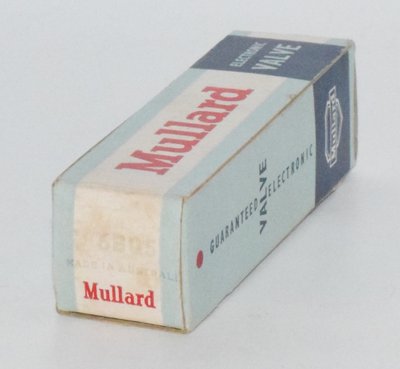
1. Introduction and History
The 6BQ5 (also known as EL84 in European designation) is a small power pentode vacuum tube that was introduced by Philips in the early 1950s. Originally designed in Europe, it quickly gained worldwide popularity for its impressive performance despite its compact size. The tube was introduced at a time when audio equipment was transitioning toward more compact designs, making the 6BQ5/EL84 perfectly positioned to meet market demands.
Philips first released the tube under the European designation EL84, with the "E" indicating a 6.3V heater, "L" designating a power pentode, and "84" being the type number. The American designation 6BQ5 followed the RMA (Radio Manufacturers Association) naming convention, with "6" indicating the heater voltage, "B" representing the second generation of tube designs, "Q" indicating a pentode, and "5" being the sequential number.
The 6BQ5/EL84 became particularly famous for its use in the Mullard 5-10 amplifier design and later in the VOX AC15 and AC30 guitar amplifiers, which were famously used by The Beatles and many other British invasion bands of the 1960s. Its sweet, musical distortion characteristics helped define the sound of an era.
2. Technical Specifications and Design
Physical Characteristics:
- Envelope: Small glass, 9-pin miniature base (B9A/Noval)
- Height: Approximately 71mm (2.8 inches)
- Diameter: Approximately 22.5mm (0.89 inches)
- Pin Configuration: 9-pin miniature
Electrical Specifications:
- Filament/Heater Voltage: 6.3V
- Filament Current: 0.76A (760mA)
- Plate (Anode) Voltage: Maximum 300V
- Screen Grid Voltage: Maximum 300V
- Plate Dissipation: 12W maximum
- Screen Dissipation: 2W maximum
- Transconductance: Approximately 11,300 μmhos (11.3 mA/V)
- Amplification Factor: About 19
- Load Impedance: Typically 5-7 kΩ (single-ended), 8-10 kΩ (push-pull)
Typical Operating Conditions (Class A, Single-Ended):
- Plate Voltage: 250V
- Screen Grid Voltage: 250V
- Grid Bias: -7.3V
- Plate Current: 48mA
- Screen Current: 5.5mA
- Power Output: Approximately 5.7W
Design Features:
The 6BQ5/EL84 is a beam power pentode with a unique design that allows it to deliver a relatively high power output from a compact envelope. It features a high transconductance value, which contributes to its sensitivity and gain capabilities. The internal structure includes a cathode, control grid, screen grid, suppressor grid, and plate (anode), arranged to optimize electron flow and minimize distortion.
The tube's relatively high efficiency allows it to produce significant power output with modest plate voltages, making it ideal for compact amplifier designs where power supply limitations might be a concern.
3. Applications and Usage
Audio Amplification:
The 6BQ5/EL84 found its primary application in audio amplification, particularly in:
- Hi-Fi Amplifiers: Single-ended configurations for approximately 5-6W output, or push-pull pairs delivering 15-20W of high-quality audio.
- Guitar Amplifiers: Famous for use in VOX AC15 and AC30 amplifiers, as well as many other classic and modern guitar amps where its distinctive overdrive characteristics are valued.
- Radios and Radiograms: Used in higher-end radio receivers and integrated audio systems of the 1950s and 1960s.
- Public Address Systems: Employed in moderate-power PA systems where compact design was important.
Circuit Configurations:
- Single-Ended: One tube driving an output transformer, typically producing 5-6W with pleasing even-order harmonics when pushed into saturation.
- Push-Pull: Two tubes in a push-pull configuration, capable of 15-20W with lower distortion.
- Ultralinear: Using tapped output transformers to connect the screen grids, providing a balance between triode and pentode operation characteristics.
Modern Usage:
Despite being designed over 70 years ago, the 6BQ5/EL84 remains popular in modern boutique audio equipment, particularly in:
- Audiophile tube amplifiers where its warm, detailed sound is prized
- Boutique guitar amplifiers where players seek vintage tones
- DIY audio projects due to its relatively low voltage requirements and forgiving nature
4. Equivalent or Substitute Types
Direct Equivalents:
- EL84: The European designation for the same tube
- 7189: An industrial version with slightly higher ratings (400V plate voltage)
- 7189A: Enhanced version of the 7189 with higher dissipation ratings
- CV2975: British military designation
- E84L: Special quality/long-life version
- SV83: Russian equivalent
- 6P14P/6П14П: Soviet equivalent
Partial Substitutes (may require circuit adjustments):
- 6V6: Higher power output but different pin configuration and operating parameters
- 6AQ5: Similar characteristics but different pinout
- N709: Special version used in some European equipment
Notable Manufacturers:
The 6BQ5/EL84 was manufactured by numerous companies worldwide, including:
- Philips (original designer)
- Mullard (Philips subsidiary, highly regarded)
- Telefunken
- RCA
- GE
- Siemens
- Amperex
- Ei (Yugoslavia)
- Philips Miniwatt (Australia)
- JJ Electronic (current production)
- Electro-Harmonix (current production)
- Tung-Sol (reissue)
- Sovtek (Russian)
5. Notable Characteristics
Sound Signature:
The 6BQ5/EL84 is renowned for its distinctive sonic character, which includes:
- Midrange Focus: A pronounced and expressive midrange that brings vocals and lead instruments forward in the mix.
- Sweet Distortion: When pushed into saturation, it produces a smooth, musical distortion with prominent even-order harmonics, making it ideal for guitar amplifiers.
- Dynamic Response: Excellent transient response and dynamic expression, allowing for nuanced playing and listening experiences.
- Efficient Bass: Despite its small size, it can produce surprisingly robust bass response, especially in well-designed push-pull configurations.
Technical Advantages:
- Compact Size: Smaller than many power tubes of similar output capability.
- Efficiency: Provides good power output at relatively modest plate voltages.
- Low Driving Voltage: Requires less voltage swing at the grid for full output compared to some alternatives.
- Reliability: Generally robust and long-lasting when operated within specifications.
- Heat Dissipation: Lower operating temperatures than larger power tubes.
Collector and Audiophile Interest:
The 6BQ5/EL84 has developed a significant following among collectors and audiophiles for several reasons:
- NOS (New Old Stock) versions from manufacturers like Mullard, Telefunken, and Amperex command premium prices due to their perceived superior construction and sound quality.
- Philips Miniwatt Australia tubes, as mentioned in the product reference, are particularly sought after for their build quality and sonic characteristics.
- Different manufacturing eras and factories produced tubes with subtle variations in sound, leading to a rich collecting subculture.
- The tube's association with classic British guitar amplifiers has created crossover appeal between hi-fi enthusiasts and musicians.
Design Considerations:
When designing circuits around the 6BQ5/EL84, engineers typically consider:
- Proper ventilation due to heat generation
- Appropriate bias circuitry to ensure optimal operation
- Output transformer matching for best performance and frequency response
- Screen grid protection to prevent damage during startup or fault conditions
The Philips Miniwatt Australia NOS 6BQ5/EL84 tubes mentioned in the product reference are particularly valued for their consistent quality, robust construction, and excellent sonic characteristics. These NOS tubes, manufactured to high standards, often deliver superior performance compared to modern production equivalents, making them highly sought after by audio enthusiasts and professionals seeking the authentic vintage sound of the golden era of tube audio.