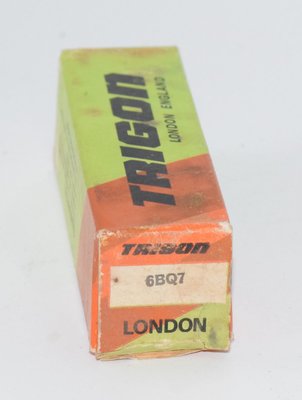
1. Introduction and History
The 6BQ7 is a miniature, medium-mu twin triode vacuum tube (valve) originally developed in the early 1950s for use as a cascode radio-frequency amplifier in very-high-frequency (VHF) television tuners. Manufactured by major American tube producers including General Electric, RCA, Sylvania, and others, the 6BQ7 was designed to deliver high gain with a low noise figure — critical requirements for the front-end stages of television receivers during the golden age of broadcast television.
The tube features two independent triode sections housed within a single miniature glass envelope, with an internal shield between the sections to provide excellent isolation. This internal shielding was a key design feature that made the 6BQ7 particularly effective in cascode amplifier configurations, where one triode operates as a common-cathode stage and the other as a common-grid stage stacked above it.
The 6BQ7 was soon followed by an improved version, the 6BQ7-A (also designated 6BQ7A), which offered tighter specifications and controlled heater warm-up characteristics. The family also includes the 4BQ7-A and 5BQ7-A variants, which are electrically identical to the 6BQ7-A except for their heater voltage ratings (4.2V and 5.6V respectively), making them suitable for series-string heater configurations in television receivers. The General Electric datasheet ET-T852B (dated December 1956) covers all three variants comprehensively.
While originally a television tube, the 6BQ7 and its 'A' suffix variant have found a devoted following in the audio community, where their low noise characteristics and favorable triode curves make them attractive candidates for high-fidelity preamplifier and line-stage designs.
2. Technical Specifications and Design
Heater Ratings
| Parameter | 4BQ7-A | 5BQ7-A | 6BQ7-A |
|---|---|---|---|
| Heater Voltage (AC or DC) | 4.2 V | 5.6 V | 6.3 V |
| Heater Current | 0.6 A | 0.45 A | 0.4 A |
| Heater Warm-up Time | 11 seconds | 11 seconds | — |
Note: The original 6BQ7 (without the 'A' suffix) shares the 6.3V / 0.4A heater rating but may lack the controlled warm-up characteristics of the 'A' version. Specifications below are drawn from the General Electric 6BQ7-A datasheet (ET-T852B) and are representative of the 6BQ7 family.
Maximum Ratings (Design-Center Values, Each Section)
| Parameter | Value |
|---|---|
| Maximum Plate Voltage | 250 V * |
| Maximum Plate Dissipation | 2.0 W |
| Maximum DC Cathode Current | 20 mA |
| Heater-Cathode Voltage (Heater Positive, DC) | 100 V |
| Heater-Cathode Voltage (Heater Positive, Total DC and Peak) | 200 V |
| Heater-Cathode Voltage (Heater Negative, Total DC and Peak) | 200 V * |
| Grid Circuit Resistance | 0.5 MΩ |
* When the tube is used as a cascode amplifier and the two sections are connected in series, the plate voltage may be as high as 300 volts maximum under cutoff conditions.
Typical Operating Characteristics — Class A₁ Amplifier (Each Section)
| Parameter | Value |
|---|---|
| Plate Voltage | 150 V |
| Cathode-Bias Resistor | 220 Ω |
| Amplification Factor (μ) | 38 |
| Plate Resistance (rp), approximate | 5,900 Ω |
| Transconductance (gm) | 6,400 µmhos |
| Plate Current | 9.0 mA |
| Grid Voltage at Ib = 100 µA (approximate cutoff) | −6.5 V |
Direct Interelectrode Capacitances
| Parameter | Section 1 | Section 2 |
|---|---|---|
| Grid to Plate | 1.2 µµF | 1.2 µµF |
| Input | 2.6 µµF | — † |
| Output | 1.2 µµF | — † |
| Heater to Cathode | 2.6 µµF | 2.6 µµF |
| Plate to Plate, maximum | 0.01 µµF | |
| Plate (Section 2) to Plate and Grid (Section 1), maximum | 0.024 µµF | |
| Plate to Cathode | 0.12 µµF | 0.12 µµF |
| Grounded-Grid Input | 5.0 µµF | |
| Grounded-Grid Output | 2.2 µµF | |
† Capacitance values for Section 2 input and output are not specified separately in the datasheet. Measurements taken with external shield (RETMA 315) connected to pin 9.
Physical Construction
- Base Type: Noval (B9A) — E9-1, Small Button 9-Pin
- Envelope: T-6½, Glass (miniature)
- Mounting Position: Any
- Cathode Type: Coated, Unipotential
- Internal Shield: Yes (connected to pin 9; recommended to be grounded)
Pin Connections (RETMA 9AJ Basing)
| Pin | Connection |
|---|---|
| 1 | Plate (Section 2) |
| 2 | Grid (Section 2) |
| 3 | Cathode (Section 2) |
| 4 | Heater |
| 5 | Heater |
| 6 | Plate (Section 1) |
| 7 | Grid (Section 1) |
| 8 | Cathode (Section 1) |
| 9 | Internal Shield (ground recommended) |
3. Applications and Usage
The 6BQ7 was primarily designed for VHF cascode amplifier applications in television tuner front-ends. In this configuration, Section 1 operates as a common-cathode amplifier while Section 2 operates as a common-grid amplifier stacked above it, with the two sections connected in series for the plate supply. This cascode arrangement provides:
- High voltage gain comparable to a pentode
- Low noise figure characteristic of triode operation
- Excellent input-to-output isolation aided by the internal shield
- Reduced Miller effect at the input grid
The datasheet provides specific cascode connection diagrams showing the two triode sections connected in series with 470KΩ resistors providing the grid bias network for the upper (common-grid) section, with the total B+ supply voltage (Ecc2) of 250 volts across the series combination.
Beyond television, the 6BQ7 found use in:
- FM tuner front-ends — where its low noise figure was equally valuable
- Amateur radio VHF receivers — as a low-noise RF preamplifier
- Laboratory instrumentation — wideband amplifier stages
- Audio preamplifiers — where the two triode sections can be used as independent gain stages or as a phase splitter for push-pull output stages
4. Sound Characteristics
The 6BQ7 and 6BQ7-A have earned a reputation in the audio community for a distinctive and appealing sonic signature. Audiophiles and circuit designers who have employed this tube in line-stage and phono preamplifier circuits frequently describe its sound as follows:
- Low noise floor: The 6BQ7's heritage as a low-noise RF tube translates directly to audio applications. When properly implemented, it offers an exceptionally quiet background, making it well-suited for phono stages and other high-gain applications where residual noise is critical.
- Detailed and transparent midrange: The medium amplification factor of 38 and relatively high transconductance of 6,400 µmhos give the 6BQ7 a lively, detailed character. The midrange is often described as clear and articulate, with good resolution of vocal textures and instrumental timbres.
- Extended but smooth treble: Owing to its RF heritage and low interelectrode capacitances, the 6BQ7 maintains excellent high-frequency response. The treble is typically described as airy and extended without the harshness sometimes associated with higher-mu twin triodes.
- Moderate warmth: While not as overtly warm or lush as some lower-mu triodes (such as the 6SN7 or 12AU7), the 6BQ7 offers a pleasant degree of harmonic richness. Its distortion spectrum in Class A₁ operation tends to be dominated by low-order even harmonics, contributing to a natural and musical presentation.
- Good dynamics and transient response: The relatively low plate resistance of approximately 5,900 ohms allows the 6BQ7 to drive subsequent stages or moderate capacitive loads with authority. Listeners note good microdynamic nuance and a sense of speed in transient reproduction.
- Slightly forward presentation: Some listeners characterize the 6BQ7 as having a slightly forward or present quality compared to the more laid-back character of tubes like the 12AU7, which can be advantageous in systems that benefit from enhanced immediacy and presence.
The sonic character can vary noticeably between manufacturers. NOS (New Old Stock) examples from General Electric, RCA, Sylvania, and Amperex each have their devotees, with subtle differences in tonal balance, soundstage presentation, and harmonic texture attributed to variations in construction materials and manufacturing techniques.
5. Equivalent or Substitute Types
The following types are related to the 6BQ7, though care must be taken when substituting:
| Type | Relationship | Notes |
|---|---|---|
| 6BQ7A | Improved version | Tighter specifications and controlled heater warm-up. Generally a direct replacement for the 6BQ7 in most circuits. Listed as a different-rating substitute, not necessarily a drop-in in all applications. |
| 6BZ7 | Higher-gm variant | Similar construction and pinout but with higher transconductance. Often used as a substitute in cascode TV tuner circuits. Check operating point compatibility before substituting in audio circuits. |
| 6BS8 | Similar twin triode | Another VHF cascode twin triode with similar pinout. Electrical parameters differ; verify suitability for the specific circuit. |
| CV5365 | Military/European equivalent | Listed as a different-rating substitute for the 6BQ7. Verify exact specifications before use as a drop-in replacement. |
| 4BQ7-A | Heater variant (4.2V / 0.6A) | Electrically identical to the 6BQ7-A except for heater voltage. NOT interchangeable unless the heater supply is adjusted accordingly. |
| 5BQ7-A | Heater variant (5.6V / 0.45A) | Electrically identical to the 6BQ7-A except for heater voltage. NOT interchangeable unless the heater supply is adjusted accordingly. |
Important: The 6BQ7 and 6BQ7A are listed in reference databases as different-rating substitutes rather than exact drop-in equivalents. While they share the same pinout and general characteristics, the 'A' version has tighter tolerances. In most practical audio circuits, the 6BQ7A can replace the 6BQ7 without modification, but designers should verify bias points and operating conditions. The 6BQ7 should not be confused with the 6BQ5 (EL84), which is a completely different tube type (a power pentode).
6. Notable Characteristics
- Internal Shield: The 6BQ7 features an internal electrostatic shield between its two triode sections, connected to pin 9. The datasheet recommends grounding this pin for optimal performance. This shield provides excellent section-to-section isolation, with a plate-to-plate capacitance of only 0.01 µµF maximum and a plate (Section 2) to plate-and-grid (Section 1) capacitance of only 0.024 µµF maximum. This level of isolation is exceptional and is one of the tube's defining features.
- Controlled Heater Warm-up: The 'A' variants (4BQ7-A, 5BQ7-A, 6BQ7-A) feature controlled heater warm-up characteristics, making them especially suited for series-connected heater strings in television receivers. The warm-up time is specified as 11 seconds for the 4BQ7-A and 5BQ7-A (defined as the time for the heater voltage to reach 80% of rated value under specific test conditions).
- Favorable Triode Curves: The plate characteristic curves shown in the datasheet reveal well-spaced, relatively linear characteristics that are conducive to low-distortion amplification. The transfer characteristics show a smooth, predictable relationship between grid voltage and plate current.
- Versatile Operating Range: With a maximum plate voltage of 250V per section (or 300V under cutoff in cascode configuration) and a plate dissipation of 2.0W per section, the 6BQ7 offers reasonable design flexibility. The 220Ω cathode bias resistor specified for the typical operating point provides self-biasing simplicity.
- Medium-Mu Design: The amplification factor of 38 places the 6BQ7 in the medium-mu category — higher than the 12AU7 (µ ≈ 17) but lower than the 12AX7 (µ ≈ 100). This makes it a versatile choice for applications requiring moderate gain with good linearity.
- High Transconductance: At 6,400 µmhos, the 6BQ7 offers notably high transconductance for a medium-mu twin triode, contributing to its excellent high-frequency performance and dynamic response.
7. Usage in the Audio Community
Although the 6BQ7 was never designed as an audio tube, it has been embraced by the DIY audio and high-fidelity communities for several compelling reasons:
Preamplifier and Line-Stage Applications
The 6BQ7's two independent triode sections make it a natural fit for stereo preamplifier designs where one section handles each channel, or for two-stage mono preamplifiers where the sections are cascaded for additional gain. Its low noise floor — a direct benefit of its RF pedigree — makes it particularly attractive for phono preamplifier stages where signal levels are very low (on the order of millivolts).
Several notable DIY preamplifier designs have been published using the 6BQ7/6BQ7A, taking advantage of its combination of moderate gain (µ = 38), high transconductance (gm = 6,400 µmhos), and low plate resistance (rp ≈ 5,900 Ω). The low plate resistance is particularly advantageous for driving long interconnect cables or low-impedance loads without significant high-frequency rolloff.
Headphone Amplifier Designs
The 6BQ7's relatively low plate resistance and moderate gain make it suitable for hybrid headphone amplifier designs, where it can serve as a voltage gain stage ahead of a solid-state output buffer. The tube's detailed and transparent sonic character pairs well with high-quality headphones that benefit from a resolving source.
Cascode Audio Amplifiers
Some audio designers have adapted the 6BQ7's original cascode topology for audio use, creating high-gain, low-noise preamplifier stages that exploit the tube's internal shielding and low interelectrode capacitances. In a cascode audio configuration, the circuit can achieve pentode-like gain with triode-like distortion characteristics — an appealing combination for audiophiles.
Phase Splitter Applications
The dual triode configuration also lends itself to split-load (cathodyne) or differential (long-tailed pair) phase splitter circuits for driving push-pull output stages. The well-matched sections within a single envelope help ensure balanced drive signals.
Availability and Cost
The 6BQ7 and 6BQ7A were produced in enormous quantities during the 1950s and 1960s for the television industry, which means NOS (New Old Stock) examples remain relatively plentiful and affordable compared to more sought-after audio tubes like the 12AX7 or 6SN7. This availability makes the 6BQ7 an attractive option for experimenters and budget-conscious audiophiles seeking high-quality tube sound without premium pricing. However, as with all NOS tubes, supplies are finite and prices have been gradually increasing as audio enthusiasts discover the tube's merits.
Manufacturer Preferences
Among audio enthusiasts, certain manufacturers' versions of the 6BQ7/6BQ7A are preferred:
- Amperex (Bugle Boy): Prized for a rich, warm midrange with excellent spatial presentation
- RCA: Valued for a balanced, slightly warm character with good bass definition
- General Electric: Known for clarity and detail, sometimes described as slightly analytical
- Sylvania: Often praised for a smooth, musical quality with good extension at both frequency extremes
Note: Sonic descriptions of specific manufacturer variants are subjective and based on community consensus rather than measurable specifications. Individual tube samples may vary.
Design Considerations for Audio Use
When employing the 6BQ7 in audio circuits, designers should note:
- The maximum grid circuit resistance of 0.5 MΩ limits the input impedance of the stage
- Pin 9 (internal shield) should be grounded for lowest noise and best channel separation
- The 220Ω cathode bias resistor specified in the datasheet provides a convenient self-bias operating point at 150V plate voltage and 9.0 mA plate current per section
- The 2.0W plate dissipation limit per section should be respected to ensure long tube life and stable operation
- Heater-to-cathode voltage ratings must be observed, particularly in circuits where the cathode is elevated significantly above ground potential