Introduction and History
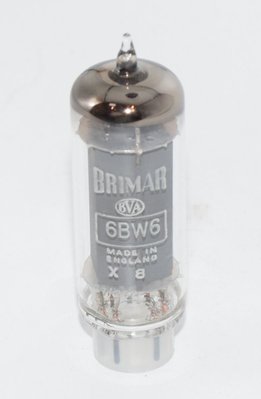
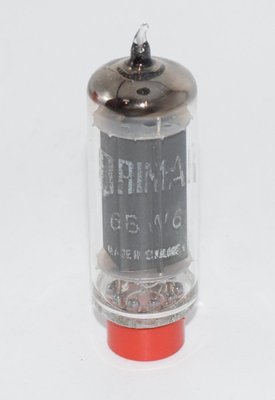
The 6BW6 is an indirectly heated beam tetrode designed for audio output service, manufactured primarily by Standard Telephones and Cables Pty. Ltd. (STC) and Brimar in the United Kingdom and Australia. First documented in application reports dating to March 1955, the 6BW6 was developed as a compact, noval-based output valve capable of delivering approximately 5 watts of audio power — making it ideally suited for use in receivers, small public address amplifiers, and domestic audio equipment.
The 6BW6 was explicitly designed to have the same characteristics and ratings as the 6V6GT, but in a smaller, more modern noval (B9A) envelope rather than the older octal format. This made it an attractive choice for manufacturers looking to reduce chassis size while maintaining the familiar and well-proven 6V6 circuit topology. The valve found widespread use in Australian and British equipment, where STC and Brimar were dominant suppliers.
A series-heater variant, the 9BW6, was also produced. The 9BW6 is identical in all respects except that its heater is rated at 9.0 volts at 0.3 amperes, designed for use in series-connected heater chains common in AC/DC receivers.
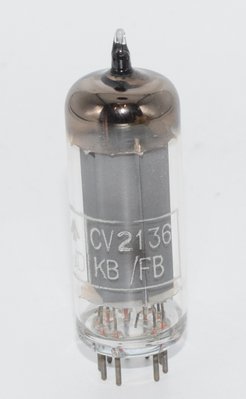
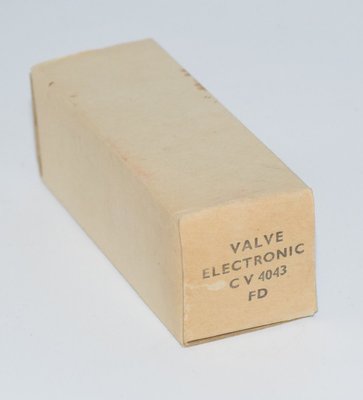
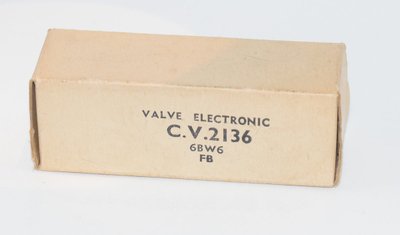
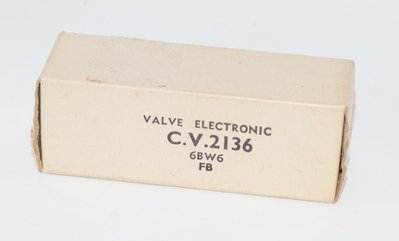
The 6BW6 was assigned several military and government designations, including CV2136, CV4043, and CV8048, reflecting its adoption into British military and telecommunications equipment. The type number 6061 was also used as an equivalent designation.
Technical Specifications and Design
General Description
The 6BW6 consists of a beam tetrode unit mounted in a standard T6½ bulb with a B9A (Noval) nine-pin base. It is capable of an output of the order of 5 watts. The heater is intended for operation in parallel with other valves in AC-operated equipment.
Heater Ratings
| Parameter | 6BW6 | 9BW6 |
|---|---|---|
| Heater Voltage | 6.3 volts | 9.0 volts |
| Heater Current | 0.45 ampere | 0.3 ampere |
| Max. DC Heater-Cathode Potential | 250 volts | 250 volts |
Note: The heater voltage should not vary by more than 5% of the rated value if the valve is used under Class AB2 conditions, or more than 7% if used under Class A or AB1 conditions. The 9BW6 heater current should not vary by more than ±5% of the rated value.
Physical Dimensions
| Parameter | Value |
|---|---|
| Max. Overall Length | 2-5/8 inches (66.7 mm) |
| Max. Diameter | 7/8 inch (22.2 mm) |
| Max. Seated Height | 2-3/8 inches (60.3 mm) |
| Envelope | T6½ glass bulb |
| Base | B9A (Noval) Nine Pin |
Pin Connections
| Pin | Connection |
|---|---|
| Pin 1 | Internal Connection |
| Pin 2 | Control Grid (g₁) |
| Pin 3 | Cathode |
| Pin 4 | Heater |
| Pin 5 | Heater |
| Pin 6 | No Connection (internal connection) |
| Pin 7 | Plate (Anode) |
| Pin 8 | Screen Grid (g₂) |
| Pin 9 | Beam Plates |
Important Note: Pin 1 is an internal connection and Pin 6 is also noted as an internal connection. These pins should not be used for external circuit connections.
Maximum Ratings — Tetrode Connections
| Parameter | Maximum Value |
|---|---|
| Max. Plate Voltage | 350 volts |
| Max. Screen Voltage | 310 volts |
| Max. Plate Dissipation | 13.2 watts |
| Max. Screen Dissipation | 2.2 watts |
| Max. Bulb Temperature | 250°C |
| Max. DC Plate Current | 70 mA |
Maximum Ratings — Triode Connections (Pins 7 and 8 Strapped)
| Parameter | Maximum Value |
|---|---|
| Max. Plate and Screen Strapped Voltage | 310 volts |
| Max. Plate and Screen Strapped Dissipation | 12.5 watts |
| Max. DC Plate Current | 75 mA |
Note: In order to avoid parasitic oscillation when triode-connected, pins 7 and 8 should be connected together through a 100 ohm resistor or an RF choke of about 20 microhenries.
Typical Operating Conditions — Class A Single-Ended Tetrode
| Parameter | Value |
|---|---|
| Plate Voltage (Va) | 315 volts |
| Screen Voltage (Vg2) | 225 volts |
| Control Grid Voltage (Vg1) | -13.0 volts |
| Plate Current (Ia) | 34.0 mA |
| Screen Current (Ig2) | 2.2 mA |
| Load Resistance (Ra) | 77,000 Ω |
| Transconductance (gm / S) | 3.75 mA/V |
| Cathode Resistor (Rk) | 360 Ω |
| Output Impedance (Zout) | 8,500 Ω |
| Power Output (Pout) | 5.5 watts |
| Total Harmonic Distortion (THD) | 12% |
Interelectrode Capacitances (Approximate, Without Shield)
| Capacitance | Value |
|---|---|
| Grid-Plate | 0.6 pF |
| Input | 8.5 pF |
| Output | 7.5 pF |
| Heater-Cathode | 7.0 pF |
Frequency Ratings
Whilst the 6BW6 is not intended primarily for operation as an oscillator or as a frequency multiplier, it may be used for such purposes up to a maximum frequency of 160 Mc/s. However, these valves are not recommended for use as Class B or C RF amplifiers above 100 Mc/s.
Applications and Usage
The 6BW6 was designed as a versatile audio output beam tetrode suitable for a range of applications:
- Single-ended audio output stages — The valve delivers approximately 5.5 watts in Class A single-ended tetrode operation, making it well-suited for domestic radio receivers, small integrated amplifiers, and bedside radios.
- Push-pull audio output stages — Two 6BW6 valves in push-pull configuration can deliver significantly more power with reduced distortion, suitable for small public address systems and higher-fidelity domestic amplifiers.
- Triode-connected operation — With pins 7 and 8 strapped (plate and screen connected), the 6BW6 operates as a triode, offering lower distortion at the expense of reduced power output. This mode is favoured by audiophiles seeking a more linear, harmonically rich sound.
- Military and telecommunications — The valve's adoption under CV2136, CV4043, and CV8048 designations indicates its use in British military communications equipment, where reliability and consistency were paramount.
- Frequency multiplier service — Though not its primary application, the 6BW6 can function as a frequency multiplier up to 160 Mc/s.
The 6BW6's design as a noval-based equivalent to the 6V6GT meant that it could be used in more compact chassis designs while leveraging the extensive body of 6V6 application knowledge. Circuit designers could adapt proven 6V6 circuits with minimal changes, needing only to accommodate the different base wiring.
Sound Characteristics
The 6BW6, sharing its electrical characteristics with the beloved 6V6, exhibits a tonal character that is warmly regarded by those who have encountered it in audio applications:
- Warm and musical midrange — Like its 6V6 sibling, the 6BW6 is known for a rich, warm midrange that lends a pleasing musicality to vocals and acoustic instruments. The midrange has a gentle presence that avoids harshness.
- Sweet, smooth highs — The treble response is characteristically smooth and non-fatiguing. High frequencies are present but lack the aggressive edge that some larger beam tetrodes can exhibit, making the 6BW6 well-suited to extended listening sessions.
- Controlled, articulate bass — At 5.5 watts output, the bass response is tight and well-defined rather than thunderous. The relatively high output impedance of 8,500 Ω means that speaker matching and output transformer quality significantly influence bass performance.
- Harmonic character — In tetrode mode, the 6BW6 produces a blend of even and odd harmonics. The 12% THD figure at full rated output in single-ended Class A is typical for this class of operation, and much of this distortion is composed of lower-order harmonics that the ear perceives as warmth and richness rather than harshness. When triode-connected, the harmonic profile shifts toward predominantly even-order harmonics (especially second harmonic), yielding a smoother, more "liquid" sound that many audiophiles prize.
- Dynamic response — The 6BW6 exhibits a lively, responsive dynamic character. Transients are handled with a natural ease that gives music a sense of life and immediacy, particularly noticeable on percussive material and plucked strings.
- Overall tonal signature — The 6BW6 occupies the same sonic territory as the 6V6 — often described as the "small tube with a big heart." It delivers a tone that is intimate, detailed, and emotionally engaging, with a character that sits between the crystalline clarity of an EL84 and the robust warmth of a 6L6. It excels in low-power, high-quality applications where sonic refinement matters more than raw wattage.
In guitar amplifier contexts (where 6V6 types are legendary), the 6BW6 can deliver the same creamy overdrive characteristics — a smooth, singing distortion that compresses gracefully as the valve is driven into clipping.
Equivalent and Substitute Types
The following types are confirmed as close or identical substitutes for the 6BW6:
| Type | Relationship | Notes |
|---|---|---|
| 6061 | Identical / Direct substitute | Same electrical and physical specifications |
| CV2136 | Identical / Military designation | British military equivalent of the 6BW6 |
| CV4043 | Identical / Military designation | British military equivalent, often to tighter tolerances |
| CV8048 | Identical / Military designation | British military equivalent |
| 9BW6 | Series-heater variant | Identical except heater: 9.0V at 0.3A. Not a direct drop-in substitute in parallel-heater circuits |
The 6BW6 is described by the manufacturer as having "the same characteristics and ratings as the 6V6GT." However, it is important to note that the 6BW6 uses a noval (B9A) base while the 6V6GT uses an octal base. Therefore, the 6BW6 is not a direct plug-in replacement for the 6V6GT — the pinout is entirely different and a socket change would be required. Electrically, however, 6V6GT circuit values and operating points can generally be applied to the 6BW6 with appropriate base wiring changes.
Other noval-based output beam tetrodes in a similar power class include the EL84/6BQ5, though the EL84 has different operating parameters and is not a direct substitute.
Notable Characteristics
- Noval 6V6 equivalent — The 6BW6's most notable characteristic is that it brings the well-known 6V6GT performance into the compact noval package, enabling smaller equipment designs without sacrificing audio quality.
- Beam plate connection — Pin 9 provides a separate connection for the beam plates, which are internally connected to the cathode in normal operation. This is a feature of the beam tetrode design that helps suppress secondary emission and contributes to the valve's efficient power conversion.
- Internal connections on Pins 1 and 6 — Both Pin 1 and Pin 6 are designated as internal connections. Designers must ensure these pins are not used for external circuit wiring. Pin 6 is specifically noted as an internal connection in manufacturer documentation.
- Triode strapping precaution — When operating in triode mode, the manufacturer specifically warns that pins 7 and 8 should be connected through a 100 ohm resistor or a 20 µH RF choke to prevent parasitic oscillation. This is a critical design consideration that is sometimes overlooked.
- Robust plate dissipation — At 13.2 watts maximum plate dissipation, the 6BW6 has considerable headroom above its typical 5.5-watt output rating, contributing to reliability and longevity in properly designed circuits.
- Low grid-plate capacitance — The 0.6 pF grid-to-plate capacitance is impressively low for a beam tetrode of this era, contributing to stability and enabling use at frequencies up to 160 Mc/s in multiplier service.
- Military-grade availability — The existence of multiple CV-numbered equivalents (CV2136, CV4043, CV8048) means that military-specification examples are available on the surplus market, often manufactured to tighter tolerances and with superior quality control compared to commercial production.
- STC and Brimar manufacture — The 6BW6 was primarily manufactured by STC (Standard Telephones and Cables) and Brimar, both respected British/Australian valve manufacturers known for high-quality construction. STC was an IT&T (International Telephone and Telegraph) associate company.
Usage in the Audio Community
The 6BW6 occupies an interesting niche in the audio community. While it never achieved the widespread fame of its octal-based equivalent, the 6V6GT, it has developed a dedicated following among enthusiasts who appreciate its unique combination of qualities:
DIY Amplifier Projects
The 6BW6 is a popular choice for DIY single-ended amplifier projects, particularly among builders who appreciate the noval format. At 5.5 watts in single-ended Class A, it provides sufficient power for efficient loudspeakers in domestic listening environments. The extensive availability of 6V6 circuit designs means that builders have a wealth of proven topologies to adapt, simply adjusting the socket wiring for the B9A base.
Value Proposition
One of the 6BW6's greatest attractions in the audio community is its relative affordability compared to the 6V6GT. As the 6V6 has become increasingly sought-after (and expensive) due to demand from both audiophiles and guitar amplifier enthusiasts, the 6BW6 offers essentially identical performance at a fraction of the cost. NOS (New Old Stock) examples from STC and Brimar are still available at reasonable prices, and military-specification CV2136 and CV4043 examples offer exceptional quality.
Vintage Receiver Restoration
The 6BW6 appears in numerous Australian and British vintage receivers and amplifiers. Restorers of these sets rely on NOS stocks of 6BW6 valves, and the availability of military-surplus CV-designated equivalents has been a boon for keeping these vintage pieces operational.
Triode-Connected Applications
A significant number of audio enthusiasts use the 6BW6 in triode-connected mode, strapping the plate and screen grid together. This sacrifices some output power but yields lower distortion and a more linear, triode-like sound character. The manufacturer's recommendation to use a 100 ohm resistor or 20 µH choke between pins 7 and 8 is an important consideration that experienced builders follow carefully to avoid parasitic oscillation.
Push-Pull Configurations
Pairs of 6BW6 valves in push-pull configuration can deliver meaningful power output with reduced distortion compared to single-ended operation. Push-pull 6BW6 amplifiers, whether in Class A or Class AB1, offer a compelling combination of power and sonic quality for small to medium listening rooms.
Guitar Amplifier Experimentation
Some guitar amplifier builders have experimented with the 6BW6 as an alternative to the 6V6 in custom builds. Since the electrical characteristics are essentially identical, the 6BW6 can deliver the same coveted "6V6 tone" — that warm, compressed, singing overdrive character — in a noval-based format. This opens up interesting possibilities for compact amplifier designs.
Collectibility
NOS 6BW6 valves from STC and Brimar are collected by enthusiasts, with military-marked CV4043 and CV2136 examples being particularly prized. The STC-manufactured examples, produced in Sydney, Australia, are notable for their robust construction and consistent performance. Brimar examples are equally well-regarded, reflecting that company's reputation for precision manufacturing.
In summary, the 6BW6 represents an excellent and often overlooked option for audio enthusiasts seeking the classic 6V6 sound in a more compact and frequently more affordable package. Its solid engineering pedigree, military-grade availability, and proven circuit compatibility make it a valve well worth exploring for both vintage restoration and new audio projects.