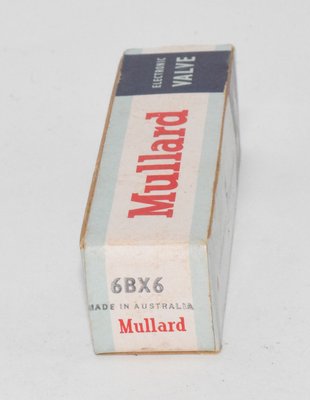
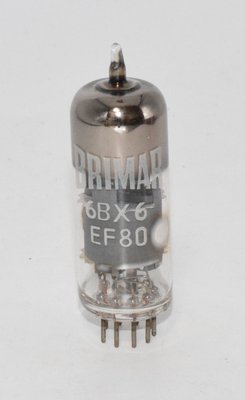
Introduction and History
The 6BX6 is a miniature sharp-cutoff RF pentode designed for high-frequency amplification, primarily in VHF and UHF television and radio receivers. It is the American RETMA designation for the European type EF80, one of the most widely produced and versatile small-signal pentodes of the post-war era. The tube was developed in the early 1950s as part of the noval (B9A) miniature tube family, replacing older octal-based RF pentodes with a compact, high-performance design optimized for the emerging television broadcast bands.
The EF80/6BX6 was manufactured by virtually every major tube producer worldwide, including Mullard, Philips, Philips Miniwatt (Australia), Mazda, Brimar, Toshiba (Japan), Valvo, Siemens, Tesla, and many others. The Tesla datasheet from the Czechoslovak Ministry of Precision Engineering, dated December 28, 1956, provides one of the most comprehensive published references for this type. The tube saw enormous production volumes due to its ubiquitous use in European and Australian television receivers throughout the 1950s and 1960s.
The 6BX6 designation was primarily used in Australian and some American markets, while EF80 remained the standard European Mullard-Philips designation. Despite being designed as an RF/IF amplifier, the tube has found renewed interest among audio experimenters and DIY amplifier builders due to its high transconductance, low noise characteristics, and wide availability on the surplus market.
Technical Specifications and Design
General Description
The 6BX6/EF80 is a sharp-cutoff (variable-mu is NOT a characteristic of this tube) VHF pentode with high transconductance and low noise, housed in a miniature all-glass envelope with a noval (B9A) 9-pin base. The suppressor grid (g3) and internal shielding are brought out to separate pins on the base. The cathode connection is provided via two pins (pins 1 and 3) to minimize inductance at high frequencies, and the input impedance is maximized when all input circuit connections are made to one cathode pin and all output circuit connections to the other.
Heater Data
| Parameter | Symbol | Value | Unit |
|---|---|---|---|
| Heater Voltage | Vf | 6.3 | V |
| Heater Current | If | 0.3 | A |
| Heater Type | — | Indirect, oxide-coated cathode | |
| Heating Time | t | 20 | s |
| Heater Supply | — | AC/DC, parallel or series string | |
Interelectrode Capacitances
| Parameter | Symbol | Value | Unit |
|---|---|---|---|
| Input Capacitance (control grid) | Cg1 | 7.5 | pF |
| Input Capacitance (screen grid) | Cg2 | 5.4 | pF |
| Output Capacitance | Ca | 3.35 | pF |
| Grid-to-Anode (Feedback) Capacitance | Cg-a | 0.008 | pF |
| Screen Grid to Control Grid Capacitance | Cg2/g1 | 2.9 | pF |
| Anode to Cathode Capacitance | Ca/k | 0.012 | pF |
| Control Grid to Heater Capacitance | Cg1/f | < 0.15 | pF |
| Heater to Cathode Capacitance | Cf/k | < 6 | pF |
Note: The verified reference data lists Cgk = 7.5 pF, Cak = 3.3 pF, and Cga = 0.007 pF. The Tesla datasheet specifies Cg1 = 7.5 pF, Ca = 3.35 pF, and Ca/g1 = 0.008 pF. These minor differences are within normal manufacturing tolerances between producers.
Characteristic Values (VF/MF Amplifier Service)
| Parameter | Symbol | Value (170V) | Value (200V) | Value (250V) | Unit |
|---|---|---|---|---|---|
| Anode Voltage | Va | 170 | 200 | 250 | V |
| Screen Grid Voltage | Vg2 | 170 | 200 | 250 | V |
| Suppressor Grid Voltage | Vg3 | 0 | 0 | 0 | V |
| Control Grid Bias | Vg1 | −2.0 | −2.55 | −3.5 | V |
| Cathode Resistor | Rk | 160 | 200 | 270 | Ω |
| Anode Current | Ia | 10 | 10 | 10 | mA |
| Screen Grid Current | Ig2 | 2.5 | 2.6 | 2.8 | mA |
| Transconductance | S (gm) | 7.4 | 7.1 | 6.8 | mA/V |
| Plate Resistance | Ri (rp) | 500 | 550 | 650 | kΩ |
| Screen Grid Amplification Factor | μg2/g1 | 50 | 50 | 50 | — |
| Input Impedance (f = 100 Mc/s) | Xg1 | 2.5 | 3 | 3.75 | kΩ |
| Equivalent Noise Resistance | Rekv | 1 | 1.1 | 1.2 | kΩ |
Additional characteristic data at the standard 170V operating point:
- Input Impedance at 50 Mc/s: Xg1 = 10 kΩ
- Equivalent Noise Resistance: Rekv = 1 kΩ
- Anode Current at Cutoff (Vg1 = −5V): Ia2 = 1.8 mA
Amplification Factor (μ)
The screen-to-control-grid amplification factor (μg2/g1) is consistently 50 across all operating conditions. The overall amplification factor μ (anode to control grid) can be calculated from the relationship μ = gm × rp. At the 170V operating point: μ = 7.4 mA/V × 500 kΩ = 3,700. This extremely high amplification factor is characteristic of a well-designed sharp-cutoff RF pentode.
Maximum Ratings (Absolute Limits)
| Parameter | Symbol | Max Value | Unit |
|---|---|---|---|
| Anode Voltage (cold, no signal) | Va0 | 550 | V |
| Anode Voltage (operating) | Va | 300 | V |
| Anode Dissipation | Wa | 2.5 | W |
| Screen Grid Voltage (cold) | Vg2,0 | 550 | V |
| Screen Grid Voltage (operating) | Vg2 | 300 | V |
| Screen Grid Dissipation | Wg2 | 0.7 | W |
| Cathode Current | Ik | 15 | mA |
| Grid Bias for Grid Current Onset (Ig1 = +0.3 μA) | Vg1i | −1.3 | V |
| Grid Leak Resistance (fixed bias) | Rg1 | 500 | kΩ |
| Grid Leak Resistance (automatic bias) | Rg1 | 1 | MΩ |
| Cathode-to-Heater Voltage (DC or peak AC) | Ek/f | 150 | V |
| External Cathode-to-Heater Resistance | Rk/f | 20 | kΩ |
Physical Characteristics
| Parameter | Value |
|---|---|
| Base Type | Noval (B9A), 9-pin miniature |
| Envelope | All-glass miniature (T-6½ equivalent) |
| Mounting | Any position |
| Weight | Approximately 15 g |
| Maximum Overall Length | 67.4 mm |
| Maximum Seated Height | ~62.2 mm |
| Maximum Diameter | 22.2 mm |
| Bulb Diameter | ~20 mm (min 60.0 mm base to tip per Tesla) |
Pin Configuration (B9A Base, Bottom View)
| Pin | Connection |
|---|---|
| 1 | Cathode (k) — input circuit connection |
| 2 | Control Grid (g1) |
| 3 | Cathode (k) — output circuit connection |
| 4 | Heater (f) |
| 5 | Heater (f) |
| 6 | Screen Grid (g2) |
| 7 | Anode (a) |
| 8 | Internal Shield / Suppressor Grid (g3) |
| 9 | Suppressor Grid (g3) — top cap: none |
Important note from the Tesla datasheet: The suppressor grid (g3) and internal shielding are brought out to separate pins on the base. The cathode is brought out to two pins (1 and 3). For maximum input impedance, all input circuit leads should connect to one cathode pin and all output circuit leads to the other cathode pin. It is recommended to use DC feedback via cathode resistor or screen grid circuit resistor to minimize scatter effects when replacing tubes in high-gain circuits.
Applications and Usage
The 6BX6/EF80 was designed as a versatile high-frequency pentode and found widespread use in the following applications:
Original Design Applications
- VHF/UHF RF Amplifier: The primary intended application. The tube's high transconductance (7.4 mA/V), low feedback capacitance (0.008 pF), and good input impedance at VHF frequencies made it ideal for television tuner front-end stages. The Tesla datasheet provides detailed VHF amplifier circuits operating at frequencies up to 100 Mc/s and beyond.
- IF Amplifier: Widely used in television intermediate frequency amplifier stages, where its high gain and sharp cutoff characteristic provided excellent selectivity and AGC performance.
- Wideband Video Amplifier: The datasheet includes a detailed video output stage circuit with cathode compensation, operating at Vb = 180V with Ra = 10 kΩ, achieving a voltage gain of 12 with 60 V peak-to-peak output. The maximum gain was limited to 25 to prevent ringing.
- Additive Mixer (Self-Oscillating): Extensively documented in the Tesla datasheet with operating data at 170V, 200V, and 250V supply voltages. The tube served as a combined mixer-oscillator in television tuners, with conversion transconductance (Sc) values ranging from 2.75 to 3.15 mA/V depending on operating conditions.
- Sync Separator: Used as a synchronization pulse separator in television receivers.
- General-Purpose RF/IF Amplifier: Suitable for radio receivers operating at VHF and MF frequencies.
Mixer Operating Data (Additive Mixer with Self-Oscillation)
The Tesla datasheet provides comprehensive mixer data at three supply voltages:
| Parameter | 170V | 200V | 250V | Unit |
|---|---|---|---|---|
| Supply Voltage (Vb) | 170 | 200 | 250 | V |
| Screen Grid Circuit Resistance (Rg2) | 25 | 25 | 25 | kΩ |
| Cathode Resistor (Rk) | 500 | 300 | 250 | Ω |
| Grid Leak Resistance (Rg1) | 0.2 | 0.2 | 0.2 | MΩ |
| Anode Current (Ia) | 4.5 | 6 | 8.5 | mA |
| Screen Current (Ig2) | 1.5 | 1.7 | 2.5 | mA |
| Mean Transconductance (S) | 3.55 | 4.0 | 4.7 | mA/V |
| Conversion Transconductance (Sc) | 2.75 | 2.8 | 3.15 | mA/V |
| Oscillation Voltage (Eosc) | 1.6 | 1.6 | 1.8 | Vef |
| Internal Resistance (Ri) | 450 | 500 | 540 | kΩ |
Video Output Stage Data
| Parameter | Value | Unit |
|---|---|---|
| Supply Voltage | 180 | V |
| Anode Load Resistance | 10 | kΩ |
| Screen Grid Circuit Resistance | 800 | kΩ |
| Cathode Resistor | 300 | Ω |
| Cathode Bypass Capacitor | 500 | pF |
| Anode Current | 6.5 | mA |
| Screen Current | 1.8 | mA |
| AC Output Voltage (peak-to-peak) | 60 | V |
| AC Anode Current (peak-to-peak) | 9.4 | mA |
| Voltage Gain | 12 | — |
Sound Characteristics
While the 6BX6/EF80 was never designed as an audio tube, its sonic characteristics have been explored by experimenters who have pressed it into service in audio preamplifier and driver stages. The following observations reflect the consensus among those who have used this tube in audio circuits:
Tonal Qualities
- Clean and Detailed: The EF80/6BX6's high transconductance of 7.4 mA/V and relatively low plate resistance of 500 kΩ (at 170V) give it excellent gain and a clean, detailed sound when used as a voltage amplifier. The high gm provides ample gain with low distortion at moderate signal levels.
- Extended High Frequencies: Being designed for VHF operation, the tube has inherently excellent high-frequency response. In audio circuits, this translates to an open, airy top end with excellent transient response and detail retrieval. The low grid-to-anode capacitance (0.008 pF) means minimal Miller effect, preserving bandwidth even with moderate plate loads.
- Low Noise Floor: The equivalent noise resistance of only 1 kΩ (at 170V, Ia = 10 mA) makes the 6BX6 one of the quieter pentodes available. This low noise floor allows it to resolve fine musical detail and micro-dynamics that noisier tubes would mask.
- Slightly Lean Midrange: Compared to dedicated audio pentodes like the EF86, the EF80 can sound slightly lean or analytical through the midrange. It lacks the warmth and body that some audio-specific pentodes provide, though this can be an advantage in circuits where transparency is valued over coloration.
- Dynamic and Fast: The tube's sharp-cutoff characteristic and high transconductance give it excellent dynamic range and transient speed. Musical attacks are rendered with precision and clarity.
- Manufacturer Variations: Significant sonic differences exist between manufacturers. Mullard-made examples (including Australian Mullard and Philips Miniwatt) are generally considered to have the smoothest, most musical presentation. Brimar examples tend toward a brighter, more detailed sound. Tesla and other Eastern European examples can vary considerably but often offer good value with acceptable sonic performance.
Comparison with Audio-Specific Pentodes
Compared to the EF86 (6267), which was specifically designed for audio preamplifier service, the EF80/6BX6 has higher transconductance but also higher plate resistance and less inherent shielding against microphonics. The EF86 features a special internal suspension system to minimize microphonic noise, which the EF80 lacks. In practice, the EF80 can be more prone to microphonic behavior in high-gain audio circuits, particularly in phono stages where vibration sensitivity is critical. However, in line-level applications and driver stages, the EF80 can perform admirably.
Equivalent or Substitute Types
The following types are directly interchangeable with the 6BX6:
| Type | Designation System | Notes |
|---|---|---|
| EF80 | Mullard-Philips (European Pro-Electron) | Identical type — the European designation. Direct pin-for-pin replacement. This is the most common designation worldwide. |
| CV1376 | British Military (CV series) | British military specification equivalent. Selected and tested to tighter tolerances. Direct replacement. |
| Z152 | Alternative designation | Direct equivalent, same electrical and mechanical specifications. |
Important notes on equivalents:
- All of the above types use the same B9A (noval) base and have identical pinouts.
- No bias or circuit changes are required when substituting between these types.
- The Tesla EF80 datasheet explicitly states that the TESLA EF80 replaces foreign types 6BX6 and Z719.
- The 6BX6 should not be confused with the 6BX6GT or other similarly numbered types that may have different characteristics.
- While the EF80 and 6BX6 are the same tube, specimens from different manufacturers may show variations in transconductance, noise, and microphonic behavior. For critical audio applications, testing individual tubes is recommended.
Notable Characteristics
Dual Cathode Connections
One of the most distinctive features of the 6BX6/EF80 is its dual cathode pin arrangement (pins 1 and 3). This design was specifically implemented to minimize lead inductance at VHF frequencies. The Tesla datasheet provides detailed guidance: for maximum input impedance, all input circuit connections should be made to one cathode pin, and all output circuit connections to the other. When measuring input impedance, both cathode pins must be connected together. This dual-cathode arrangement also benefits audio applications by providing a low-inductance ground return path.
Exceptional VHF Performance
The tube maintains useful input impedance even at 100 Mc/s (Xg1 = 2.5 to 3.75 kΩ depending on operating voltage), and the feedback capacitance of only 0.008 pF ensures stable operation at high frequencies without neutralization in most circuits.
High Voltage Capability
Despite its small size, the 6BX6 can withstand remarkably high voltages. The maximum cold anode voltage rating of 550V and operating anode voltage of 300V provide generous safety margins for most applications. The maximum cathode-to-heater voltage of 150V allows use in series-heater string television receivers.
Comprehensive Mixer Performance
The Tesla datasheet provides unusually detailed mixer data, including operation as an additive mixer with self-oscillation and with cathode feedback. The conversion transconductance values of 2.75–3.15 mA/V are excellent for a self-oscillating mixer, contributing to the tube's popularity in television tuner designs.
Sharp Cutoff Characteristic
The 6BX6 is a sharp-cutoff pentode, meaning its transconductance drops rapidly as the grid bias is increased beyond the operating point. This is visible in the published characteristic curves, where the Ia vs. Vg1 curves show a steep, consistent slope. This characteristic makes the tube well-suited for applications requiring precise gain control and clean signal handling, but less ideal for variable-gain (AGC) applications compared to remote-cutoff types.
Scatter and Replacement Considerations
The Tesla datasheet includes an important practical note: to minimize undesirable scatter effects that commonly occur when replacing high-transconductance tubes, it is recommended to incorporate DC feedback via a cathode resistor or screen grid circuit resistor. This advice is equally relevant for audio applications, where tube-to-tube variations can cause significant changes in operating point and gain.
Usage in the Audio Community
DIY Preamplifier Projects
The 6BX6/EF80 has become a popular choice among DIY audio enthusiasts for building preamplifier stages, primarily due to its extremely low cost and wide availability. Millions of these tubes were produced for the television industry, and NOS (New Old Stock) examples from quality manufacturers like Mullard, Philips Miniwatt, and Brimar can be obtained for a fraction of the cost of dedicated audio pentodes like the EF86. This economic advantage has driven considerable experimentation in the audio community.
Common Audio Circuit Configurations
- Pentode Voltage Amplifier: The most straightforward application, using the tube in its native pentode configuration with a plate load resistor. The high gain (μ ≈ 3,700 in pentode mode) must be managed carefully, and the plate load resistor is typically kept relatively low (47–100 kΩ) to maintain bandwidth and reduce distortion. Operating at the datasheet's recommended 10 mA anode current with 170–250V plate supply provides a good starting point.
- Triode-Strapped Operation: Many audio builders connect the screen grid (pin 6) to the anode (pin 7) through a small resistor (typically 100–470Ω) to operate the EF80 as a triode. This dramatically reduces gain but also reduces plate resistance and distortion, yielding a more linear, warmer sound. The resulting triode has moderate gain and relatively low plate resistance compared to pentode operation.
- Ultralinear Connection: Some builders have experimented with connecting the screen grid to an ultralinear tap on the output transformer in single-ended amplifier configurations, though this is uncommon.
- Cascode Amplifier: The EF80's excellent high-frequency characteristics make it suitable for cascode configurations in audio circuits where wide bandwidth and low noise are required.
- Driver Stage: The tube's high transconductance and ability to swing reasonable voltage makes it useful as a driver for power output tubes in small amplifier designs.
Phono Stage Applications
Some experimenters have used the 6BX6/EF80 in phono preamplifier stages, attracted by its low equivalent noise resistance (1 kΩ). However, the tube's lack of anti-microphonic mounting (unlike the EF86) means that careful attention must be paid to vibration isolation. Rubber socket mounts, tube damper rings, and careful chassis placement away from loudspeakers are essential for satisfactory results in phono applications.
Guitar Amplifier Modifications
The 6BX6/EF80 has found some use in guitar amplifier modifications and custom builds, particularly in the UK and Australia where these tubes are abundantly available. The tube's high gain and sharp cutoff characteristic can produce interesting overdrive characteristics, transitioning from clean to clipped relatively abruptly compared to remote-cutoff pentodes. Some players appreciate this characteristic for its aggressive, cutting tone when driven hard.
Headphone Amplifiers
The EF80/6BX6 has been used in hybrid headphone amplifier designs, typically as a voltage gain stage feeding a solid-state output buffer. The tube's high gain allows single-stage designs with sufficient voltage swing for most headphone loads, and its low noise floor is advantageous in the intimate listening environment of headphone use.
Preferred Manufacturers for Audio Use
Within the audio community, the following manufacturer preferences have emerged:
- Mullard (UK and Australia): Generally considered the gold standard for audio use. Mullard EF80s and 6BX6s are prized for their smooth, musical sound and consistent quality. Australian Mullard examples are particularly sought after.
- Philips Miniwatt (Australia): Essentially the same production as Mullard Australia, these are equally well-regarded and often available at lower prices due to less brand recognition.
- Brimar (UK): Known for detailed, slightly bright sound. The CV1376 military-spec version is particularly valued for its tight tolerances and reliability.
- Toshiba (Japan): Japanese-made EF80/6BX6 tubes are generally well-constructed with good consistency, though less commonly encountered than European examples.
- Mazda (Philips Australia): Another Australian-market brand from the Philips family, offering similar quality to Philips Miniwatt.
- Tesla (Czechoslovakia): Widely available and inexpensive. Quality can be variable, but good examples perform well in audio circuits. The comprehensive Tesla datasheet (reproduced in this article's reference data) demonstrates the thoroughness of their engineering.
Practical Considerations for Audio Use
When using the 6BX6/EF80 in audio circuits, the following practical points should be observed:
- The suppressor grid (g3, pins 8 and 9) should be connected to the cathode for normal pentode operation, or left connected to cathode when triode-strapping.
- The dual cathode pins (1 and 3) should both be connected to ground/cathode resistor in audio applications for lowest impedance.
- A cathode bypass capacitor of adequate value is essential for full gain; without it, local feedback will significantly reduce gain (which may be desirable for linearity).
- Screen grid supply should be well-filtered and decoupled, as screen supply noise will appear amplified at the output.
- The maximum grid leak resistance of 1 MΩ (with automatic bias) provides flexibility in input coupling network design.
- Operating the tube at its rated 10 mA anode current provides the best transconductance and lowest noise. Reducing anode current significantly degrades both parameters, as shown in the published characteristic curves.