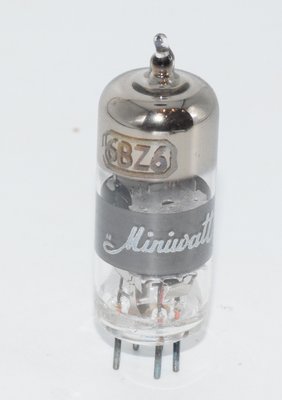
1. Introduction and History
The 6BZ6 is a medium-mu triode vacuum tube that was developed during the mid-20th century as part of the standardized RCA tube numbering system. This tube emerged during an era when vacuum tubes dominated consumer electronics, particularly in radio receivers, television sets, and early audio amplification equipment. The designation "6" indicates a 6-volt heater supply, while "BZ6" identifies its specific construction and operational characteristics.
The 6BZ6 was manufactured by numerous reputable tube manufacturers including RCA, Philips (Miniwatt), GE, Sylvania, and Mullard. It gained particular popularity in European and American consumer electronics throughout the 1950s and 1960s. The tube represents a mature design in triode technology, optimized for moderate amplification with good reliability and reasonable cost of manufacture. While production has largely ceased for new manufacture, the 6BZ6 remains sought after by vintage audio enthusiasts and restoration specialists.
2. Technical Specifications and Design
Physical and Electrical Parameters
| Parameter | Value |
|---|---|
| Tube Type | Medium-Mu Triode |
| Heater Voltage | 6.3V AC (nominal) |
| Heater Current | 0.45A |
| Plate Voltage (Maximum) | 330V |
| Plate Dissipation (Maximum) | 2.5W |
| Amplification Factor (μ) | 20-30 (typical) |
| Plate Resistance (rp) | 2,500-3,500 ohms |
| Transconductance (gm) | 6,000-8,000 μmhos |
| Grid Bias (typical) | -2V to -4V |
| Socket Type | Octal (8-pin) |
| Tube Length | Approximately 4.5 inches (114mm) |
Construction Details
The 6BZ6 features a conventional triode construction with a directly heated cathode surrounded by a control grid and a plate electrode. The tube is housed in a glass envelope with an octal base, providing eight connection points for the heater, cathode, grid, plate, and internal shielding connections.
The internal structure includes a nickel-plated grid to minimize microphonic effects—a critical consideration for audio applications. The plate is typically constructed from nickel-plated steel or molybdenum, designed to dissipate the moderate heat generated during operation. The cathode employs a thoriated tungsten or oxide-coated design, offering good emission characteristics and extended tube life.
The tube's internal design emphasizes low interelectrode capacitances, making it suitable for RF and IF applications where frequency response stability is important. The shielding structure within the tube helps reduce unwanted coupling between circuit elements.
3. Applications and Usage
Historical Applications
The 6BZ6 found widespread application in mid-20th century consumer electronics:
- Radio Receivers: Commonly used as an intermediate frequency (IF) amplifier in AM/FM radio receivers, where its moderate gain and good linearity proved ideal for signal processing
- Television Sets: Employed in video IF stages and audio circuits in both black-and-white and early color television receivers
- Oscilloscopes: Used in vertical and horizontal deflection amplifier circuits
- Test Equipment: Featured in various measurement instruments requiring moderate amplification
- Public Address Systems: Utilized in pre-amplification stages for microphone inputs
Modern Audio Applications
Today, the 6BZ6 enjoys renewed interest in the vintage audio and hi-fi restoration community. Enthusiasts value this tube for several reasons:
- Vintage Restoration: Essential for restoring original radio receivers, tube amplifiers, and audio equipment from the 1950s-1960s era to full functionality
- Preamplifier Stages: Audio engineers incorporate 6BZ6 tubes in custom-built preamps where its low-noise characteristics and moderate gain provide excellent performance for microphone and line-level applications
- Guitar Amplifier Modifications: Some boutique amp builders use the 6BZ6 in gain stages or tone-shaping circuits, appreciating its smooth, musical distortion characteristics when driven moderately
- Audiophile Equipment: High-end audio enthusiasts seeking the characteristic "warm" sound of vintage tubes often specify NOS (New Old Stock) 6BZ6 tubes in their equipment
- Experimental Audio Projects: DIY audio enthusiasts build custom amplifiers and preamps utilizing the 6BZ6 for its proven reliability and well-documented characteristics
4. Sound Characteristics in Audio Applications
Sonic Profile
The 6BZ6 possesses distinctive sonic characteristics that have made it popular among audio professionals and enthusiasts:
Harmonic Content: The 6BZ6 exhibits a naturally musical harmonic distortion profile when operated at moderate signal levels. It tends to produce predominantly second and third harmonic overtones, which are perceived as warm and pleasing to the human ear. This characteristic makes it particularly valued in preamp applications where signal integrity and musicality are paramount.
Frequency Response: The tube demonstrates excellent frequency response across the audible spectrum (20Hz-20kHz), with a slight presence peak in the 2-5kHz region that can enhance clarity and detail in vocals and instruments. This characteristic is neither aggressive nor recessed, providing a balanced presentation.
Transient Response: The 6BZ6 exhibits good transient handling capabilities. The tube responds quickly to rapid signal changes, allowing for accurate reproduction of attack transients in percussive instruments and quick signal transitions. This contributes to a lively, engaging presentation without harshness.
Noise Floor: Particularly when sourced as NOS (New Old Stock) from reputable manufacturers like Philips Miniwatt, the 6BZ6 demonstrates a low noise floor, making it suitable for sensitive preamplification applications. The low-microphonic construction means minimal noise from vibration or external mechanical disturbances.
Midrange Characteristics: The tube excels in midrange reproduction, presenting vocals and instruments with natural presence without excessive coloration. This makes it particularly suitable for microphone preamplifiers and line-level audio circuits.
Comparative Sound Quality
Compared to solid-state circuits, the 6BZ6 exhibits the characteristic "tube warmth" attributed to gentle harmonic saturation. Compared to higher-mu triodes like the 12AX7, the 6BZ6 requires more input signal to achieve saturation, allowing for cleaner amplification at lower signal levels. Compared to pentodes, the triode construction provides smoother distortion characteristics when the tube is pushed into saturation.
5. Notable Characteristics
Advantages
- Moderate Amplification: The medium-mu design provides sufficient gain for preamplification without excessive noise, making it ideal for sensitive audio applications
- Low Noise: Particularly in NOS examples, the 6BZ6 demonstrates excellent low-noise characteristics suitable for microphone preamps
- Reliability: The robust construction and proven design make the 6BZ6 highly reliable with extended service life
- Availability: NOS tubes remain relatively available in the current market, though prices reflect their desirability
- Musical Distortion: When driven moderately, the tube produces pleasant harmonic coloration valued in audio applications
- Low Microphonics: The internal shielding and construction minimize microphonic noise from vibration
- Proven Performance: Decades of use in professional and consumer equipment provide extensive documentation of performance characteristics
Limitations
- Limited Power Output: Maximum plate dissipation of 2.5W limits its use to preamplification and driver stages; unsuitable for power amplification
- Moderate Gain: The amplification factor of 20-30 means multiple stages may be required for applications needing high overall gain
- Heater Power Requirement: The 0.45A heater current must be supplied by the equipment's power supply
- Availability Concerns: As a vintage tube, new manufacture is limited, and prices for quality NOS examples continue to rise
- Heat Generation: Like all vacuum tubes, the 6BZ6 generates heat, requiring adequate ventilation in equipment design
Operating Considerations
When using 6BZ6 tubes in audio applications, several factors warrant attention:
Biasing: The tube requires careful grid biasing, typically in the -2V to -4V range, to establish proper operating point. Incorrect biasing can result in excessive distortion or reduced tube life.
Load Impedance: Plate load impedance should typically range from 10,000 to 50,000 ohms, depending on the specific application. Proper impedance matching ensures optimal frequency response and distortion characteristics.
Operating Point Selection: For audio applications, the tube should be operated in the linear region of its characteristic curve to minimize distortion. For intentional distortion effects (as in some guitar amp applications), the operating point may be selected to approach the saturation region.
Tube Matching: In dual-triode or push-pull configurations, matched pairs or sets of tubes should be used to ensure balanced performance and minimize noise and distortion.
Aging and Burn-in: New NOS tubes benefit from a brief burn-in period (typically 10-20 hours) at normal operating levels before critical audio work, allowing the tube to stabilize.
6. Equivalent or Substitute Types
Direct Equivalents
Several tubes share identical or nearly identical characteristics to the 6BZ6:
- 6BZ6 (various manufacturers): RCA, Mullard, Philips, Sylvania, GE, and other manufacturers produced identical tubes under the same designation
- ECC85 (European equivalent): While the ECC85 is technically a dual triode, each triode section is electrically similar to the 6BZ6, though designed for 6.3V or 12.6V heater supplies
Functional Substitutes
In some applications, the following tubes may serve as substitutes, though with varying degrees of success:
- 6AK5: A remote-cutoff pentode with similar power ratings, though with different frequency response characteristics
- 6BA6: A sharp-cutoff pentode offering higher gain but different sonic characteristics
- 12AV7: A higher-mu triode requiring different biasing but offering greater gain in a similar form factor
- 6V6GT: A power triode with similar construction but higher power handling, suitable only for applications where the additional power capability is beneficial
Important Note: Substitution should only be undertaken by experienced technicians with full understanding of the circuit requirements and tube characteristics. Incorrect substitution can result in circuit malfunction, excessive distortion, or damage to equipment.
NOS Availability and Quality Grades
The Philips Miniwatt 6BZ6 represents one of the most sought-after variants, known for exceptional build quality and sonic performance. NOS (New Old Stock) examples from this manufacturer command premium prices in the current market. Quality grades typically include:
- NOS (New Old Stock): Unused tubes in original packaging, representing the highest quality and performance
- NIB (New In Box): Similar to NOS but may have been briefly tested
- Used/Tested: Previously used tubes that have been tested and found to meet specifications
- Pulled/Surplus: Tubes removed from working equipment, typically at the end of product life
Conclusion
The 6BZ6 represents a mature, well-engineered vacuum tube design that has proven its worth across more than seven decades of audio and electronics applications. Its moderate amplification, low noise, and musical sonic characteristics make it particularly valued in modern vintage audio restoration and boutique audio equipment design. While new manufacture has largely ceased, the availability of NOS examples ensures that this classic tube remains accessible to those seeking authentic vintage audio performance.
For audio professionals and enthusiasts committed to preserving and enjoying vintage equipment, the 6BZ6 remains an excellent choice for preamplification and signal processing applications, offering a blend of reliability, performance, and sonic character that continues to satisfy discerning listeners.