Home > Articles > 6C4 Vacuum Tube: Technical Specifications, Applications, and Characteristics

6C4 Vacuum Tube: Technical Specifications, Applications, and Characteristics

Comprehensive guide to the 6C4 vacuum tube: history, specifications, applications, substitutes, and unique characteristics of this miniature triode.

1. Introduction and History

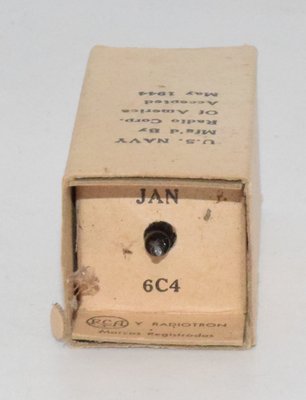
The 6C4 is a miniature triode vacuum tube introduced in the mid-1940s during the post-World War II era when vacuum tube technology was transitioning from larger glass envelope designs to more compact and efficient miniature tubes. Developed by RCA, the 6C4 was part of the new 7-pin miniature tube family that helped revolutionize electronic equipment design by allowing for smaller, more portable devices.

The 6C4 was derived from the popular octal-based 6J5 triode, essentially offering the same electrical characteristics but in a much smaller package. This miniaturization was significant in the evolution of electronic equipment, as it enabled manufacturers to design more compact radios, amplifiers, and test equipment. The 6C4 quickly became a standard component in many consumer and professional electronic devices throughout the 1950s and into the 1960s, before solid-state technology began to dominate the market.

2. Technical Specifications and Design

The 6C4 is a single triode vacuum tube with a 7-pin miniature base (NOVAL). Its compact design made it ideal for space-constrained applications where a simple, reliable triode was needed.

Key Specifications:

  • Heater Voltage: 6.3 volts
  • Heater Current: 0.15 amperes (150mA)
  • Plate Voltage (maximum): 300 volts
  • Plate Dissipation (maximum): 2.75 watts
  • Transconductance: Approximately 2200 micromhos (2.2 mA/V)
  • Amplification Factor (μ): 17
  • Plate Resistance: Approximately 7700 ohms

Physical Characteristics:

  • Base: 7-pin miniature (NOVAL)
  • Envelope: Glass, T-6½ size
  • Pin Configuration:
    • Pin 1: Plate
    • Pin 2: Grid
    • Pin 3: Not connected
    • Pin 4: Heater
    • Pin 5: Heater
    • Pin 6: Not connected
    • Pin 7: Cathode

The 6C4's design features a unipotential cathode with oxide coating, which provides efficient electron emission. The tube's internal structure is designed to minimize interelectrode capacitances, making it suitable for high-frequency applications.

3. Applications and Usage

The 6C4 triode found widespread use in various electronic applications due to its versatility, reliability, and compact size:

Audio Applications:

  • Preamplifiers: Commonly used in the input stages of audio amplifiers
  • Phase Inverters: In push-pull amplifier circuits
  • Cathode Followers: For impedance matching and buffering
  • Small-Signal Amplifiers: In various audio equipment

RF Applications:

  • Oscillators: In radio receivers and transmitters
  • Mixers: For frequency conversion in superheterodyne receivers
  • RF Amplifiers: In VHF circuits and communications equipment

Test and Measurement Equipment:

  • Oscilloscopes: As vertical and horizontal amplifiers
  • Signal Generators: As oscillators and buffer amplifiers
  • Vacuum Tube Voltmeters (VTVM): As input amplifiers

Computer and Industrial Applications:

  • Early Computing: As switching elements in early computer circuits
  • Control Circuits: In industrial equipment
  • Relay Drivers: For interfacing with electromechanical components

The 6C4 was particularly valued in applications where a simple, reliable triode with moderate gain was required in a compact package. Its relatively low plate resistance made it suitable for transformer coupling, while its moderate transconductance provided adequate gain for many applications.

4. Equivalent or Substitute Types

The 6C4 has several direct and near equivalents that can often be used as substitutes:

Direct Equivalents:

  • EC90: European designation for the same tube
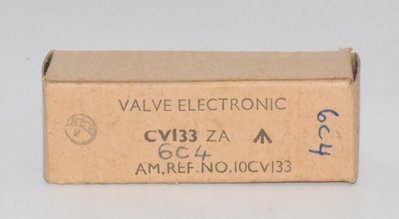
  • CV5072: British military designation
  • 12C4: Identical except for 12.6V heater (0.075A) for series heater string applications

Near Equivalents (may require circuit adjustments):

  • 6J5: Octal-based predecessor with similar electrical characteristics
  • ½ 6SN7: One section of this dual triode has similar characteristics
  • ½ 12AU7/ECC82: One section of this dual triode, though with somewhat different characteristics
  • 6AQ8/ECC85: Each section can substitute in some applications
  • 5719: A premium industrial version with tighter specifications
  • 6100: Military ruggedized version

When substituting tubes, it's important to consider not just the electrical characteristics but also the physical dimensions, pin configuration, and heater requirements. In some critical applications, especially those involving RF or precision measurements, direct substitutes are strongly recommended.

5. Notable Characteristics

The 6C4 has several characteristics that made it notable among vacuum tubes of its era:

Advantages:

  • Compact Size: The miniature envelope allowed for space-efficient designs
  • Versatility: Suitable for a wide range of applications from audio to RF
  • Low Microphonics: Relatively resistant to mechanical vibration compared to some other triodes
  • Good High-Frequency Performance: Lower interelectrode capacitances than octal predecessors
  • Reliability: Simple internal structure contributed to long service life
  • Low Noise: Good signal-to-noise ratio for a tube of its era

Limitations:

  • Moderate Gain: Not as high as some other triodes
  • Limited Power Handling: 2.75W plate dissipation restricts use in power applications
  • Single Section: Less economical in applications where dual triodes could be used

The 6C4 remains popular among vintage audio enthusiasts and tube amplifier builders for several reasons. Its straightforward triode design produces a characteristic "tube sound" that many find pleasing, particularly in audio preamplifier applications. The tube's relatively low gain actually makes it easier to design stable circuits without excessive feedback.

For collectors and restorers of vintage equipment, the 6C4 is significant as it represents an important transition in vacuum tube technology—the shift from larger octal-based tubes to the more compact miniature designs that would dominate until the transistor revolution. Many NOS (New Old Stock) 6C4 tubes are still available from various manufacturers, including sought-after brands like RCA, Sylvania, GE, and Tung-Sol, as well as European manufacturers.

Today, while no longer in production, the 6C4 continues to be used in boutique audio equipment, particularly in preamplifier stages where its characteristics complement modern circuit designs that aim to capture the classic tube sound.