1. Introduction and History
The 6C8G is a dual-triode vacuum tube that emerged during the golden age of tube electronics in the 1940s. Developed as an improved variant of earlier triode designs, the 6C8G was engineered to provide enhanced performance characteristics suitable for both audio amplification and general-purpose signal processing applications. The tube designation follows the RCA numbering system, where "6" indicates the heater voltage (6.3V AC), "C" denotes the tube category (triode), "8" represents the tube's performance class, and "G" indicates the glass envelope type.
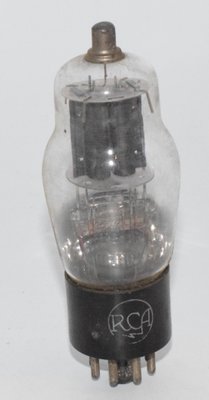
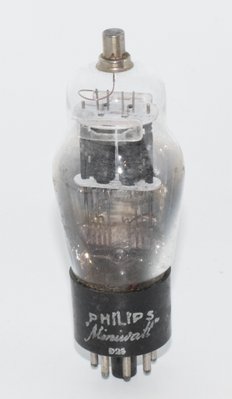
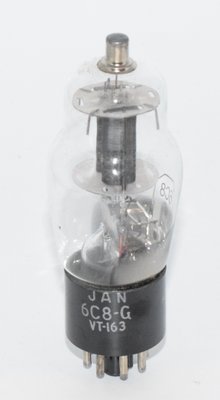
The 6C8G gained prominence during World War II and the immediate post-war era, with significant production by major manufacturers including RCA, Philips, Mullard, and Telefunken. Military applications, particularly in radio communications and radar equipment, drove much of the early demand. The JAN RCA VT163 designation represents the military specification version of this tube, ensuring stricter quality control and reliability standards for military service.
Post-war, the 6C8G found extensive use in consumer audio equipment, including high-fidelity amplifiers, preamplifiers, and radio receivers. Today, the tube remains highly sought after by vintage audio enthusiasts and audiophiles who value its sonic characteristics and historical significance.
2. Technical Specifications and Design
Physical Characteristics
The 6C8G features a glass envelope construction with an octal (8-pin) base. The tube measures approximately 2.5 inches (6.35 cm) in height and 1.0 inch (2.54 cm) in diameter. The octal base configuration provides robust mechanical and electrical connections, making it suitable for both vintage equipment and modern amplifier designs.
Electrical Specifications
| Parameter | Specification |
|---|---|
| Heater Voltage | 6.3V AC (±10%) |
| Heater Current | 0.45A per triode (0.9A total) |
| Maximum Plate Voltage | 330V DC |
| Maximum Plate Dissipation | 2.5W per triode |
| Amplification Factor (μ) | 20 |
| Plate Resistance (rp) | 7,700 ohms |
| Transconductance (gm) | 2,600 micromhos |
| Grid Bias | -2V to -8V (typical) |
Internal Configuration
The 6C8G contains two independent triodes within a single glass envelope, each with its own cathode, grid, and plate. This dual-triode configuration allows for flexible circuit designs, enabling cascaded amplification, phase splitting, or independent signal processing. The triodes share a common heater but maintain separate plate and grid circuits, providing design flexibility without requiring multiple tube sockets.
Pin Configuration
The octal base pinout is as follows:
- Pin 1: Plate 1
- Pin 2: Grid 1
- Pin 3: Cathode 1
- Pin 4: No connection (NC)
- Pin 5: Cathode 2
- Pin 6: Grid 2
- Pin 7: Plate 2
- Pin 8: Heater (common)
- Pins 0 (center): Heater (common)
Performance Characteristics
The 6C8G demonstrates moderate gain and relatively low output impedance compared to high-μ triodes. The amplification factor of 20 provides balanced performance between gain and linearity. The transconductance of 2,600 micromhos indicates good current-handling capability, making the tube suitable for driving subsequent stages or moderate loads.
The tube exhibits good linearity across its operating range, with minimal distortion at normal operating levels. The relatively low plate resistance contributes to stable performance in various circuit configurations, from simple voltage amplifiers to more complex phase-splitter applications.
3. Applications and Usage
Historical Applications
During its development and early production years, the 6C8G served critical roles in military electronics:
- Radio Communication Equipment: Used as intermediate frequency (IF) amplifiers and detector stages in military radio receivers
- Radar Systems: Employed in signal processing and amplification circuits for radar detection equipment
- Test Equipment: Utilized in oscilloscopes and signal generators for laboratory and field testing
Audio Amplifier Applications
In consumer audio applications, the 6C8G found widespread use in:
- Preamplifiers: As voltage amplification stages for phono inputs and line-level sources
- Power Amplifier Input Stages: Providing gain and impedance buffering before power tube stages
- Phase Splitters: Converting single-ended signals to balanced push-pull signals for power amplifier grids
- Tone Control Circuits: Active tone shaping stages in integrated amplifiers
Modern Audio Applications
Contemporary audio enthusiasts continue to employ 6C8G tubes in:
- Vintage Amplifier Restoration: Replacement tubes for original equipment requiring period-correct components
- Custom Tube Amplifier Design: Modern amplifier builders utilize 6C8G tubes for their sonic characteristics and proven reliability
- High-Fidelity Preamps: Boutique audio manufacturers incorporate 6C8G tubes in premium preamplifier designs
- Hybrid Amplifiers: Combination designs using 6C8G tubes in the analog front-end with solid-state output stages
4. Sound Characteristics
Tonal Profile
The 6C8G is renowned among audio professionals for its balanced, neutral tonal characteristics. The tube exhibits:
- Midrange Clarity: Exceptional clarity and presence in the midrange frequencies (500Hz-5kHz), making vocals and instruments sound articulate and well-defined
- Extended Highs: Clean, non-fatiguing treble response with good extension, avoiding excessive brightness or harshness
- Controlled Bass: Tight, well-controlled bass reproduction without excessive bloom or muddiness
- Overall Neutrality: A relatively transparent sonic character that doesn't impose significant coloration on the source material
Distortion Characteristics
The 6C8G produces harmonic distortion with a benign character when operated within normal parameters:
- Low-Order Harmonics: Primarily second and third-order harmonic generation, which many listeners perceive as musically pleasant
- Linearity: Excellent linearity across the audio spectrum minimizes intermodulation distortion
- Dynamic Headroom: Good headroom before audible distortion becomes apparent, allowing for dynamic musical passages
Noise and Microphonics
Well-maintained NOS (New Old Stock) 6C8G tubes typically exhibit:
- Low Noise Floor: Minimal thermal and shot noise, contributing to excellent signal-to-noise ratio in preamplifier applications
- Microphonic Behavior: Some specimens exhibit moderate microphonics; careful mechanical isolation and tube damping rings are recommended for sensitive applications
- Consistency: Vintage examples from reputable manufacturers demonstrate consistent performance across multiple samples
Comparative Sonic Character
Compared to other dual-triodes, the 6C8G occupies a middle ground:
- vs. 12AX7: The 6C8G offers slightly lower gain but superior linearity and a more neutral tonal balance, making it preferred for preamp applications where transparency is paramount
- vs. 6N1P/6DJ8: The 6C8G provides a warmer, more traditional tube sound with gentler harmonic coloration
- vs. 5687: The 6C8G delivers comparable performance with slightly different tonal character; the 6C8G emphasizes midrange clarity while the 5687 offers extended low-frequency extension
5. Notable Characteristics
Reliability and Longevity
The 6C8G demonstrates excellent reliability characteristics:
- Robust Design: Conservative electrical ratings and proven thermal management contribute to extended operational life
- Typical Lifespan: Well-manufactured examples often exceed 5,000-10,000 hours of operation
- Graceful Aging: Performance degradation occurs gradually, allowing users to plan replacement schedules
Manufacturing Quality Variations
Different manufacturers produced 6C8G tubes with subtle variations:
- RCA USA: Known for robust construction and consistent performance; military-spec JAN RCA VT163 variants command premium prices due to stringent quality control
- Philips/Miniwatt: European manufacturing, particularly Australian-produced Miniwatt variants, demonstrates excellent reliability and a slightly warmer sonic character
- Mullard (UK): Highly regarded for audio applications, featuring excellent linearity and low noise
- Telefunken (Germany): Premium construction quality with distinctive sonic character; rare and expensive
Availability and Pricing
The 6C8G remains relatively available compared to rarer tube types:
- NOS Pricing: Typical NOS 6C8G tubes range from $15-$40 USD, with military-spec variants and premium brands commanding higher prices
- Market Availability: Readily available through vintage tube dealers and online marketplaces
- Investment Potential: Rare variants from prestigious manufacturers (Telefunken, Mullard) appreciate in value for collectors
Operational Considerations
- Heater Warm-up: Requires approximately 30-60 seconds for full operational characteristics to stabilize
- Bias Stability: Maintains stable bias characteristics across varying ambient temperatures
- Load Impedance: Suitable for plate loads ranging from 50kΩ to 500kΩ, depending on application
- Coupling Options: Compatible with both AC and DC coupling schemes
6. Equivalent or Substitute Types
Direct Equivalents
- 6C8G: All variants from different manufacturers are directly interchangeable
- CV1088 (British Military Designation): Equivalent specification to 6C8G, produced by Mullard and other British manufacturers
Functional Alternatives
- 12AU7: Similar heater voltage and octal base; slightly higher gain and different sonic character; can substitute in many applications with circuit modifications
- 6N1P (Soviet Equivalent): Similar electrical characteristics; produces warmer, more colored sound; useful for applications favoring tube coloration
- 5687: Higher transconductance and extended frequency response; suitable for applications requiring greater bandwidth
Substitution Guidelines
While the 6C8G can be replaced by certain alternatives, direct substitution requires careful consideration:
- Verify heater voltage compatibility (6.3V for 6C8G)
- Confirm octal base pin configuration matches the circuit design
- Assess gain requirements; alternatives with different amplification factors may require circuit adjustments
- Consider sonic implications; different tubes impart different tonal characteristics
Conclusion
The 6C8G represents a pinnacle of mid-20th-century vacuum tube design, combining reliable engineering with excellent audio performance. Its balanced tonal characteristics, low noise floor, and proven longevity make it an excellent choice for audio applications ranging from vintage equipment restoration to modern custom amplifier design. Whether sourced as a military-specification JAN RCA VT163, a Philips USA example, or an Australian Miniwatt variant, the 6C8G continues to satisfy discerning audio professionals and tube enthusiasts worldwide. The availability of quality NOS examples ensures that this classic tube will remain relevant in the audio community for years to come.