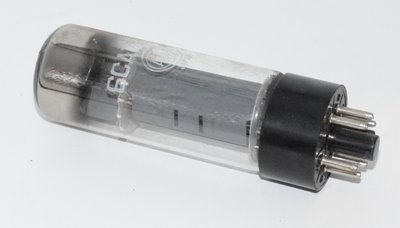
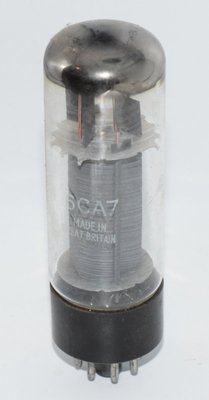
Introduction and History
The 6CA7 is a high-power beam pentode designed for audio output service, originally developed as the American RETMA designation for what is essentially the same tube as the European EL34. The tube was manufactured by several companies, with the Tung-Sol Electric Inc. datasheet dated January 1, 1960 (Plate #5722) serving as a key American reference document. The designation "6CA7" was assigned under the American numbering system, while "EL34" followed the European Mullard–Philips Pro Electron naming convention.
The history of the 6CA7/EL34 is intertwined with the golden age of high-fidelity audio. Philips/Mullard introduced the EL34 in 1953, and it quickly became one of the most important audio output tubes ever produced. The Tung-Sol datasheet describes the 6CA7 as "a power pentode of the glass octal type" suitable "for all applications which require peak powers of up to 11 watts from a single tube or up to 100 watts from two tubes in the normal push-pull arrangement." It further notes the tube is "equally suitable for domestic amplifiers and public address equipment."
What makes the 6CA7/EL34 story particularly interesting is the subtle distinction between the American and European versions. While the original EL34 was a true pentode design, some American manufacturers — notably GE and Sylvania — produced the 6CA7 as a beam tetrode with a different internal structure, though maintaining the same pinout and broadly similar operating characteristics. The Tung-Sol datasheet, however, clearly identifies the 6CA7 as a "PENTODE," aligning it with the original European EL34 pentode design. This distinction between pentode and beam tetrode versions of the 6CA7 has become a significant topic among audiophiles, as the two internal structures produce subtly different harmonic characteristics.
Notable manufacturers of the 6CA7/EL34 over the decades have included Mullard (Blackburn, UK), Philips (Eindhoven, Netherlands), Amperex, Telefunken, Siemens, Tung-Sol, GE, Sylvania, AWV (Japan), and numerous modern reissue manufacturers including JJ Electronic, Electro-Harmonix (New Sensor), Svetlana, and the revived Tung-Sol and Mullard brands.
Technical Specifications and Design
General Description
The 6CA7 is a power pentode with a coated unipotential cathode, housed in a glass bulb (T-9 envelope) with an 8-pin octal base (8ET). The tube may be operated in any mounting position and uses AC or DC heater supply.
Physical Dimensions
- Envelope: Glass bulb, T-9 shape
- Maximum diameter: 1½ inches
- Maximum seated height: 3⅞ inches
- Maximum overall height: 4⁷⁄₁₆ inches
- Base: 8-pin octal (8ET)
- Mounting: Any position
Pinout (Bottom View, 8-Pin Octal)
| Pin | Connection |
|---|---|
| 1 | No connection (key) |
| 2 | Heater (H) |
| 3 | Plate (P) |
| 4 | Grid #2 (Screen, G2) |
| 5 | Grid #1 (Control Grid, G1) |
| 6 | No connection |
| 7 | Heater (H) |
| 8 | Cathode (K) |
| Center (shell) | Grid #3 (Suppressor, G3) — internally connected or brought out |
Heater Ratings
| Parameter | Value |
|---|---|
| Heater Voltage | 6.3 V (AC or DC) |
| Heater Current | 1.5 A |
Maximum Ratings (Design Center System)
| Parameter | Value |
|---|---|
| Maximum Plate Voltage | 800 V |
| Maximum Plate Voltage Without Plate Current | 2000 V |
| Maximum Plate Dissipation | 25 W |
| Maximum Plate Dissipation Without Input Signal | 27.5 W |
| Maximum Grid #2 (Screen) Voltage | 425 V |
| Maximum Grid #2 Voltage Without Plate Current | 800 V |
| Maximum Grid #2 Dissipation | 8 W |
| Cathode Current | 150 mA |
| Maximum Grid #1 Circuit Resistance (Class A & AB) | 0.7 MΩ |
| Maximum Grid #1 Circuit Resistance (Class B) | 0.5 MΩ |
| Maximum External Resistance Between Heater and Cathode | 20,000 Ω |
| Maximum Voltage Between Heater and Cathode | 100 V |
| Maximum Grid Current Starting Point (Grid #1 voltage when Grid #1 current is 0.3 µA) | −1.3 V |
Direct Interelectrode Capacitances
| Parameter | Value |
|---|---|
| Grid #1 to all other elements except Plate | 15.5 µµF |
| Plate to all other elements except Grid #1 | 7.2 µµF |
| Plate to Grid #1 (max.) | 1.0 µµF |
| Grid #1 to Heater (max.) | 1.0 µµF |
| Heater to Cathode | 11 µµF |
Typical Operating Conditions — Class A, Single Tube (Pentode Mode)
| Parameter | Condition 1 | Condition 2 |
|---|---|---|
| Supply Voltage | 265 V | 265 V |
| Plate Voltage | 250 V | 250 V |
| Grid #2 Series Resistor | 2000 Ω | 0 Ω |
| Grid #3 Voltage | 0 V | 0 V |
| Grid #1 Bias | −14.5 V | −13.5 V |
| Plate Current | 70 mA | 100 mA |
| Grid #2 Current | 10 mA | 15 mA |
| Transconductance (gm) | 9000 µmhos | 11000 µmhos |
| Amplification Factor (Grid #2 to Grid #1) | 11 | 11 |
| Plate Resistance (rp) | 18,000 Ω | 15,000 Ω |
| Plate Load Resistance | 3000 Ω | 2000 Ω |
| Input Voltage (RMS) | 9.3 V | 8.7 V |
| Max. Signal Power Output | 8 W | 11 W |
| Total Harmonic Distortion | 10% | 10% |
| Input Voltage for 50 mW Output (RMS) | 0.65 V | 0.5 V |
Typical Operating Conditions — Triode Connection (Grid #2 Connected to Plate)
Class A, Single Tube, Supply Voltage 375 V
| Parameter | Value |
|---|---|
| Supply Voltage | 375 V |
| Grid #3 Voltage | 0 V |
| Cathode Resistor | 370 Ω |
| Load Resistance | 3000 Ω |
| Input Voltage (RMS) | 18.9 V |
| Plate Current | 70 mA |
| Max. Signal Power Output | 6 W |
| Total Harmonic Distortion | 8% |
| Input Voltage for 50 mW Output (RMS) | 1.7 V |
Class AB, Two Tubes, Supply Voltage 400 V
| Parameter | No Signal | Max. Signal |
|---|---|---|
| Supply Voltage | 400 V | 400 V |
| Grid #3 Voltage | 0 V | 0 V |
| Cathode Resistor | 220 Ω | 220 Ω |
| Load Resistance, Plate to Plate | 5000 Ω | 5000 Ω |
| Input Voltage (RMS) | 0 V | 22 V |
| Plate Current | 2×65 mA | 2×71 mA |
| Max. Signal Power Output | 0 W | 16.5 W |
| Total Harmonic Distortion | — | 3% |
Typical Operating Conditions — Class B Push-Pull (Two Tubes, Pentode Mode)
Supply Voltage 425 V
| Parameter | No Signal | Mid Drive | Max. Signal |
|---|---|---|---|
| Common Grid #2 Resistor | 1000 Ω | ||
| Grid #1 Bias | −38 V | ||
| Grid #3 Voltage | 0 V | ||
| Input Voltage (RMS) | 0 V | 27 V | 27 V |
| Load Resistance, Plate to Plate | — | 3400 Ω | 4000 Ω |
| Supply Voltage | 425 V | 425 V | 400 V |
| Plate Voltage | 420 V | 400 V | 375 V |
| Plate Current | 2×30 mA | 2×120 mA | 2×100 mA |
| Grid #2 Current | 2×4.4 mA | 2×25 mA | 2×25 mA |
| Max. Signal Power Output | 0 W | 55 W | 45 W |
| Total Harmonic Distortion | — | 5% | 6% |
Supply Voltage 375 V
| Parameter | No Signal | Mid Drive | Max. Signal |
|---|---|---|---|
| Common Grid #2 Resistor | 470 Ω | ||
| Grid #1 Bias | −32 V | ||
| Grid #3 Voltage | 0 V | ||
| Input Voltage (RMS) | 0 V | 22.7 V | 22.7 V |
| Load Resistance, Plate to Plate | — | 2800 Ω | 3800 Ω |
| Supply Voltage | 375 V | 375 V | 350 V |
| Plate Voltage | 370 V | 350 V | 325 V |
| Plate Current | 2×35 mA | 2×120 mA | 2×93 mA |
| Grid #2 Current | 2×4.7 mA | 2×25 mA | 2×25 mA |
| Max. Signal Power Output | 0 W | 44 W | 36 W |
| Total Harmonic Distortion | — | 5% | 6% |
Supply Voltage 500/400 V (Split Supply)
| Parameter | No Signal | Mid Drive | Max. Signal |
|---|---|---|---|
| Common Grid #2 Resistor | 750 Ω | ||
| Grid #1 Bias | −36 V | ||
| Grid #3 Voltage | 0 V | ||
| Input Voltage (RMS) | 0 V | 25.8 V | 25.8 V |
| Load Resistance, Plate to Plate | — | 4000 Ω | 5000 Ω |
| Plate Supply Voltage | 500 V | 500 V | 475 V |
| Plate Voltage | 495 V | 475 V | 450 V |
| Grid #2 Supply Voltage | 400 V | 400 V | 375 V |
| Plate Current | 2×30 mA | 2×125 mA | 2×10² mA |
| Grid #2 Current | 2×4 mA | 2×25 mA | 2×25 mA |
| Max. Signal Power Output | 0 W | 70 W | 58 W |
| Total Harmonic Distortion | — | 5% | 6% |
Supply Voltage 800/400 V (Split Supply)
| Parameter | No Signal | Mid Drive | Max. Signal |
|---|---|---|---|
| Common Grid #2 Resistor | 750 Ω | ||
| Grid #1 Bias | −39 V | ||
| Grid #3 Voltage | 0 V | ||
| Input Voltage (RMS) | 0 V | 23.4 V | 23.4 V |
| Load Resistance, Plate to Plate | — | 11,000 Ω | 11,000 Ω |
| Plate Supply Voltage | 800 V | 800 V | 750 V |
| Plate Voltage | 795 V | 775 V | 725 V |
| Grid #2 Supply Voltage | 400 V | 400 V | 375 V |
| Plate Current | 2×25 mA | 2×91 mA | 2×84 mA |
| Grid #2 Current | 2×3 mA | 2×19 mA | 2×19 mA |
| Max. Signal Power Output | 0 W | 100 W | 90 W |
| Total Harmonic Distortion | — | 5% | 6% |
Class AB Push-Pull (Two Tubes, Pentode Mode), Supply Voltage 375 V
| Parameter | No Signal | Max. Signal |
|---|---|---|
| Load Resistance, Plate to Plate | 3400 Ω | |
| Common Grid #2 Resistor | 470 Ω | |
| Cathode Resistor | 130 Ω | |
| Grid #3 Voltage | 0 V | |
| Input Voltage (RMS) | 0 V | 21 V |
| Supply Voltage | 375 V | 375 V |
| Plate Voltage + Voltage Across Cathode Resistor | 355 V | 350 V |
| Plate Current | 2×75 mA | 2×95 mA |
| Grid #2 Current | 2×11.5 mA | 2×22.5 mA |
| Max. Signal Power Output | 0 W | 35 W |
| Total Harmonic Distortion | — | 5% |
Key Electrical Parameters Summary
| Parameter | Value |
|---|---|
| Heater Voltage (Vh) | 6.3 V |
| Heater Current (Ih) | 1.5 A |
| Maximum Plate Voltage | 800 V |
| Maximum Screen (G2) Voltage | 425 V |
| Maximum Plate Dissipation | 25 W |
| Maximum Screen Dissipation | 8.0 W |
| Transconductance (gm) | 11,000 µmhos (at Va=250V, Vg2=250V, Vg1=−13.5V) |
| Amplification Factor (µ, G2 to G1) | 11 |
| Plate Resistance (rp) | 15,000 Ω (at Va=250V, Ia=100mA) |
| Maximum Cathode Current | 150 mA |
Applications and Usage
The 6CA7/EL34 was designed as a versatile power output tube, and the Tung-Sol datasheet demonstrates its remarkable flexibility across a wide range of operating conditions:
Single-Ended Class A Operation
In pentode mode, a single 6CA7 can deliver up to 11 watts of output power with a plate voltage of 250V, a load resistance of 2000 Ω, and 10% total harmonic distortion. With a screen series resistor of 2000 Ω, output drops to 8 watts at the same distortion level. The tube requires only 8.7V RMS of input signal to achieve full output in the higher-current condition, making it easy to drive from a single voltage amplifier stage.
Push-Pull Class B Operation
The 6CA7 truly shines in push-pull configurations. The Tung-Sol data shows a remarkable range of power output capabilities:
- 375V supply: Up to 44 watts at 5% THD (2800 Ω plate-to-plate load)
- 425V supply: Up to 55 watts at 5% THD (3400 Ω plate-to-plate load)
- 500/400V split supply: Up to 70 watts at 5% THD (4000 Ω plate-to-plate load)
- 800/400V split supply: Up to 100 watts at 5% THD (11,000 Ω plate-to-plate load)
This ability to scale from modest to very high power output made the 6CA7/EL34 ideal for everything from home hi-fi to professional PA systems and cinema sound installations.
Push-Pull Class AB Operation
For audio applications where a balance between efficiency and linearity is desired, the Class AB configuration with cathode bias is particularly attractive. With a 375V supply, common cathode resistor of 130 Ω, and 3400 Ω plate-to-plate load, two 6CA7s deliver 35 watts at 5% THD. This self-biasing arrangement simplifies the amplifier design and is the basis for many classic hi-fi amplifiers.
Triode Mode Operation
The 6CA7 can be operated in triode mode by connecting Grid #2 (screen) to the plate. In this configuration:
- Single tube, Class A: 6 watts output at 8% THD with 375V supply, 370 Ω cathode resistor, and 3000 Ω load resistance. Plate current is 70 mA.
- Two tubes, Class AB: 16.5 watts at only 3% THD with 400V supply, 220 Ω cathode resistor, and 5000 Ω plate-to-plate load.
The triode connection offers significantly lower distortion at the expense of reduced output power, making it a favorite among audiophiles who prioritize sonic purity.
Original Applications
The 6CA7/EL34 found its way into countless commercial products:
- Hi-Fi amplifiers: Dynaco Mark III, Dynaco ST-70, Leak TL25, Mullard 5-20, Quad II
- Guitar amplifiers: Marshall JTM45, Marshall Plexi, Marshall JCM800, Hiwatt DR103, Vox AC30 (some versions), Orange amplifiers, Mesa/Boogie (some models)
- Public address systems
- Cinema sound equipment
- Organ amplifiers
Sound Characteristics
The 6CA7/EL34 has a distinctive sonic signature that has made it one of the most beloved audio tubes in history. Its sound character varies significantly depending on whether it is operated in pentode, ultralinear, or triode mode, and whether the specific tube is a true pentode or beam tetrode construction.
Pentode/Ultralinear Mode
In pentode and ultralinear configurations, the 6CA7/EL34 is widely described as having a rich, warm midrange with a characteristic "woody" or "vocal" quality. The midrange emphasis is one of the tube's defining traits — it sits between the aggressive, scooped character of the 6L6/5881 family and the raw power of the KT88/6550. Key sonic attributes include:
- Midrange richness: The EL34/6CA7 is renowned for its lush, harmonically complex midrange. Frequencies in the 1–4 kHz range have a presence and warmth that gives vocals, guitars, and orchestral instruments a lifelike, three-dimensional quality.
- Smooth, singing highs: The treble response is generally described as sweet and detailed without being harsh or brittle. There is a natural roll-off at the extreme top end that many listeners find musically pleasing.
- Controlled but not overpowering bass: The low-frequency response is tight and articulate rather than massive. Compared to the 6L6 or KT88, the EL34 has somewhat less bass weight, but what it delivers is well-defined and musical.
- Harmonic structure: The true pentode versions (like the original Mullard EL34 and the Tung-Sol 6CA7 described in this datasheet) tend to produce a complex blend of even and odd harmonics. The even harmonics (2nd, 4th) contribute warmth and musicality, while the odd harmonics (3rd, 5th) add clarity and edge.
- Dynamic response: The 6CA7/EL34 has excellent dynamic range and responds well to transients. It compresses gracefully when driven hard, which is one reason it became the tube of choice for British guitar amplifiers.
Triode Mode
When operated in triode connection (screen tied to plate), the 6CA7/EL34 takes on a different character. The Tung-Sol data shows that triode-connected push-pull operation yields only 3% THD at 16.5 watts — remarkably low distortion. In triode mode, the sound becomes:
- More refined and transparent
- Lower in distortion with a predominance of even-order harmonics
- Slightly reduced in dynamic impact compared to pentode mode
- More "direct" and immediate in presentation
- Closer in character to directly heated triodes like the 300B, though with more power and drive
Pentode vs. Beam Tetrode 6CA7
An important distinction exists between the true pentode 6CA7 (as described in this Tung-Sol datasheet and the original Mullard EL34) and the beam tetrode versions produced by some American manufacturers. The beam tetrode 6CA7 (notably the fat-bottle GE/Sylvania type) tends to have a slightly different harmonic profile — often described as having more aggressive upper harmonics, greater bass punch, and a more "American" sound character. The true pentode versions are generally considered smoother and more refined in the midrange.
Overdriven Characteristics
When pushed into clipping, the 6CA7/EL34 produces a smooth, musical distortion that transitions gradually from clean to overdriven. This is in contrast to some beam tetrodes that clip more abruptly. The gradual onset of distortion, combined with the rich harmonic content, is what made the EL34 the defining sound of British rock guitar amplification.
Equivalent or Substitute Types
Direct Equivalents (Drop-in Replacements)
| Type | Notes |
|---|---|
| EL34 | The European designation for the same tube. The original Mullard/Philips EL34 is the direct equivalent of the true pentode 6CA7. Identical pinout, ratings, and characteristics. |
| EL34G | A variant designation used by some manufacturers for the EL34 in a larger glass envelope. Electrically identical, direct drop-in replacement. |
| CV1741 | The British military (CV) designation for the EL34. Identical specifications with military-grade quality control and selection. |
| EL34WXT | An enhanced version designation. Direct replacement with the same pinout and compatible ratings. |
Related Types — NOT Direct Drop-in Replacements
| Type | Notes |
|---|---|
| E34L | A higher-rated variant of the EL34 with increased plate dissipation and screen voltage ratings. Same pinout but different bias requirements. May require bias adjustment when substituting for a standard 6CA7/EL34. Not a direct drop-in without verification of operating conditions. |
| E34LS | Similar to the E34L with enhanced ratings. Same pinout but different operating parameters. Requires bias adjustment and verification before substitution. |
Important Notes on Substitution
While the 6CA7 and EL34 are generally considered interchangeable, builders and technicians should be aware of the following:
- The KT77 is sometimes mentioned as an EL34 equivalent. While it shares the same pinout and similar ratings, it is a beam tetrode rather than a pentode and has somewhat different characteristics. It can generally be used as a substitute but is not identical.
- The 6L6GC and KT88/6550 are NOT substitutes for the 6CA7/EL34. Although they are all octal-based power tubes, they have different pinouts (the 6L6 family has the suppressor grid connected differently) and significantly different bias requirements.
- When substituting any tube, always verify that the bias current is correct for the specific amplifier circuit. Even between "identical" types from different manufacturers, bias may need adjustment.
Notable Characteristics
Exceptional Versatility
The Tung-Sol datasheet reveals the extraordinary versatility of the 6CA7. Few power tubes can operate across such a wide range of conditions — from a modest 6-watt single-ended triode amplifier to a 100-watt Class B push-pull powerhouse using 800V plate supply. This versatility made it a universal choice for amplifier designers.
High Transconductance
With a transconductance of 11,000 µmhos (11 mA/V) at the typical operating point of 250V plate, 250V screen, and −13.5V grid bias, the 6CA7 is a highly sensitive tube. This high gm means it requires relatively little input signal to produce full output — only 8.7V RMS for 11 watts in Class A single-ended operation. This makes driver stage design straightforward.
Moderate Plate Resistance
The plate resistance of 15,000 Ω (at the 100 mA operating point) is moderate for a power pentode. This affects the damping factor of the amplifier and contributes to the tube's characteristic interaction with the output transformer and loudspeaker load.
Screen Grid Sensitivity
The amplification factor of 11 (Grid #2 with respect to Grid #1) indicates significant screen grid influence on plate current. The maximum screen dissipation of 8 watts requires careful attention to screen supply design, particularly in Class B operation where screen current can reach 2×25 mA. The datasheet specifies screen series resistors ranging from 470 Ω to 1000 Ω in push-pull configurations to help manage screen dissipation.
Robust Maximum Ratings
The 800V maximum plate voltage rating (with plate current flowing) and 2000V rating without plate current give designers considerable headroom. The 25-watt plate dissipation (27.5W without input signal) is generous for the tube's size and allows for conservative operating points that extend tube life.
Low Sensitivity to Milliwatt Output
An interesting specification in the Tung-Sol data is the input voltage required for 50 milliwatts of output — just 0.5V RMS in the high-current Class A condition. This indicates excellent linearity at low signal levels, which is important for high-fidelity applications where most listening occurs at a fraction of full output power.
Heater-Cathode Considerations
The maximum heater-to-cathode voltage of 100V and maximum external resistance between heater and cathode of 20,000 Ω are important design constraints. The heater-to-cathode capacitance of 11 µµF can introduce hum if the heater supply is not properly managed, particularly in single-ended designs.
Usage in the Audio Community
Hi-Fi and Audiophile Applications
The 6CA7/EL34 remains one of the most popular tubes in high-end audio. It is the output tube of choice in numerous classic and modern audiophile amplifier designs:
- Dynaco ST-70: Perhaps the most famous EL34 amplifier ever made, the ST-70 uses a pair of EL34s in push-pull ultralinear configuration to produce approximately 35 watts per channel. Hundreds of thousands were produced, and it remains a popular platform for modification and upgrading.
- Dynaco Mark III: The monoblock version, producing approximately 60 watts from a pair of EL34s.
- Leak TL25: A classic British amplifier using EL34 output tubes.
- Mullard 5-20: The reference amplifier design published by Mullard specifically to showcase the EL34.
- Modern designs: Companies like PrimaLuna, Line Magnetic, Cayin, Cary Audio, Audio Research (some models), Manley Labs, and many boutique builders continue to design amplifiers around the EL34/6CA7.
Guitar Amplifier Applications
The EL34/6CA7 is arguably the most important tube in the history of rock guitar amplification:
- Marshall amplifiers: The EL34 is the signature tube of Marshall amplifiers, defining the "British" guitar tone. From the JTM45 through the Plexi, JMP, and JCM800 series, the EL34 has been central to the Marshall sound. Players from Jimi Hendrix to Slash to virtually every classic rock guitarist have relied on EL34-powered Marshalls.
- Hiwatt: The DR103 and other Hiwatt models use EL34s to produce their characteristically clean, powerful tone favored by Pete Townshend and David Gilmour.
- Orange: Many Orange amplifier models use EL34 output tubes.
- Mesa/Boogie: Some Mesa models offer EL34 as an option alongside 6L6 tubes.
- Boutique builders: Friedman, Bogner, Diezel, and many other high-end guitar amplifier manufacturers build their flagship models around EL34 tubes.
Vintage Tube Collecting
The 6CA7/EL34 is one of the most actively collected and traded vintage tubes. Particularly sought-after examples include:
- Mullard EL34 (Blackburn factory): The original Mullard EL34s from the Blackburn, UK factory are considered the gold standard. Early production examples (1950s–early 1960s) with specific construction features command premium prices. As noted in the reference data, a 1961 Blackburn factory EL34 that tests "almost as new" is a highly desirable find.
- Telefunken EL34: German-made examples with the distinctive diamond-bottom logo are extremely rare and valuable.
- Amperex EL34: Bugle Boy and other Amperex-branded EL34s, often made at the Mullard Blackburn factory or the Philips Heerlen plant.
- Siemens EL34: German-made tubes with excellent construction quality.
- GE/Sylvania 6CA7: The American beam tetrode versions in the distinctive fat-bottle envelope are collected both for their unique sound and their historical significance.
- Tung-Sol 6CA7: Original Tung-Sol production from the Bloomfield, New Jersey factory.
- AWV (Japan) 6CA7: Japanese-made examples that are less common but sought after by collectors.
Modern Production and Reissues
The continuing demand for EL34/6CA7 tubes has led to robust modern production:
- JJ Electronic (Slovakia): Produces both the EL34 (pentode) and E34L (enhanced rating pentode). The JJ EL34 is one of the most widely used current-production tubes.
- Electro-Harmonix / New Sensor (Russia): Produces the EL34 under multiple brand names including Electro-Harmonix, Sovtek, Svetlana, Tung-Sol (reissue), Mullard (reissue), and Gold Lion (reissue).
- Shuguang / Psvane (China): Chinese manufacturers produce various grades of EL34, from budget tubes to premium "treasure" series.
- TAD (Tube Amp Doctor): Selects and brands EL34s for guitar amplifier use.
Amplifier Design Considerations for Audio Use
Audio designers working with the 6CA7/EL34 should note several practical considerations from the Tung-Sol data:
- Output transformer selection: The optimal plate-to-plate load impedance varies significantly with operating mode — from 2800 Ω in Class B at 375V to 11,000 Ω in Class B at 800/400V. For typical hi-fi Class AB operation, 3400 Ω plate-to-plate is specified.
- Bias stability: The tube's high transconductance means that small changes in bias voltage produce significant changes in plate current. Careful bias design is essential, whether using fixed bias or cathode bias.
- Screen supply design: The 8-watt screen dissipation limit requires attention, particularly in Class B where screen current can be substantial. Screen series resistors (470–1000 Ω as shown in the datasheet) help protect the screen grid.
- Ultralinear operation: While not explicitly covered in the Tung-Sol datasheet, the 6CA7/EL34 is widely used in ultralinear configuration (screen connected to a tap on the output transformer primary, typically at 40–43% of the total winding). This provides a compromise between pentode power and triode linearity that many audiophiles consider the ideal operating mode.
- Sensitivity: The input voltage for 50 mW output (0.5V RMS) confirms that the 6CA7 has excellent small-signal linearity, important for high-fidelity reproduction at typical listening levels.
The Enduring Legacy
More than six decades after its introduction, the 6CA7/EL34 remains in continuous production and active use. Its combination of musical warmth, dynamic responsiveness, and versatile power output has ensured its place as one of the most important vacuum tubes ever designed. Whether in a vintage Dynaco ST-70 playing jazz, a Marshall stack driving a stadium rock concert, or a modern boutique amplifier in a high-end listening room, the 6CA7/EL34 continues to define what many listeners consider the ideal sound of amplified music.