Introduction and History
The 6CG7 is a miniature medium-mu twin triode vacuum tube designed for general-purpose amplifier and oscillator applications. Introduced in the mid-1950s by General Electric (documented in GE datasheet ET-T941B, dated November 1956), the 6CG7 was developed as a direct miniature replacement for the popular octal-based 6SN7-GTB. The tube was specifically engineered for use in television receivers, where it served as a vertical-deflection oscillator and horizontal-deflection oscillator, but its versatile characteristics also made it suitable for resistance-coupled amplifiers, phase inverters, and multivibrators.
The 6CG7 features a controlled heater-warm-up characteristic, making it especially well-suited for television receivers employing series-connected heaters — a common design practice in AC/DC television sets of the era. Its 8CG7 variant is electrically identical except for heater ratings (8.4 volts at 0.45 amperes versus 6.3 volts at 0.6 amperes for the 6CG7), allowing use in different series heater string configurations.
As the vacuum tube era transitioned into the solid-state age, the 6CG7 found a second life in the high-fidelity audio community. Its electrical equivalence to the revered 6SN7 — combined with its compact noval (9-pin miniature) package — made it an attractive choice for designers seeking the sonic qualities of the 6SN7 in a smaller, more modern form factor. Today, the 6CG7 remains a sought-after tube among audiophiles and is actively used in both vintage and modern tube amplifier designs.
Technical Specifications and Design
General Electrical Data
| Parameter | 6CG7 | 8CG7 |
|---|---|---|
| Cathode Type | Coated Unipotential | |
| Heater Voltage (AC or DC) | 6.3 V | 8.4 V |
| Heater Current | 0.6 A | 0.45 A |
| Heater Warm-up Time | 11 seconds | 11 seconds |
Direct Interelectrode Capacitances (Approximate, Each Section)
| Parameter | Value |
|---|---|
| Grid to Plate (Cga) | 4.0 pF |
| Input (Cgk) | 2.3 pF |
| Output (Cak) | 2.2 pF |
Note: Capacitance values are without external shield.
Maximum Ratings — Design-Center Values, Each Section
Class A₁ Amplifier Service
| Parameter | Value |
|---|---|
| DC Plate Voltage | 300 V |
| Positive DC Grid Voltage | 0 V |
| Plate Dissipation, Each Plate | 3.5 W |
| Total Plate Dissipation, Both Plates | 5.0 W |
| DC Cathode Current | 20 mA |
| Heater-Cathode Voltage (Htr Positive, DC Component) | 100 V |
| Heater-Cathode Voltage (Htr Positive, Total DC and Peak) | 200 V |
| Heater-Cathode Voltage (Htr Negative, Total DC and Peak) | 200 V |
| Grid Circuit Resistance (Fixed Bias) | 1.0 MΩ |
Vertical-Oscillator Service
| Parameter | Value |
|---|---|
| DC Plate Voltage | 300 V |
| Peak Negative Grid Voltage | 400 V |
| Plate Dissipation, Each Plate | 3.5 W |
| Total Plate Dissipation, Both Plates | 5.0 W |
| DC Cathode Current | 20 mA |
| Peak Cathode Current | 70 mA |
| Grid Circuit Resistance (Fixed or Cathode Bias) | 2.2 MΩ |
Horizontal-Oscillator Service
| Parameter | Value |
|---|---|
| DC Plate Voltage | 300 V |
| Peak Negative Grid Voltage | 600 V |
| Plate Dissipation, Each Plate | 3.5 W |
| Total Plate Dissipation, Both Plates | 5.0 W |
| DC Cathode Current | 20 mA |
| Peak Cathode Current | 300 mA |
| Grid Circuit Resistance (Fixed or Cathode Bias) | 2.2 MΩ |
Note on Maximum Plate Dissipation: The GE datasheet specifies 3.5 W per plate and 5.0 W total for both plates. The TDSL reference data notes a maximum of 4.0 W per section with 5.7 W for both sections. Designers should consult the specific manufacturer's datasheet for the tubes they are using, as ratings may vary slightly between manufacturers. The more conservative GE ratings of 3.5 W per plate and 5.0 W total are recommended for reliable long-term operation.
Characteristics and Typical Operation — Class A₁ Amplifier, Each Section
| Parameter | Condition 1 | Condition 2 | Condition 3 |
|---|---|---|---|
| Plate Voltage | 90 V | 250 V | 250 V |
| Grid Voltage | 0 V | −12.5 V | −8.0 V |
| Amplification Factor (μ) | 20 | — | 20 |
| Plate Resistance (rp) | ≈6,700 Ω | — | 7,700 Ω |
| Transconductance (gm) | ≈3,000 µmhos (3.0 mA/V) | — | 2,600 µmhos (2.6 mA/V) |
| Plate Current | 10 mA | 1.3 mA | 9.0 mA |
| Grid Voltage (approx.) at Ib = 10 µA | −7 V | — | −18 V |
Mechanical Specifications
| Parameter | Value |
|---|---|
| Mounting Position | Any |
| Envelope | T-6½, Glass |
| Base | E9-1, Small Button 9-Pin (Noval / B9A) |
| Maximum Overall Length | 2⅝ inches |
| Maximum Seated Height | 2⅜ inches |
| Maximum Diameter | ⅞ inch |
| Outline | RETMA 6-3 |
Pin Connections (RETMA 9AJ Base)
| Pin | Connection |
|---|---|
| Pin 1 | Plate (Section 2) |
| Pin 2 | Grid (Section 2) |
| Pin 3 | Cathode (Section 2) |
| Pin 4 | Heater |
| Pin 5 | Heater |
| Pin 6 | Plate (Section 1) |
| Pin 7 | Grid (Section 1) |
| Pin 8 | Cathode (Section 1) |
| Pin 9 | Internal Shield |
The internal shield (pin 9) should typically be connected to ground or the cathode circuit to minimize crosstalk between the two triode sections.
Applications and Usage
The 6CG7 was originally designed for television receiver applications, where its two independent triode sections could serve multiple functions within a single envelope:
- Vertical-Deflection Oscillator: One of the primary intended applications, where the tube generates the sawtooth waveform needed to drive the vertical deflection yoke in CRT television sets.
- Horizontal-Deflection Oscillator: The tube's ability to handle high peak cathode currents (up to 300 mA in horizontal oscillator service) made it suitable for generating the horizontal sweep signal.
- Resistance-Coupled Amplifier: The GE datasheet provides extensive design tables for Class A resistance-coupled amplifier configurations at supply voltages of 90, 180, and 300 volts, with both low-impedance (approximately 200 ohms) and high-impedance (approximately 100K ohms) drive conditions. Typical voltage gains of 14–17 are achievable depending on operating conditions and load resistances.
- Phase Inverter: The matched dual-triode construction makes the 6CG7 well-suited for split-load (cathodyne) and long-tailed pair phase inverter/phase splitter circuits, which are essential in push-pull amplifier designs.
- Multivibrator: The two triode sections can be cross-coupled to form free-running, monostable, or bistable multivibrator circuits.
In modern usage, the 6CG7 has found widespread application in high-fidelity audio equipment, including preamplifiers, line stages, headphone amplifiers, and as driver/phase-splitter stages in power amplifiers. Its medium-mu characteristic (μ = 20) and moderate plate resistance make it versatile for a wide range of audio circuit topologies.
Sound Characteristics
The 6CG7 is widely regarded in the audiophile community as possessing sonic characteristics that are essentially identical to those of the 6SN7 — which is often considered one of the finest-sounding dual triodes ever produced. The tube's sound signature is frequently described in the following terms:
- Warm and Musical: The 6CG7 delivers the classic medium-mu triode warmth that audiophiles prize. It imparts a gentle, natural richness to the midrange without excessive coloration, making vocals and acoustic instruments sound lifelike and engaging.
- Smooth and Refined Highs: The treble response is typically described as smooth, extended, and free of harshness. Unlike some higher-mu miniature triodes (such as the 12AX7 or 12AU7), the 6CG7 tends to present high frequencies with a natural, unhurried quality that avoids listener fatigue.
- Solid Bass Foundation: With its relatively low plate resistance (approximately 6,700–7,700 ohms) and good current capability, the 6CG7 provides a firm, well-controlled bass response. The low-end is typically described as having good weight and definition without being bloated or loose.
- Wide, Three-Dimensional Soundstage: When used in line-stage and preamplifier applications, the 6CG7 is noted for presenting a spacious, well-defined soundstage with good depth and imaging. The internal shield (pin 9) helps maintain separation between the two triode sections, contributing to clean stereo imaging when each section handles one channel.
- Dynamic and Transparent: The tube's moderate amplification factor of 20 and good transconductance (2,600–3,000 µmhos) provide a favorable balance between gain and linearity. This results in a presentation that is dynamic and transparent, with low distortion characteristics that allow the source material to shine through with minimal editorializing.
- Harmonic Structure: Like other medium-mu triodes, the 6CG7 produces predominantly second-harmonic distortion when overdriven, which is perceived as musically pleasant. At normal operating levels, distortion is very low, contributing to the tube's reputation for clarity and naturalness.
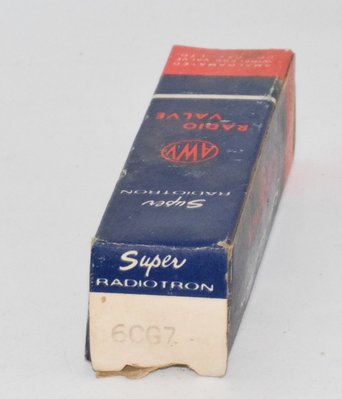
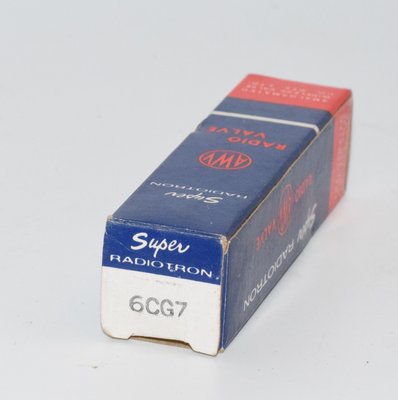
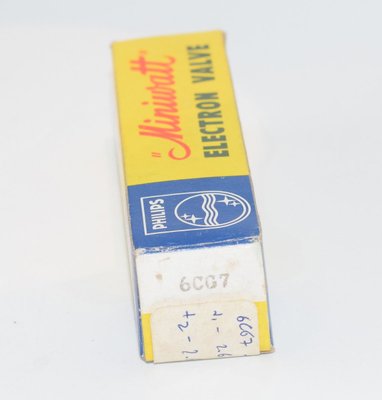
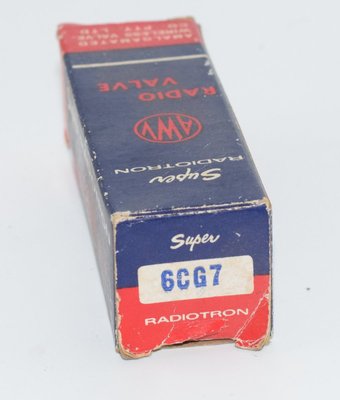
The sonic character can vary somewhat between manufacturers. NOS (New Old Stock) examples from manufacturers such as GE, RCA, Sylvania, Philips Miniwatt, and AWV Super Radiotron are each said to have subtle sonic differences, with some brands being more sought-after than others. Generally, the Philips Miniwatt and Sylvania variants are considered among the most desirable for audio applications.
Equivalent or Substitute Types
The 6CG7 has several direct equivalents and near-equivalents that can be used as substitutes in most circuits:
| Type | Relationship | Notes |
|---|---|---|
| 6FQ7 | Direct equivalent | The 6FQ7 is the most common substitute and is considered fully interchangeable with the 6CG7 in all applications. The two type numbers are often listed together as "6CG7/6FQ7." |
| 8CG7 | Electrically identical, different heater | Heater rated at 8.4 V / 0.45 A instead of 6.3 V / 0.6 A. Not a drop-in replacement unless the heater supply is adjusted accordingly. Intended for different series heater string configurations. |
| 6SN7-GTB | Electrical equivalent, different base | The 6CG7 is described by GE as "electrically equivalent" to the 6SN7-GTB. However, the 6SN7 uses an octal (8-pin) base while the 6CG7 uses a noval (9-pin) base, so they are not physically interchangeable without an adapter. The 6CG7 also includes an internal shield (pin 9) not present in the 6SN7. |
| 6SN7-GT / 6SN7-GTA | Near-equivalent, different base | Earlier versions of the 6SN7 family. Electrically very similar but may have slightly different maximum ratings. Same base incompatibility as the 6SN7-GTB. |
Important Note: While the 6CG7 and 6SN7 families are electrically equivalent, they are not pin-compatible. The 6SN7 uses an octal base with a different pin assignment. Socket adapters are available commercially for those wishing to use a 6CG7 in a 6SN7 socket or vice versa, but care must be taken to ensure proper wiring. The 12AU7 (ECC82) is sometimes mentioned as a possible substitute due to its similar dual-triode configuration and noval base, but it has significantly different electrical characteristics (higher mu of approximately 17–20 but different plate resistance and transconductance curves) and is generally not recommended as a direct substitute without circuit modifications.
Notable Characteristics
- Controlled Heater Warm-up: The 6CG7 features a controlled heater warm-up time of 11 seconds, defined as the time required for the voltage across the heater to reach 80 percent of its rated value after applying 4 times the rated heater voltage to a circuit consisting of the tube heater in series with a resistance equal to 3 times the rated heater voltage divided by the rated heater current. This characteristic is critical for series-connected heater strings in AC/DC equipment, preventing excessive voltage across cold heaters during the warm-up period.
- Internal Shield: The inclusion of an internal shield connected to pin 9 provides improved isolation between the two triode sections. This is particularly beneficial in audio applications where one section may be used for each stereo channel, or where one section serves as a gain stage and the other as a phase inverter.
- Miniature Envelope: The T-6½ glass envelope is significantly smaller than the octal 6SN7's envelope, allowing more compact equipment designs while maintaining equivalent electrical performance.
- Versatile Operating Range: The datasheet provides operating data across a wide range of supply voltages (90V to 300V), making the 6CG7 adaptable to many different circuit designs and power supply configurations.
- Good Linearity: The average plate characteristics curves show well-spaced, evenly distributed grid voltage lines, indicating good linearity across the operating range — a desirable trait for low-distortion audio amplification.
- Robust Construction: The 6CG7 can handle peak cathode currents of up to 300 mA in horizontal oscillator service, demonstrating a robust cathode structure that contributes to long service life even in demanding applications.
- Dual-Section Flexibility: The two independent triode sections with separate cathodes allow for a wide variety of circuit configurations: cascaded gain stages, differential amplifiers, cascode circuits, SRPP (Shunt-Regulated Push-Pull) stages, and mu-follower configurations.
Usage in the Audio Community
The 6CG7 (and its equivalent 6FQ7) has earned a devoted following in the audio community, valued for its combination of excellent sonic qualities, compact size, and relative availability compared to some increasingly scarce octal types.
Preamplifiers and Line Stages
The 6CG7 is widely used in tube preamplifier and line-stage designs. Its medium amplification factor of 20 provides sufficient gain for most line-level applications without the excess gain (and associated noise) of higher-mu types like the 12AX7. The two triode sections are commonly configured as one gain stage per channel in stereo preamplifiers, or as a gain stage followed by a cathode follower output buffer for low output impedance. The SRPP (Shunt-Regulated Push-Pull) topology is particularly popular with the 6CG7, as the matched sections within a single envelope simplify the design and provide excellent performance.
Headphone Amplifiers
The 6CG7's relatively low plate resistance and good current capability make it an excellent candidate for headphone amplifier designs. It can drive headphones with impedances ranging from moderate to high with good authority. Several commercial and DIY headphone amplifier designs feature the 6CG7 as the primary amplification element, often in configurations such as the White cathode follower or SRPP.
Driver and Phase Splitter Stages
In push-pull power amplifier designs, the 6CG7 serves admirably as a driver and phase splitter. The long-tailed pair (differential) configuration is especially popular, where the two triode sections provide balanced drive signals to push-pull output stages using tubes such as the EL34, 6L6, KT88, or 300B. The internal shield helps maintain good balance and low crosstalk between the two halves of the phase splitter.
Buffer Stages
Cathode follower configurations using the 6CG7 are employed as buffer stages between source components and power amplifiers, or between high-impedance tube stages and low-impedance loads. The tube's characteristics provide unity gain with low output impedance and excellent transient response.
DAC Output Stages
Modern hybrid audio designs sometimes employ the 6CG7 as an analog output stage following a digital-to-analog converter, adding the tube's characteristic warmth and dimensionality to the digital signal path while providing a low-impedance output suitable for driving interconnect cables and downstream equipment.
Commercial and DIY Popularity
Several well-known commercial amplifier manufacturers have used the 6CG7/6FQ7 in their designs, and it remains a staple of the DIY tube audio community. Its noval base makes it compatible with widely available and inexpensive 9-pin miniature sockets, and its moderate heater current draw (0.6 A at 6.3 V) simplifies power supply design. The extensive Class A resistance-coupled amplifier design tables provided in the original GE datasheet — covering multiple supply voltages, load resistances, and drive impedances — remain valuable references for modern audio circuit designers.
Tube Rolling
The 6CG7/6FQ7 is a popular tube for "tube rolling" — the practice of swapping different brands and vintages of the same tube type to explore subtle sonic differences. NOS examples from manufacturers including GE, RCA, Sylvania, Raytheon, Tung-Sol, Philips Miniwatt, and AWV Super Radiotron are actively traded among enthusiasts. Different construction techniques, plate materials, and internal geometries between manufacturers contribute to audible differences that dedicated listeners enjoy exploring. The availability of the 6CG7 from multiple manufacturers and eras provides a rich landscape for tube rolling experimentation.
Availability and Pricing
While no longer in mass production, the 6CG7/6FQ7 remains reasonably available as NOS (New Old Stock) from various sources. It was produced in very large quantities during the television era, ensuring a healthy supply that has kept prices moderate compared to some rarer audio tube types. This accessibility, combined with its excellent sonic performance, makes the 6CG7 an attractive choice for both budget-conscious builders and discerning audiophiles seeking high-quality tube sound without the premium pricing associated with some boutique tube types.