1. Introduction and History
The 6CM8 is a miniature 9-pin (noval) compound vacuum tube containing a high-mu triode and a sharp cut-off pentode within a single T-6½ glass envelope. Developed in the mid-1950s by American manufacturers including Sylvania Electric Products (Emporium, Pennsylvania), the 6CM8 was designed primarily for television receiver applications. The Sylvania Engineering Data Service bulletin for the 6CM8/5CM8 was published in April 1957, placing its commercial introduction squarely in the golden age of American television tube development.
The tube was conceived as a multi-function device: the pentode section could serve as an IF amplifier, video amplifier, or AGC amplifier, while the high-mu triode section could be used for a variety of voltage amplification and control functions. This combination of two useful sections in a single envelope reduced chassis space, socket count, and overall receiver cost — critical factors in the competitive consumer electronics market of the era.
The 5CM8 is the series-heater equivalent of the 6CM8, identical in all respects except for heater characteristics. The 5CM8 was designed for use in series-string heater television receivers where all tube heaters are connected in series across the AC mains. Both types employ controlled heater warm-up time (11 seconds) to ensure uniform warm-up in series heater string applications.
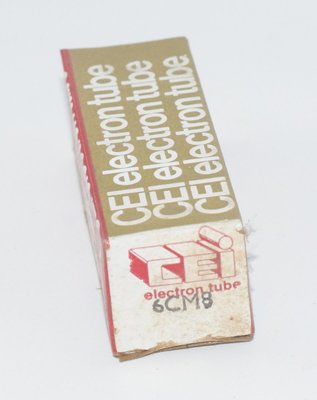
The tube was manufactured by Sylvania, CEI (USA), and other producers. It carries the military/CV designation CV9837 in British nomenclature.
2. Technical Specifications and Design
2.1 Mechanical Data
| Parameter | Value |
|---|---|
| Bulb / Envelope | T-6½ |
| Base | E9-1, Small Button 9-Pin (Noval / B9A) |
| Basing Designation | 9FZ |
| Outline | 6-2 |
| Cathode | Coated Unipotential |
| Mounting Position | Any |
| Maximum Overall Length | 1-15/16" (approx. 49 mm) |
| Maximum Seated Height | 1-21/32" (approx. 42 mm) |
| Maximum Diameter | 7/8" (approx. 22 mm) |
2.2 Heater Characteristics
| Parameter | 5CM8 | 6CM8 |
|---|---|---|
| Heater Voltage | 4.7 V | 6.3 V |
| Heater Current | 600 mA | 450 mA |
| Heater Warm-up Time | 11 seconds | 11 seconds |
| Heater-Cathode Voltage (Heater Negative w.r.t. Cathode) — Total DC and Peak | 200 V Max. | 200 V Max. |
| Heater-Cathode Voltage (Heater Positive w.r.t. Cathode) — DC | 100 V Max. | 100 V Max. |
| Heater-Cathode Voltage (Heater Positive w.r.t. Cathode) — Total DC and Peak | 200 V Max. | 200 V Max. |
2.3 Maximum Ratings (Design Center Values)
| Parameter | Triode Section | Pentode Section |
|---|---|---|
| Plate Voltage | 300 V Max. | 300 V Max. |
| Grid No. 2 (Screen) Supply Voltage | — | 300 V Max. |
| Grid No. 2 (Screen) Voltage | — | See Rating Chart |
| Positive Grid No. 1 Voltage | 0 V Max. | 0 V Max. |
| Plate Dissipation | 1.0 W Max. | 2.0 W Max. |
| Grid No. 2 Dissipation | — | 0.5 W Max. |
| Grid No. 1 Circuit Resistance (Self Bias) | 1.0 Megohm Max. | |
| Grid No. 1 Circuit Resistance (Fixed Bias) | 0.25 Megohm Max. | |
2.4 Characteristics — Class A₁ Amplifier
Triode Section
| Parameter | Value |
|---|---|
| Plate Supply Voltage | 250 V |
| Grid No. 1 Voltage | −2 V |
| Plate Current | 1.8 mA |
| Amplification Factor (μ) | 100 (approx.) |
| Plate Resistance (rp) | 50,000 Ω (approx.) |
| Transconductance (gm) | 2,000 μmhos |
Pentode Section
| Parameter | Value |
|---|---|
| Plate Supply Voltage | 200 V |
| Grid No. 2 (Screen) Voltage | 150 V |
| Grid No. 1 Voltage | 0 V |
| Cathode Bias Resistor | 180 Ω |
| Plate Current | 9.5 mA |
| Grid No. 2 (Screen) Current | 2.8 mA |
| Plate Resistance (rp) | 600,000 Ω (approx.) |
| Transconductance (gm) | 6,200 μmhos |
| Grid No. 1 Voltage for Ib = 10 μA (approx.) | −8 V |
2.5 Direct Interelectrode Capacitances (Approximate)
Triode Section
| Capacitance | Value |
|---|---|
| Grid to Plate (Cgp) | 1.9 μμF |
| Input: g to (h + k) | 1.6 μμF |
| Output: p to (h + k) | 0.22 μμF |
Pentode Section
| Capacitance | Value |
|---|---|
| Grid No. 1 to Plate (Cg1p) | 0.02 μμF Max. |
| Input: g1 to (h+k+g2+g3+I.S.) | 6.0 μμF Max. |
| Output: p to (h+k+g2+g3+I.S.) | 2.6 μμF |
Coupling Capacitances
| Capacitance | Value |
|---|---|
| Pentode Plate to Triode Grid | 0.01 μμF Max. |
| Pentode Grid No. 1 to Triode Plate | 0.15 μμF Max. |
| Pentode Plate to Triode Plate | 0.10 μμF Max. |
2.6 Pin Configuration (9FZ Basing)
The 6CM8 uses the 9FZ basing arrangement on a standard 9-pin noval (B9A) base. Viewed from the bottom of the socket (pin side):
| Pin | Connection |
|---|---|
| Pin 1 | Pentode Plate (p) |
| Pin 2 | Pentode Grid No. 1 (G1) |
| Pin 3 | Pentode Grid No. 3 / Internal Shield (G3/IS) |
| Pin 4 | Heater (H) |
| Pin 5 | Heater (H) |
| Pin 6 | Triode Plate (P) |
| Pin 7 | Pentode Grid No. 2 / Screen (G2) |
| Pin 8 | Cathode (K) — common to both sections |
| Pin 9 | Triode Grid (G) |
Note: The cathode is common (unipotential) to both the triode and pentode sections. Pin 3 (Grid No. 3 / Internal Shield) is typically connected to cathode.
3. Applications and Usage
The 6CM8 was designed as a versatile compound tube for television receiver circuits. Its original intended applications included:
- IF Amplifier: The sharp cut-off pentode section, with its high transconductance of 6,200 μmhos and very low grid-to-plate capacitance (0.02 μμF max.), made it well-suited for intermediate frequency amplification stages in television receivers.
- Video Amplifier: The pentode section's high gm and moderate plate resistance allowed it to serve as a wideband video amplifier with good gain characteristics.
- AGC (Automatic Gain Control) Amplifier: The pentode's sharp cut-off characteristic made it suitable for AGC keying and amplification circuits, where precise control of gain was required.
- Reactance Tube: The triode section, with its high amplification factor of 100 and moderate plate resistance of 50 kΩ, could be employed as a reactance tube for AFC (Automatic Frequency Control) circuits in television receivers.
- General Voltage Amplification: The high-mu triode section provided useful voltage gain for various signal processing stages within the receiver.
The combination of a high-mu triode and a sharp cut-off pentode in a single envelope was particularly economical for television manufacturers, as it allowed two circuit functions to share a single socket, heater supply connection, and physical mounting space. The controlled warm-up time of 11 seconds was essential for reliable operation in series-string heater configurations common in AC/DC television receivers of the era.
4. Sound Characteristics
The 6CM8 was not originally designed as an audio tube, but its electrical characteristics give it distinctive sonic properties when pressed into audio service:
Triode Section
The high-mu triode section (μ = 100, rp = 50 kΩ, gm = 2,000 μmhos) has characteristics somewhat reminiscent of the 12AX7's individual triode sections, though with lower current capability (1.8 mA typical plate current). In audio voltage amplifier stages, this section tends to produce:
- Smooth, refined midrange: The high amplification factor and moderate transconductance contribute to a detailed yet non-aggressive midrange presentation. The triode's plate curves show good linearity in the operating region, which translates to low harmonic distortion at moderate signal levels.
- Warm harmonic overtones: When driven into mild non-linearity, the triode section generates predominantly even-order harmonics (primarily second harmonic), which are perceived as musical warmth and richness rather than harshness.
- Delicate, airy top end: The relatively low interelectrode capacitances (Cgp = 1.9 μμF) help preserve high-frequency detail, giving the triode section a somewhat open and extended treble character.
- Limited dynamic headroom: With only 1.0 W maximum plate dissipation and low operating currents, the triode section clips relatively early, producing a soft, compressed character at higher signal levels that some describe as "intimate" or "small-scale."
Pentode Section
The sharp cut-off pentode section (gm = 6,200 μmhos, rp = 600 kΩ) offers a different sonic character:
- High gain with edge: The pentode's high transconductance delivers substantial voltage gain, and when used in audio circuits, it can produce a more forward, present sound compared to triode-connected alternatives.
- Richer harmonic spectrum: Pentode operation generates a more complex mix of harmonics including odd-order components, which can add bite and presence to the sound — useful for guitar amplifier applications where tonal complexity is desired.
- Triode-strapped operation: When the pentode section is connected as a triode (screen tied to plate), the sonic character softens considerably, approaching a warmer, more rounded presentation with reduced gain but improved linearity.
Overall, the 6CM8 is described by those who have experimented with it as having a characteristically "vintage American" sound — slightly warm, with good detail retrieval but without the aggressive brightness sometimes associated with higher-gm frame-grid pentodes. The tube's relatively modest power handling gives it a delicate, nuanced quality that works well in low-power applications.
5. Equivalent or Substitute Types
| Type | Relationship | Notes |
|---|---|---|
| CV9837 | Direct equivalent | British military designation for the 6CM8. Fully interchangeable — identical pinout, ratings, and characteristics. |
| 5CM8 | Series-heater variant | Identical to the 6CM8 in all respects except heater characteristics: 4.7 V at 600 mA instead of 6.3 V at 450 mA. Electrically interchangeable in all other parameters. Not a drop-in replacement unless the heater supply is adjusted accordingly. |
Note: The 6CM8 does not have a widely recognized European equivalent. While some compound triode-pentode types (such as the ECF80/6BL8 or ECF82/6U8) share the general concept of a triode-pentode combination in a noval envelope, they differ significantly in electrical characteristics and pinout and are not interchangeable with the 6CM8. Any substitution beyond the CV9837 and 5CM8 should be verified carefully against the specific circuit requirements.
6. Notable Characteristics
- Compound tube design: The 6CM8 combines a high-mu triode (μ = 100) and a sharp cut-off pentode in a single compact T-6½ envelope, sharing a common unipotential cathode. This makes it a versatile building block for multi-function circuits.
- Sharp cut-off pentode: Unlike remote cut-off (variable-mu) pentodes, the 6CM8's pentode section has a sharp cut-off characteristic, reaching Ib = 10 μA at approximately −8 V on Grid No. 1. This makes it suitable for switching, gating, and applications requiring a well-defined pinch-off point.
- High pentode transconductance: At 6,200 μmhos, the pentode section offers excellent gain capability for its size and power rating, making it efficient in IF and video amplifier applications.
- Exceptionally low coupling capacitances: The inter-section coupling capacitances are remarkably low — pentode plate to triode grid is only 0.01 μμF maximum, and pentode plate to triode plate is 0.10 μμF maximum. This excellent internal shielding minimizes unwanted interaction between the two sections when used in different circuit functions.
- Controlled warm-up time: Both the 5CM8 and 6CM8 feature a controlled 11-second heater warm-up time, essential for reliable operation in series-string heater configurations where all tubes must reach operating temperature at approximately the same rate to prevent excessive heater voltage on fast-warming tubes.
- High-mu triode section: With an amplification factor of 100, the triode section provides substantial voltage gain. The plate resistance of 50 kΩ is moderate, allowing reasonable voltage swing capability despite the relatively low plate current of 1.8 mA.
- Versatile mounting: The tube may be operated in any mounting position, providing design flexibility.
- Low pentode grid-to-plate capacitance: At only 0.02 μμF maximum, the pentode section's feedback capacitance is extremely low, enabling stable high-frequency operation without neutralization in most IF amplifier circuits.
7. Usage in the Audio Community
The 6CM8 occupies an interesting niche in the audio community. While it was never designed as an audio tube, its compound triode-pentode structure and the ready availability of NOS (New Old Stock) examples at reasonable prices have attracted the attention of DIY audio enthusiasts and experimental amplifier builders.
Preamplifier and Line Stage Applications
The most natural audio application for the 6CM8 is as a preamplifier or line-stage amplifier. The high-mu triode section (μ = 100) can serve as a voltage amplifier stage with characteristics broadly similar to half of a 12AX7, while the pentode section can provide additional gain or serve as a second amplification stage. Some builders have used both sections in cascade within a single tube envelope to create a complete two-stage preamplifier from a single tube — an elegant and space-efficient approach.
Phono Stage Use
The triode section's high gain makes it potentially suitable for phono preamplifier stages, particularly for moving-magnet cartridges. The pentode section, with its high transconductance of 6,200 μmhos, can provide the additional gain needed for RIAA equalization networks. However, the relatively low plate dissipation limits (1.0 W triode, 2.0 W pentode) must be respected in the design.
Guitar Amplifier Experimentation
Some guitar amplifier builders have experimented with the 6CM8 in preamp stages, attracted by the ability to get two different tonal characters from a single tube. The triode section provides clean, high-gain amplification, while the pentode section (either in pentode or triode-strapped mode) offers a different harmonic texture. This allows creative circuit topologies where the two sections are used for different channels or cascaded for high-gain lead tones.
Headphone Amplifiers
The 6CM8's modest power capabilities actually make it well-suited for headphone amplifier designs. The pentode section, with 2.0 W maximum plate dissipation and 9.5 mA typical plate current, can drive headphones directly through an output transformer or serve as a driver stage. Several DIY headphone amplifier designs have appeared on audio forums utilizing the 6CM8.
Availability and Collectibility
The 6CM8 remains relatively available as NOS stock from manufacturers including Sylvania, CEI, and others. Because it was primarily a television tube and has not achieved the cult status of types like the 12AX7 or 6SN7, prices remain moderate compared to more sought-after audio tubes. This makes it an attractive option for experimenters and budget-conscious builders. NOS examples from Sylvania are generally considered to be of high quality, with good consistency between samples.
Community Perspective
Within the audio DIY community, the 6CM8 is regarded as a "sleeper" tube — not widely known but capable of surprisingly good performance in well-designed circuits. Its compound nature appeals to minimalist designers who appreciate the elegance of achieving multiple circuit functions from a single envelope. The tube is particularly popular among builders who enjoy exploring lesser-known tube types and discovering their unique sonic signatures, rather than following the well-trodden paths of more conventional audio tube choices.
The main limitations noted by audio experimenters are the relatively low plate dissipation of the triode section (1.0 W) and the modest plate current capability, which restrict its use to small-signal applications. For power amplification, other tube types are more appropriate. However, as a preamplifier and driver tube, the 6CM8 has earned a small but dedicated following among those who have taken the time to explore its capabilities.