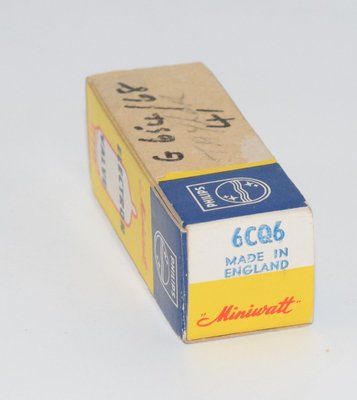
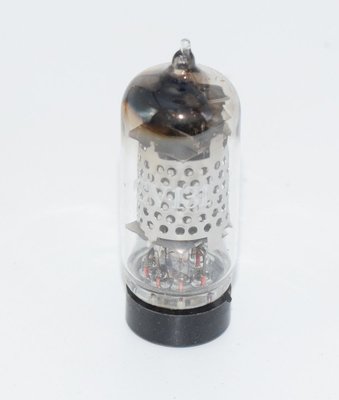
1. Introduction and History
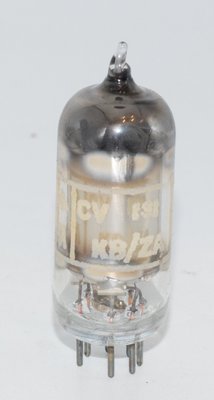
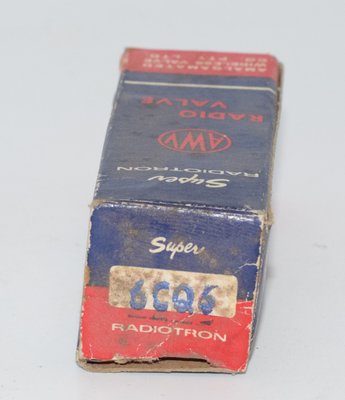
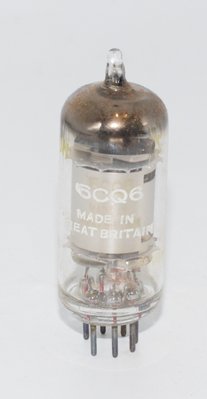
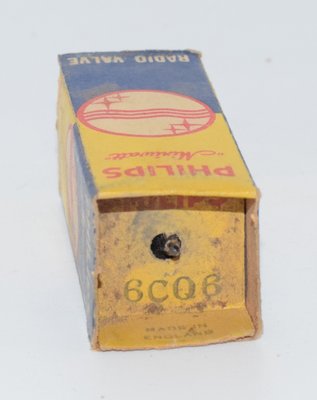
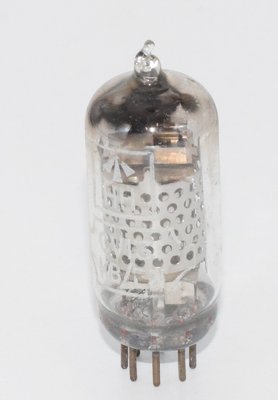
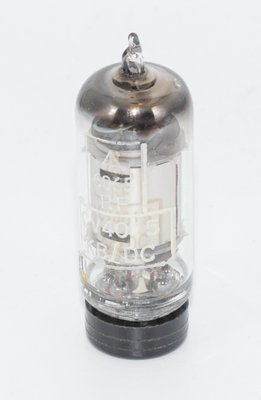
The 6CQ6 is a miniature sharp-cutoff RF pentode designed for use in radio-frequency amplifier, intermediate-frequency amplifier, and general-purpose amplification circuits. Manufactured primarily during the 1950s and 1960s by companies including Philips Miniwatt, Mullard (MWT), and Super Radiotron (AWV/STC), the 6CQ6 belongs to the prolific family of small-signal pentodes built on the miniature 7-pin (B7G) base platform that revolutionized compact receiver and equipment design in the post-war era.
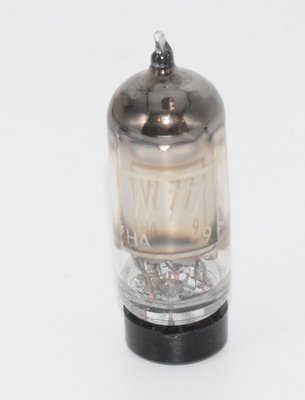
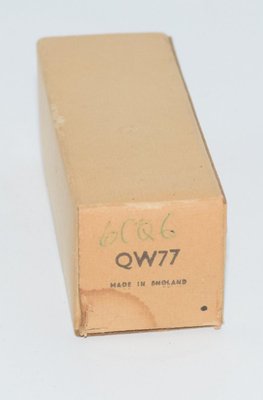
The 6CQ6 is closely related to the well-known EF92 (also designated W77 or QW77 in British military/CV nomenclature), sharing fundamental design characteristics while carrying its own specific rating designations. The tube was widely used in British, Australian, and European equipment, and its military equivalents — CV8017 and CV8071 — attest to its reliability and suitability for demanding service conditions. Today, the 6CQ6 enjoys a second life among audiophiles and DIY enthusiasts who prize its sonic qualities in low-level amplification stages.
2. Technical Specifications and Design
General Description
- Type: Sharp-cutoff RF pentode
- Base: Miniature 7-pin (B7G / Noval subset)
- Envelope: Miniature glass (T-6½ or similar small glass envelope)
- Mounting: Vertical or horizontal (depending on manufacturer recommendations)
Heater Ratings
- Heater Voltage (Vf): 6.3 V
- Heater Current (If): 0.3 A (approximately) [Note: This value is consistent with the EF92 family; confirm against the specific 6CQ6 manufacturer datasheet for exact current draw, as slight variations may exist between manufacturers.]
Maximum Ratings (Absolute Maximum Values)
- Maximum Plate (Anode) Voltage (Va max): 250 V [Typical for the EF92/6CQ6 family; confirm against specific 6CQ6 datasheet.]
- Maximum Screen Grid Voltage (Vg2 max): 250 V [Confirm against datasheet.]
- Maximum Plate Dissipation (Pa max): 2.0 W [Typical for EF92 family; confirm against specific 6CQ6 datasheet.]
- Maximum Screen Grid Dissipation (Pg2 max): 0.5 W [Confirm against datasheet.]
- Maximum Cathode Current (Ik max): 10 mA [Confirm against datasheet.]
Typical Operating Characteristics
The following values are representative of typical operating conditions for the 6CQ6 / EF92 family at Va = 250 V, Vg2 = 140 V, Vg1 = −2 V:
- Plate Current (Ia): ~5.0 mA
- Screen Current (Ig2): ~1.3 mA
- Transconductance (gm): ~2.0 mA/V (2000 µS) [Some sources cite values between 1.8 and 2.2 mA/V depending on operating point; confirm against specific datasheet.]
- Amplification Factor (µ): ~200 (approximate, derived from gm × rp) [Confirm against datasheet.]
- Plate Resistance (rp): ~100 kΩ (approximate) [Typical for this class of pentode; confirm against datasheet.]
- Grid Bias Range (Vg1): 0 V to approximately −6 V (cutoff typically around −6 V to −7 V at standard screen voltage) [Confirm exact cutoff voltage against datasheet.]
Pin Configuration (B7G Base — Bottom View)
| Pin | Connection |
|---|---|
| 1 | Grid 3 (Suppressor Grid) — internally connected to cathode on most versions |
| 2 | Anode (Plate) |
| 3 | Heater |
| 4 | Heater |
| 5 | Grid 2 (Screen Grid) |
| 6 | Grid 1 (Control Grid) |
| 7 | Cathode |
Note: The suppressor grid (g3) is typically internally connected to the cathode. Some versions may bring g3 out to pin 1 separately. Always verify the specific manufacturer's datasheet for the exact pinout, as minor variations can exist between production runs and manufacturers. An internal shield or screen may be connected to pin 1 on certain variants.
3. Applications and Usage
The 6CQ6 was designed and deployed across a wide range of applications:
- Radio-Frequency (RF) Amplification: The tube's sharp-cutoff characteristic and good transconductance made it well-suited for RF amplifier stages in AM and FM radio receivers, where stable gain and low noise were required.
- Intermediate-Frequency (IF) Amplification: Widely used in IF strips of superheterodyne receivers, the 6CQ6 provided reliable gain with predictable AGC behavior due to its sharp-cutoff grid characteristic.
- Audio Preamplification: The pentode's moderate gain and relatively low noise floor made it suitable for microphone preamplifiers, phono stages, and first-stage audio amplification in high-fidelity equipment.
- Instrumentation and Test Equipment: Its military-grade equivalents (CV8017, CV8071) indicate use in precision measurement equipment, oscilloscopes, and military communications gear where long-term stability and reliability were paramount.
- Video Amplification: Some manufacturers specified the tube for wideband video amplifier applications in early television receivers.
- Oscillator Circuits: The 6CQ6 could serve as a local oscillator in receiver front-ends or as a general-purpose oscillator in signal generators.
4. Sound Characteristics
The 6CQ6, like its close relative the EF92, has developed a devoted following among audiophiles and recording engineers who appreciate its distinctive sonic signature. Here is how the tube is typically described in audio circles:
- Tonal Balance: The 6CQ6 is generally characterized as having a warm, smooth midrange with a slightly rich lower-midrange presence. It avoids the clinical or sterile quality sometimes associated with more modern small-signal tubes.
- High Frequencies: The treble response is described as detailed but never harsh or fatiguing. There is a gentle, natural roll-off at the extreme top end that many listeners find musically pleasing, lending recordings a sense of "air" without excessive brightness.
- Low Frequencies: Bass response is considered adequate but not the tube's strongest suit — typical of small-signal pentodes in this class. When used in well-designed circuits with appropriate plate loads, it can deliver surprisingly articulate low-frequency performance.
- Dynamics and Transients: The 6CQ6 handles transients with a smooth, natural quality. Micro-dynamics are well-preserved, giving the tube a reputation for revealing subtle details in recordings without sounding analytical.
- Noise Performance: When properly selected and operated within its ratings, the 6CQ6 exhibits low microphony and acceptable noise levels for high-gain preamplifier applications. However, as with all miniature pentodes of this era, individual tube selection is recommended for the most critical low-noise applications.
- Overall Character: Audiophiles often describe the 6CQ6 as possessing a "classic British" sound — refined, musical, and slightly warm. It is frequently compared favorably to the Mullard EF92 and CV4015 in terms of tonal character, which is unsurprising given their shared lineage.
It should be noted that the sonic character of any vacuum tube is heavily influenced by the surrounding circuit topology, operating point, and passive component choices. The descriptions above represent general consensus among experienced listeners and should be taken as guidelines rather than absolutes.
5. Equivalent or Substitute Types
Close / Identical Substitutes (Direct Drop-In Replacements)
- CV8017 — British military (CV) equivalent of the 6CQ6. Direct drop-in replacement with identical pinout and ratings. Often manufactured to tighter tolerances due to military specifications.
- CV8071 — Another British military (CV) registered equivalent. Direct drop-in replacement.
- QW77 — British designation used by Mullard and others; appears to be the same tube marketed under a different type number. Direct substitute.
Closely Related Types (Use with Caution)
- EF92 (CV138, W77, 6CQ6 in some cross-references): The EF92 is listed as a "different rating substitute" and is NOT a guaranteed drop-in replacement. While the EF92 shares the same B7G base and similar internal construction, there may be differences in maximum ratings, bias points, or specific electrical parameters. In many practical circuits, the EF92 and 6CQ6 can be interchanged successfully, but designers should verify that the operating conditions fall within the safe ratings of whichever type is actually installed. Some vendor listings describe the 6CQ6 as equivalent to the EF92, but this should be treated as an approximate equivalence rather than an absolute one.
- CV4015 (M8161): A premium-grade, ruggedized version of the EF92 manufactured to special quality (SQ) standards. May be usable in place of the 6CQ6 in many circuits, but verify ratings carefully.
- 6065: A U.S. industrial/military type related to the EF92 family. Check pinout and ratings before substituting.
Types That Are NOT Substitutes
Despite superficial similarities in type numbering or general pentode classification, the following are not interchangeable with the 6CQ6:
- 6CQ8 — A completely different tube (triode-pentode compactron).
- EF91 (6AM6) — While also a B7G miniature pentode, the EF91 has different characteristics and is not a direct substitute.
- EF86 (6267) — A 9-pin (B9A/Noval) pentode with a completely different base and pinout. Not physically compatible.
6. Notable Characteristics
- Sharp-Cutoff Design: The 6CQ6 features a sharp-cutoff (non-remote) grid characteristic, meaning that plate current drops to zero relatively abruptly as grid bias is increased. This makes it ideal for applications requiring well-defined signal handling but less suitable for AGC-controlled RF stages where a variable-mu (remote-cutoff) characteristic would be preferred.
- Compact Construction: The B7G miniature base and small glass envelope allow the 6CQ6 to be used in space-constrained designs. The tube's compact size also contributes to lower inter-electrode capacitances compared to larger octal-based pentodes.
- Military Heritage: The existence of multiple CV-registered equivalents (CV8017, CV8071) confirms that the 6CQ6 met stringent military reliability and performance standards. Military-spec examples are particularly prized by collectors and audiophiles for their consistent quality.
- Manufacturer Variations: The 6CQ6 was produced by several manufacturers including Philips Miniwatt, Mullard (branded as MWT), and Super Radiotron (the Australian Philips/AWV brand). Each manufacturer's production may exhibit subtle sonic and electrical differences due to variations in materials, construction techniques, and factory tolerances. Philips Miniwatt and Mullard examples are generally the most sought-after.
- Low Microphony Potential: When carefully selected, the 6CQ6 can exhibit very low microphonic noise, making it suitable for sensitive audio input stages. However, as with all miniature glass-envelope tubes, mechanical isolation (rubber grommets, spring-loaded sockets) is recommended in vibration-prone environments.
- Moderate Power Requirements: With a heater draw of approximately 1.9 W (6.3 V × 0.3 A) and low plate dissipation, the 6CQ6 places minimal demands on power supply design, making it attractive for compact and portable equipment.
7. Usage in the Audio Community
The 6CQ6 has carved out a respected niche in the modern audio community, particularly among DIY builders and boutique equipment manufacturers:
Microphone Preamplifiers
The 6CQ6 is used in high-quality microphone preamplifier designs where its combination of moderate gain, low noise, and warm tonal character can enhance vocal and instrument recordings. Its pentode topology provides sufficient gain to amplify low-level microphone signals without requiring excessive gain stages, and its smooth clipping behavior when gently overdriven adds a pleasing harmonic coloration that many recording engineers find musically useful.
Phono Stages and RIAA Preamplifiers
Audiophiles have employed the 6CQ6 in phono preamplifier circuits, where its gain characteristics are well-matched to the requirements of moving-magnet cartridges. The tube's warm midrange and detailed treble complement the RIAA equalization curve, and its relatively low noise floor (when carefully selected) makes it viable for this demanding application. Some designers use the 6CQ6 in pentode mode for maximum gain, while others wire it in triode mode (screen tied to plate) for lower gain but potentially lower distortion and output impedance.
Headphone Amplifiers
The growing headphone audiophile community has embraced small-signal pentodes like the 6CQ6 for use in hybrid or all-tube headphone amplifier designs. The tube's intimate, detailed sound character is particularly well-suited to the personal listening experience that headphones provide.
Guitar and Studio Effects
Some boutique guitar effects pedal and studio outboard gear manufacturers have incorporated the 6CQ6 into their designs, taking advantage of its smooth overdrive characteristics and vintage tonal quality. The tube can add subtle harmonic richness to guitar signals or serve as a "color box" for studio mixing applications.
DIY and Hobbyist Projects
The 6CQ6 is popular in the DIY audio community for several practical reasons: NOS (New Old Stock) examples remain available at reasonable prices from various suppliers; the B7G base is easy to work with and sockets are readily available; the tube's modest power requirements simplify power supply design; and there is a wealth of circuit information available for the closely related EF92 family that can be adapted for the 6CQ6.
Tube Rolling
In equipment designed for the EF92 family, the 6CQ6 is a popular "tube rolling" option. Audiophiles report that swapping between different manufacturers' versions of the 6CQ6 (Philips Miniwatt vs. Mullard vs. Super Radiotron) can yield noticeable differences in tonal character, providing an enjoyable and relatively inexpensive way to fine-tune the sound of their systems. The CV-registered military versions (CV8017, CV8071) are particularly sought after for their reputed consistency and premium build quality.
Availability and Market
As of the current market, NOS 6CQ6 tubes remain available through specialist vintage tube dealers. Prices are generally moderate compared to more famous audio tubes like the EF86 or 12AX7, making the 6CQ6 an excellent value proposition for experimenters and audiophiles seeking high-quality vintage tube sound without premium pricing. Philips Miniwatt and Mullard-branded examples typically command a modest premium due to their reputation for quality and sonic excellence.