Introduction and History
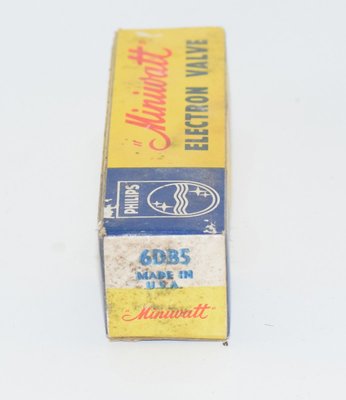
The 6DB5 is a beam power tube manufactured by the Radio Corporation of America (RCA) and introduced in the early 1960s, with the original RCA datasheet dated July 1961. Designed as a 9-pin miniature (noval) type, the 6DB5 was primarily intended for use as a vertical-deflection amplifier in television receivers, but its electrical characteristics also made it suitable as a Class A1 audio power amplifier. The tube belongs to the family of compact beam power tubes that emerged during the transition era when television manufacturers sought smaller, more efficient components to reduce chassis size while maintaining reliable performance.
The 6DB5 represents an interesting design point in the evolution of beam power tubes — it packs a respectable 10 watts of plate dissipation into a compact T6-1/2 envelope with a noval base, making it a versatile tube for both deflection and audio output duties. Its relatively high transconductance of 8000 µmhos and moderate plate voltage requirements made it an attractive choice for designers working within the constraints of consumer electronics power supplies of the era.
While never achieving the legendary status of tubes like the EL34 or 6L6, the 6DB5 has found a dedicated following among DIY audio enthusiasts who appreciate its unique sonic characteristics and the challenge of designing around a less common tube type.
Technical Specifications and Design
Heater / Filament
| Parameter | Value |
|---|---|
| Heater Voltage (AC or DC) | 6.3 volts |
| Heater Current | 1.2 amps |
| Cathode Type | Unipotential (indirectly heated) |
Maximum Ratings (Class A1 Amplifier, Design-Center Values)
| Parameter | Value |
|---|---|
| Plate Voltage | 300 volts max. |
| Peak Positive-Pulse Plate Voltage (Vertical Deflection) | 2000 volts max. (absolute maximum) |
| Grid No.2 (Screen-Grid) Voltage | 150 volts max. |
| Grid No.2 Input Power | 1.25 watts max. |
| Plate Dissipation | 10 watts max. |
| Cathode Current (Average) | 55 mA max. |
| Peak Cathode Current | 200 mA max. |
| Peak Heater-Cathode Voltage (Heater negative w.r.t. cathode) | 200 volts max. |
| Peak Heater-Cathode Voltage (Heater positive w.r.t. cathode) | 200 volts max. (DC component must not exceed 100V) |
Maximum Circuit Values
| Parameter | Value |
|---|---|
| Grid No.1 Circuit Resistance (Fixed-bias operation) | 0.1 megohm max. |
| Grid No.1 Circuit Resistance (Cathode-bias operation) | 2.2 megohms max. |
Direct Interelectrode Capacitances (Approximate, without external shield)
| Parameter | Value |
|---|---|
| Grid No.1 to Plate (Cga) | 0.2 pF |
| Grid No.1 to Cathode, Grid No.3, Grid No.2, and Heater (Cgk) | 13 pF |
| Plate to Cathode, Grid No.3, Grid No.2, and Heater (Cak) | 8 pF |
Typical Operation — Class A1 Amplifier
The RCA datasheet provides two sets of typical operating conditions:
Condition 1 (Higher Plate Voltage)
| Parameter | Value |
|---|---|
| Plate Supply Voltage | 200 volts |
| Grid No.2 Supply Voltage | 125 volts |
| Cathode Resistor | 180 ohms |
| Zero-Signal Plate Current | 46 mA |
| Max.-Signal Plate Current | 47 mA |
| Zero-Signal Grid No.2 Current | 2.2 mA |
| Max.-Signal Grid No.2 Current | 8.5 mA |
| Plate Resistance (Approx.) | 28,000 ohms |
| Transconductance | 8000 µmhos |
| Load Resistance | 4000 ohms |
| Peak AF Grid No.1 Voltage | 8.5 volts |
| Total Harmonic Distortion | 10% |
| Max.-Signal Power Output | 3.8 watts |
Condition 2 (Lower Plate Voltage / Field Output)
| Parameter | Value |
|---|---|
| Plate Supply Voltage | 110 volts |
| Grid No.2 Supply Voltage | 110 volts |
| Grid No.1 (Control-Grid) Voltage | -7.5 volts |
| Cathode Resistor | — |
| Zero-Signal Plate Current | 49 mA |
| Max.-Signal Plate Current | 50 mA |
| Zero-Signal Grid No.2 Current | 4 mA |
| Max.-Signal Grid No.2 Current | 10 mA |
| Plate Resistance (Approx.) | 13,000 ohms |
| Transconductance | 8000 µmhos |
| Load Resistance | 2000 ohms |
| Peak AF Grid No.1 Voltage | 7.5 volts |
| Total Harmonic Distortion | 10% |
| Max.-Signal Power Output | 2.1 watts |
Note on Amplification Factor (µ): The amplification factor is not explicitly stated in the RCA datasheet. However, it can be estimated from the relationship µ = gm × rp. Using the higher plate voltage operating condition: µ ≈ 8000 × 10-6 × 28,000 = 224. Using the lower voltage condition: µ ≈ 8000 × 10-6 × 13,000 = 104. These values are typical for beam power tubes and reflect the tube's behavior at different operating points.
Physical and Mechanical Specifications
| Parameter | Value |
|---|---|
| Base Type | Small-Button Noval 9-Pin (JEDEC No. E9-1) / B9A |
| Bulb Type | T6-1/2 |
| Operating Position | Any |
| Maximum Overall Length | 2-3/4 inches |
| Maximum Seated Length | 2-1/2 inches |
| Length, Base Seat to Bulb Top (excl. tip) | 2-1/8" ± 3/32" |
| Diameter | 0.750" to 0.875" |
Pin Configuration (Bottom View, Basing Designation 9GR)
| Pin | Connection |
|---|---|
| Pin 1 | Grid No.2 (Screen Grid) |
| Pin 2 | Cathode, Grid No.3 (Suppressor Grid) |
| Pin 3 | Grid No.1 (Control Grid) |
| Pin 4 | Heater |
| Pin 5 | Heater |
| Pin 6 | Grid No.1 (Control Grid) |
| Pin 7 | Cathode, Grid No.3 (Suppressor Grid) |
| Pin 8 | Internal Connection — Do Not Use |
| Pin 9 | Plate |
Important Note: Pin 8 is an internal connection and must not be used or connected to any external circuit. The control grid (Grid No.1) is brought out to two pins (3 and 6), and the cathode/suppressor grid combination is also brought out to two pins (2 and 7). This dual pin-out arrangement for the grid and cathode helps reduce lead inductance and is common in tubes designed for deflection service.
Applications and Usage
Original Design Intent: Vertical Deflection
The 6DB5 was primarily designed as a vertical-deflection output amplifier for television receivers operating in the 525-line, 30-frame system (the NTSC standard used in North America). In this application, the tube was required to handle peak positive-pulse plate voltages up to 2000 volts (absolute maximum), with the stipulation that the voltage pulse duration not exceed 15 percent of one vertical scanning cycle (2.5 milliseconds in a 525-line, 30-frame system). The tube's ability to handle high peak cathode currents of 200 mA while maintaining an average cathode current within 55 mA made it well-suited for the sawtooth waveform demands of vertical deflection circuits.
In vertical deflection service, the tube would typically operate with a DC plate voltage of 300 volts maximum and a screen grid voltage of 150 volts maximum, with the peak negative-pulse control grid voltage reaching up to 250 volts.
Audio Amplifier Service
The 6DB5 is equally capable as a Class A1 audio power amplifier. In its higher-voltage operating condition (200V plate, 125V screen), it delivers 3.8 watts of output power into a 4000-ohm load with 10% total harmonic distortion. At the lower voltage operating point (110V plate and screen), it produces 2.1 watts into a 2000-ohm load. These power levels are suitable for small single-ended amplifier designs, personal listening amplifiers, and practice amplifiers for musical instruments.
The cathode-bias configuration using a 180-ohm cathode resistor (in the 200V operating condition) simplifies circuit design and eliminates the need for a separate negative bias supply, making the 6DB5 attractive for DIY audio projects.
Other Applications
Like many beam power tubes of its era, the 6DB5 could also be employed in regulated power supplies, servo amplifiers, and other industrial control circuits where moderate power output and high transconductance were desirable.
Sound Characteristics
The 6DB5, while not as widely documented in audiophile literature as mainstream audio tubes, possesses sonic qualities that are characteristic of beam power tubes operating in single-ended Class A configurations. Based on the experiences of DIY builders and the tube's electrical characteristics, the following sonic attributes can be described:
Tonal Character
The 6DB5 exhibits a warm, rich midrange that is typical of beam power pentodes operating at moderate plate voltages. With its high transconductance of 8000 µmhos, the tube is responsive and dynamic, offering good transient detail for a single-ended design. The relatively low plate voltage operation (200V or less in typical audio circuits) contributes to a smooth, rounded character that avoids the harshness sometimes associated with higher-voltage beam power tubes.
Bass and Treble Response
At 3.8 watts in the higher-voltage configuration, the 6DB5 delivers surprisingly authoritative bass for its power rating, particularly when paired with efficient speakers (93 dB/W/m or higher). The beam power structure provides good current delivery into the output transformer, resulting in controlled low-frequency reproduction. The treble response is smooth and extended, though the 8 pF plate-to-cathode capacitance and 13 pF input capacitance mean that careful attention to output transformer quality and driver stage design is important for maintaining high-frequency performance.
Harmonic Structure
Operating in single-ended Class A, the 6DB5 produces the characteristic even-order harmonic distortion profile that audiophiles associate with musical, euphonic sound. The 10% THD figure at maximum rated output represents the tube being driven to its limits; at lower power levels (1-2 watts), distortion drops significantly and the tube operates in its most linear region, producing a clean, detailed sound with subtle harmonic enrichment that adds warmth and dimensionality to the music.
Overall Impression
Listeners describe the 6DB5 as having a "sweet" and "intimate" quality that works particularly well with vocal music, jazz, and acoustic instruments. The moderate power output naturally suits near-field listening environments where the tube can be operated within its comfort zone. The sound is often compared favorably to other small beam power tubes like the 6AQ5 and EL84, with some builders noting a slightly more refined midrange character.
Equivalent or Substitute Types
The 6DB5 is a relatively specialized tube, and direct equivalents are limited. The following information should be considered carefully:
- No widely recognized direct equivalents — The 6DB5 does not have a commonly listed European or international equivalent in standard cross-reference guides. It was primarily an RCA type designed for specific television receiver applications.
- Potential functional substitutes (NOT pin-compatible without verification): Other noval-based beam power tubes with similar ratings, such as the 6AQ5A/6HG5 family or the EL84/6BQ5, operate in a similar power range but have different pinouts, bias requirements, and operating characteristics. These should not be substituted without a complete circuit redesign.
- Philips Miniwatt production: The 6DB5 was also manufactured by Philips Miniwatt (USA), and NOS examples from this source are occasionally available. These are direct replacements for RCA-branded 6DB5 tubes.
Caution: Due to the internal connection on Pin 8 and the dual grid/cathode pin arrangement, substituting other tube types into a 6DB5 socket without careful verification of the pinout and electrical compatibility could result in damage to the tube or circuit. Always consult datasheets for both the original and proposed substitute tube before attempting any substitution.
Notable Characteristics
- Pin 8 Internal Connection: One of the most important things to note about the 6DB5 is that Pin 8 is an internal connection and must not be used. This is clearly stated in the RCA datasheet and is critical for anyone designing circuits or adapting sockets for this tube.
- Dual Control Grid Pins: The control grid (Grid No.1) is connected to both Pin 3 and Pin 6. This dual connection reduces lead inductance, which was important for the tube's intended use in vertical deflection circuits where fast-rising waveforms are present. In audio applications, this feature can be exploited by connecting both pins to the grid circuit for lowest impedance, or by using one pin for signal input and leaving the other as a redundant connection.
- Dual Cathode/Suppressor Pins: Similarly, the cathode and internally-connected suppressor grid (Grid No.3) are brought out to both Pin 2 and Pin 7, providing low-impedance cathode connections.
- High Peak Plate Voltage Rating: The 2000-volt peak positive-pulse plate voltage rating (in vertical deflection service) demonstrates the robust construction of this tube's plate structure, even though the DC plate voltage maximum is only 300 volts.
- Consistent Transconductance: The 6DB5 maintains its transconductance of 8000 µmhos across both listed operating conditions (110V and 200V plate supply), indicating stable and predictable performance across a range of operating points.
- Low Grid-to-Plate Capacitance: At only 0.2 pF, the grid-to-plate capacitance is very low, which contributes to stability and reduces the Miller effect in amplifier circuits. This is a benefit of the beam power tube construction with its effective internal shielding.
- Any-Position Operation: The tube can be mounted in any position, providing flexibility in chassis layout and amplifier design.
- Relatively High Heater Current: At 1.2 amps, the heater current is notable for a miniature tube and should be accounted for in power transformer selection. The heater power consumption is approximately 7.56 watts.
Usage in the Audio Community
DIY and Hobbyist Appeal
The 6DB5 occupies an interesting niche in the DIY audio community. As a tube originally designed for television service, it was produced in large quantities but has not been as heavily sought after by mainstream audiophiles as dedicated audio tubes. This means that NOS (New Old Stock) examples can sometimes be found at reasonable prices compared to more popular audio tubes, making the 6DB5 an attractive option for budget-conscious builders who enjoy experimenting with unconventional tube types.
Single-Ended Amplifier Projects
The most common audio application for the 6DB5 is in single-ended (SE) Class A amplifiers. With 3.8 watts available at 200V plate supply, the tube can drive efficient loudspeakers to satisfying listening levels in a domestic environment. Builders typically pair the 6DB5 with a 12AX7 or 12AU7 dual triode as a preamplifier/driver stage, creating a simple two-stage amplifier with minimal component count. The 180-ohm cathode bias resistor specified in the datasheet makes self-biasing straightforward, and the 4000-ohm optimal load impedance is a standard value readily available in single-ended output transformers.
Guitar Amplifier Applications
Some guitar amplifier builders have experimented with the 6DB5 in small practice amplifiers. The 2-4 watt power range is ideal for bedroom practice levels, and the beam power tube's harmonic distortion characteristics when driven hard produce the type of natural overdrive that guitarists find musically pleasing. The tube's robust construction (designed to handle 2000V pulses in its original application) means it can tolerate the abuse that guitar amplifier service sometimes demands.
Availability and Sourcing
The 6DB5 is available as NOS from various sources, including Philips Miniwatt USA production. As the tube is no longer in current production, supplies are finite but generally adequate for hobbyist use. Collectors and builders should look for tubes with strong, balanced emission and low microphonics for the best audio performance. Testing on a mutual conductance tube tester calibrated for the 6DB5's 8000 µmhos transconductance specification is recommended when evaluating NOS stock.
Community Perspective
Within the audio community, the 6DB5 is regarded as a "hidden gem" — a tube that offers genuine musical enjoyment at a fraction of the cost of more fashionable output tubes. It appeals particularly to builders who value the journey of discovery and the satisfaction of creating something unique. While it will never replace the EL34 or 6L6 in mainstream amplifier design, the 6DB5 rewards those who take the time to design a proper circuit around its specific characteristics with a sound that is warm, engaging, and distinctly its own.