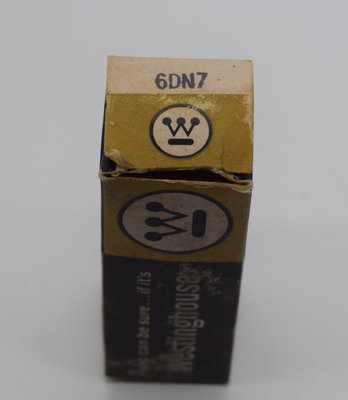
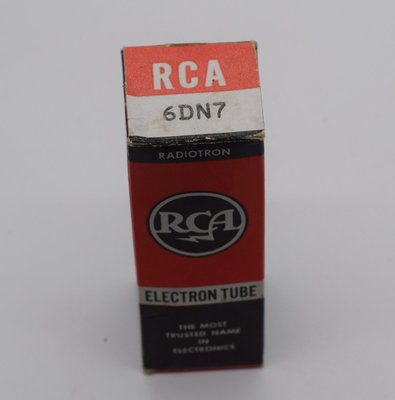
1. Introduction and History
The 6DN7 is a dissimilar dual triode vacuum tube featuring two triode sections of markedly different characteristics within a single glass envelope. Developed in the late 1950s by American manufacturers including RCA and Westinghouse, the 6DN7 was designed primarily for use in vertical deflection oscillator and amplifier circuits in television receivers. Its unique combination of a high-mu (high amplification factor) triode section and a low-mu, high-current triode section within one envelope made it an elegant solution for TV designers seeking to reduce tube count and simplify circuit design.
The tube was manufactured by several major American companies including RCA, Westinghouse, Sylvania, and General Electric. While its original application was firmly rooted in television technology, the 6DN7 has found a second life in the high-fidelity audio community, where its dissimilar triode sections offer creative possibilities for amplifier designers — particularly in single-ended triode (SET) amplifier topologies where one section can serve as a voltage amplifier/driver and the other as an output stage or vice versa.
The 6DN7 uses an octal base (8-pin) and features a T-9 (or similar medium) glass envelope, consistent with many American-designed tubes of its era.
2. Technical Specifications and Design
General Characteristics
| Parameter | Value |
|---|---|
| Tube Type | Dissimilar Dual Triode |
| Base | Octal (8-pin, International Octal) |
| Envelope | T-9 glass envelope |
| Mounting Position | Any |
Heater Ratings
| Parameter | Value |
|---|---|
| Heater Voltage (Eh) | 6.3 V |
| Heater Current (Ih) | 0.9 A |
Triode Section 1 — High-Mu Section
| Parameter | Value |
|---|---|
| Maximum Plate Voltage | 300 V |
| Maximum Plate Dissipation | 1.5 W |
| Amplification Factor (μ) | ~68 |
| Transconductance (gm) | ~2,200 µmhos (2.2 mA/V) |
| Plate Resistance (rp) | ~31 kΩ |
Note: The high-mu section is broadly similar in character to a 6SL7-type triode section, offering moderate gain suitable for voltage amplification and driver stages.
Triode Section 2 — Low-Mu / Power Section
| Parameter | Value |
|---|---|
| Maximum Plate Voltage | 300 V |
| Maximum Plate Dissipation | 7.5 W |
| Amplification Factor (μ) | ~3.7 |
| Transconductance (gm) | ~5,500 µmhos (5.5 mA/V) |
| Plate Resistance (rp) | ~670 Ω |
Note: The low-mu power section has characteristics reminiscent of a small power triode, with low plate resistance and relatively high transconductance. This section is capable of delivering meaningful current, making it suitable for driving output transformers in low-power SET amplifier configurations.
⚠ Data Verification Note: The specifications listed above are drawn from commonly referenced sources for the 6DN7. However, some values — particularly the exact amplification factor and transconductance of the high-mu section — may vary slightly between manufacturer datasheets. Builders are strongly advised to consult an original RCA, Sylvania, or GE datasheet for the 6DN7 to confirm exact operating point data, characteristic curves, and maximum ratings before committing to a design. The plate dissipation figures (1.5 W for the high-mu section and 7.5 W for the low-mu section) and the heater current of 0.9 A should be verified against the specific manufacturer's data for the production lot in question.
Pin-Out (Octal Base — Bottom View)
| Pin | Connection |
|---|---|
| Pin 1 | Triode 2 Plate (Low-Mu Section) |
| Pin 2 | Triode 2 Grid (Low-Mu Section) |
| Pin 3 | Heater |
| Pin 4 | Heater |
| Pin 5 | Triode 1 Plate (High-Mu Section) |
| Pin 6 | Triode 1 Grid (High-Mu Section) |
| Pin 7 | Triode 1 Cathode (High-Mu Section) |
| Pin 8 | Triode 2 Cathode (Low-Mu Section) |
⚠ Pin-Out Verification Note: The pin assignments listed above represent the commonly cited configuration for the 6DN7. However, there can be discrepancies between sources regarding which section (high-mu or low-mu) corresponds to which set of pins. Builders must verify the pin-out against an authoritative manufacturer datasheet (RCA RC-series reference, Sylvania Technical Manual, or equivalent) before wiring any circuit. Incorrect pin assignment could result in damage to the tube or associated components.
3. Applications and Usage
Original Applications
- Television Vertical Deflection: The 6DN7 was designed as a combined vertical oscillator and vertical output tube in television receivers. The high-mu section served as the vertical oscillator, while the low-mu power section drove the vertical deflection yoke. This allowed TV manufacturers to replace two separate tubes with a single envelope, reducing cost, chassis space, and heat.
- Industrial Control Circuits: The dissimilar dual triode configuration found occasional use in industrial applications where a voltage amplifier and a power driver stage were needed in close proximity.
Modern Applications
- Single-Ended Triode (SET) Amplifiers: The 6DN7 has become popular among DIY audio enthusiasts and boutique amplifier builders as a "complete amplifier in one envelope." The high-mu section provides voltage gain, while the low-mu power section — with its 7.5 W plate dissipation and low plate resistance — can serve as a small SET output stage capable of delivering approximately 1–2 watts of single-ended Class A power into a suitable output transformer.
- Headphone Amplifiers: The power section's characteristics make it well-suited for driving headphones, either directly or through a small output transformer. Several popular DIY headphone amplifier designs utilize the 6DN7.
- Preamplifier and Buffer Stages: The high-mu section can be used as a line-level preamplifier, while the low-mu section serves as a low-impedance buffer or cathode follower output stage.
4. Sound Characteristics
The 6DN7 has earned a loyal following in the audio community, and its sonic character is frequently discussed among tube enthusiasts. While subjective descriptions of tube sound should always be taken in context — as the overall sonic signature depends heavily on circuit topology, output transformer quality, passive component selection, and power supply design — the following observations are commonly reported:
- Warm and Musical Midrange: The low-mu power section, with its very low plate resistance (~670 Ω), exhibits excellent damping characteristics and produces a midrange that is frequently described as warm, liquid, and richly textured. Vocals and acoustic instruments are often cited as sounding particularly natural and present through 6DN7-based amplifiers.
- Smooth, Non-Fatiguing Treble: The high-frequency response is generally characterized as smooth and extended without harshness. The low plate resistance of the output section provides good coupling to output transformers, which helps maintain treble clarity and extension.
- Surprisingly Authoritative Bass: For a tube with modest power output, the 6DN7's low-mu section delivers bass that is often described as surprisingly tight and controlled. The low rp contributes to a favorable damping factor when paired with quality output transformers, yielding bass performance that belies the tube's small power rating.
- Intimate, Small-Scale Presentation: Given its limited power output (typically 1–2 watts in SET configuration), the 6DN7 excels with high-efficiency speakers and creates an intimate, detailed soundstage. It is not a tube for large-scale orchestral dynamics at high volumes, but rather one that rewards careful listening with nuance and micro-detail.
- Direct-Heated Triode Character: Despite being an indirectly heated tube, the low-mu section's low plate resistance and low amplification factor give it sonic characteristics that some listeners compare favorably to small directly heated triodes (DHTs) like the 2A3, albeit at lower power levels.
- Manufacturer Variations: NOS examples from RCA are often considered the benchmark, with a reputation for a slightly warmer, more romantic presentation. Westinghouse-branded tubes (which may have been manufactured by Sylvania or other contractors) are sometimes described as slightly more linear and neutral. Sylvania-made examples are generally regarded as offering excellent clarity and detail.
5. Equivalent or Substitute Types
The 6DN7 is a somewhat unique tube, and there is no direct, drop-in equivalent that exactly replicates both its pin-out and the specific characteristics of both triode sections. However, the following tubes are worth noting:
| Type | Relationship | Notes |
|---|---|---|
| 6DN7 | Direct equivalent | All manufacturers' versions (RCA, Westinghouse, Sylvania, GE) are interchangeable. |
| 6BX7GT | NOT a direct substitute | Dual medium-mu triode (octal base) with two identical sections. Sometimes mentioned in similar SET amplifier contexts but has completely different section characteristics and is not pin-compatible in circuits designed specifically for the 6DN7's dissimilar sections. |
| 6SN7 + 6AS7 combination | Functional equivalent (two separate tubes) | A 6SN7 (dual medium-mu triode) driving a 6AS7 (dual low-mu power triode) can approximate the functional topology of a 6DN7-based amplifier, but requires two octal sockets and a completely different circuit design. |
| 6CK4 | NOT a direct substitute | A single medium-power triode sometimes used in similar low-power SET applications. Different pin-out and characteristics; not interchangeable. |
Important: Do not attempt to substitute other dissimilar dual triodes (such as the 6GH8A, ECF80, or similar triode-pentode combinations) without a complete circuit redesign. The 6DN7's specific combination of section characteristics is essentially unique among octal-base dual triodes.
6. Notable Characteristics
- "Complete Amplifier in One Bottle": The 6DN7's most notable characteristic is its ability to serve as both driver and output stage in a single envelope. This makes it exceptionally appealing for minimalist amplifier designs where signal path simplicity is prized.
- Low Plate Resistance Power Section: The ~670 Ω plate resistance of the low-mu section is remarkably low for an indirectly heated triode of this size. This characteristic provides excellent output transformer coupling and contributes to the tube's reputation for controlled, dynamic sound.
- Generous Power Section Dissipation: At 7.5 W maximum plate dissipation, the power section offers meaningful headroom for a small SET amplifier design, allowing for Class A operation with reasonable power output.
- Moderate Heater Current: The 0.9 A heater draw is reasonable and does not place excessive demands on the power supply, making the 6DN7 practical for compact amplifier builds.
- NOS Availability: As a television tube that was produced in large quantities during the late 1950s and 1960s, NOS (New Old Stock) examples remain available at reasonable prices compared to more sought-after audio tubes. This makes the 6DN7 an excellent value proposition for experimenters and audiophiles alike.
- Reliability: Being designed for continuous operation in television sets, the 6DN7 is generally a robust and long-lived tube when operated within its ratings.
- Octal Base Advantage: The octal base provides secure, reliable contact and is mechanically robust — an advantage over miniature 9-pin (noval) bases in terms of long-term connection reliability and ease of tube rolling.
7. Usage in the Audio Community
The 6DN7 has carved out a distinctive niche in the audio community, particularly among DIY builders and enthusiasts who appreciate minimalist, high-quality tube amplifier designs. Its usage spans several key areas:
DIY Single-Ended Triode Amplifiers
The 6DN7 is a favorite among DIY SET amplifier builders. Numerous designs have been published online and in audio forums that use a single 6DN7 per channel — the high-mu section as the input/driver stage and the low-mu section as the output stage. These designs typically produce 1–2 watts of pure Class A, single-ended power and are paired with high-efficiency speakers (95 dB/W/m or higher) for satisfying listening levels. The simplicity of these circuits — often requiring only a single tube socket, one output transformer, and a handful of passive components per channel — makes them ideal first projects for aspiring tube amplifier builders.
Headphone Amplifiers
The 6DN7 has found significant popularity in the headphone amplifier community. The low plate resistance of the power section provides excellent drive capability for a wide range of headphone impedances. Several well-regarded DIY headphone amplifier designs feature the 6DN7, and some boutique manufacturers have incorporated it into commercial products. The tube's ability to deliver a warm, detailed, and dynamic sound at headphone listening levels makes it particularly well-suited to this application.
Boutique and Small-Scale Commercial Amplifiers
A number of small-scale and boutique amplifier manufacturers have recognized the 6DN7's potential and have incorporated it into commercial designs. These amplifiers are typically marketed as desktop or near-field listening amplifiers, paired with high-efficiency bookshelf speakers or as dedicated headphone amplifiers.
Tube Rolling and Collecting
Among 6DN7 enthusiasts, tube rolling (comparing different manufacturers' versions) is a popular pursuit. NOS examples from RCA, Sylvania, Westinghouse, General Electric, and Raytheon are all sought after, with each brand reputed to offer subtly different sonic characteristics. RCA examples, particularly those with certain internal construction features (such as specific plate structures or getter configurations), are often considered the most desirable. Prices for NOS 6DN7 tubes remain relatively modest compared to more famous audio tubes like the 300B or 2A3, making the 6DN7 an accessible entry point into the world of NOS tube collecting.
Community Resources
The 6DN7 is actively discussed on major audio forums including DIYAudio.com, Head-Fi.org, and various tube audio groups. Circuit designs, modification tips, and listening impressions are freely shared, creating a supportive community for both newcomers and experienced builders. The tube's combination of excellent sonic potential, circuit simplicity, and affordable NOS pricing has made it something of a cult favorite in the tube audio world.
Recommended Pairings
For optimal results in SET amplifier applications, the 6DN7 is typically paired with:
- Output Transformers: Quality single-ended output transformers with primary impedances in the range of 2.5 kΩ to 5 kΩ (the optimal value depends on the specific operating point chosen for the power section).
- Speakers: High-efficiency designs rated at 95 dB/W/m or higher, including single-driver full-range speakers (Fostex, Lowther, etc.), horn-loaded designs, and efficient two-way bookshelf speakers.
- Headphones: Both high-impedance (250–600 Ω) and moderate-impedance (32–80 Ω) headphones can be driven effectively, depending on the circuit topology employed.