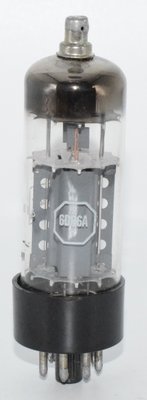
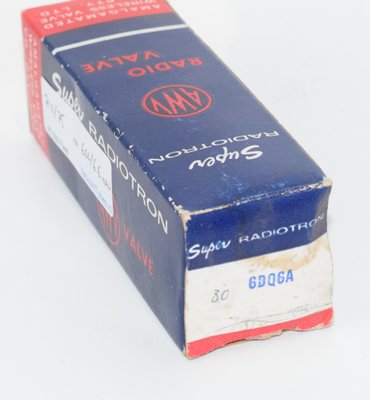
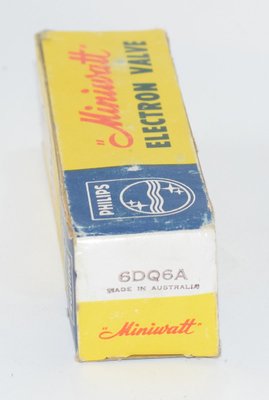
Introduction and History
The 6DQ6-A is a beam power pentode originally designed by General Electric for use as a horizontal-deflection amplifier in television receivers. Introduced during the mid-1950s — the GE datasheet (ET-T1449) is dated December 1956 — the tube was developed to meet the demands of the rapidly expanding American television industry. Its primary design goal was to deliver high zero-bias plate current at relatively low plate and screen voltages, making it ideally suited for TV sets operating on modest power supply rails.
The 6DQ6-A is part of a family that includes the 12DQ6-A and 17DQ6-A, which are electrically identical except for their heater ratings. The 12DQ6-A and 17DQ6-A variants incorporate a controlled heater warm-up characteristic, making them especially suited for television receivers employing series-connected heater strings. The 6DQ6-A succeeded the earlier 6DQ6 and was itself followed by the 6DQ6-B, each revision offering incremental improvements in reliability and consistency.
Manufactured by virtually every major tube producer — including General Electric, RCA, Sylvania, Philips Miniwatt, AWV (Super Radiotron) in Australia, Mullard, and numerous others — the 6DQ6-A was one of the most widely produced beam power tubes of the television era. Millions were manufactured throughout the late 1950s and 1960s, and NOS (New Old Stock) examples remain readily available today.
Technical Specifications and Design
General Electrical Data
| Parameter | 6DQ6-A | 12DQ6-A | 17DQ6-A | Unit |
|---|---|---|---|---|
| Cathode Type | Coated, Unipotential | — | ||
| Heater Voltage (AC or DC) | 6.3 | 12.6 | 16.8 | Volts |
| Heater Current | 1.2 | 0.6 | 0.45 | Amperes |
| Heater Warm-up Time | — | 11 | 11 | Seconds |
Direct Interelectrode Capacitances (approximate, without external shield)
| Parameter | Value | Unit |
|---|---|---|
| Grid-Number 1 to Plate | 0.55 | µµf (pF) |
| Input | 15 | µµf (pF) |
| Output | 7.0 | µµf (pF) |
Maximum Ratings — Horizontal-Deflection Amplifier Service
Design-center values unless otherwise indicated. For operation in a 525-line, 30-frame television system per FCC Standards of Good Engineering Practice. Duty cycle of the voltage pulse must not exceed 15 percent of one scanning cycle.
| Parameter | Maximum | Unit |
|---|---|---|
| DC Plate-Supply Voltage (Boost + DC Power Supply) | 700 | Volts |
| Peak Positive Pulse Plate Voltage | 6000 (absolute max) | Volts |
| Peak Negative Pulse Plate Voltage | 1375 | Volts |
| Screen Voltage | 200 | Volts |
| Negative DC Grid-Number 1 Voltage | 50 | Volts |
| Peak Negative Grid-Number 1 Voltage | 300 | Volts |
| Plate Dissipation | 15 | Watts |
| Screen Dissipation | 3.0 | Watts |
| DC Cathode Current | 140 | Milliamperes |
| Peak Cathode Current | 440 | Milliamperes |
| Heater-Cathode Voltage (Heater Positive, DC) | 100 | Volts |
| Heater-Cathode Voltage (Heater Positive, Total DC and Peak) | 200 | Volts |
| Heater-Cathode Voltage (Heater Negative, Total DC and Peak) | 200 | Volts |
| Grid-Number 1 Circuit Resistance (with Grid-Leak Bias) | 1.0 | Megohms |
| Bulb Temperature at Hottest Point | 220 | °C |
Average Characteristics and Typical Operation
| Parameter | Condition 1 | Condition 2 | Unit |
|---|---|---|---|
| Plate Voltage | 60 | 250 | Volts |
| Screen Voltage | 150 | 150 | Volts |
| Grid-Number 1 Voltage | 0 (approx.) | −22.5 | Volts |
| Plate Resistance (approx.) | — | 20,000 | Ohms |
| Transconductance | — | 6,600 | Micromhos (µS) |
| Plate Current | 300 | 75 | Milliamperes |
| Screen Current | 27 | 2.4 | Milliamperes |
| Grid-Number 1 Voltage for Ib = 1.0 mA (approx.) | — | −46 | Volts |
| Triode Amplification Factor (µ) | — | 4.1 | — |
Note: The triode amplification factor of 4.1 is measured in triode connection (screen tied to plate) with Eb = Ec2 = 150 volts and Ec1 = −22.5 volts.
Derived pentode amplification factor (µ): From the datasheet values of transconductance (gm = 6,600 µmhos) and plate resistance (rp = 20,000 ohms), the pentode-mode amplification factor can be calculated as µ = gm × rp = 6,600 × 10⁻⁶ × 20,000 = 132. This is the pentode-mode µ at the stated operating point.
Mechanical and Physical Data
| Envelope | T-12, Glass |
| Base | B7-119, Short Medium-Shell Octal 7-Pin (RETMA 6AM) |
| Top Cap | C1-3, Skirted Miniature (Plate connection) |
| Mounting Position | Any |
| Maximum Overall Height | 4¼ inches (approx. 108 mm) |
| Maximum Diameter | 1⅝ inches (approx. 41 mm) |
Pin-Out (RETMA 6AM Basing)
| Pin | Connection |
|---|---|
| Pin 1 | No Connection |
| Pin 2 | Heater |
| Pin 3 | No Connection |
| Pin 4 | Grid Number 2 (Screen) |
| Pin 5 | Grid Number 1 (Control Grid) |
| Pin 7 | Heater |
| Pin 8 | Cathode and Beam Plates |
| Top Cap | Plate (Anode) |
Important: The plate connection is brought out to a top cap, not to a base pin. This is a critical detail for circuit design and socket selection. A skirted miniature top cap connector is required.
Applications and Usage
Original Television Application
The 6DQ6-A was primarily designed as a horizontal-deflection output tube in television receivers. In this role, it operated as a switch, driving the horizontal deflection yoke coils with sawtooth current waveforms. The tube's ability to deliver 300 mA of plate current at zero bias with only 60 volts on the plate made it exceptionally well-suited for this demanding service, where the tube must handle peak positive plate pulses up to 6,000 volts and peak cathode currents of 440 mA.
The horizontal output stage in a television is one of the hardest-working circuits in the entire set. The tube must withstand enormous voltage swings during flyback, generate the high-voltage pulse used to produce the EHT (Extra High Tension) supply for the CRT, and do so reliably for thousands of hours. The 6DQ6-A was engineered specifically for this punishing duty cycle.
Other Applications
Beyond television, the 6DQ6-A found use in several other applications:
- RF Power Amplifiers: Amateur radio operators adopted the 6DQ6-A for low-power transmitter output stages, particularly on HF bands. Its high transconductance and ability to handle significant plate voltages made it a cost-effective choice for QRP and medium-power transmitters.
- Pulse Circuits: The tube's ability to handle extreme peak voltages and currents made it useful in pulse-forming networks, radar modulators, and industrial timing circuits.
- Audio Amplifiers: While not originally designed for audio, the 6DQ6-A has been adopted by DIY audio builders and guitar amplifier designers seeking an affordable, high-current beam power tube with distinctive tonal characteristics.
Sound Characteristics
The 6DQ6-A was never intended as an audio tube, and it does not appear in any classic high-fidelity amplifier designs from the golden age of tube audio. However, its adoption by experimenters and guitar amplifier builders has generated a body of subjective listening impressions that, while not as extensive as for tubes like the 6L6 or EL34, is nonetheless informative.
Tonal Profile
When used in audio amplifier circuits — typically in single-ended (SE) or push-pull configurations at modest plate voltages — the 6DQ6-A exhibits the following sonic characteristics:
- Midrange Presence: The tube tends to produce a forward, assertive midrange. This is consistent with its beam power pentode topology and relatively low plate resistance of 20,000 ohms, which provides good damping and control in the midband frequencies.
- Bass Response: Bass can be somewhat loose and warm compared to more refined audio pentodes. The tube's high zero-bias current capability means it can deliver substantial current swings, but the relatively low triode amplification factor (µ = 4.1 in triode mode) suggests that triode-connected operation will yield a softer, warmer bass character with reduced damping factor.
- Treble Character: The interelectrode capacitances (input: 15 pF, output: 7.0 pF, grid-to-plate: 0.55 pF) are moderate for a beam power tube. High-frequency extension is adequate but not exceptional. The top end tends toward a slightly rolled-off, smooth character rather than the airy sparkle of purpose-designed audio tubes.
- Distortion Character: Like most beam power pentodes, the 6DQ6-A produces predominantly even-order harmonics at low overdrive levels, transitioning to a mix of even and odd harmonics as drive increases. In guitar amplifier applications, this translates to a crunchy, aggressive overdrive character that some players find appealing for blues and rock tones.
- Dynamic Response: The high transconductance of 6,600 µmhos gives the tube good transient response and dynamic punch. It responds quickly to signal changes, which can lend a lively, immediate quality to the sound.
Overall, the 6DQ6-A is best described as a utilitarian-sounding tube — it lacks the refined harmonic complexity of a KT66 or the liquid sweetness of an EL34, but it offers honest, muscular power delivery with a characterful midrange that can be appealing in the right circuit context.
Equivalent or Substitute Types
The 6DQ6-A belongs to a family of closely related types. However, care must be taken when substituting, as not all variants are true drop-in replacements:
Heater-Variant Family (Electrically Identical Except Heater)
| Type | Heater Voltage | Heater Current | Notes |
|---|---|---|---|
| 6DQ6-A | 6.3 V | 1.2 A | Standard parallel-heater version |
| 12DQ6-A | 12.6 V | 0.6 A | Controlled warm-up; for series heater strings |
| 17DQ6-A | 16.8 V | 0.45 A | Controlled warm-up; for series heater strings |
| 25DQ6-A | 25.0 V | 0.3 A (typical) | For series heater strings; confirm heater current before substituting |
These are NOT drop-in substitutes for each other unless the heater supply is appropriately modified. The section from cathode to plate is identical across all variants.
Related Types (Different Ratings — NOT Drop-In)
- 6DQ6: The original version, preceding the 6DQ6-A. The "-A" suffix indicates improved specifications or tighter manufacturing tolerances. The 6DQ6 may be usable in some circuits but does not meet the full ratings of the 6DQ6-A.
- 6DQ6-B: A later revision with further improvements. Generally usable as a replacement for the 6DQ6-A, but the reverse substitution should be verified against the specific circuit requirements.
Functionally Similar Types
The following tubes serve similar functions (horizontal deflection output) but have different pinouts, ratings, or characteristics and are not interchangeable without circuit modification:
- 6BQ6-GT / 6CU6: Earlier horizontal output tubes with similar but not identical characteristics.
- 6GW6: A later horizontal output tube with different ratings.
- 6JE6 / 6LQ6: Higher-power horizontal output tubes for color television sets.
Always verify pinout, heater requirements, and maximum ratings before substituting any tube type.
Notable Characteristics
- Top-Cap Plate Connection: Unlike many audio power tubes, the 6DQ6-A brings its plate connection out through a top cap rather than a base pin. This was a deliberate design choice to provide adequate insulation for the extreme peak plate voltages (up to 6,000 V) encountered in horizontal deflection service. For audio applications, this requires a top-cap connector and appropriate high-voltage wiring practices.
- Extraordinary Zero-Bias Current: At only 60 volts on the plate and 150 volts on the screen, the 6DQ6-A delivers 300 mA of plate current at zero grid bias. This is an unusually high current for a tube of this size and reflects its design optimization for the low-impedance deflection yoke load.
- High Peak Voltage Capability: The 6,000-volt peak positive pulse plate voltage rating is remarkable and far exceeds what most audio power tubes can withstand. This rating is specific to the pulsed conditions of horizontal deflection service.
- Beam Plates Tied to Cathode: The beam-forming plates are internally connected to the cathode (both on pin 8), which is standard for beam power tubes and simplifies external circuit connections.
- Controlled Warm-Up (12DQ6-A and 17DQ6-A): The series-heater variants feature a controlled warm-up time of 11 seconds, defined as the time for the heater voltage to reach 80% of rated value when the heater is placed in series with a resistance equal to 3 times the rated heater voltage divided by the rated heater current, with 4 times the rated heater voltage applied.
- Robust Construction: The T-12 glass envelope and short medium-shell octal base provide a mechanically sturdy package. The tube can be mounted in any position, offering flexibility in chassis layout.
- High Transconductance: At 6,600 µmhos (µS), the 6DQ6-A has a notably high transconductance for its class, meaning it requires relatively little grid drive voltage to produce large changes in plate current. This makes it sensitive to input signals and efficient as an amplifier.
Usage in the Audio Community
The 6DQ6-A occupies an interesting niche in the audio community. It was never designed for audio, never appeared in any commercial hi-fi amplifier of note, and is absent from the canonical lists of "great audio tubes." Yet it has attracted a dedicated following among certain segments of the tube audio world, primarily for practical and economic reasons.
DIY and Experimental Audio
The 6DQ6-A is a favorite among DIY tube amplifier builders, particularly those on a budget. NOS examples from manufacturers like GE, RCA, Sylvania, Philips Miniwatt, and AWV (Super Radiotron) Australia are abundantly available at very low prices — often a fraction of the cost of equivalent-power audio tubes like the 6L6GC or EL34. For experimenters building their first tube amplifier or exploring unusual circuit topologies, the 6DQ6-A offers an affordable entry point.
The tube's 15-watt plate dissipation rating allows for single-ended amplifiers producing roughly 4–6 watts of audio output, or push-pull amplifiers in the 12–18 watt range, depending on operating conditions and circuit topology. These power levels are well-suited to high-efficiency speakers in small listening rooms.
Guitar Amplifier Applications
Some guitar amplifier builders have experimented with the 6DQ6-A as an output tube, attracted by its high transconductance, aggressive overdrive character, and rock-bottom pricing. The top-cap plate connection adds a vintage aesthetic that appeals to some builders, though it complicates chassis layout. The tube's forward midrange character can be advantageous for guitar, where midrange cut-through is often desirable.
Practical Considerations for Audio Use
Builders considering the 6DQ6-A for audio applications should be aware of several practical issues:
- Output Transformer Matching: The 20,000-ohm plate resistance in pentode mode requires an output transformer with an appropriate primary impedance. For single-ended operation, a primary impedance in the range of 3,000–5,000 ohms is typical; for push-pull, 6,000–10,000 ohms plate-to-plate is a reasonable starting point. These values should be optimized for the specific operating point chosen.
- Top-Cap Wiring: The plate connection via top cap requires careful attention to insulation and lead dress. High-quality top-cap connectors and shielded or well-routed plate leads are essential to avoid oscillation and noise.
- Bias Considerations: The tube's cutoff voltage of approximately −46 volts (at Eb = 250V, Ec2 = 150V) and its high zero-bias current mean that proper bias circuitry is essential. Fixed bias with adjustment is recommended for audio applications to allow optimization of the operating point and to accommodate tube-to-tube variation.
- Screen Supply: The 3.0-watt screen dissipation limit requires attention to screen supply design. A dropping resistor from the B+ supply is common, and a screen bypass capacitor is typically employed for audio applications.
- Triode Connection: The 6DQ6-A can be triode-connected (screen tied to plate) for lower distortion and a more linear transfer characteristic, though output power will be significantly reduced. The triode amplification factor of 4.1 indicates a very low-mu triode in this configuration, which will produce a warm, soft sound with limited voltage gain.
- Ultralinear Operation: With an appropriate tapped output transformer, ultralinear operation offers a compromise between pentode power and triode linearity. This is perhaps the most rewarding mode for hi-fi applications with the 6DQ6-A.
Community Perception
Within the audio community, the 6DQ6-A is generally regarded as a "sleeper" — a tube that punches above its weight in terms of sonic performance relative to its cost, but one that will never challenge the established audio royalty. It is appreciated by pragmatists and experimenters rather than by those seeking the last word in sonic refinement. Its abundance and low cost make it an excellent tube for learning, experimenting, and building budget-friendly amplifiers that nonetheless deliver the essential tube audio experience: warmth, harmonic richness, and dynamic engagement.
Collectors and NOS enthusiasts will find examples from Philips Miniwatt, AWV Super Radiotron (Australia), GE, RCA, and Sylvania, among others. There is no significant price premium for any particular brand, making the 6DQ6-A one of the most accessible vintage tubes on the market today.