Introduction and History
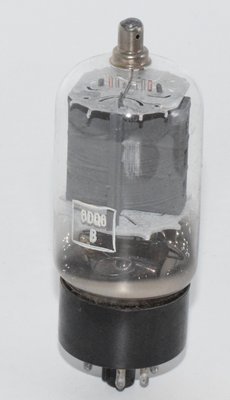
The 6DQ6B is a beam power pentode (beam tetrode) originally designed for use as a horizontal-deflection amplifier in television receivers. It belongs to the well-known 6DQ6 family of tubes, which evolved through several iterations — the original 6DQ6, the 6DQ6-A, and finally the 6DQ6B — each revision bringing improved ratings and reliability. The 6DQ6B represents the final and most robust version of this lineage, featuring an increased maximum plate dissipation of 18 watts (up from 15 watts in the 6DQ6-A) and a slightly higher screen dissipation rating of 3.6 watts (versus 3.0 watts for the 6DQ6-A).
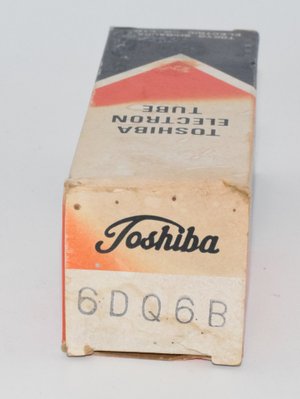
Manufactured by numerous companies worldwide — including General Electric, RCA, Sylvania, Philips Miniwatt, Toshiba, and AWV (Amalgamated Wireless Valve Company) in Australia — the 6DQ6B was a staple of television production throughout the 1950s and 1960s. Its high zero-bias plate current at low plate and screen voltages made it particularly well suited for TV sets operating at modest supply voltages. Like its predecessors, the 6DQ6B uses a cathode-coated unipotential construction and features a top-cap plate connection, a hallmark of high-voltage sweep tubes designed to handle the large pulse voltages encountered in horizontal deflection circuits.
While the tube was designed squarely for television service, its robust construction, generous power handling, and interesting transfer characteristics have attracted the attention of guitar amplifier builders and experimenters in the decades since its original application became obsolete. Today, NOS (New Old Stock) examples from manufacturers such as Toshiba, Philips Miniwatt, and AWV remain available on the surplus market.
Technical Specifications and Design
Heater / Filament
| Parameter | Value |
|---|---|
| Heater Voltage (AC or DC) | 6.3 V |
| Heater Current | 1.2 A |
The 6DQ6B shares the same 6.3 V / 1.2 A heater ratings as the original 6DQ6-A. Companion types with different heater voltages include the 12DQ6B (12.6 V / 0.6 A) and 17DQ6B (16.8 V / 0.45 A), which incorporate controlled warm-up characteristics for series-string television heater chains.
Maximum Ratings
| Parameter | 6DQ6B | Unit |
|---|---|---|
| Maximum Plate Dissipation | 18 | Watts |
| Maximum Screen (Grid 2) Dissipation | 3.6 | Watts |
| DC Plate-Supply Voltage (Boost + DC) | 700 * | Volts |
| Peak Positive Pulse Plate Voltage | 6000 * | Volts |
| Peak Negative Pulse Plate Voltage | 1375 * | Volts |
| Screen Voltage | 200 | Volts |
| Negative DC Grid-1 Voltage | 50 * | Volts |
| Peak Negative Grid-1 Voltage | 300 * | Volts |
| DC Cathode Current | 140 * | mA |
| Peak Cathode Current | 440 * | mA |
| Grid-1 Circuit Resistance (Grid-Leak Bias) | 1.0 * | MΩ |
| Bulb Temperature at Hottest Point | 220 * | °C |
* Values marked with an asterisk are carried over from the 6DQ6-A datasheet for horizontal-deflection service. The key improvements of the 6DQ6B over the 6DQ6-A are the increased plate dissipation (18 W vs. 15 W) and screen dissipation (3.6 W vs. 3.0 W). Other maximum ratings should be confirmed against a specific 6DQ6B manufacturer datasheet, though they are generally understood to be identical or very similar to the 6DQ6-A values.
Direct Interelectrode Capacitances
| Parameter | Value | Unit |
|---|---|---|
| Grid-1 to Plate (Cga) | 0.5 | pF |
| Input (Cgk) | 15 | pF |
| Output (Cak) | 7.0 | pF |
Typical Operating Characteristics (RF Power Amplifier, Class C)
| Parameter | Value | Unit |
|---|---|---|
| Plate Voltage | 400 | Volts |
| Screen Voltage (Grid 2) | 200 | Volts |
| Grid-1 Voltage | −40 | Volts |
| Plate Current | 100 | mA |
| Screen Current | 12 | mA |
| Transconductance (gm) | 7.3 | mA/V |
| Power Output | 25 | Watts |
Additional Characteristic Data (from 6DQ6-A datasheet, applicable to 6DQ6B)
| Condition | Plate Voltage | Screen Voltage | Grid-1 Voltage | Plate Current | Screen Current | Plate Resistance | Transconductance |
|---|---|---|---|---|---|---|---|
| Low Voltage | 60 V | 150 V | 0 V | 300 mA | 27 mA | — | — |
| High Voltage | 250 V | 150 V | −22.5 V | 75 mA | 2.4 mA | 20,000 Ω | 6,600 µmhos |
The triode amplification factor (µ), measured with the screen tied to the plate at Eb = Ec2 = 150 V and Ec1 = −22.5 V, is approximately 4.1. The grid-1 voltage for Ib = 1.0 mA cutoff is approximately −46 V under these conditions.
Mechanical and Physical Details
| Parameter | Detail |
|---|---|
| Base | Octal (B7-119, Short Medium-Shell Octal 7-Pin) |
| Envelope | T-12, Glass |
| Top Cap | C1-3, Skirted Miniature (Plate connection) |
| Cathode Type | Cathode-Coated Unipotential |
| Mounting Position | Any |
| Overall Height (max) | Approximately 4¼ inches |
| Seated Height | Approximately 3½ inches ± 3/16" |
Pin-Out (RETMA 6AM Basing)
| Pin | Connection |
|---|---|
| Pin 1 | No Connection |
| Pin 2 | Heater |
| Pin 3 | No Connection |
| Pin 4 | Grid Number 2 (Screen) |
| Pin 5 | Grid Number 1 (Control Grid) |
| Pin 7 | Heater |
| Pin 8 | Cathode and Beam Plates |
| Top Cap | Plate (Anode) |
Note: Pin 6 is the key pin on the octal base and has no electrical connection. The plate is brought out through a top cap to maintain adequate insulation for the high pulse voltages encountered in horizontal-deflection service.
Applications and Usage
Original Television Application
The 6DQ6B was primarily designed as a horizontal-deflection output tube in television receivers. In this role, it operated as a switch, driving the horizontal deflection yoke with sawtooth current waveforms. The tube had to withstand extreme peak plate voltages — up to 6,000 volts positive pulse — while delivering the substantial peak cathode currents (up to 440 mA) needed to drive the yoke. The controlled heater warm-up time of the companion 12DQ6B and 17DQ6B types made them particularly suitable for series-string heater configurations common in "transformerless" (AC/DC) television sets.
RF Power Amplifier
The 6DQ6B found significant secondary use as an RF power amplifier, particularly in amateur (ham) radio transmitters. With a plate voltage of 400 V and screen voltage of 200 V in Class C service, the tube can deliver 25 watts of output power with a transconductance of 7.3 mA/V. Its relatively low cost and wide availability made it a popular choice for QRP and medium-power transmitter stages, especially on the HF bands.
Audio Amplifier Use
Although never intended as an audio output tube, the 6DQ6B has been adopted by DIY amplifier builders and guitar amp designers. Its 18-watt plate dissipation, robust construction, and high transconductance make it capable of delivering useful audio power in single-ended or push-pull configurations. The top-cap plate connection adds some construction complexity but also provides excellent insulation and reduces stray capacitance at the plate terminal.
Sound Characteristics
The 6DQ6B was never designed with audio fidelity in mind, and its sonic character reflects its origins as a sweep tube. However, builders and listeners who have employed it in audio circuits report a distinctive set of tonal qualities:
- Midrange Presence: The 6DQ6B tends to produce a forward, assertive midrange. The beam power pentode structure, combined with its relatively high transconductance of 7.3 mA/V, contributes to a punchy, immediate quality in the vocal and guitar frequency ranges.
- Aggressive Overdrive: When pushed into clipping, sweep tubes like the 6DQ6B tend to produce a harder, more abrupt transition into distortion compared to purpose-designed audio tubes like the 6L6 or EL34. This gives the tube a raw, gritty overdrive character that some guitar players find appealing for aggressive rock and blues tones.
- Bass Response: The low-frequency performance is generally described as tight but somewhat lean compared to premium audio output pentodes. The relatively high plate resistance (approximately 20,000 ohms) means that without careful output transformer matching and negative feedback, bass damping can be less controlled.
- Treble Character: The high-frequency response can be somewhat bright and edgy, with a certain "glassiness" that is characteristic of many sweep tubes used in audio service. This can be tamed with appropriate circuit design and output transformer selection.
- Dynamic Response: The tube's ability to handle large peak currents (440 mA peak cathode current) gives it good transient response and dynamic headroom, contributing to a lively, responsive feel under the fingers of a guitar player.
Overall, the 6DQ6B is not typically described as "refined" or "warm" in the way that classic audio tubes are. Its character is better described as raw, energetic, and somewhat rough around the edges — qualities that can be either a virtue or a limitation depending on the application.
Equivalent or Substitute Types
The following tubes are related to the 6DQ6B but are not direct drop-in replacements without consideration of their differing ratings:
| Type | Relationship | Key Differences |
|---|---|---|
| 6DQ6 | Original version | Lower plate and screen dissipation ratings. Same pinout and heater. Different rating substitute, not a drop-in for circuits designed to the 6DQ6B's higher ratings. |
| 6DQ6-A (6DQ6A) | Improved version | Plate dissipation 15 W (vs. 18 W), screen dissipation 3.0 W (vs. 3.6 W). Same pinout and heater. Can generally be substituted in circuits that do not push the 6DQ6B's higher dissipation limits. |
| 12DQ6B | 12.6 V heater variant | Identical internal structure but heater is 12.6 V at 0.6 A. Has controlled 11-second warm-up time. Not interchangeable without heater circuit modification. |
| 17DQ6B | 16.8 V heater variant | Identical internal structure but heater is 16.8 V at 0.45 A. Has controlled 11-second warm-up time. Designed for series-string TV sets. Not interchangeable without heater circuit modification. |
Other sweep tubes with broadly similar characteristics but different pinouts or ratings that are sometimes mentioned in the same context include the 6GW6, 6HB5, and 6JE6/6LQ6, though none of these are direct substitutes for the 6DQ6B.
Important Note: When substituting within the 6DQ6 family, always verify that the circuit's operating conditions do not exceed the maximum ratings of the substitute tube. The 6DQ6B's higher dissipation ratings mean that a 6DQ6 or 6DQ6-A substituted into a circuit designed for the 6DQ6B may be operated beyond its safe limits.
Notable Characteristics
- Top-Cap Plate Connection: The plate is brought out through a top cap (C1-3 skirted miniature type) rather than through a base pin. This was essential for the high-voltage pulse service in television horizontal deflection, where peak plate voltages could reach 6,000 volts. For audio use, this requires a top-cap connector and appropriate high-voltage wiring practices.
- High Zero-Bias Plate Current: At zero grid-1 bias with 60 V on the plate and 150 V on the screen, the tube draws approximately 300 mA of plate current. This characteristic, while useful in sweep service, means that the tube must always be operated with adequate negative bias in audio applications to prevent excessive dissipation.
- Beam Power Construction: The 6DQ6B uses beam-forming plates connected internally to the cathode (both brought out on pin 8). This beam power design provides pentode-like characteristics with lower screen current and reduced screen dissipation compared to a true pentode of similar power capability.
- Robust Construction: Designed to withstand the mechanical and thermal stresses of television sweep service, the 6DQ6B features a sturdy internal structure that contributes to long service life and resistance to microphonics — a useful trait in audio applications.
- Improved Ratings Over Predecessors: The 6DQ6B's 18-watt plate dissipation and 3.6-watt screen dissipation represent a 20% improvement over the 6DQ6-A's 15 W and 3.0 W ratings respectively, providing additional operating margin in demanding applications.
- Low Grid-1 to Plate Capacitance: The Cga of only 0.5 pF, combined with the top-cap plate connection, provides excellent isolation between input and output circuits, reducing the tendency toward parasitic oscillation in RF amplifier service.
Usage in the Audio Community
The 6DQ6B occupies a niche position in the audio world, primarily among DIY builders, experimenters, and guitar amplifier enthusiasts rather than in mainstream high-fidelity audio. Its appeal stems from several factors:
Guitar Amplifiers
The 6DQ6B has found its most enthusiastic audio following among guitar amplifier builders. Its raw, aggressive overdrive character and substantial power handling make it an interesting alternative to more conventional output tubes. Several small-scale and boutique amplifier builders have designed circuits around sweep tubes like the 6DQ6B, attracted by their low cost on the surplus market and their distinctive tonal character. The tube's ability to deliver approximately 15–20 watts in a push-pull audio configuration places it in the sweet spot for practice and small-venue amplifiers.
DIY and Experimental Hi-Fi
Some adventurous DIY audio builders have experimented with the 6DQ6B in single-ended (SE) and push-pull hi-fi amplifier designs. The tube's 18-watt plate dissipation allows a single-ended amplifier to produce several watts of Class A power, sufficient for use with high-efficiency speakers. However, the tube's relatively high plate resistance of approximately 20,000 ohms means that output transformer selection is critical, and negative feedback is typically required to achieve acceptable damping factor and frequency response in hi-fi applications.
Practical Considerations for Audio Use
- Output Transformer: The high plate resistance requires a carefully matched output transformer. Primary impedances in the range of 5,000–8,000 ohms are commonly used for push-pull configurations, though optimal values depend on the specific operating point chosen.
- Bias Requirements: The tube's high zero-bias current makes fixed bias strongly recommended for audio use. Cathode bias can be used but requires a substantial cathode resistor to develop the necessary negative voltage (approximately −22.5 V to −40 V depending on plate and screen voltages).
- Top-Cap Wiring: The plate top-cap connection requires appropriate high-voltage wiring and a suitable top-cap connector. Builders should use adequately insulated wire and maintain proper clearances from the chassis and other components.
- Availability and Cost: NOS 6DQ6B tubes remain widely available from surplus dealers at modest prices compared to sought-after audio tubes like the 6L6GC or EL34. Manufacturers represented in the NOS market include Toshiba, Philips Miniwatt, AWV (Super Radiotron), and various American brands. Matched pairs are available for push-pull applications.
- Triode Mode Operation: The 6DQ6B can be operated in triode mode by connecting the screen to the plate. With a triode amplification factor of approximately 4.1, this configuration produces lower power but may offer a smoother, more linear tonal character preferred by some listeners.
Community Perspective
The audio community generally views the 6DQ6B as an interesting and affordable tube for experimentation rather than a serious contender for high-end audio reproduction. Its strengths — low cost, wide availability, robust construction, and distinctive tonal character — make it an excellent choice for builders who enjoy exploring unconventional tube types. For guitar amplifier use, where a degree of harmonic distortion is desirable, the 6DQ6B's raw character can be a genuine asset. For hi-fi applications, it requires more careful circuit design to achieve refined results, but capable builders have demonstrated that musically satisfying amplifiers can be built around this humble television sweep tube.