Introduction and History
The 6DT8 is a miniature, high-mu twin triode vacuum tube designed by General Electric in the late 1950s, with the original datasheet (ET-T1549) dated June 1959. It was developed primarily for use as a radio-frequency amplifier and as a combined oscillator and mixer in FM receivers. The tube's incorporation of an internal shield was a notable design feature that contributed to stable performance as a high-frequency amplifier, making it particularly well-suited for the front-end stages of FM tuners and receivers.
The 6DT8 was part of a family that included the 12DT8, which is electrically identical in all respects except for its heater ratings — the 12DT8 operates with a 12.6-volt heater at 0.15 amperes, while the 6DT8 uses a 6.3-volt heater at 0.3 amperes. This dual offering allowed equipment designers to choose the appropriate heater voltage for their power supply topology, whether series-string (12V) or parallel (6.3V) heater configurations.
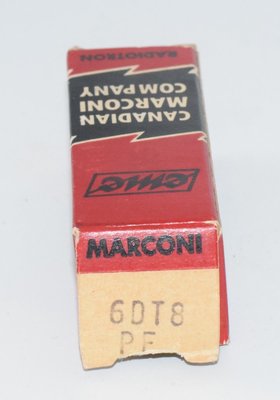
Manufactured by General Electric, Marconi Canada, and other producers, the 6DT8 found widespread use in high-quality FM tuners throughout the 1960s and into the 1970s. Its high amplification factor of 60 and respectable transconductance made it an excellent choice for low-noise RF and IF amplification stages.
Technical Specifications and Design
General Electrical Data
| Parameter | 6DT8 | 12DT8 |
|---|---|---|
| Cathode Type | Coated, Unipotential | |
| Heater Voltage (AC or DC) | 6.3 Volts | 12.6 Volts |
| Heater Current | 0.3 Amperes | 0.15 Amperes |
Direct Interelectrode Capacitances (approximate)
| Parameter | Section 1 | Section 2 |
|---|---|---|
| Grid to Plate | 1.6 µµf | 1.6 µµf |
| Input | 2.7 µµf | 2.7 µµf |
| Output | 1.6 µµf | 1.6 µµf |
| Heater to Cathode | 3.0 µµf | 3.0 µµf |
| Grounded-Grid Input† | 5.3 µµf | |
| Grounded-Grid Output† | 2.8 µµf | |
* With external shield (EIA 315) connected to cathode of section under test unless otherwise indicated.
† With external shield (EIA 315) connected to grid.
Maximum Ratings (Design-Center Values, Each Section)
| Parameter | Value |
|---|---|
| Plate Voltage | 300 Volts |
| Negative DC Grid Voltage | 50 Volts |
| Plate Dissipation | 2.5 Watts |
| Heater-Cathode Voltage (Heater Positive, DC Component) | 100 Volts |
| Heater-Cathode Voltage (Heater Positive, Total DC and Peak) | 200 Volts |
| Heater-Cathode Voltage (Heater Negative, Total DC and Peak) | 200 Volts |
| Grid Circuit Resistance (Fixed Bias) | 0.25 Megohms |
| Grid Circuit Resistance (Cathode Bias) | 1.0 Megohms |
Class A₁ Amplifier Characteristics and Typical Operation (Each Section)
| Parameter | Condition 1 | Condition 2 |
|---|---|---|
| Plate Voltage | 100 Volts | 250 Volts |
| Cathode-Bias Resistor | 270 Ohms | 200 Ohms |
| Amplification Factor (µ) | 60 | 60 |
| Plate Resistance (approximate) | 15,000 Ohms | 10,900 Ohms |
| Transconductance (gm) | 4,000 Micromhos | 5,500 Micromhos |
| Plate Current | 3.7 mA | 10 mA |
| Grid Voltage (approximate, Ib = 10 µA) | −5 Volts | −12 Volts |
Mechanical Data
- Mounting Position: Any
- Envelope: T-6½, Glass
- Base: E9-1, Small Button 9-Pin (Noval)
- Maximum Diameter: 7/8 inch
- Maximum Seated Height: 2 3/16 inches
- Basing Diagram: EIA 9DE
Pin Connections
| Pin | Connection |
|---|---|
| Pin 1 | Plate (Section 2) |
| Pin 2 | Grid (Section 2) |
| Pin 3 | Cathode (Section 2) |
| Pin 4 | Heater |
| Pin 5 | Heater |
| Pin 6 | Plate (Section 1) |
| Pin 7 | Grid (Section 1) |
| Pin 8 | Cathode (Section 1) |
| Pin 9 | Internal Shield |
Applications and Usage
The 6DT8 was designed with several specific applications in mind, all centered around its high-mu characteristics and internal shielding:
- FM Receiver RF Amplifier: The tube's primary intended application was as a radio-frequency amplifier in FM receivers. Its high transconductance of 5,500 micromhos at 250V plate voltage provided excellent gain, while the internal shield between the two triode sections minimized unwanted coupling and ensured stable operation at FM frequencies (88–108 MHz).
- Combined Oscillator-Mixer: The dual triode configuration made the 6DT8 ideal for use as a combined local oscillator and mixer in FM front-end circuits. One section could serve as the local oscillator while the other functioned as the mixer, with the internal shield providing essential isolation between the two functions.
- High-Frequency Amplifier: The low interelectrode capacitances (grid-to-plate capacitance of only 1.6 µµf per section) and the internal shield made this tube suitable for general high-frequency amplification duties beyond just FM reception.
- Grounded-Grid Amplifier: The datasheet specifically provides grounded-grid input and output capacitance figures (5.3 µµf and 2.8 µµf respectively), indicating that the tube was also intended for grounded-grid RF amplifier configurations, which were common in high-quality FM tuner front ends for their excellent noise performance.
- Cascode Amplifier: The two matched triode sections could be configured in a cascode arrangement, providing high gain with low noise — a topology frequently employed in premium FM tuner designs of the era.
The 6DT8 appeared in numerous FM tuners and receivers from the late 1950s through the 1960s, manufactured by companies such as Fisher, Scott, Marantz, and others who were producing high-fidelity FM equipment during the golden age of tube-based hi-fi.
Sound Characteristics
While the 6DT8 was designed primarily as an RF/IF tube rather than an audio amplification tube, its sonic characteristics are relevant in several contexts — particularly when used in audio preamplifier stages, phono stages, or line-level circuits where experimenters have repurposed it for audio duties.
Tonal Qualities
The 6DT8's high amplification factor of 60 places it in the high-mu triode category, similar in character to tubes like the 12AX7 (µ=100) but with a somewhat lower gain and different harmonic signature. Users and experimenters who have employed the 6DT8 in audio circuits report the following characteristics:
- Clean and Detailed: The relatively high transconductance (5,500 µmhos at 250V) and moderate plate resistance (10,900 ohms) give the 6DT8 a clean, articulate sound with good detail retrieval. The tube does not tend toward excessive warmth or coloration at moderate signal levels.
- Extended High Frequencies: Owing to its design heritage as an RF tube, the 6DT8 exhibits excellent high-frequency response with low interelectrode capacitances. This translates to an airy, open top end when used in audio circuits.
- Moderate Warmth: With a µ of 60, the 6DT8 sits between the lush warmth of lower-mu triodes (like the 12AU7 at µ=17) and the higher-gain, sometimes edgier character of the 12AX7. This gives it a balanced tonal character that many find musical without being overly colored.
- Low Microphonics: The miniature T-6½ glass envelope and robust internal construction contribute to relatively low microphonic sensitivity, which is beneficial in high-gain audio applications.
- Harmonic Structure: Like most triodes, the 6DT8 produces predominantly even-order harmonics (primarily second harmonic) when driven into mild nonlinearity, which is perceived as musically pleasant. The harmonic distortion profile is gentle and progressive.
It should be noted that the 6DT8's sonic character in audio applications is somewhat dependent on the specific operating point chosen. At the lower plate voltage condition (100V, 3.7 mA), the sound tends to be slightly softer and warmer, while at the higher plate voltage condition (250V, 10 mA), the tube delivers more dynamic headroom and a tighter, more controlled presentation.
Equivalent or Substitute Types
The 6DT8 occupies a somewhat specialized niche, and direct equivalents are limited:
- 12DT8: This is the direct electrical equivalent with a 12.6V / 0.15A heater instead of the 6DT8's 6.3V / 0.3A heater. All other specifications are identical. The 12DT8 is a direct drop-in replacement in circuits designed for 12.6V heater supplies, and vice versa — provided the heater supply voltage matches.
- 6BK8 / 6BQ8: These are sometimes mentioned as related types for FM front-end applications, though they are not pin-for-pin equivalents and have different electrical characteristics. Any substitution would require circuit modifications.
- ECC85 (6AQ8): Another high-frequency twin triode designed for FM applications with a similar intended use case, but with different specifications and pinout. Not a direct substitute without circuit redesign.
Important Note: The 6DT8's unique pinout (EIA 9DE basing) with the internal shield on pin 9 means that substitution with other 9-pin twin triodes is generally not possible without verifying pin compatibility. The internal shield connection is critical to the tube's intended performance, and many other twin triodes do not share this feature or this specific basing arrangement. Always verify pin connections before attempting any substitution.
Notable Characteristics
- Internal Shield: The most distinctive feature of the 6DT8 is its internal shield (connected to pin 9), which provides isolation between the two triode sections. This was a key design element that enabled stable high-frequency operation and made the tube particularly effective in FM front-end circuits where oscillator-to-mixer isolation was critical.
- Consistent Amplification Factor: The µ of 60 remains constant across both tested operating conditions (100V and 250V plate voltage), indicating excellent linearity and a well-designed electrode structure.
- Matched Sections: Both triode sections share identical interelectrode capacitance specifications (1.6 µµf grid-to-plate, 2.7 µµf input, 1.6 µµf output), indicating careful manufacturing to ensure section-to-section matching — important for balanced circuit applications.
- Versatile Operating Range: The tube operates well across a wide range of plate voltages, from 100V to the maximum of 300V, with the characteristic curves showing well-behaved, evenly-spaced grid lines indicating good linearity throughout the operating range.
- Low Plate Dissipation Limit: At 2.5 watts per section (5 watts total for both sections), the 6DT8 is a small-signal tube. This is consistent with its intended use in voltage amplification stages rather than power output stages.
- Heater-Cathode Voltage Ratings: The generous heater-cathode voltage ratings (100V DC positive, 200V peak in either polarity) allow the tube to be used in circuits where the cathode operates at elevated DC potentials, which is common in series-string television and radio receiver designs.
- Transconductance Variation: The transconductance varies significantly with operating point — from 4,000 µmhos at 100V plate voltage to 5,500 µmhos at 250V — as shown in the average characteristics curves. This is typical of high-mu triodes and should be considered when designing circuits for specific gain requirements.
Usage in the Audio Community
While the 6DT8 was not originally designed as an audio tube, it has found a dedicated following among certain segments of the audio community:
FM Tuner Restoration
The most common audio-related use of the 6DT8 remains in the restoration and maintenance of vintage FM tuners from the late 1950s and 1960s. High-fidelity FM tuners from manufacturers like Fisher, Scott, Marantz, McIntosh, and others frequently employed the 6DT8 in their RF front-end stages. Audiophiles restoring these classic tuners seek out NOS (New Old Stock) 6DT8 tubes from quality manufacturers like General Electric, RCA, Amperex, and Mullard to maintain or improve the performance of these vintage units. The quality of the front-end tube directly affects the tuner's sensitivity, selectivity, and signal-to-noise ratio, all of which impact the ultimate audio quality.
DIY Audio Experimentation
The 6DT8's high mu of 60 and respectable transconductance of 5,500 µmhos make it an interesting candidate for DIY audio preamplifier and line-stage projects. Some experimenters have used the 6DT8 in:
- Phono Preamplifiers: The high gain per stage and low noise characteristics (inherited from its RF heritage) make the 6DT8 suitable for RIAA phono stage designs, where it can provide sufficient gain for moving-magnet cartridges.
- Line-Level Preamplifiers: With both triode sections available, a single 6DT8 can provide two stages of amplification in a line-level preamp, with the internal shield offering additional isolation between stages.
- Headphone Amplifiers: Some DIY builders have experimented with the 6DT8 in hybrid headphone amplifier designs, using the tube for voltage gain and solid-state devices for current output.
Availability and Market
The 6DT8 is not among the most commonly sought-after audio tubes, which works in favor of those who wish to use it — NOS examples can often be found at reasonable prices compared to the highly inflated market for popular audio types like the 12AX7 or 6SN7. General Electric examples are the most commonly encountered, as GE was the primary manufacturer. Marconi Canada also produced the 6DT8. The tube's relative obscurity in the audio world means that high-quality NOS specimens are still available from tube dealers and online marketplaces at modest cost.
Comparative Context
In the audio community, the 6DT8 is sometimes compared to other high-mu twin triodes:
- Compared to the 12AX7/ECC83 (µ=100, gm≈1,600 µmhos), the 6DT8 offers lower voltage gain but significantly higher transconductance, resulting in lower output impedance and better ability to drive subsequent stages or loads.
- Compared to the 12AT7/ECC81 (µ=60, gm≈5,500 µmhos), the 6DT8 shares remarkably similar specifications. However, the different pinout and the internal shield of the 6DT8 distinguish it, and the two are not pin-compatible.
- The 6DT8's combination of µ=60 and gm=5,500 µmhos gives it a plate resistance of approximately 10,900 ohms at 250V — a value that provides a good balance between gain and output impedance for driving typical audio loads.
While the 6DT8 will never rival the 12AX7 or 6SN7 in terms of audio community popularity, it remains a capable and underappreciated tube that rewards those willing to design circuits around its specific characteristics. Its RF heritage gives it inherently low noise and excellent high-frequency performance — qualities that translate well into audio applications demanding transparency and detail.