1. Introduction and History
The 6EA8 is a medium-mu dual triode vacuum tube that gained prominence during the 1950s and 1960s, primarily as a converter tube in radio frequency (RF) applications. Manufactured by major tube producers including Philips Miniwatt, RCA, Mullard, and Telefunken, the 6EA8 represents a significant advancement in miniaturized tube design for consumer electronics.
The tube was developed during the post-World War II era when the electronics industry sought more compact and efficient solutions for AM/FM radio receivers and television tuners. The dual-triode configuration allowed designers to combine multiple functions within a single envelope, reducing component count and improving reliability. The 6EA8 became a standard component in European and American radio manufacturing throughout the 1950s-1970s, with particular popularity in FM tuner sections where its frequency conversion capabilities proved invaluable.
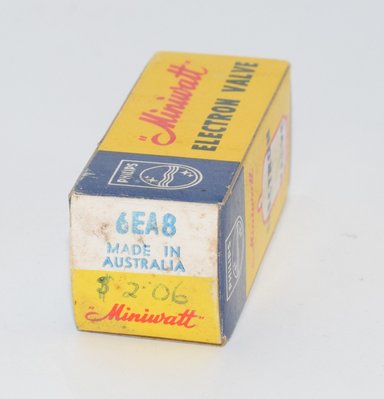
The Philips Miniwatt 6EA8 represented some of the finest examples of this tube type, known for exceptional build quality and consistent performance characteristics that made them highly sought after by vintage radio enthusiasts and audio professionals.
2. Technical Specifications and Design
Tube Type and Configuration
The 6EA8 is classified as a medium-mu dual triode, meaning it contains two independent triode sections within a single glass envelope. The designation "6" indicates a 6.3-volt heater supply, while "EA8" identifies the specific tube type and its functional characteristics.
Physical Specifications
- Heater Voltage: 6.3V AC nominal
- Heater Current: 0.45A per triode section
- Envelope Type: Noval (9-pin miniature)
- Dimensions: Approximately 2.75 inches (70mm) in height
- Weight: Approximately 0.5 ounces (14 grams)
Electrical Characteristics
Per Triode Section:
- Maximum Plate Voltage: 330V
- Maximum Plate Dissipation: 1.2W
- Amplification Factor (μ): 20 (medium-mu classification)
- Plate Resistance (rp): Approximately 5,000-7,000 ohms
- Transconductance (gm): 2.8-3.2 mA/V
- Grid Bias Range: -2V to -16V typical
Pin Configuration
The 6EA8 employs a standard noval (9-pin) configuration:
- Pin 1: Plate 1 (Triode 1)
- Pin 2: Grid 1 (Triode 1)
- Pin 3: Cathode 1 (Triode 1)
- Pin 4: Heater
- Pin 5: Heater
- Pin 6: Plate 2 (Triode 2)
- Pin 7: Grid 2 (Triode 2)
- Pin 8: Cathode 2 (Triode 2)
- Pin 9: No connection (NC)
Design Features
The 6EA8 incorporates several design elements that contributed to its widespread adoption:
- Dual Triode Configuration: Two independent triode sections allow for oscillator and mixer functions in a single tube, or parallel amplification configurations
- Medium-Mu Classification: The moderate amplification factor provides a good balance between gain and stability
- Miniature Envelope: The noval design reduces physical size compared to octal tubes, enabling compact receiver designs
- Robust Construction: Heavy-duty internal structure and quality cathode materials ensure reliable operation under demanding conditions
- Low Microphonics: Carefully designed electrode spacing minimizes microphonic feedback, important for RF applications
3. Applications and Usage
Original Radio and Television Applications
The 6EA8 was primarily designed for use as a converter tube in FM radio tuners and television receivers. In FM tuner applications, one triode section typically functioned as a local oscillator while the other served as a mixer stage, converting incoming RF signals to an intermediate frequency (IF) for further processing. This configuration proved highly effective for consumer-grade receivers where cost and component count were critical factors.
In television sets, the 6EA8 found application in both VHF and UHF tuner sections, where its dual-triode design allowed efficient frequency conversion across the broadcast bands. The tube's moderate gain and low noise characteristics made it particularly suitable for these critical front-end applications.
Audio Community Applications
Within the vintage audio community, the 6EA8 has found renewed interest among enthusiasts and professionals engaged in tube audio restoration and design:
- Vintage Radio Restoration: Collectors and restorers of classic AM/FM radios routinely seek quality 6EA8 tubes to restore original functionality and performance. The Philips Miniwatt variants are particularly prized for their sonic qualities and reliability in period-correct restorations
- Tube Preamplifier Design: Audio engineers have discovered that the 6EA8's dual-triode configuration offers interesting possibilities for low-noise preamplifier stages. Some boutique audio manufacturers have incorporated 6EA8s into microphone preamplifiers and line preamps, where the tube's moderate gain and warm sonic character prove advantageous
- DIY Audio Projects: The 6EA8 has become popular in DIY audio circles for experimental amplifier and preamp designs. Its availability in NOS (New Old Stock) condition, particularly Philips examples, makes it accessible for hobbyist builders seeking vintage tube characteristics
- Guitar Amplifier Applications: Some boutique guitar amplifier manufacturers have explored the 6EA8 in low-power amp designs and reverb recovery circuits, where its warm midrange and natural compression characteristics complement instrument amplification
- Tone Stack Drivers: Audio designers appreciate the 6EA8's suitability as a tone stack driver in guitar and bass amplifiers, where its moderate output impedance and gain characteristics provide excellent tone shaping capabilities
- Hybrid Audio Systems: In hybrid amplifier designs combining tubes and solid-state components, the 6EA8 serves as an economical yet sonically pleasing front-end stage, bridging analog warmth with modern efficiency
Sound Characteristics in Audio Applications
Sonic Profile: The 6EA8 exhibits distinctive sonic characteristics that have earned it a devoted following among tube audio enthusiasts:
- Midrange Warmth: The 6EA8 is renowned for its smooth, warm midrange presentation. This characteristic makes it particularly valued in preamp applications where vocal clarity and instrumental texture are paramount
- Natural Compression: The tube exhibits a subtle, musical compression characteristic that adds cohesion to audio signals without obvious dynamic processing. This quality appeals to audio professionals seeking transparent yet musical signal conditioning
- Low Distortion Profile: When properly biased and operated within ratings, the 6EA8 produces remarkably low harmonic distortion, with a predominance of lower-order harmonics that are generally perceived as musically pleasant
- Extended Frequency Response: Despite its vintage design, the 6EA8 demonstrates extended frequency response suitable for modern audio applications, with smooth roll-off at the extremes rather than harsh cutoff
- Noise Performance: Quality examples, particularly Philips Miniwatt tubes, exhibit exceptionally low noise floors, making them suitable for sensitive microphone preamp applications
- Dynamic Character: The tube responds well to dynamic program material, with a natural "breathing" quality that many engineers describe as musical and engaging
Operational Considerations for Audio Use:
- The 6EA8 requires careful biasing for optimal sonic performance in audio applications, with different bias points yielding varying harmonic structures
- Load impedance selection significantly affects tone, with higher impedances generally producing warmer, more colored output, while lower impedances yield cleaner, more neutral characteristics
- The tube benefits from quality output coupling, as its moderate output impedance interacts significantly with coupling component values
- Proper cathode bypass capacitor selection in cathode-biased configurations substantially influences the tube's gain and frequency response
4. Equivalent or Substitute Types
Direct Equivalents
- 6GH8A: A closely related dual triode with slightly higher plate dissipation rating, often suitable as a substitute with minor circuit modifications
- ECL84: European equivalent designation for essentially the same tube type, commonly found in vintage European equipment
- 6N1P: Soviet-era equivalent with similar electrical characteristics, though generally exhibiting higher noise and slightly different sonic coloration
Functional Alternatives
- 12AX7/ECC83: While not pin-compatible, these dual triodes can replace 6EA8s in many audio applications with appropriate circuit modifications, offering higher gain
- 6DJ8/ECH84: Another dual triode option for specific applications, though with different electrical characteristics requiring circuit redesign
- 12AU7/ECC82: A lower-gain dual triode suitable for applications where less amplification is desired
Substitution Guidelines
When considering substitutes for the 6EA8, engineers must account for differences in:
- Heater current requirements
- Maximum plate voltage and dissipation ratings
- Amplification factor and transconductance
- Plate resistance and output impedance
- Frequency response characteristics
Direct substitution without circuit modification is generally not recommended except between the 6EA8 and ECL84, which are essentially identical tubes with different designation systems.
5. Notable Characteristics
Reliability and Longevity
The 6EA8 is renowned for exceptional reliability, with many examples remaining functional after 50+ years of operation. This durability stems from robust internal construction, quality materials, and conservative electrical ratings. Properly stored NOS tubes often exhibit no measurable degradation in electrical characteristics.
Philips Miniwatt Quality
Philips Miniwatt 6EA8 tubes represent the pinnacle of this tube type's engineering. These examples typically feature:
- Superior electrode geometry for minimal microphonics
- High-purity cathode materials for extended life
- Precision-wound filament for uniform heating
- Exceptional consistency between production batches
- Lower noise floors than competing manufacturers
- Superior frequency response linearity
- More musical harmonic structure in audio applications
Availability and Pricing
NOS 6EA8 tubes remain relatively available in the vintage tube market, with Philips Miniwatt examples commanding premium prices reflecting their superior performance. Pricing typically ranges from moderate for tested used tubes to significantly higher for certified NOS examples, particularly those with original packaging and documentation.
Identification and Authentication
Authentic Philips Miniwatt 6EA8 tubes feature:
- Clear "Philips" branding on the glass envelope
- "Miniwatt" designation printed below the Philips logo
- Precise "6EA8" type designation
- Manufacturing date codes (typically printed on the side)
- Consistent, high-quality printing without smudging or irregularities
- Clean, clear glass envelope free of internal contamination
- Original box with matching serial numbers (when available)
Storage and Handling
To preserve 6EA8 tubes in optimal condition:
- Store in original packaging when possible, protecting from physical shock
- Maintain stable room temperature (60-75°F ideal)
- Avoid exposure to humidity extremes
- Keep away from strong magnetic fields
- Handle with clean hands or cotton gloves to prevent contamination
- Test periodically to verify continued functionality
Performance Metrics
Quality 6EA8 tubes typically exhibit:
- Leakage current: Less than 0.1 mA at rated voltage
- Gain (as amplifier): 15-25 times depending on load impedance
- Noise figure: Typically 10-15 dB in RF applications
- Microphonic index: Less than 5 mV/G in quality examples
- Frequency response: 20 Hz to beyond 100 kHz in audio applications
Conclusion
The 6EA8 dual triode represents a significant achievement in vacuum tube engineering, successfully combining functionality, reliability, and sonic performance in a compact package. While originally designed for RF applications in consumer radio and television, the tube has found renewed appreciation in the audio community, where its warm midrange characteristics, low noise, and musical harmonic structure make it valuable for preamp design, vintage radio restoration, and boutique audio applications.
The Philips Miniwatt variant stands as a particularly fine example of this tube type, offering the consistency and performance that discerning audio professionals and enthusiasts demand. For those engaged in vintage audio restoration or exploring tube-based audio design, the 6EA8 remains a worthy consideration, offering proven reliability paired with genuinely musical sonic characteristics that have earned it a permanent place in audio history.