Introduction and History
The 6EM7 is a dual triode vacuum tube (valve) manufactured by RCA and other producers, originally designed for use in television vertical-deflection circuits. What makes the 6EM7 unique among dual triodes is its dissimilar sections: it combines a high-mu (high amplification factor) triode unit with a low-mu (high current) triode unit within a single envelope. This asymmetric design was intentional — in television applications, the high-mu section served as the vertical-deflection oscillator while the beefy low-mu section functioned as the vertical-deflection output amplifier.
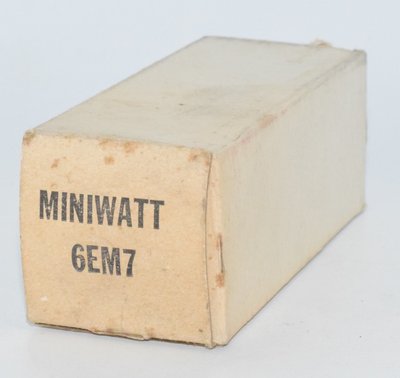
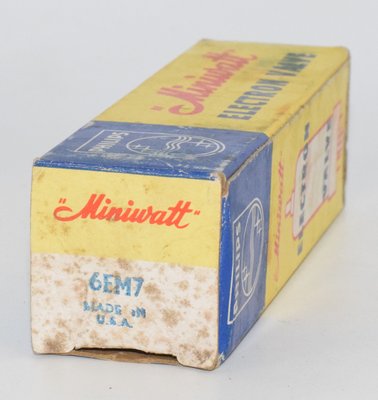
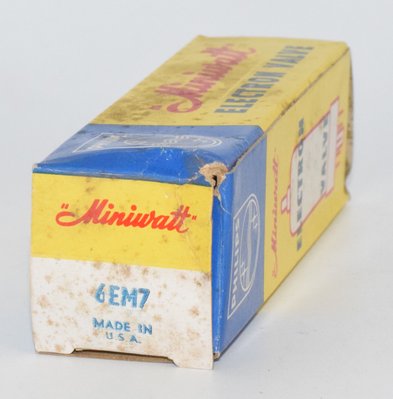
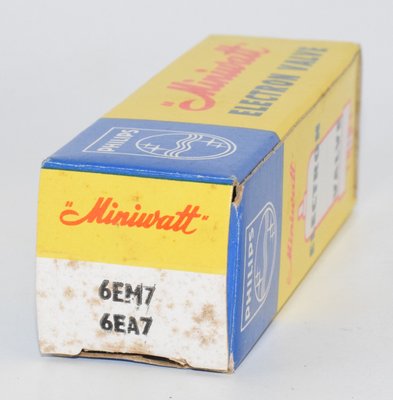
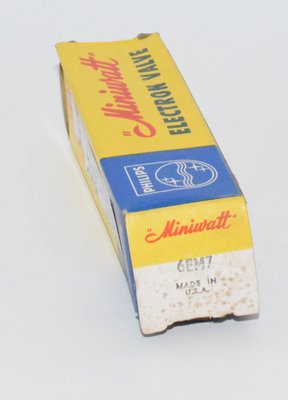
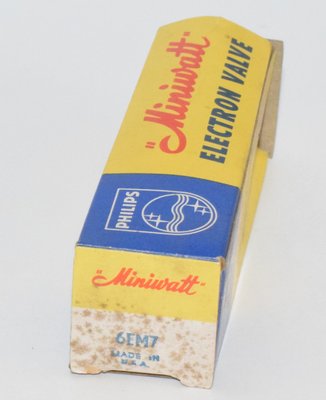
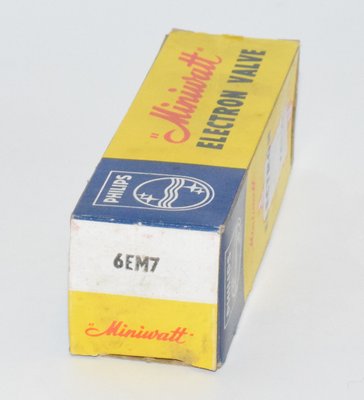
Introduced in the late 1950s by RCA's Electron Tube Division in Harrison, New Jersey, the 6EM7 was part of a family of dissimilar dual triodes developed for the increasingly sophisticated television receivers of the era. The RCA datasheet is dated August 1960 (with a revision in May 1961), placing its commercial introduction squarely in the golden age of American television tube development. The tube was manufactured by RCA, Philips/Miniwatt (both European and USA production), and other licensees.
While the 6EM7 was designed purely as a television component, its unusual combination of a voltage-amplifier triode and a power triode in one bottle has made it a fascinating subject for audio experimenters and DIY amplifier builders. The tube has enjoyed a remarkable second life in the audio community, where its availability, low cost, and unique dual-section topology have inspired numerous creative amplifier designs.
Technical Specifications and Design
General Electrical Data
| Parameter | Value |
|---|---|
| Heater Voltage (AC or DC) | 6.3 ± 10% volts |
| Heater Current (at 6.3V) | 0.925 A |
| Cathode Type | Unipotential (indirectly heated), separate cathodes |
Direct Interelectrode Capacitances (Approximate, without external shield)
| Capacitance | Unit No. 1 (High-Mu) | Unit No. 2 (Low-Mu) |
|---|---|---|
| Grid to Plate | 4.8 µµF | 10 µµF |
| Grid to Cathode and Heater | 2.2 µµF | 7 µµF |
| Plate to Cathode and Heater | 0.6 µµF | 1.8 µµF |
Unit No. 1 — High-Mu Triode Section (Pins 4, 5, 6)
Class A₁ Amplifier Characteristics
| Parameter | Value |
|---|---|
| Plate Voltage | 250 volts |
| Grid Voltage | −3 volts |
| Amplification Factor (µ) | 68 |
| Plate Resistance (Approx.) | 40,000 ohms |
| Transconductance (gm) | 1,600 µmhos (1.6 mA/V) |
| Plate Current | 1.4 mA |
| Grid Voltage (Approx.) for µa = 10 | −5.5 volts |
Maximum Ratings — Vertical-Deflection Oscillator (Unit No. 1)
| Parameter | Value |
|---|---|
| DC Plate Voltage | 330 volts max. |
| Peak Negative-Pulse Grid Voltage | 400 volts max. |
| Cathode Current, Peak | 77 mA max. |
| Cathode Current, Average | 22 mA max. |
| Plate Dissipation | 1.5 watts max. |
| Peak Heater-Cathode Voltage (negative) | 200 volts max. |
| Peak Heater-Cathode Voltage (positive) | 200 volts max. (DC component ≤ 100V) |
| Grid-Circuit Resistance (grid-resistor or cathode bias) | 2.2 megohms max. |
Unit No. 2 — Low-Mu Triode Section (Pins 1, 2, 3)
Class A₁ Amplifier Characteristics
| Parameter | Value |
|---|---|
| Plate Voltage | 150 volts |
| Grid Voltage | −20 volts |
| Amplification Factor (µ) | 5.4 |
| Plate Resistance (Approx.) | 750 ohms |
| Transconductance (gm) | 7,200 µmhos (7.2 mA/V) |
| Plate Current | 50 mA |
| Plate Current for plate volts = 60 and grid volts = 0 | 95 mA |
| Plate Current for grid volts = −28 | 10 mA |
| Grid Voltage (Approx.) for µa = 100 | −45 volts |
Maximum Ratings — Vertical-Deflection Amplifier (Unit No. 2)
| Parameter | Value |
|---|---|
| DC Plate Voltage | 330 volts max. |
| Peak Positive-Pulse Plate Voltage | 1,500 volts max. |
| Peak Negative-Pulse Grid Voltage | 250 volts max. |
| Cathode Current, Peak | 175 mA max. |
| Cathode Current, Average | 50 mA max. |
| Plate Dissipation | 10 watts max. |
| Peak Heater-Cathode Voltage (negative) | 200 volts max. |
| Peak Heater-Cathode Voltage (positive) | 200 volts max. (DC component ≤ 100V) |
| Grid-Circuit Resistance (grid-resistor or cathode bias) | 2.2 megohms max. |
Physical and Mechanical Data
| Parameter | Value |
|---|---|
| Bulb Type | T9 |
| Base | Short Intermediate-Shell Octal 8-Pin with External Barriers (JEDEC Group 1, B8-58) |
| Basing Designation | 8BD (Bottom View) |
| Maximum Overall Length | 2-7/8" (later revision; originally listed as 3") |
| Maximum Seated Length | 2-5/16" (later revision; originally 2-7/16") |
| Maximum Diameter | 1-9/32" |
| Bulb Diameter | 1.062" min. to 1.188" max. |
| Operating Position | Any |
Pin Configuration (Bottom View)
| Pin | Connection |
|---|---|
| Pin 1 | Grid of Unit No. 2 (Low-Mu) |
| Pin 2 | Plate of Unit No. 2 (Low-Mu) |
| Pin 3 | Cathode of Unit No. 2 (Low-Mu) |
| Pin 4 | Grid of Unit No. 1 (High-Mu) |
| Pin 5 | Plate of Unit No. 1 (High-Mu) |
| Pin 6 | Cathode of Unit No. 1 (High-Mu) |
| Pin 7 | Heater |
| Pin 8 | Heater |
Note: The two triode sections have separate cathodes, which provides significant design flexibility in audio applications, allowing each section to be biased independently.
Operating Considerations
Per the RCA datasheet: "The bulb becomes hot during operation. To insure adequate cooling, therefore, it is essential that free circulation of air be provided." This is particularly relevant when the power section (Unit No. 2) is operated near its 10-watt plate dissipation limit.
Applications and Usage
Original Television Applications
The 6EM7 was designed specifically for television vertical-deflection circuits in a 525-line, 30-frame system (the NTSC standard used in North America). In this application:
- Unit No. 1 (High-Mu section) served as the vertical-deflection oscillator, generating the sawtooth waveform needed to drive the vertical scanning of the CRT. Its high amplification factor of 68 and low plate current of 1.4 mA made it ideal for this oscillator/waveshaping role.
- Unit No. 2 (Low-Mu section) served as the vertical-deflection output amplifier, driving the vertical deflection yoke coils. Its low plate resistance of 750 ohms, high transconductance of 7,200 µmhos, and ability to handle 50 mA average cathode current with up to 10 watts of plate dissipation gave it the muscle needed to drive the inductive yoke load.
This combination allowed television manufacturers to use a single tube socket where two separate tubes would otherwise have been required, saving cost and chassis space.
Audio Amplifier Applications
The 6EM7's dissimilar dual-triode topology makes it uniquely suited for building a complete single-ended triode (SET) amplifier channel using just one tube per channel:
- Unit No. 1 as voltage amplifier/driver: With a µ of 68 and plate resistance of 40,000 ohms, the high-mu section provides sufficient voltage gain to drive the power section directly from a line-level source, often eliminating the need for a separate driver stage.
- Unit No. 2 as power output stage: With a µ of 5.4, plate resistance of 750 ohms, and 10 watts maximum plate dissipation, the low-mu section can deliver meaningful audio power in single-ended Class A operation. Typical output power in audio service ranges from approximately 1 to 2 watts depending on the operating point and output transformer used.
The separate cathodes allow independent biasing of each section, which is essential for optimizing both the voltage gain stage and the power output stage simultaneously.
Sound Characteristics
The 6EM7 has developed a devoted following among audiophiles and DIY builders who describe its sonic character in distinctive terms:
- Warm and rich midrange: The low-mu power section, with its plate resistance of only 750 ohms, provides excellent damping and coupling to the output transformer. This results in a full-bodied, harmonically rich midrange that is characteristic of low-mu triode operation. The sound is often compared favorably to other low-mu power triodes like the 2A3, though at considerably lower power levels.
- Sweet, liquid highs: The triode topology of both sections contributes to a smooth, non-fatiguing treble presentation. The absence of screen grids means the tube generates predominantly even-order harmonics (primarily second harmonic), which the ear perceives as musical warmth rather than harshness.
- Intimate soundstage: At 1–2 watts of output power, the 6EM7 is best suited to high-efficiency speakers (95 dB/W/m and above). In these systems, listeners report an intimate, immediate soundstage with excellent micro-detail retrieval — the hallmark of low-power SET amplifiers.
- Dynamic and punchy for its size: Despite its modest power output, the low-mu section's high transconductance of 7,200 µmhos gives the 6EM7 a lively, dynamic quality that some listeners find more engaging than other low-power triodes. The tube responds quickly to transients.
- Slightly colored but musical: The high-mu driver section, with its amplification factor of 68, introduces some coloration compared to a dedicated high-quality driver tube. However, most listeners describe this coloration as pleasant and musically engaging rather than objectionable. The overall character is often described as "vintage" or "classic tube sound."
- Bass performance: Bass extension and control are reasonable for a low-power SET design, though the limited power means deep bass authority depends heavily on speaker efficiency and the quality of the output transformer. The 750-ohm plate resistance of the power section provides a relatively low output impedance, which helps with bass damping.
Overall, the 6EM7 is valued for delivering a genuine single-ended triode experience at a fraction of the cost of more exotic tubes. It won't compete with a 300B or 2A3 amplifier in absolute terms, but it offers a remarkably satisfying taste of the SET aesthetic for budget-conscious builders.
Equivalent or Substitute Types
The 6EM7 does not have a true drop-in equivalent with identical specifications. However, several related types exist within the same dissimilar dual-triode family:
| Type | Relationship | Notes |
|---|---|---|
| 6EA7 | Different ratings substitute | Often cross-referenced with the 6EM7 by Philips/Miniwatt. Frequently listed as 6EM7/6EA7 on tube boxes. The 6EA7 has similar but not identical characteristics. Some sources treat them as interchangeable; designers should verify specifications for critical applications. |
| 6GL7 | Different ratings substitute | Another dissimilar dual triode in the same family. Not a direct drop-in; electrical parameters differ. |
| 10EM7 | Different ratings substitute | Similar internal structure but designed for a 10-volt heater supply (series-string television sets). Not interchangeable without heater supply modification. |
| 13EM7 | Different ratings substitute | Similar internal structure but designed for a 13-volt heater supply (series-string television sets). Not interchangeable without heater supply modification. |
Important: None of the above types are guaranteed drop-in replacements. The 10EM7 and 13EM7 in particular require different heater voltages and cannot be substituted without circuit modification. The 6EA7 is the closest relative and is frequently sold alongside the 6EM7, but designers should confirm specifications match their circuit requirements. Always consult the specific datasheet for any substitute type before use.
Notable Characteristics
- Extreme asymmetry between sections: The ratio of amplification factors between the two sections is approximately 12.6:1 (µ = 68 vs. µ = 5.4). The ratio of plate resistances is even more dramatic at approximately 53:1 (40,000 ohms vs. 750 ohms). This makes the 6EM7 one of the most asymmetric dual triodes ever produced.
- High heater current: At 0.925 amperes, the 6EM7 draws nearly 6 watts of heater power alone. This is substantial for a single tube and must be accounted for in power supply design. A stereo amplifier using two 6EM7s requires nearly 2 amperes of 6.3V heater supply.
- Separate cathodes: Unlike many dual triodes (such as the 12AX7 or 12AU7), the 6EM7's two sections have completely independent cathodes. This is essential for its intended application and provides maximum flexibility in audio circuit design.
- Robust power section: Unit No. 2 can handle peak cathode currents up to 175 mA and peak positive-pulse plate voltages up to 1,500 volts — testament to its television deflection heritage. The 10-watt plate dissipation rating is generous for a tube of this size.
- Thermal considerations: RCA specifically notes that the bulb becomes hot during operation and requires free air circulation. This is important for chassis layout in audio amplifier designs.
- Complete amplifier in one envelope: The 6EM7 is one of very few tubes that can serve as a complete amplifier channel — from line-level input to speaker output — in a single envelope. This makes it ideal for minimalist amplifier designs.
- Availability and cost: Because millions of 6EM7s were manufactured for the television industry and the tube has no significant demand from guitar amplifier manufacturers, NOS (New Old Stock) examples remain readily available at modest prices compared to popular audio tubes like the 12AX7, 6L6, or 300B.
Usage in the Audio Community
The 6EM7 has carved out a distinctive niche in the audio community, particularly among DIY builders and enthusiasts of single-ended triode amplifiers. Its appeal stems from several factors:
Single-Ended Triode (SET) Amplifiers
The most common audio application for the 6EM7 is in single-ended Class A triode amplifiers. A typical design uses the high-mu Unit No. 1 as the input/driver stage and the low-mu Unit No. 2 as the output stage, creating a complete amplifier channel with just one tube. These amplifiers typically produce 1–2 watts of output power, which is sufficient for high-efficiency speakers such as single-driver full-range designs (Fostex, Lowther, Tangband), horn-loaded systems, or vintage high-efficiency speakers.
Headphone Amplifiers
The 6EM7's power output is well-suited to headphone amplification. The low plate resistance of the power section (750 ohms) provides good current delivery for a variety of headphone impedances. Several DIY headphone amplifier designs have been published using the 6EM7, and the tube's ability to serve as both gain stage and output stage in a single envelope makes for elegant, compact designs.
Budget-Friendly Entry to Tube Audio
The 6EM7 is frequently recommended as an entry point for builders new to vacuum tube audio. The reasons are compelling:
- NOS tubes are abundant and inexpensive (typically $5–$15 per tube as of recent years)
- A complete stereo amplifier requires only two tubes
- The circuit topology is straightforward — one tube per channel, direct-coupled or capacitor-coupled between sections
- The octal base is robust and easy to work with
- Multiple manufacturers produced the tube (RCA, Philips/Miniwatt, and others), ensuring good supply
Notable DIY Projects and Community Designs
The 6EM7 has been featured in numerous DIY audio projects published on forums such as DIYAudio.com, AudioKarma, and various tube audio blogs. Common design approaches include:
- Direct-coupled designs: Taking advantage of the separate cathodes, some designers direct-couple the plate of Unit No. 1 to the grid of Unit No. 2, eliminating an interstage coupling capacitor for improved transient response.
- Capacitor-coupled designs: More traditional approaches use a coupling capacitor between stages, which simplifies biasing and allows each section to be optimized independently.
- Parallel single-ended: Some builders parallel the two sections of a single 6EM7 (or use one 6EM7 per section with two tubes per channel) for increased output power, though this sacrifices the elegant one-tube-per-channel topology.
Pairing with Speakers
Given its modest power output, the 6EM7 is almost exclusively paired with high-efficiency speakers in the audio community. Popular pairings include:
- Fostex single-driver speakers (FE-series) in back-loaded horn or bass-reflex enclosures
- Lowther drivers in horn or reflex cabinets
- Klipsch Heritage series (Heresy, Cornwall, La Scala, Klipschorn)
- Altec Lansing vintage speakers
- DIY horn-loaded designs
With speakers of 95–100+ dB/W/m sensitivity, the 6EM7 can produce satisfying listening levels in a typical room, delivering the intimacy and micro-dynamic detail that SET enthusiasts prize.
Matched Pairs
For stereo amplifier use, matched pairs of 6EM7 tubes are available from specialty tube dealers, including Philips Miniwatt USA matched pairs. Matching ensures balanced channel performance, though the simplicity of the single-tube-per-channel topology means that minor tube-to-tube variations are less critical than in push-pull designs.