Introduction and History
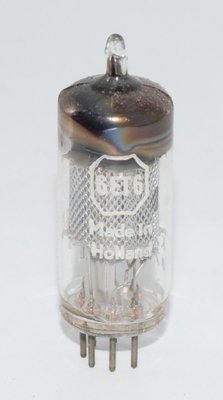
The 6ET6 is a miniature sharp-cutoff pentode designed specifically for use as an I.F. amplifier, oscillator, or A.F. amplifier in car radio ("carradio") sets intended to operate directly from a 6-volt or 12-volt storage battery. Documented by Rogers Electronic Tubes & Components with a datasheet dated October 10th, 1958 (from JEDEC release #2382, February 9, 1959), the 6ET6 belongs to a family of low-voltage tubes engineered for the unique constraints of automotive electronics in the late 1950s.
During this era, car radios were transitioning from vibrator-based power supplies to designs that could operate at the low B+ voltages available directly from a vehicle's electrical system. The 6ET6 was purpose-built for this environment, capable of useful amplification at plate voltages as low as 6.3 volts — a remarkable feat for a vacuum tube. This made it possible to simplify car radio designs by eliminating or reducing the complexity of voltage-multiplying power supplies, improving reliability in the harsh automotive environment.
The tube was manufactured by Rogers in Canada and also produced by Mullard in Holland, among other manufacturers. It represents one of the final evolutionary steps in vacuum tube technology before transistors completely took over automotive electronics in the early 1960s.
Technical Specifications and Design
General Description
The 6ET6 is a pentode for use as an I.F. amplifier, oscillator, or A.F. amplifier in car radio sets, to be operated directly from a storage battery.
Mechanical Data
| Parameter | Value |
|---|---|
| Cathode | Coated, unipotential |
| Base | E 7-1 (Miniature 7-pin, B7G) |
| Bulb | T 5½ |
| Outline | 5 - 2 |
| Basing designation | 7 EN |
| Mounting position | Any |
Pin Configuration (Bottom View of Base)
| Pin Number | Element |
|---|---|
| 1 | Grid No. 1 (Control Grid) |
| 2 | Cathode, Internal Shield |
| 3 | Heater |
| 4 | Heater |
| 5 | Plate (Anode) |
| 6 | Grid No. 2 (Screen Grid) |
| 7 | Grid No. 3 (Suppressor Grid) |
Note that pin 2 serves as both the cathode connection and the internal shield, which helps reduce unwanted coupling and microphonic effects.
Heater Data
| Parameter | Value |
|---|---|
| Heater voltage | 6.3 volts |
| Heater current | 300 mA |
Interelectrode Capacitances
| Parameter | Value |
|---|---|
| Grid No. 1 to all other elements except plate | 6.7 µµF |
| Plate to all other elements except Grid No. 1 | 4.0 µµF |
| Plate to Grid No. 1 | 0.015 µµF |
| Grid No. 1 to Grid No. 2 | 3.0 µµF |
The extremely low plate-to-grid-1 capacitance of 0.015 µµF is noteworthy, as it minimizes feedback and makes the tube well-suited for stable I.F. amplifier service.
Maximum Ratings (Design Center Values)
| Parameter | Maximum Value |
|---|---|
| Plate voltage | 50 volts max. |
| Plate dissipation | 0.5 watt max. |
| Grid No. 2 voltage | 50 volts max. |
| Grid No. 2 dissipation | 0.5 watt max. |
| Grid No. 3 voltage | 50 volts max. |
| Cathode current | 15 mA max. |
| Grid No. 1 circuit resistance | 22 megohms max. |
| Grid No. 3 circuit resistance | 0.1 megohm max. |
| Voltage between cathode and heater | 50 volts max. |
Operating Characteristics as I.F. Amplifier
The datasheet provides three sets of operating conditions for I.F. amplifier service, reflecting the range of supply voltages encountered in automotive applications:
| Parameter | Condition 1 | Condition 2 | Condition 3 |
|---|---|---|---|
| Plate voltage | 25 V | 12.6 V | 6.3 V |
| Grid No. 2 voltage | 6.3 V | 6.3 V | 3.2 V |
| Grid No. 3 voltage | 0 V | 0 V | 0 V |
| Grid No. 1 bias | −0.75 V | −0.75 V | −0.8 V |
| Plate current | 2.2 mA | 2 mA | 0.6 mA |
| Grid No. 2 current | 0.6 mA | 0.7 mA | 0.2 mA |
| Transconductance (gm) | 2100 µmhos | 2000 µmhos | 1000 µmhos |
| Plate resistance (rp) | 0.09 MΩ | 0.2 MΩ | 0.1 MΩ |
| Amplification factor of Grid No. 2 with respect to Grid No. 1 | 4.1 | 4.1 | 3.2 |
Note: Nearly the same results can be obtained when the Grid No. 1 bias is obtained by grid current biasing with a Grid No. 1 resistor of 10 megohms.
Operating Characteristics as A.F. Driver
The 6ET6 also provides useful performance as an audio frequency driver stage. The datasheet notes that data at supply voltages of 7 volts and 14 volts have been included because these values represent normal practice when the car engine is running (charging system active).
| Parameter | Cond. 1 | Cond. 2 | Cond. 3 | Cond. 4 |
|---|---|---|---|---|
| Plate voltage | 25 V | 12.6 V | 14 V | 6.3 V / 7 V |
| Grid No. 2 voltage | 12.6 V | 12.6 V | 14 V | 6.3 V / 7 V |
| Grid No. 3 voltage | 25 V | 12.6 V | 14 V | 6.3 V / 7 V |
| Grid No. 1 voltage | −2 V | −2.3 V | −2.4 V | −1.2 V / −1.3 V |
| Plate + Grid No. 3 current | 3 mA | 2.1 mA | 2.5 mA | 1.1 mA / 1.2 mA |
| A.C. load resistance | 8000 Ω | 6000 Ω | 6000 Ω | 5800 Ω / 5800 Ω |
| Input A.F. voltage | 1.2 V rms | 1 V rms | 1 V rms | 0.4 V rms |
| Power output | 30 mW | 11 mW | 14 mW | 1.2 mW / 1.6 mW |
| Total harmonic distortion | 10% | 10% | 10% | 10% |
Note: Connection of Grid No. 3 to the anode (plate) is preferred in the A.F. driver configuration.
Applications and Usage
Original Intended Applications
The 6ET6 was designed primarily for three applications in car radio receivers:
- I.F. Amplifier: This was the tube's primary intended role. With a transconductance of 2100 µmhos at 25V plate supply (and still a useful 1000 µmhos at just 6.3V), the 6ET6 provided excellent gain in intermediate frequency amplifier stages. The very low plate-to-grid capacitance of 0.015 µµF ensured stable operation without neutralization in most I.F. circuit designs.
- A.F. Amplifier/Driver: The tube could deliver up to 30 mW of audio output power at 25V plate supply with an 8000-ohm load, making it suitable as a driver stage ahead of a power output tube or as a small-signal audio amplifier.
- Oscillator: The 6ET6 could serve as a local oscillator in superheterodyne receiver front ends, though this was a less common application.
Low-Voltage Operation
The defining characteristic of the 6ET6 is its ability to operate at extremely low plate voltages. In a 6-volt automotive electrical system (engine off), the tube could function with plate voltages as low as 6.3 volts. When the engine was running and the charging system active, typical supply voltages of 7V (6V system) or 14V (12V system) provided improved performance. This eliminated the need for vibrator power supplies or voltage doublers in many car radio designs, significantly improving reliability.
Automotive Environment Considerations
The tube's design addressed several automotive-specific challenges:
- The internal shield (connected to the cathode at pin 2) helped reject electrical noise from the vehicle's ignition system and charging circuit.
- The "any" mounting position rating allowed flexible installation in the cramped confines of a car radio chassis.
- The coated unipotential cathode provided quick warm-up and stable operation despite the vibration inherent in automotive use.
- The relatively high maximum Grid No. 1 circuit resistance of 22 megohms allowed simplified biasing circuits.
Sound Characteristics
The 6ET6 occupies a unique niche in the world of vacuum tube sound, owing to its low-voltage design heritage. While it was never intended as a high-fidelity audio tube, its sonic characteristics are distinctive and have attracted interest from experimenters and lo-fi audio enthusiasts.
Tonal Qualities
When used in audio circuits, the 6ET6 tends to exhibit the following sonic characteristics:
- Warm, compressed midrange: Operating at very low plate voltages, the tube naturally produces a soft, compressed sound with a warm midrange character. The limited headroom before clipping means that the tube enters saturation gently, producing a pleasant, rounded distortion rather than harsh clipping.
- Soft high-frequency rolloff: The interelectrode capacitances, while well-controlled for I.F. work, contribute to a gentle high-frequency rolloff in audio applications, giving the sound a smooth, non-fatiguing quality.
- Rich harmonic content at low levels: Because the tube operates near its limits even at modest signal levels (given the low supply voltages), it generates a complex harmonic spectrum that adds richness and body to the sound, particularly on vocals and acoustic instruments.
- Vintage "radio" character: Given its car radio origins, the 6ET6 naturally imparts a nostalgic, bandwidth-limited quality reminiscent of mid-century AM radio — a characteristic that some musicians and recording engineers find musically useful for effect.
Distortion Profile
The datasheet specifies 10% total harmonic distortion at rated A.F. driver output levels across all operating conditions. This is relatively high by hi-fi standards but is characteristic of the tube's intended application in car radios where intelligibility mattered more than fidelity. At lower signal levels, distortion drops considerably, and the tube can provide reasonably clean amplification for small-signal audio work. The distortion character is predominantly even-order harmonics, which the ear perceives as warmth rather than harshness.
Equivalent or Substitute Types
The 6ET6 is a somewhat specialized type, and direct equivalents are limited:
- CV8694: This is a British military CV-numbered equivalent. However, it is listed as a different rating substitute, not a direct drop-in replacement. Users should verify that the specific ratings of the CV8694 are compatible with their circuit before substituting.
- EF98: The European designation equivalent. Like the CV8694, this is listed as a different rating substitute rather than a guaranteed drop-in. The EF98 shares the same basic design philosophy (low-voltage pentode for car radio use) and uses the same B7G base, but specific ratings may differ. Pin compatibility should be verified against the EF98 datasheet before substitution.
Important: Neither the CV8694 nor the EF98 should be assumed to be exact drop-in replacements without consulting their respective datasheets. Differences in maximum ratings, bias points, or pinout details could affect circuit performance or tube longevity.
The 6ET6 does not have a widely recognized direct equivalent in the standard American or European numbering systems beyond these types. It is a relatively uncommon tube, and sourcing can be challenging. Mullard Holland is known to have manufactured this type as NOS (New Old Stock).
Notable Characteristics
Exceptionally Low Operating Voltages
The most remarkable feature of the 6ET6 is its ability to function as a useful amplifier at plate voltages as low as 6.3 volts. Most conventional receiving tubes require plate voltages of 100V or more for proper operation. The 6ET6 achieves a transconductance of 1000 µmhos at just 6.3V on the plate — a testament to its carefully optimized electrode geometry and spacing.
Versatile Grid No. 3 (Suppressor) Configuration
The suppressor grid (Grid No. 3) can be configured in multiple ways depending on the application. For I.F. amplifier service, it is typically connected to the cathode (0V). For A.F. driver service, connecting Grid No. 3 to the anode is preferred, which effectively converts the tube to triode-like operation with improved linearity and power output capability. At higher supply voltages (25V), Grid No. 3 can be connected to the full supply voltage for maximum current capability.
High Grid No. 1 Circuit Resistance
The maximum allowable Grid No. 1 circuit resistance of 22 megohms is notably high, even for a miniature pentode. This allows the use of very high-impedance grid circuits and simplifies biasing arrangements, particularly useful in the space-constrained environment of a car radio chassis.
Internal Shield
The inclusion of an internal shield connected to the cathode (pin 2) is an important feature for automotive applications, where electrical interference from the ignition system, generator/alternator, and other vehicle electrical components could otherwise degrade receiver performance.
Comprehensive Characteristic Curves
The Rogers datasheet provides an unusually thorough set of characteristic curves covering multiple operating conditions, including plate characteristics at various supply voltages (6.3V, 12.6V, and 25V) and both pentode and triode-connected configurations. This reflects the wide range of operating conditions the tube might encounter in automotive service.
Usage in the Audio Community
The 6ET6 is not a mainstream audio tube, but it has found a dedicated following among several groups within the audio community:
Low-Voltage Tube Audio Projects
The 6ET6 is a natural choice for hobbyists and DIY audio enthusiasts building low-voltage tube amplifiers. Its ability to operate from a 12V supply makes it ideal for:
- Battery-powered tube amplifiers: Portable tube audio devices that run from standard 12V batteries or USB power banks (with appropriate voltage conversion for the heater).
- Desktop headphone amplifiers: Small, low-power headphone amplifiers where the 6ET6 serves as a voltage amplifier or driver stage, operating from a simple 12V wall adapter.
- "Starved plate" designs: While many tubes are operated at artificially low voltages in so-called "starved plate" configurations, the 6ET6 was actually designed for low-voltage operation, making it a more technically sound choice than running a conventional tube far below its rated conditions.
Guitar Effects and Stompboxes
The 6ET6's low-voltage operation and pleasant distortion characteristics make it attractive for guitar effects pedals and small practice amplifiers. Its ability to run from a 12V supply simplifies power supply design for pedalboard-friendly tube circuits. The natural compression and warm overdrive character at low voltages is musically useful for blues, jazz, and vintage rock tones.
Vintage Radio Restoration
Collectors and restorers of vintage car radios from the late 1950s seek out 6ET6 tubes to maintain the authenticity of their restorations. NOS (New Old Stock) examples, particularly those manufactured by Mullard Holland, are prized for their reliability and consistent performance in original-equipment applications.
Experimental and Educational Use
The 6ET6's low operating voltages make it an excellent tube for educational purposes, as circuits can be built and tested at voltages that pose minimal safety risk. This makes it popular among electronics educators and students learning about vacuum tube theory and circuit design without the hazards associated with the high voltages typically required by conventional tubes.
Availability and Sourcing
The 6ET6 is a relatively uncommon type on the surplus market. NOS examples from Mullard Holland and Rogers occasionally appear from specialty tube dealers. Due to its niche application in car radios of a specific era, production quantities were modest compared to more universal types. Collectors should expect to pay a premium for tested, guaranteed examples, particularly matched pairs or sets for multi-tube applications.