1. Introduction and History
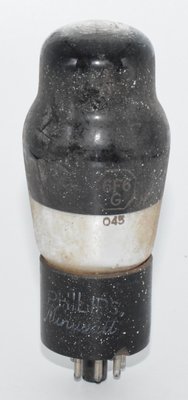
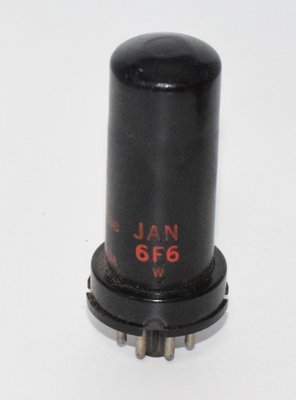
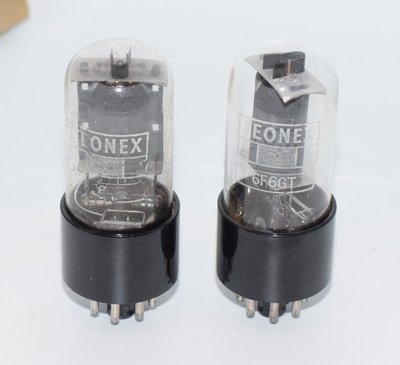
The 6F6G is a power pentode amplifier vacuum tube (valve) designed for use in the output stages of audio receivers and amplifiers. Introduced in the mid-1930s during the golden age of American radio, the 6F6G belongs to a family of electrically identical tubes that includes the 6F6 (metal shell), 6F6GT/G (smaller glass tubular envelope), and their 2.5-volt heater equivalents, the 2A5 and 42. The "G" suffix denotes the shouldered glass (ST-shape) envelope, which is the earliest and most visually distinctive glass version of this tube type.
The 6F6G was manufactured by virtually every major tube maker of the era, including Tung-Sol, RCA, Sylvania, Philips/Miniwatt, Mullard, and many others. It was a workhorse of 1930s and 1940s radio receivers, public address systems, and early phonograph amplifiers. The tube features a coated unipotential cathode and was designed to deliver meaningful audio power from relatively modest supply voltages — a critical requirement for the consumer electronics of its day.
The 6F6 family was originally introduced as the Type 42 (with a 6-pin base and 6.3V heater) and the 2A5 (with a 6-pin base and 2.5V heater). When the octal base system was adopted, the design was re-released as the 6F6 in a metal envelope and the 6F6G/6F6GT in glass envelopes. All versions share identical electrical characteristics, differing only in heater voltage (for the 2A5) or physical envelope and base type. The Tung-Sol datasheet, dated December 15, 1943, confirms that "Types 6F6, 6F6GT/G, 2A5 and 42 are pentode amplifiers designed for application in power output stages of receivers. With the exception of heater ratings, their electrical characteristics are identical."
Today, the 6F6G enjoys a devoted following among audiophiles and vintage audio enthusiasts who prize its warm, musical character and the aesthetic beauty of its large shouldered glass envelope, which often displays a satisfying orange glow during operation.
2. Technical Specifications and Design
General Description
- Type: Power Pentode Amplifier
- Cathode: Coated Unipotential (indirectly heated)
- Envelope: ST-shape (shouldered) glass bulb
- Base: Medium 7-pin Octal
- Mounting: Vertical or horizontal (consult manufacturer for specific limitations)
Heater Ratings
- Heater Voltage (Vh): 6.3 V
- Heater Current (Ih): 0.7 A
Maximum Ratings
| Parameter | Pentode Connection | Triode Connection | Unit |
|---|---|---|---|
| Maximum Plate Voltage | 375 | 350 | Volts |
| Maximum Screen Voltage | 285 | — | Volts |
| Maximum Plate Dissipation | 11 | — | Watts |
| Maximum Screen Dissipation | 3.75 | — | Watts |
| Maximum Total Plate and Screen Dissipation | — | 10 | Watts |
Typical Operating Conditions — Class A₁ Single Tube (Pentode Connection)
| Parameter | Condition 1 | Condition 2 | Unit |
|---|---|---|---|
| Plate Voltage | 250 | 285 | Volts |
| Screen Voltage | 250 | 285 | Volts |
| Control Grid Voltage | −16.5 | −20 | Volts |
| Peak AF Signal Voltage | 16.5 | 20 | Volts |
| Zero-Signal Plate Current | 34 | 38 | mA |
| Zero-Signal Screen Current | 6.5 | 7 | mA |
| Maximum-Signal Plate Current | 36 | 40 | mA |
| Maximum-Signal Screen Current | 10.5 | 13 | mA |
| Plate Resistance (approx.) | 80,000 | 78,000 | Ohms |
| Transconductance (gm) | 2,500 | 2,550 | µmhos |
| Load Resistance | 7,000 | 7,000 | Ohms |
| Total Harmonic Distortion | 8 | 9 | % |
| Power Output | 3.2 | 4.8 (4.5 per TDSL) | Watts |
Note: The TDSL reference data lists the 285V operating point as producing 4.5 watts output at 9% THD with a 7,000-ohm load, gm of 2.55 mA/V (2,550 µmhos), and plate resistance of 78,000 ohms. The Tung-Sol datasheet lists 4.8 watts for this same condition. The slight discrepancy may reflect rounding or measurement methodology differences.
Typical Operating Conditions — Class A₁ Single Tube (Triode Connection)
| Parameter | Value | Unit |
|---|---|---|
| Plate Voltage | 250 | Volts |
| Control Grid Voltage | −20 | Volts |
| Peak AF Signal Voltage | 20 | Volts |
| Zero-Signal Plate Current | 31 | mA |
| Maximum-Signal Plate Current | 34 | mA |
| Plate Resistance (approx.) | 2,600 | Ohms |
| Transconductance (gm) | 2,600 | µmhos |
| Amplification Factor (µ) | 6.8 | — |
| Load Resistance | 4,000 | Ohms |
| Total Harmonic Distortion | 6.5 | % |
| Power Output | 0.85 | Watts |
Push-Pull Operation (Two Tubes)
| Parameter | Class A₁ Pentode | Class AB₂ Pentode | Class AB₂ Triode | Unit |
|---|---|---|---|---|
| Plate Voltage | 315 | 375 | 350 | Volts |
| Screen Voltage | 285 | 250 | — | Volts |
| Control Grid Voltage | −24 | −26 | −38 | Volts |
| Peak AF Signal Voltage (grid to grid) | 48 | 82 | 123 | Volts |
| Zero-Signal Plate Current | 62 | 34 | 48 | mA |
| Maximum-Signal Plate Current | 80 | 82 | 92 | mA |
| Effective Load Resistance (plate to plate) | 10,000 | 10,000 | 6,000 | Ohms |
| Total Harmonic Distortion | 4 | 3.5 | 2 | % |
| Power Output | 11 | 18.5 | 13 | Watts |
Cathode Bias Operating Conditions
For self-biased (cathode bias) operation, the datasheet provides the following cathode resistor values:
| Configuration | Cathode Resistor | Notes |
|---|---|---|
| Single-ended pentode (250V plate/screen) | 410 Ω | — |
| Single-ended pentode (285V plate/screen) | 440 Ω (per TDSL) | — |
| Single-ended triode (250V plate) | 650 Ω | — |
| Push-pull Class A₁ pentode | 320 Ω | Per tube pair |
| Push-pull Class AB₂ pentode | 340 Ω | Per tube pair |
| Push-pull Class AB₂ triode | 730 Ω | Per tube pair |
The DC resistance in the grid circuit should not exceed 0.5 MΩ for self-bias operation and 0.1 MΩ for fixed-bias operation.
Pin Configuration
The 6F6G uses a medium 7-pin octal base. Viewed from the bottom of the socket:
- Pin 1: No Connection (NC)
- Pin 2: Heater (H)
- Pin 3: Plate (P)
- Pin 4: Screen Grid (G2)
- Pin 5: Control Grid (G1)
- Pin 6: Not used
- Pin 7: Heater (H)
- Pin 8 (top cap): Not applicable — the 6F6G uses a top cap for the control grid (G1) on some versions
Note: The 6F6G (shouldered glass) version typically brings the control grid (G1) out to a top cap connection, with the grid pin on the octal base left unconnected. The metal 6F6 and the 6F6GT bring all connections through the octal base. Builders should verify the specific tube in hand, as some later 6F6G production may vary. The Tung-Sol datasheet shows the 6F6GT/G with pin connections: H (pin 2), P (pin 3), G2 (screen, pin 4), G (control grid, pin 5 or top cap), H (pin 7), K (cathode, pin 8), and NC/shell on pin 1. The cathode (K) connects to pin 8 on the octal base.
Physical Dimensions (6F6GT/G Glass Bulb)
- Maximum Overall Length: Approximately 4-11/16 inches (per datasheet outline for 6F6GT/G)
- Maximum Diameter: Approximately 2-1/8 inches
- Envelope: ST-14 shouldered glass (for the 6F6G specifically)
3. Applications and Usage
The 6F6G was designed primarily as a power output tube for radio receivers, and it served this role extensively throughout the late 1930s and 1940s. Its applications include:
- Single-ended audio output stages: In pentode mode, a single 6F6G delivers approximately 3.2 to 4.8 watts depending on operating conditions — more than sufficient for the typical table radio or small console of the era.
- Push-pull audio output stages: A pair of 6F6G tubes in push-pull Class A₁ pentode configuration delivers 11 watts, while Class AB₂ pentode operation yields an impressive 18.5 watts. In triode push-pull Class AB₂, the pair produces 13 watts at a remarkably low 2% THD.
- Public address amplifiers: The tube's robust power output and reliability made it a natural choice for PA systems in schools, churches, and small commercial installations.
- Phonograph amplifiers: Many record players and console phonographs of the 1930s–1940s used the 6F6G as their output tube.
- Military equipment: The tube received military designations VT66 and VT66A, and was used in various military communications and audio equipment during World War II.
The 6F6G can be operated in either pentode or triode mode. In triode mode (screen grid tied to plate), the tube exhibits much lower plate resistance (2,600 Ω vs. 78,000–80,000 Ω), lower distortion characteristics, and significantly reduced power output (0.85 watts single-ended). The triode connection is favored by many audiophiles for its superior linearity and more natural harmonic structure, despite the substantial reduction in available power.
4. Sound Characteristics
The 6F6G has earned a reputation among audiophiles and vintage audio enthusiasts for a distinctive and appealing sonic signature. While subjective descriptions of tube sound always carry a degree of personal interpretation, several characteristics are consistently noted:
Pentode Mode
- Warm and full-bodied midrange: The 6F6G in pentode mode is frequently described as having a rich, warm midrange that lends a pleasing body to vocals and acoustic instruments. It does not have the clinical precision of later beam tetrodes but instead offers a more "romantic" presentation.
- Smooth, slightly rolled-off treble: Compared to more modern output pentodes like the EL34 or 6L6, the 6F6G tends toward a gentler high-frequency presentation. This can be perceived as a lack of "edge" or harshness, making it forgiving of bright or aggressive source material.
- Adequate but not thunderous bass: The relatively high plate resistance in pentode mode (78,000–80,000 Ω) means that the tube's damping factor is heavily dependent on the output transformer and feedback topology. Bass can be warm and pleasant but may lack the tight control of beam tetrodes or triode-connected tubes without adequate negative feedback.
- Harmonic distortion character: At rated output, the 6F6G produces 8–9% THD in single-ended pentode mode, with a harmonic spectrum that includes both even and odd harmonics. The distortion rises progressively with output level, and the tube clips relatively gracefully, contributing to its reputation for a "musical" overload character.
- Dynamic and lively presentation: Despite its modest power rating, the 6F6G has a reputation for sounding dynamic and engaging, with good transient response for a tube of its era.
Triode Mode
- Greater linearity and refinement: With the screen tied to the plate, the 6F6G's distortion drops and the harmonic structure shifts toward predominantly even-order harmonics (primarily second harmonic), which are perceived as more musically consonant.
- Improved damping and bass control: The dramatically lower plate resistance in triode mode (2,600 Ω) provides significantly better damping of the loudspeaker, resulting in tighter, more controlled bass reproduction.
- Reduced power but increased sweetness: At only 0.85 watts in single-ended triode mode, the 6F6G is limited to high-efficiency speakers, but within its power envelope, the sound is often described as exceptionally sweet, transparent, and three-dimensional.
- Intimate, small-scale presentation: The low power in triode mode makes the 6F6G ideal for near-field listening or bedroom systems, where its delicate, nuanced character can be fully appreciated.
Comparison to Related Types
Compared to the 6V6, which largely replaced it, the 6F6G is often described as having a slightly softer, more vintage character with less aggressive dynamics. Compared to the 2A3 or 45 directly heated triodes, the 6F6G in triode mode offers a similar intimacy but with a slightly different tonal color — some listeners describe it as slightly less transparent but with a charming warmth of its own. In pentode mode, it sits sonically between the gentle 6K6GT and the more powerful 6L6, offering a middle ground of warmth and authority.
5. Equivalent or Substitute Types
The following tubes are genuinely interchangeable with the 6F6G, sharing identical electrical characteristics and differing only in physical envelope or designation:
| Type | Notes |
|---|---|
| 6F6 | Metal shell version. Identical electrically. 7-pin octal base with all connections on base pins (no top cap). Direct plug-in replacement if socket accommodates metal envelope. |
| 6F6GT | Smaller tubular glass (GT) envelope. Identical electrically. All connections on octal base. Direct plug-in replacement. |
| 42 | Earlier version with 6-pin base (not octal). Electrically identical to 6F6G but requires a different socket. Not a direct plug-in substitute without an adapter. |
| 2A5 | 2.5V heater version (1.75A). Electrically identical except for heater. 6-pin base. Not interchangeable without heater supply modification and socket adapter. |
| ARP17 | British military designation. Equivalent to 6F6G. |
| CV1186 | British CV (Common Valve) designation. Equivalent. |
| CV1911 | British CV designation. Equivalent. |
| CV1912 | British CV designation. Equivalent. |
| CV731 | British CV designation. Equivalent. |
| VT66 / VT66A | US military designations for the 6F6 family. Equivalent. |
Important note on substitution: While the 6F6, 6F6G, and 6F6GT are direct electrical and pin-for-pin equivalents (all using the octal base), builders should be aware that the 6F6G with its larger ST-14 glass envelope requires more physical clearance than the compact 6F6GT or metal 6F6. Additionally, some early 6F6G tubes bring the control grid to a top cap, requiring a grid lead wire — this is not the case with the metal 6F6 or most 6F6GT versions where all connections are on the base.
The 6V6 / 6V6GT is sometimes suggested as a substitute, but it is not electrically identical — the 6V6 is a beam tetrode with different characteristics and operating points, and should not be considered a drop-in replacement without circuit modifications.
6. Notable Characteristics
- Versatile operating modes: The 6F6G can be operated as a pentode, triode (screen tied to plate), or even as an ultralinear pentode with appropriate output transformer taps, giving designers considerable flexibility in balancing power output against distortion.
- Robust construction: The ST-14 glass envelope of the 6F6G is substantial and well-built, contributing to the tube's reputation for long service life. Many NOS (New Old Stock) examples from the 1930s and 1940s still test strongly today.
- High plate resistance in pentode mode: At approximately 78,000–80,000 Ω, the pentode-mode plate resistance is quite high, meaning the tube's output impedance is dominated by the load resistance rather than the tube itself. This makes output transformer quality and negative feedback design particularly important for good bass damping.
- Moderate transconductance: At 2,500–2,550 µmhos (2.5–2.55 mA/V), the 6F6G has respectable but not exceptional transconductance, requiring a reasonable signal swing from the driver stage (16.5–20V peak for full output).
- Aesthetic appeal: The large shouldered glass envelope of the 6F6G is widely considered one of the most attractive tube shapes ever produced. The visible internal structure and warm cathode glow make it a favorite for open-chassis amplifier builds where visual presentation is valued.
- Grid circuit resistance limits: The DC resistance in the grid circuit should not exceed 0.5 MΩ for self-bias operation and 0.1 MΩ for fixed-bias operation — an important consideration for driver stage design.
- Multiple manufacturer sources: The 6F6G was produced by Tung-Sol, RCA, Sylvania, National Union, Philips/Miniwatt (Australia), Mullard, and many others. Each manufacturer's production has subtle sonic differences that collectors and audiophiles enjoy exploring.
7. Usage in the Audio Community
The 6F6G occupies a special niche in the modern audio community, appreciated both for its sonic qualities and its vintage charm. Here is how it is used today:
Single-Ended Triode (SET) Amplifiers
Perhaps the most popular modern application for the 6F6G is in single-ended triode amplifiers. With the screen grid tied to the plate, a single 6F6G produces approximately 0.85 watts of Class A power — enough to drive high-efficiency speakers (95 dB/W/m and above) to satisfying listening levels in a small to medium room. SET amplifier builders prize the 6F6G for its sweet, intimate sound and the relative simplicity of the required circuit. A typical SET amplifier using the 6F6G might use a 6SJ7 or 6J5 as a driver, with a high-quality single-ended output transformer having a 4,000-ohm primary impedance.
Single-Ended Pentode Amplifiers
For those wanting more power without the complexity of push-pull, the 6F6G in pentode mode delivers 3.2 to 4.8 watts — a meaningful amount of power that can drive moderately efficient speakers. Some builders use ultralinear output transformers with screen taps to achieve a compromise between pentode power and triode linearity. The 7,000-ohm load impedance is well-served by many commercially available single-ended output transformers.
Push-Pull Amplifiers
A pair of 6F6G tubes in push-pull configuration can produce 11 watts in Class A₁ pentode mode or up to 18.5 watts in Class AB₂ pentode mode — serious power for a vintage tube type. The push-pull triode configuration is particularly attractive to audiophiles, delivering 13 watts at only 2% THD. These power levels are sufficient for most domestic listening situations with speakers of average efficiency.
Vintage Radio Restoration
The 6F6G remains in demand for the restoration of vintage radios from the late 1930s and 1940s. Many classic console radios and table sets used the 6F6G as their output tube, and restorers seek NOS examples to maintain originality and performance. Tung-Sol, RCA, and Sylvania examples are particularly sought after for restorations of American-made sets.
Guitar Amplifiers
While not as common as the 6V6 or 6L6 in guitar amplifier applications, the 6F6G has found a small but enthusiastic following among boutique guitar amplifier builders and players seeking unusual vintage tones. The tube's smooth clipping characteristics and warm midrange translate well to guitar amplification, particularly for blues, jazz, and classic rock styles. Some builders create small practice amplifiers or recording amplifiers around the 6F6G for its unique voice.
Collector and NOS Market
The 6F6G is actively collected and traded in the NOS tube market. Tung-Sol 6F6G tubes are among the most sought-after, with matched pairs commanding premium prices. Philips/Miniwatt Australian production and Mullard examples are also highly valued. The tube's relative scarcity compared to later types like the 6V6GT adds to its collectibility. Prices for tested NOS 6F6G tubes have risen steadily as the supply of vintage stock diminishes and demand from the audiophile community continues.
DIY Community
The 6F6G is a popular choice in the DIY audio community, particularly among builders who enjoy constructing amplifiers from scratch. Its moderate operating voltages (250–285V plate supply for single-ended operation), reasonable heater current (0.7A), and straightforward biasing requirements make it accessible to intermediate builders. Numerous amplifier designs and schematics featuring the 6F6G are shared on audio forums and in DIY publications. The tube's compatibility with commonly available octal sockets and output transformers further enhances its appeal for home construction projects.
Recommended Pairings
In the audio community, the 6F6G is commonly paired with:
- Driver tubes: 6SJ7, 6J5, 6SN7, 6SC7, 76, or 6C5
- Rectifier tubes: 5Y3GT, 5V4G, or 80 (for vintage-correct builds)
- Speakers: High-efficiency designs from Altec, JBL, Klipsch, or modern high-efficiency drivers from Fostex, Lowther, or similar manufacturers — particularly important for triode-mode operation where power is limited
The 6F6G represents a beautiful intersection of vintage engineering, aesthetic appeal, and genuine sonic merit. Whether used in a carefully designed SET amplifier, a push-pull stereo system, or a lovingly restored vintage radio, this classic pentode continues to reward listeners with its warm, musical voice more than eight decades after its introduction.