1. Introduction and History
The 6F6GT is a pentode power amplifier vacuum tube (valve) designed for use in the output stages of radio receivers and audio amplifiers. Introduced in the mid-1930s as part of the octal tube family, the 6F6 series became one of the most widely used power output pentodes of the pre-war and wartime era. The tube was manufactured by virtually every major tube maker, including RCA, Tung-Sol, Sylvania, GE, Ken-Rad, and many European firms under various designations.
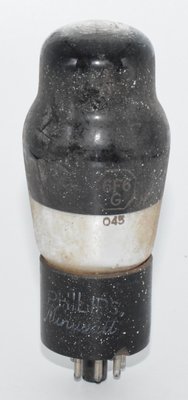
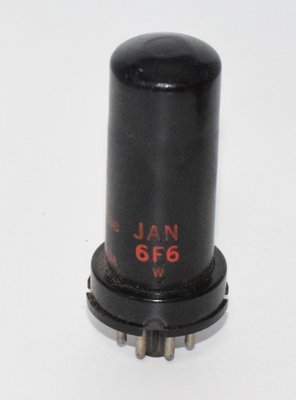
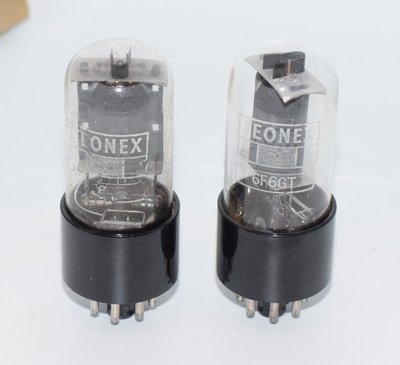
The 6F6 was originally released in a metal shell envelope (the 6F6), followed by the full-size glass "G" envelope (6F6G) and the smaller "GT" bantam glass envelope (6F6GT). All three share identical electrical characteristics, differing only in physical construction and heater ratings relative to their 2.5-volt equivalents (the 2A5 and 42). The 6F6GT, with its compact GT-style glass envelope and octal base, became the most common variant in later production and is the version most frequently encountered today.
The 6F6 family served extensively in military equipment during World War II, earning several military designations including VT66, VT66A, and various CV numbers. Its robust construction, moderate power output, and reliable performance made it a staple of Allied communications and entertainment equipment throughout the 1940s and into the 1950s.
The tube features a coated unipotential cathode and can be operated in either pentode or triode connection, giving designers considerable flexibility in circuit topology. While it was eventually superseded by higher-power types like the 6V6 and 6L6 in many applications, the 6F6GT retains a loyal following among vintage radio restorers and audiophiles who appreciate its distinctive sonic character.
2. Technical Specifications and Design
Heater
| Heater Voltage | 6.3 V |
| Heater Current | 0.7 A |
Note: The electrically identical 2A5 uses a 2.5 V heater at 1.75 A. The type 42 also operates at 6.3 V, 0.7 A and is electrically identical.
Maximum Ratings
| Parameter | Pentode Connection | Triode Connection |
|---|---|---|
| Maximum Plate Voltage | 375 V | 350 V |
| Maximum Screen Voltage | 285 V | — |
| Maximum Plate Dissipation | 11 W | — |
| Maximum Screen Dissipation | 3.75 W | — |
| Maximum Total Plate and Screen Dissipation | — | 10 W |
Typical Operating Conditions — Class A₁ Single Tube (Pentode Connection)
| Parameter | Condition 1 | Condition 2 |
|---|---|---|
| Plate Voltage | 250 V | 285 V |
| Screen Voltage | 250 V | 285 V |
| Control Grid Voltage | −16.5 V | −20 V |
| Peak AF Signal Voltage | 16.5 V | 20 V |
| Zero-Signal Plate Current | 34 mA | 38 mA |
| Zero-Signal Screen Current | 6.5 mA | 7 mA |
| Maximum-Signal Plate Current | 36 mA | 40 mA |
| Maximum-Signal Screen Current | 10.5 mA | 13 mA |
| Plate Resistance (approx.) | 80,000 Ω | 78,000 Ω |
| Transconductance (gm) | 2,500 µmhos | 2,550 µmhos |
| Load Resistance | 7,000 Ω | 7,000 Ω |
| Total Harmonic Distortion | 8% | 9% |
| Power Output | 3.2 W | 4.8 W |
Typical Operating Conditions — Class A₁ Single Tube (Triode Connection)
| Plate Voltage | 250 V |
| Control Grid Voltage | −20 V |
| Peak AF Signal Voltage | 20 V |
| Zero-Signal Plate Current | 31 mA |
| Maximum-Signal Plate Current | 34 mA |
| Plate Resistance (approx.) | 2,600 Ω |
| Transconductance (gm) | 2,600 µmhos |
| Amplification Factor (µ) | 6.8 |
| Load Resistance | 4,000 Ω |
| Total Harmonic Distortion | 6.5% |
| Power Output | 0.85 W |
Push-Pull Operation — Class A₁ (Pentode, Two Tubes)
| Plate Voltage | 315 V |
| Screen Voltage | 285 V |
| Control Grid Voltage | −24 V |
| Peak AF Signal Voltage (grid to grid) | 48 V |
| Zero-Signal Plate Current | 62 mA |
| Zero-Signal Screen Current | 12 mA |
| Maximum-Signal Plate Current | 80 mA |
| Maximum-Signal Screen Current | 19.5 mA |
| Effective Load Resistance (plate to plate) | 10,000 Ω |
| Total Harmonic Distortion | 4% |
| Power Output | 11 W |
Push-Pull Operation — Class AB₂ (Pentode, Two Tubes)
| Plate Voltage | 375 V |
| Screen Voltage | 250 V |
| Control Grid Voltage | −26 V |
| Peak AF Signal Voltage (grid to grid) | 82 V |
| Zero-Signal Plate Current | 34 mA |
| Maximum-Signal Plate Current | 82 mA |
| Maximum-Signal Screen Current | 19.5 mA |
| Effective Load Resistance (plate to plate) | 10,000 Ω |
| Total Harmonic Distortion | 3.5% |
| Power Output | 18.5 W |
Push-Pull Operation — Class AB₂ (Triode, Two Tubes)
| Plate Voltage | 350 V |
| Control Grid Voltage | −38 V |
| Peak AF Signal Voltage (grid to grid) | 123 V |
| Zero-Signal Plate Current | 48 mA |
| Maximum-Signal Plate Current | 92 mA |
| Effective Load Resistance (plate to plate) | 6,000 Ω |
| Total Harmonic Distortion | 2% |
| Power Output | 13 W |
Cathode Bias Operating Conditions
For self-biased (cathode bias) operation, the datasheet specifies the following cathode resistor values:
| Configuration | Cathode Resistor |
|---|---|
| Single-ended pentode (250 V plate, 250 V screen) | 410 Ω |
| Single-ended pentode (285 V plate, 285 V screen) | 440 Ω (Rk) |
| Single-ended triode (250 V plate) | 650 Ω |
| Push-pull pentode Class A₁ (315 V plate) | 320 Ω |
| Push-pull pentode Class AB₂ (375 V plate) | 340 Ω |
| Push-pull triode Class AB₂ (350 V plate) | 730 Ω |
Note: The DC resistance in the grid circuit should not exceed 0.5 MΩ for self-bias operation and 0.1 MΩ for fixed-bias operation.
Physical Construction
| Envelope | GT (bantam glass) — also available as metal shell (6F6) and full-size glass (6F6G) |
| Base | Octal (7-pin for 6F6GT/G; 7-pin for 6F6 metal) |
| Cathode Type | Coated unipotential (indirectly heated) |
| Maximum Overall Length | Approximately 4-5/16" (6F6GT/G) |
| Maximum Diameter | Approximately 1-13/16" (6F6GT/G) |
Pin Configuration (6F6GT/G — Octal Base, Bottom View)
- Pin 1: No Connection (NC)
- Pin 2: Heater (H)
- Pin 3: Plate (P)
- Pin 4: Screen Grid (G2)
- Pin 5: Control Grid (G1)
- Pin 6: Not used
- Pin 7: Heater (H)
- Pin 8: Cathode (K)
- Shell: Connected internally (6F6 metal type) or not connected
Note: The suppressor grid (G3) is internally connected to the cathode in all versions.
3. Applications and Usage
The 6F6GT was designed primarily as a power output tube for the audio frequency stages of radio receivers, public address systems, and small amplifiers. Its principal applications include:
- Single-ended audio output stages: In pentode connection, the 6F6GT delivers up to 4.8 watts of audio power from a single tube with 285 V on the plate and screen, making it well-suited for table radios, console receivers, and small PA systems. In triode connection, it provides 0.85 watts with significantly lower distortion (6.5% THD).
- Push-pull audio output stages: A pair of 6F6GTs in push-pull Class A₁ pentode connection delivers 11 watts at 4% THD. In Class AB₂ pentode operation, the same pair can produce 18.5 watts at 3.5% THD, while Class AB₂ triode connection yields 13 watts at a remarkably low 2% THD.
- Vintage radio receivers: The 6F6GT was one of the most common output tubes in American radio receivers of the late 1930s and 1940s, appearing in countless models from manufacturers such as Philco, Zenith, RCA, Emerson, and others.
- Military communications equipment: Under designations VT66 and VT66A, the tube served in various military radio and audio applications during World War II.
- Small guitar amplifiers: Some early guitar amplifiers and practice amps used the 6F6GT as an output tube, taking advantage of its moderate power and pleasant overdrive characteristics.
The tube's versatility in both pentode and triode modes, combined with its moderate power consumption (approximately 4.4 watts heater power) and reasonable output capability, made it an excellent choice for a wide range of audio applications where the higher power of a 6L6 or 6V6 was not required.
4. Sound Characteristics
The 6F6GT occupies a distinctive sonic niche that has earned it a dedicated following among audiophiles and vintage audio enthusiasts. Its sound character varies significantly depending on whether it is operated in pentode or triode mode:
Pentode Mode
In pentode connection, the 6F6GT produces a lively, dynamic sound with a characteristically warm midrange. The high plate resistance of approximately 78,000–80,000 ohms means the tube interacts strongly with the output transformer and speaker, contributing to a sound that many describe as having a pleasant "vintage" quality. The harmonic distortion spectrum in pentode mode is rich in both even and odd harmonics — the datasheet shows 8–9% THD at full output in single-ended operation — which gives the tube a complex, textured tone that is distinctly different from the cleaner sound of beam tetrodes like the 6V6.
Listeners frequently describe the pentode sound of the 6F6GT as having:
- A warm, slightly "woody" midrange character
- A sweet, singing quality on vocals and acoustic instruments
- Pleasant, musical compression as the tube approaches clipping
- A slightly rolled-off top end compared to more modern output tubes, lending a smooth, non-fatiguing quality to extended listening
- Good bass weight for its power rating, though not as tight or controlled as beam tetrodes
Triode Mode
When operated in triode connection (screen tied to plate), the 6F6GT transforms into a remarkably refined-sounding tube. The plate resistance drops dramatically to approximately 2,600 ohms, providing much better damping of the output transformer and speaker. The amplification factor of 6.8 and transconductance of 2,600 µmhos in triode mode yield a more linear transfer characteristic. While power output drops to only 0.85 watts in single-ended Class A₁, the sonic quality is often described as exceptionally pure and transparent.
In triode mode, the 6F6GT is praised for:
- Exceptional midrange clarity and purity
- A more refined, "direct-heated triode-like" quality than many other pentodes strapped as triodes
- Natural, unforced dynamics within its limited power envelope
- Very low intermodulation distortion at moderate listening levels
- A sense of intimacy and presence that suits small-room listening
Push-Pull Operation
In push-pull configuration, particularly in Class AB₂ triode mode, the 6F6GT achieves a remarkable balance of power (13 watts) and low distortion (2% THD). This configuration is often described as having the best of both worlds — enough power for moderate listening levels with the tonal refinement of triode operation. The cancellation of even-order harmonics in push-pull further cleans up the sound, resulting in an amplifier that can sound surprisingly modern and transparent despite using 1930s-era tube technology.
5. Equivalent or Substitute Types
The following types are genuinely interchangeable with the 6F6GT, sharing identical electrical characteristics and pin configurations unless otherwise noted:
| Type | Notes |
|---|---|
| 6F6 | Metal shell version. Electrically identical. 7-pin octal base. Direct substitute. |
| 6F6G | Full-size glass ("G") envelope version. Electrically identical. Direct substitute. |
| 42 | Electrically identical to the 6F6 family. Uses a 6-pin base (not octal) — requires socket adapter or different socket. Same heater: 6.3 V, 0.7 A. |
| 2A5 | Electrically identical but uses a 2.5 V heater at 1.75 A. Uses a 6-pin base. Not a drop-in replacement due to different heater voltage and base type. |
| ARP17 | British military designation. Equivalent type. |
| CV1186 | British CV (Common Valve) designation. Equivalent. |
| CV1911 | British CV designation. Equivalent. |
| CV1912 | British CV designation. Equivalent. |
| CV731 | British CV designation. Equivalent. |
| VT66 | US military designation. Equivalent. |
| VT66A | US military designation. Equivalent (may indicate tighter specifications). |
Important note on substitution: While the 6F6GT is sometimes compared to the 6V6GT, these are not interchangeable types. The 6V6 is a beam power tetrode with different characteristics, different pin connections, and different operating parameters. Do not substitute one for the other without circuit modifications.
6. Notable Characteristics
- Dual-mode versatility: The 6F6GT's ability to operate effectively in both pentode and triode modes gives amplifier designers — and DIY builders — significant flexibility. The dramatic difference in plate resistance between pentode (~78,000–80,000 Ω) and triode (~2,600 Ω) modes means the tube essentially behaves as two different devices depending on configuration.
- Moderate power, low heater consumption: At only 0.7 A heater current, the 6F6GT is economical in terms of power supply demands. Its 11-watt maximum plate dissipation in pentode mode and 10-watt total dissipation in triode mode are sufficient for a wide range of applications without requiring elaborate cooling or heavy-duty power supplies.
- Excellent push-pull performance: The Class AB₂ triode push-pull configuration is particularly noteworthy, delivering 13 watts at only 2% THD — an impressive figure that rivals many more modern tube types.
- Robust construction: Military-grade versions (VT66, CV types) were built to exacting standards and are known for exceptional longevity. Even commercial versions are generally long-lived, with many NOS (New Old Stock) examples still testing strong after 70+ years.
- Self-bias friendly: The tube works well with cathode bias, with clearly specified cathode resistor values for various operating conditions (e.g., 440 Ω for single-ended pentode at 285 V). This simplifies amplifier design and eliminates the need for a separate negative bias supply.
- Characteristic curves: The plate characteristic curves show well-defined, evenly-spaced grid lines in both pentode and triode modes, indicating good linearity over much of the operating range. The pentode curves show the typical high plate resistance (flat curves) above the knee, while the triode curves display the more linear, lower-impedance characteristics expected of triode operation.
- Grid circuit considerations: The maximum DC resistance in the grid circuit should not exceed 0.5 MΩ for self-bias operation and 0.1 MΩ for fixed-bias operation, as specified in the datasheet. This is an important design consideration that must be observed to prevent grid emission problems and ensure stable operation.
7. Usage in the Audio Community
The 6F6GT enjoys a special place in the audio community, appreciated by several distinct groups of enthusiasts:
Vintage Radio Restoration
The 6F6GT is one of the most commonly needed tubes for restoring American radio receivers from the late 1930s and 1940s. Restorers prize NOS (New Old Stock) examples from premium manufacturers like Tung-Sol, RCA, Ken-Rad, and Sylvania. The tube appeared in hundreds of radio models, and a properly functioning 6F6GT is essential for authentic restoration. Fortunately, the tube was produced in enormous quantities, and NOS supplies remain reasonably available, though premium brands command increasingly high prices.
Single-Ended Triode (SET) Amplifiers
The 6F6GT has found a niche in the single-ended triode amplifier community, where its triode-mode characteristics are highly valued. While its 0.85-watt triode output may seem modest, it is sufficient to drive high-efficiency speakers (95 dB/W/m and above) to satisfying listening levels in small to medium rooms. SET enthusiasts appreciate the 6F6GT's low plate resistance in triode mode (2,600 Ω), which provides good damping and control of the loudspeaker. The tube's relatively low cost compared to exotic directly-heated triodes makes it an attractive option for budget-conscious SET builders.
Push-Pull Amplifier Projects
DIY amplifier builders have rediscovered the 6F6GT as an excellent candidate for push-pull amplifier projects. The Class AB₂ triode push-pull configuration, delivering 13 watts at 2% THD, provides enough power for most domestic listening situations while maintaining the sonic purity of triode operation. The Class A₁ pentode push-pull configuration at 11 watts offers even more headroom with acceptable distortion levels. These power levels are well-matched to modern high-sensitivity loudspeakers and represent a sweet spot for many listeners.
Guitar Amplifier Community
While not as widely used as the 6V6 or 6L6 in guitar amplifiers, the 6F6GT has attracted interest from boutique amp builders and tone seekers looking for something different. Its pentode distortion character — rich in both even and odd harmonics — produces a distinctive overdrive tone that some players find more complex and interesting than the more common beam tetrode sound. Small practice amplifiers and recording amps using the 6F6GT can produce beautiful clean tones at low volumes and a satisfying, harmonically rich breakup when pushed.
Tube Rolling and Collecting
The 6F6GT is a popular tube for collectors and "tube rollers" who enjoy comparing the sonic differences between various manufacturers and production eras. Notable variations include:
- Tung-Sol 6F6GT: Often considered among the finest examples, with excellent construction quality and a reputation for a particularly smooth, refined sound.
- RCA 6F6GT: Widely available and generally well-regarded, with a warm, full-bodied character.
- Ken-Rad 6F6GT: Prized by some collectors for a slightly more detailed, articulate sound.
- Sylvania 6F6GT: Known for consistent quality and a balanced tonal presentation.
- Military-grade versions (VT66, VT66A): Built to tighter tolerances and often exhibiting superior longevity and consistency.
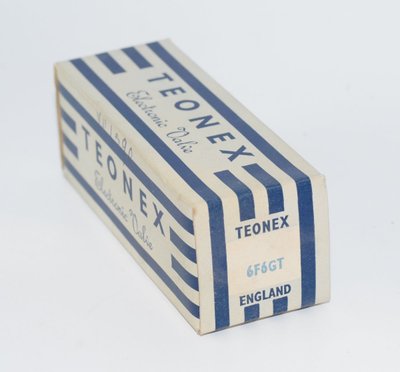
The availability of matched pairs, such as those offered by suppliers like Teonex, is particularly important for push-pull amplifier applications where tube matching ensures optimal performance and minimum distortion.
Practical Considerations for Audio Use
When using the 6F6GT in audio applications, designers and builders should keep the following practical points in mind:
- Output transformer selection: For single-ended pentode operation, a primary impedance of 7,000 Ω is specified. For single-ended triode, 4,000 Ω is recommended. Push-pull configurations require plate-to-plate impedances of 10,000 Ω (pentode) or 6,000 Ω (triode). Quality output transformers are essential for realizing the tube's full sonic potential.
- Power supply requirements: The tube is relatively undemanding in terms of power supply design. B+ voltages of 250–350 V are typical, and the moderate current draw (31–48 mA per tube depending on configuration) means that standard power supply designs are adequate.
- Driver stage considerations: In Class A₁ operation, the 6F6GT requires modest drive levels (16.5–20 V peak), easily provided by a single triode stage such as a 6SN7, 6J5, or 6SL7. Class AB₂ operation requires higher drive voltages and a driver capable of supplying grid current, necessitating a more robust driver stage.
- Cathode bypass capacitor: For maximum gain and power output, the cathode resistor should be bypassed with an electrolytic capacitor of adequate value (typically 100–250 µF). Leaving the cathode resistor unbypassed introduces local negative feedback, reducing gain and distortion while improving linearity — a technique favored by some audiophile designers.
The 6F6GT remains a thoroughly enjoyable tube for audio use, offering a combination of vintage charm, genuine sonic merit, and practical affordability that few other tubes can match. Whether used in a lovingly restored 1940s radio or a newly built single-ended triode amplifier, it continues to reward listeners with its warm, musical voice more than eight decades after its introduction.