Introduction and History
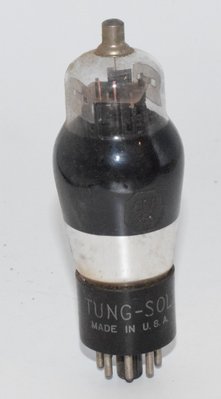
The 6F8G is a general-purpose twin triode voltage amplifier tube that houses two completely independent triode units within a single glass envelope. Manufactured by Tung-Sol Lamp Works Inc. and introduced in the early 1940s (the original datasheet is copyrighted 1941), the 6F8G was designed as a versatile dual triode for use in radio receivers, audio amplifiers, and general electronic equipment. The tube features unipotential (common) cathodes shared between the two triode sections, though each section operates with fully independent grid and plate connections.
The 6F8G is historically significant as a predecessor and electrical equivalent to the legendary 6SN7GT family of dual triodes. With the exception of interelectrode capacitances, the electrical characteristics of each triode section are identical to those of the 6J5, 6J5G, and 6J5GT single triodes. This lineage places the 6F8G squarely in one of the most celebrated families of audio tubes ever produced, and it has earned a devoted following among audiophiles who prize its sonic qualities — often considered superior to its later octal-based successors.
The tube was manufactured by several companies including Tung-Sol, Brimar (in the USA), RCA, Sylvania, and others. Its ST-12 glass envelope gives it a distinctive and elegant appearance that is prized by collectors and audio enthusiasts alike.
Technical Specifications and Design
Heater Data
| Parameter | Value |
|---|---|
| Heater Voltage | 6.3 Volts (AC or DC) |
| Heater Current | 0.6 Ampere |
| Cathode Type | Unipotential (indirectly heated, common cathode) |
Maximum Ratings
| Parameter | Value |
|---|---|
| Maximum Plate Voltage | 300 Volts |
| Maximum Plate Dissipation (per unit) | 2.5 Watts |
| Minimum Control Grid Voltage | 0 Volts |
Typical Operating Conditions — Class A1 Amplifier (Each Unit)
| Parameter | Condition 1 | Condition 2 |
|---|---|---|
| Plate Voltage | 90 Volts | 250 Volts |
| Control Grid Voltage | 0 Volts | -8 Volts |
| Plate Current | 10.0 mA | 9.0 mA |
| Plate Resistance | 6,700 Ohms | 7,700 Ohms |
| Transconductance (gm) | 3,000 µmhos | 2,600 µmhos |
| Amplification Factor (µ) | 20 | 20 |
Direct Interelectrode Capacitances
(With external shield connected to cathode)
| Parameter | Triode Unit 1 | Triode Unit 2 |
|---|---|---|
| Grid to Cathode | 3.2 µµf | 3.0 µµf |
| Plate to Cathode | 3.2 µµf | 3.8 µµf |
| Grid to Plate | 4.0 µµf | 3.6 µµf |
Inter-Section Capacitances
| Parameter | Value |
|---|---|
| Grid 1 to Grid 2 | 0.2 µµf |
| Plate 1 to Plate 2 | 0.4 µµf |
| Grid 2 to Plate 1 | 0.1 µµf |
Physical Construction
| Parameter | Detail |
|---|---|
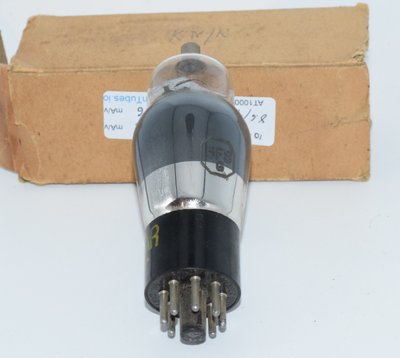
| Base Type | Small 8-Pin Octal Base |
| Envelope | ST-12 Glass Bulb |
| Maximum Overall Length | 4-1/2 inches (approximately) |
| Maximum Diameter | 1-5/8 inches (approximately) |
| Maximum Seated Height | 3-29/32 inches |
| Base Diameter | 1.165 inches maximum |
Pin Configuration (G-8G Base, Bottom View)
The 6F8G uses the standard octal base with the following pin assignments:
- Pin 1: No Connection (NC)
- Pin 2: Heater (H)
- Pin 3: Plate (P) — Triode Unit 2
- Pin 4: Grid (G) — Triode Unit 2 (Note: Triode 2 grid is also brought out to the top cap)
- Pin 5: Plate (P) — Triode Unit 1
- Pin 6: Grid (G) — Triode Unit 1 (Note: Triode 1 grid is brought out to a base pin)
- Pin 7: Heater (H)
- Pin 8: Cathode (K) — shared
Important Note: Triode 1 has its grid brought out to a base pin, while Triode 2 has its grid brought out to the top cap. This is a critical distinction from the later 6SN7GT, which has all connections on the octal base pins with no top cap. The presence of the top cap connection is the primary physical difference between the 6F8G and the 6SN7GT.
Applications and Usage
The 6F8G was designed as a general-purpose twin triode voltage amplifier, and its applications span a wide range of electronic circuits:
- Voltage Amplification: The primary intended application. Each triode section provides a gain factor (µ) of 20, making it well-suited for line-level audio amplification, driver stages, and general signal amplification duties.
- Phase Splitter / Phase Inverter: With two matched triode sections in one envelope, the 6F8G is an excellent choice for cathodyne (split-load), long-tailed pair, and other phase-inverter topologies used to drive push-pull output stages.
- Preamplifier Stages: The moderate gain and low plate resistance make each section ideal for high-fidelity preamplifier circuits, including RIAA phono stages and line stages.
- Cascaded Amplifier Stages: Both triode sections can be used in series (cascaded) to achieve higher overall voltage gain in a single tube envelope.
- Radio Receiver Circuits: Originally designed for use in radio receivers as RF amplifiers, detector stages, and audio voltage amplifiers.
- Oscillator Circuits: The tube can be used in various oscillator configurations where a medium-mu triode is required.
- Headphone Amplifiers: The relatively low plate resistance (7,700 ohms at 250V) and moderate current capability make it suitable for driving headphones through an output transformer.
The Class A1 operating mode (grid never driven positive) ensures linear operation with minimal distortion, making the 6F8G particularly well-suited for high-fidelity audio applications.
Sound Characteristics
The 6F8G has earned a reputation among audiophiles as one of the finest-sounding dual triodes ever produced. Its sonic character is frequently described in glowing terms by those who have compared it directly to its more common successor, the 6SN7GT:
- Warmth and Body: The 6F8G is consistently praised for its rich, warm midrange that gives vocals and acoustic instruments a natural, lifelike presence. The tonal balance leans slightly toward warmth without sacrificing clarity.
- Smoothness and Liquidity: Listeners frequently describe the 6F8G's presentation as exceptionally smooth and liquid, with a freedom from grain or harshness that is remarkable even among premium triode types. Transients are rendered naturally without artificial edge.
- Spatial Presentation: The 6F8G is noted for producing an expansive and three-dimensional soundstage. Image placement is precise, and the sense of depth and air around instruments is often described as superior to the 6SN7GT.
- Bass Performance: The low-frequency response is typically described as full, well-controlled, and articulate. The moderate plate resistance contributes to good damping and bass definition.
- Treble Character: High frequencies are extended but never aggressive. The top end has a natural sweetness and delicacy that avoids the analytical or clinical quality sometimes associated with more modern tube types.
- Harmonic Richness: Like most medium-mu triodes, the 6F8G produces predominantly even-order harmonics (primarily second harmonic), which the ear perceives as musical and pleasant. This contributes to the tube's reputation for musicality.
- Dynamic Expression: The 6F8G handles dynamic contrasts with grace, preserving micro-dynamics and subtle musical nuances that contribute to an engaging and emotionally involving listening experience.
Many experienced listeners consider the 6F8G to be sonically superior to the 6SN7GT, attributing this in part to the ST-12 glass envelope construction and the top-cap grid connection, which may reduce stray capacitance and improve signal purity. The larger physical separation between the grid connection (top cap) and other electrode connections is believed by some to contribute to lower noise and improved high-frequency performance.
Among different manufacturers, Tung-Sol 6F8G tubes are particularly sought after and are considered reference-grade by many audiophiles. Brimar-branded examples also command respect for their sonic qualities.
Equivalent or Substitute Types
The 6F8G belongs to a well-established family of electrically similar tubes. However, direct substitution requires careful attention to physical and pinout differences:
Electrically Equivalent Types
| Type | Relationship | Notes |
|---|---|---|
| 6SN7GT / 6SN7GTA / 6SN7GTB | Electrical equivalent | All-base pinout (no top cap). The 6SN7GT is the most direct successor. NOT a direct plug-in substitute due to the different grid connection arrangement — the 6F8G uses a top cap for Triode 2's grid, while the 6SN7GT brings all connections to the octal base. An adapter is required for substitution. Interelectrode capacitances also differ. |
| 6J5 / 6J5G / 6J5GT | Single-triode equivalent of each section | Each triode section of the 6F8G is electrically identical to a 6J5 (with the exception of capacitances). Two 6J5 tubes can replace one 6F8G functionally, though the wiring is completely different. |
| B65 | British equivalent | The British designation for a tube with similar characteristics. Verify pinout before substitution. |
| 12SN7GT | 12.6V heater version of 6SN7GT | Same electrical characteristics per section but requires 12.6V heater supply. Not a direct substitute without heater circuit modification. |
Important Substitution Warnings
- The 6F8G and 6SN7GT are not pin-for-pin compatible despite being electrically equivalent. The 6F8G has a top cap grid connection for Triode 2, while the 6SN7GT has all pins on the octal base. Adapters are commercially available for this conversion.
- The 6F8G has slightly different interelectrode capacitances compared to the 6SN7GT, which may affect performance in RF or high-frequency circuits but is generally inconsequential in audio applications.
- The 6CG7 (6FQ7) is sometimes mentioned as a 6SN7 substitute, but it has different maximum ratings and characteristics. It is not a recommended substitute for the 6F8G in circuits designed specifically for 6F8G/6SN7 specifications.
Notable Characteristics
- ST-12 Envelope: The 6F8G uses the classic shouldered ST-12 glass envelope, which gives it a distinctive and aesthetically pleasing appearance. This larger glass envelope compared to the GT (tubular) style of the 6SN7GT may contribute to lower microphonic sensitivity due to the different resonant characteristics of the glass structure.
- Top Cap Grid Connection: The use of a top cap for Triode 2's grid connection is a defining physical characteristic. This design provides greater physical separation between the grid lead and other electrode connections, potentially reducing stray capacitance and improving signal isolation. Many audiophiles believe this contributes to the 6F8G's superior sonic performance.
- Matched Sections: The two triode sections share a common cathode structure (unipotential cathodes), which can be advantageous in circuits requiring closely matched operating points, such as differential amplifiers and long-tailed pair phase inverters.
- Constant Amplification Factor: The amplification factor (µ) remains remarkably stable at 20 across both operating conditions specified in the datasheet (90V and 250V plate voltage), indicating excellent linearity — a highly desirable trait for audio amplification.
- Moderate Plate Resistance: The plate resistance ranges from 6,700 ohms (at 90V plate) to 7,700 ohms (at 250V plate), which is relatively low for a voltage amplifier triode. This contributes to good high-frequency response and effective driving of subsequent stages or output transformers.
- Low Inter-Section Capacitances: The capacitances between the two triode sections are very low (Grid 1 to Grid 2: 0.2 µµf, Plate 1 to Plate 2: 0.4 µµf, Grid 2 to Plate 1: 0.1 µµf), ensuring excellent isolation between sections when used in cascaded or independent configurations.
- Vintage Date Code: The original Tung-Sol datasheet is dated September 1941, placing this tube's introduction at the dawn of America's entry into World War II. This historical context adds to its collectibility.
Usage in the Audio Community
The 6F8G occupies a special and somewhat cult-like status in the audio community. While it is less commonly encountered than the ubiquitous 6SN7GT, those who have discovered it often become passionate advocates:
High-End Preamplifier Applications
The 6F8G is used in boutique and DIY high-end preamplifiers where its sonic qualities can be fully appreciated. Several respected amplifier designers have created dedicated 6F8G preamplifier circuits, and the tube is a popular choice for custom-built line stages and phono preamplifiers. Its moderate gain (µ=20) makes it ideal for line-stage duty, providing sufficient amplification without excessive gain that could compromise signal-to-noise ratio.
Driver Stage Applications
In power amplifier designs, the 6F8G serves admirably as a driver tube, particularly in push-pull configurations where its two matched triode sections can be used in a long-tailed pair or other phase-splitting topology. The tube's linearity and low distortion characteristics make it an excellent choice for driving output tubes such as the 300B, 2A3, EL34, KT88, and 6L6 families.
6SN7GT Adapter Conversions
One of the most popular uses of the 6F8G in the audio community is as an upgrade substitute for the 6SN7GT in existing amplifiers. Commercially available adapters allow the 6F8G to be plugged into a 6SN7GT socket, routing the top cap grid connection appropriately. Many audiophiles report that swapping a 6SN7GT for a 6F8G (via adapter) in their preamplifiers or amplifier driver stages yields a noticeable improvement in sound quality — particularly in terms of midrange richness, soundstage depth, and overall musical engagement.
Tube Rolling and Collecting
The 6F8G is a prized tube for collectors and tube rollers. Because it was produced by multiple manufacturers over a relatively limited production period (primarily the 1940s), genuine NOS (New Old Stock) examples are becoming increasingly scarce and valuable. Tung-Sol examples are particularly sought after, commanding premium prices on the vintage tube market. Brimar USA-branded 6F8G tubes are also well-regarded.
Tube rollers appreciate the 6F8G because different manufacturer variants can exhibit noticeably different sonic signatures, allowing listeners to fine-tune the sound of their systems. The relatively small number of manufacturers and production variants makes collecting a complete set an achievable goal for dedicated enthusiasts.
DIY Community
The DIY audio community has embraced the 6F8G enthusiastically. Numerous circuit designs, construction guides, and modification articles are available online. The tube's straightforward operating requirements — 6.3V heater at 0.6A, moderate plate voltages up to 300V, and simple bias requirements — make it accessible to builders of all experience levels. Popular DIY projects include:
- Single-ended triode (SET) amplifiers using the 6F8G as a combined input/driver stage
- Dedicated headphone amplifiers exploiting the tube's low plate resistance and musical character
- Phono preamplifiers taking advantage of the tube's low noise and natural tonal balance
- Line-level preamplifiers and buffer stages
- Hybrid amplifier designs combining the 6F8G with solid-state output stages
Commercial Amplifiers
While fewer commercial amplifiers are designed specifically around the 6F8G compared to the 6SN7GT, several boutique manufacturers have produced amplifiers and preamplifiers that feature the 6F8G as a key tube. These products typically occupy the higher end of the market, reflecting both the tube's sonic reputation and the premium cost of sourcing quality NOS examples.
In summary, the 6F8G represents a golden-era tube design that continues to reward listeners with exceptional sonic performance. Its combination of electrical excellence, historical significance, and aesthetic beauty ensures its enduring place in the pantheon of great audio tubes.