1. Introduction and History
The 6FC7 is a frame-grid double triode vacuum tube designed for high-frequency cascode amplifier service, manufactured by Tung-Sol Electric Inc. at their Bloomfield, New Jersey facility. The tube was introduced around 1960, as indicated by the Tung-Sol tentative data sheet (Plate #5998) dated October 1, 1960. Its development coincided with the push for improved VHF and UHF television front-end performance, where low noise and high gain at frequencies up to 220 megacycles per second (MHz) were critical requirements.
The 6FC7 utilizes frame-grid construction — a significant advancement in tube manufacturing where the grid wires are wound on a rigid rectangular frame rather than the traditional helical winding on support rods. This technique allowed for much tighter tolerances in grid-to-cathode spacing, resulting in higher transconductance, lower noise, and more consistent performance at VHF frequencies. The frame-grid design was a hallmark of the final generation of receiving tubes, representing the pinnacle of vacuum tube engineering before solid-state devices overtook most applications.
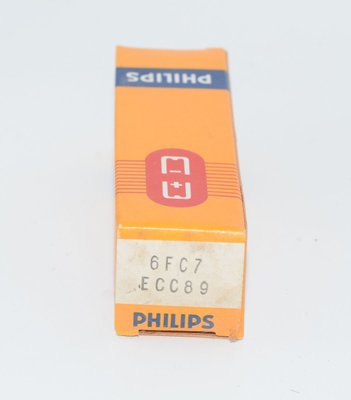
Except for heater ratings, the 6FC7 is identical to the 7FC7, its series-string heater counterpart. The tube is also closely related to the European designation ECC89, which is considered a direct equivalent. The 6FC7 was produced in a 9-pin miniature (noval) envelope, making it compatible with the standard 9-pin sockets widely used in television and communications equipment of the era.
2. Technical Specifications and Design
General Description
- Type: Frame-Grid Double Triode
- Construction: 9-pin miniature (noval) base, glass bulb envelope (T-6½)
- Base: 9DD (9-pin miniature)
- Mounting Position: Any
- Manufacturer: Tung-Sol Electric Inc., Electron Tube Division
- Maximum Overall Length: 1-13/16 inches
- Maximum Seated Height: 1-13/16 inches
- Maximum Diameter: 2-5/64 inches
Heater Ratings
- Heater Voltage: 6.3 volts
- Heater Current: 0.34 amperes
Maximum Ratings (Design Center System, Each Section)
- Maximum Plate Voltage: 130 volts
- Maximum DC Component: 130 volts
- Maximum Plate Dissipation: 1.8 watts
- Maximum Cathode Current: 22 mA
- Maximum Negative Grid Voltage: 50 volts
- Maximum Grid Circuit Resistance (Grounded Cathode Section): 1.0 megohm
- Maximum Grid Circuit Resistance (Grounded Grid Section): 500 kilohms
- Maximum Heater-to-Cathode Voltage (RMS): 50 volts
- Maximum Heater-to-Cathode Voltage (Heater Negative): 180 volts
Typical Characteristics (Each Section)
- Heater Voltage: 6.3 volts
- Heater Current: 0.34 amperes
- Plate Voltage: 90 volts
- Grid Voltage: −1.2 volts
- Plate Current: 15 mA
- Mutual Conductance (Transconductance, gm): 12,000 μmhos (12 mA/V)
- Noise Factor (in Cascode Circuit): 5.5 dB
Derived Parameters
Note: The Tung-Sol tentative data sheet does not explicitly list the amplification factor (μ) or plate resistance (rp). These values should be confirmed against a complete manufacturer datasheet or measured. However, based on the ECC89 equivalence and typical frame-grid triode characteristics, the following approximate values are commonly cited:
- Amplification Factor (μ): Approximately 42–48 (should be verified against complete datasheet)
- Plate Resistance (rp): Approximately 3,500–4,000 ohms (should be verified against complete datasheet)
Direct Interelectrode Capacitances (With External Shield)
| Between Sections | ||
|---|---|---|
| Plate #1 to Plate #2 (max.) | 0.015 | μμF (pF) |
| Grid #1 to Plate #2 (max.) | 0.005 | μμF (pF) |
| Grounded Cathode Section | ||
|---|---|---|
| Plate to Grid | 1.9 | μμF (pF) |
| Input | 3.8 | μμF (pF) |
| Output | 2.5 | μμF (pF) |
| Grid to Heater (max.) | 0.3 | μμF (pF) |
| Grounded Grid Section | ||
|---|---|---|
| Plate to Grid | 4.1 | μμF (pF) |
| Plate to Cathode | 0.2 | μμF (pF) |
| Input | 6.3 | μμF (pF) |
| Output | 4.5 | μμF (pF) |
| Cathode to Heater | 2.9 | μμF (pF) |
Pin Configuration (Bottom View, 9-Pin Miniature Base — 9DD)
The triode on pins 6, 7, 8, and 9 is intended for grounded cathode connection, while the triode on pins 1, 2, and 3 is intended for grounded grid connection. It is recommended that pins 7 and 8 be strapped together.
Based on the bottom view diagram from the Tung-Sol datasheet:
- Pin 1: Grid (Section 2 — Grounded Grid Section)
- Pin 2: Cathode (Section 2)
- Pin 3: Plate (Section 2)
- Pin 4: Heater
- Pin 5: Heater
- Pin 6: Plate (Section 1 — Grounded Cathode Section)
- Pin 7: Grid (Section 1) — strap to pin 8
- Pin 8: Grid (Section 1) — strap to pin 7
- Pin 9: Cathode (Section 1)
Note: The pin assignments should be verified against the specific manufacturer's datasheet diagram, as the bottom-view orientation shown in the Tung-Sol data clearly labels each element.
3. Applications and Usage
The 6FC7 was specifically designed for use as a cascode amplifier at VHF frequencies up to 220 MHz. The cascode configuration — where one triode section operates in grounded-cathode mode and the other in grounded-grid mode — was the preferred topology for television tuner front ends in the late 1950s and 1960s. This configuration offered several advantages:
- Low Noise: The 6FC7 achieves a noise factor of only 5.5 dB in a cascode circuit, which was excellent for the era and critical for weak-signal VHF reception.
- High Gain: The high transconductance of 12,000 μmhos provided substantial gain at VHF frequencies.
- Low Miller Capacitance: The cascode arrangement effectively neutralizes the Miller effect, keeping the input capacitance low and stable — essential for broadband VHF tuner design.
- Stability: The extremely low plate-to-plate capacitance (0.015 pF max) and grid-to-plate capacitance of the opposite section (0.005 pF max) ensured stable operation without parasitic oscillation.
Primary applications included:
- VHF television tuner RF amplifier stages
- VHF communications receiver front ends
- Low-noise preamplifiers for instrumentation
- General-purpose cascode amplifier circuits requiring high gain and low noise at high frequencies
The dual-section design with separate optimized connections for grounded-cathode and grounded-grid operation made the 6FC7 a purpose-built cascode tube, eliminating the need to match two separate triodes while ensuring consistent section-to-section characteristics within a single envelope.
4. Sound Characteristics
The 6FC7, while originally designed for RF applications rather than audio, possesses characteristics that give it a distinctive sonic signature when employed in audio circuits:
- Detail and Clarity: The frame-grid construction and high transconductance (12,000 μmhos) contribute to an exceptionally detailed and transparent sound. Frame-grid tubes are generally regarded as having superior resolution compared to conventional wound-grid types, and the 6FC7 is no exception. Listeners often describe the presentation as "fast" and articulate, with excellent micro-detail retrieval.
- Low Noise Floor: With a noise factor of 5.5 dB in cascode configuration, the 6FC7 is inherently a low-noise device. This translates directly to audio applications, where the tube can provide a very quiet background — a "black" noise floor that allows subtle musical details to emerge.
- Extended High Frequencies: Designed for operation up to 220 MHz, the 6FC7 has no difficulty whatsoever with the audio bandwidth. Its high-frequency extension is effortless, and the top end is typically described as airy, open, and extended without harshness.
- Tonal Balance: The 6FC7 tends toward a neutral-to-slightly-lean tonal balance. It does not possess the warm, lush midrange coloration associated with some classic audio triodes (such as the 12AX7 or 6SN7). Instead, it offers a more analytical, precise presentation that some listeners find refreshing and others may find slightly clinical.
- Dynamic Response: The high transconductance and relatively low plate resistance give the 6FC7 excellent transient response and dynamic capability. Percussive attacks are rendered with speed and impact.
- Comparison to ECC89: European-made ECC89 equivalents (particularly Philips/Mullard examples) are sometimes described as having a slightly warmer and more refined character compared to American-made 6FC7s, though this is subjective and varies with specific production runs and circuit implementation.
Overall, the 6FC7's sonic character is best described as precise, detailed, and transparent — qualities that make it appealing for high-fidelity applications where accuracy is valued over euphonic coloration.
5. Equivalent or Substitute Types
| Type | Equivalence | Notes |
|---|---|---|
| ECC89 | Direct equivalent | European designation. Pin-compatible and electrically identical. Manufactured by Philips, Mullard, and other European producers. The most commonly encountered substitute. |
| 7FC7 | Near-identical | Identical to the 6FC7 except for heater ratings. The 7FC7 has a different heater voltage (designed for series-string operation). Not a drop-in replacement without heater circuit modification. |
Important Notes on Substitution:
- The ECC89 is the only true drop-in substitute for the 6FC7 in all circuits. Pin assignments, electrical characteristics, and maximum ratings are identical.
- The 7FC7 should not be substituted without verifying and adjusting the heater supply, as the heater voltage differs from the 6FC7's 6.3V rating.
- While other high-gm double triodes (such as the 6DJ8/ECC88 or 6922/E88CC) may seem similar in general terms, they have different pinouts, different operating points, and different maximum ratings. They are not interchangeable with the 6FC7 without complete circuit redesign.
6. Notable Characteristics
- Frame-Grid Construction: The 6FC7's frame-grid design is its most distinguishing feature. This construction technique, where grid wires are precisely wound on a rigid metal frame, allows for extremely tight grid-to-cathode spacing (on the order of a few thousandths of an inch). This results in the tube's exceptionally high transconductance of 12,000 μmhos — significantly higher than conventional double triodes of similar size and power rating.
- Optimized Cascode Layout: Unlike general-purpose double triodes where both sections are identical and interchangeable, the 6FC7's internal layout and pin arrangement are specifically optimized for cascode operation. The datasheet explicitly designates which section should be used for grounded-cathode and which for grounded-grid service, and recommends strapping pins 7 and 8 together for the grounded-cathode section's grid connection.
- Exceptionally Low Inter-Section Capacitance: The plate-to-plate capacitance of only 0.015 pF maximum and grid-to-plate (opposite section) capacitance of 0.005 pF maximum are remarkably low values that reflect careful internal shielding and element placement. These low coupling capacitances are essential for stable VHF cascode operation.
- Moderate Plate Voltage Rating: The maximum plate voltage of 130 volts is relatively modest, reflecting the tube's design for low-voltage, high-current operation typical of VHF amplifier stages. This limits its flexibility in some audio circuit topologies that require higher B+ voltages.
- High Heater-to-Cathode Voltage Rating: The 180-volt maximum heater-to-cathode voltage (heater negative) is generous and allows the tube to be used in circuits where the cathode operates at elevated DC potentials — a common situation in cascode amplifiers where the upper (grounded-grid) section's cathode sits at the plate voltage of the lower section.
- Tentative Data Status: The Tung-Sol datasheet is marked "TENTATIVE DATA," suggesting the tube may have been in the early stages of production or qualification when the sheet was published in October 1960. This was not uncommon for new tube types, and final production specifications may have been slightly refined.
7. Usage in the Audio Community
The 6FC7 occupies a niche but respected position in the audio community. While it was never designed for audio service, its exceptional electrical characteristics have attracted the attention of adventurous DIY builders and boutique amplifier designers:
Phono Preamplifiers
The 6FC7's combination of high transconductance (12,000 μmhos) and low noise factor (5.5 dB) makes it an attractive candidate for phono preamplifier input stages, where the signal levels from a moving-magnet or moving-coil cartridge are extremely small and noise performance is paramount. The tube's inherently low noise floor can rival or exceed that of more commonly used audio tubes like the 12AX7 or 6922 in this application.
Line-Stage Preamplifiers
Some builders have experimented with the 6FC7 in line-stage preamplifier circuits, taking advantage of its high gain and wide bandwidth. The relatively low plate voltage maximum of 130 volts constrains the design somewhat, but creative circuit topologies — including cascode configurations adapted for audio — can yield excellent results with generous headroom at typical line-level signals.
Headphone Amplifiers
The 6FC7's high transconductance and ability to deliver up to 22 mA of cathode current per section make it suitable for headphone amplifier designs, where the ability to drive low-impedance loads with authority is valued. The tube's fast transient response translates to tight, controlled bass and crisp treble in headphone listening.
Cascode Audio Amplifiers
Perhaps the most natural audio application for the 6FC7 is in cascode voltage amplifier stages, directly leveraging the tube's intended purpose but at audio frequencies. A cascode stage using the 6FC7 can provide very high voltage gain with excellent linearity and bandwidth, making it an effective driver stage for power amplifiers.
Availability and Collectibility
The 6FC7 is not a mainstream audio tube, and NOS (New Old Stock) examples can be found at reasonable prices compared to heavily demanded audio types like the 12AX7 or 6SN7. Tung-Sol-branded examples are the most commonly encountered American production. European ECC89 equivalents — particularly those made by Philips and Mullard (including production from the Mullard Mitcham factory) — are sought after by collectors and audiophiles who value the perceived sonic refinement of European frame-grid tube manufacturing. Mullard Mitcham-produced ECC89 tubes, in particular, carry a premium among enthusiasts due to the factory's legendary reputation for quality.
Community Perception
Within the audio DIY community, the 6FC7/ECC89 is regarded as a hidden gem — a high-performance tube that flies under the radar of mainstream audio tube demand. Its frame-grid construction places it in the same elite category as the 6DJ8/ECC88 family, but with less market hype and correspondingly lower prices. Builders who have worked with the 6FC7 often praise its resolution and quietness, while noting that its relatively low maximum plate voltage requires thoughtful circuit design to extract the best performance.
The tube is sometimes discussed in comparison to the more popular 6DJ8/6922/ECC88 family, with proponents arguing that the 6FC7's purpose-built cascode design and slightly different operating characteristics give it a unique sonic character that rewards experimentation. However, the limited availability of published audio circuits using the 6FC7 means that builders must often adapt existing designs or create original circuits — a challenge that appeals to the more experienced segment of the DIY community.