Introduction and History
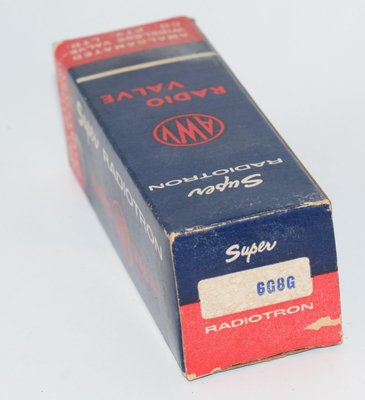
The 6G8G is a duo-diode super-control pentode, a multi-function vacuum tube that combines two independent diode units with a remote-cutoff (super-control, or variable-mu) pentode section within a single glass envelope. This type of tube was developed during the late 1930s as part of the effort to reduce the number of tubes required in radio receiver designs by combining multiple functions into one envelope. The 6G8G was manufactured by several companies, including notable production by AWV (Amalgamated Wireless Valve Company) under the Super Radiotron brand in Australia, as well as by American and European manufacturers.
The tube was designed primarily for use in superheterodyne radio receivers, where the pentode section served as an intermediate-frequency (IF) amplifier or radio-frequency (RF) amplifier with automatic gain control (AGC), while the two diode sections handled signal detection (demodulation) and AGC rectification. The super-control characteristic of the pentode section allowed smooth, distortion-free gain reduction over a wide range of signal levels — a critical feature for effective automatic volume control (AVC) in broadcast receivers.
The 6G8G uses the ST-12 (shouldered) glass bulb and a small shell octal 8-pin base, placing it firmly in the "G" series of octal tubes that became the dominant standard from the late 1930s through the 1950s. Its combination of functions made it an economical choice for compact receiver designs of the era.
Technical Specifications and Design
General Information
| Tube Type | Duo-Diode Super-Control Pentode |
| Cathode Type | Coated Uni-potential (Indirectly Heated) |
| Envelope | ST-12 Glass Bulb |
| Base | Small Shell Octal 8-Pin |
| Overall Length | 4-7/32" to 4-15/32" |
| Maximum Diameter | 1-9/16" |
| Cap | Skirted Miniature (Grid connection) |
Heater Ratings
| Heater Voltage | 6.3 volts (AC or DC) |
| Heater Current | 0.3 amperes |
Pin Configuration (Bottom View)
| Pin 1 | No Connection |
| Pin 2 | Heater |
| Pin 3 | Plate (Pentode) |
| Pin 4 | Diode Plate #2 |
| Pin 5 | Diode Plate #1 |
| Pin 6 | Screen Grid |
| Pin 7 | Heater |
| Pin 8 | Cathode |
| Cap | Control Grid (Grid 1) |
Note: The control grid is brought out to a top cap connection, which is typical for RF/IF tubes of this era to minimize stray capacitance between the grid and other elements.
Direct Interelectrode Capacitances (Pentode Unit)
| Grid to Plate (with shield-can) | 0.007 max. µµf |
| Input | 3.5 µµf |
| Output | 9.5 µµf |
Pentode Unit – R-F or I-F Amplifier Operating Conditions and Characteristics
| Parameter | Condition 1 | Condition 2 | Unit |
|---|---|---|---|
| Heater Voltage | 6.3 | 6.3 | volts |
| Plate Voltage | 250 | 250 | volts |
| Screen Voltage | 100 | 125 | volts |
| Grid Voltage | −3 | −3 | volts |
| Amplification Factor (µ) | 900 | 600 | — |
| Plate Resistance (rp) | 0.85 | 0.51 | megohm |
| Mutual Conductance (gm) | 1100 | 1210 | µmhos |
| Plate Current | 6.5 | 9.5 | mA |
| Grid Bias (for gm = 10 µmhos) | −35 | −43 | approx. volts |
| Screen Current | 1.5 | 2.2 | mA |
**For Mutual Conductance = 10 µmhos
Pentode Unit – A-F Amplifier Operating Conditions
| Heater Voltage | 6.3 volts |
| Plate Supply | 250 volts |
| Screen Supply | 250 volts |
| Load Resistance | 0.25 megohm |
| Cathode Bias Resistor | 2000 ohms |
Screen voltage may be obtained from a voltage divider consisting of 1 megohm and 0.25 megohm resistors.
Diode Units
The two diode units are independent of each other and from the pentode unit, except for the common cathode sleeve. Their rectifying or detecting action may be used in half-wave or full-wave arrangement to supply signal voltage to the pentode unit and/or voltage to regulate the gain of the R-F or I-F amplifier stages, maintaining essentially constant-carrier input to the audio detector. The half-wave circuit will provide approximately twice the rectified voltage obtainable from the full-wave circuit.
Important Design Notes
The cathode should preferably be connected directly to the mid-tap of the heater winding. If this practice is not followed, the potential difference between heater and cathode should be kept as low as possible.
Applications and Usage
The 6G8G was designed as a multi-purpose tube for superheterodyne radio receivers, and its applications include:
- IF Amplifier with AVC and Detection: The primary intended application. The pentode section amplifies the intermediate-frequency signal, while one diode provides signal detection (demodulation) and the second diode provides the AVC (automatic volume control) rectified voltage. The super-control characteristic of the pentode allows the AVC voltage to smoothly reduce gain without introducing cross-modulation distortion.
- RF Amplifier: The pentode section can serve as a variable-gain RF amplifier ahead of the mixer stage, with the diode sections available for other functions.
- Combined AF Amplifier and Detector: In some circuit configurations, the pentode section is used as a first audio-frequency amplifier stage, with the diodes handling detection and AVC duties. The A-F amplifier operating conditions specified in the datasheet (250V plate, 250V screen, 0.25 megohm load, 2000 ohm cathode bias) support this application.
- AGC Voltage Regulation: The regulation of amplifier gain by means of a rectified voltage may be accomplished by a number of methods. The regulating voltage may be applied to the control grids of the amplifier valves, or it may be applied in the case of R-F pentodes to their suppressors, plates, and/or screens.
Sound Characteristics
While the 6G8G was not originally designed as an audiophile tube, its sonic characteristics are noteworthy for those who encounter it in vintage equipment or experimental audio circuits:
- Warm and Smooth Midrange: As a super-control pentode, the 6G8G exhibits a characteristically warm and rounded midrange presentation. The variable-mu grid structure, designed to handle varying signal levels gracefully, imparts a gentle, non-abrupt compression character to the signal that many listeners find musically pleasing.
- Soft Clipping Behavior: The remote-cutoff characteristic means that as the tube is driven harder, it transitions into compression gradually rather than abruptly. This produces a soft, progressive saturation that is less harsh than sharp-cutoff pentode types, lending a forgiving quality to overdriven signals.
- Moderate Detail and Resolution: With a transconductance of 1100–1210 µmhos and a plate resistance of 0.51–0.85 megohm, the 6G8G offers moderate gain and a relatively high output impedance. This tends to produce a sound that is smooth and slightly rolled off at the frequency extremes compared to higher-gm pentodes, giving a vintage, mellow character.
- Low Noise Floor: The coated uni-potential cathode and well-shielded construction (with the grid brought to a top cap) contribute to a relatively low noise floor when the tube is in good condition, making it suitable for sensitive signal stages.
- Vintage Coloration: The overall sonic signature is quintessentially "vintage radio" — warm, slightly compressed, with a pleasant harmonic richness that adds character without excessive coloration. The pentode section's high plate resistance means it interacts significantly with its load, and the resulting tonal character is highly dependent on the output coupling and load impedance.
Equivalent or Substitute Types
The 6G8G belongs to a family of duo-diode pentode types. The following are related or potentially interchangeable types:
- 6G8 (Metal): The metal-envelope version of the same tube. Electrically identical to the 6G8G, with the same pinout and operating characteristics. The metal version offers better shielding but is less commonly found.
- 6G8GT: The tubular glass (GT) envelope version. Electrically identical, same octal base and pinout. Direct substitute.
- 6B8 / 6B8G: Another duo-diode pentode with similar function, though it uses a sharp-cutoff pentode rather than a super-control pentode. Not a direct substitute due to the different cutoff characteristic, which affects AGC behavior significantly.
- 6SF7: A later loktal-based duo-diode variable-mu pentode with similar function but a different base type. Not pin-compatible.
Note: When substituting tubes, always verify that the pinout, heater ratings, and operating characteristics match the circuit requirements. The super-control (variable-mu) characteristic is essential in AGC-controlled circuits and cannot be replaced by a sharp-cutoff type without circuit modifications.
Notable Characteristics
- Triple Function in One Envelope: The 6G8G combines two independent diodes and a super-control pentode in a single octal tube, reducing tube count and simplifying receiver design. The diode units share only the common cathode sleeve with the pentode section.
- Super-Control (Variable-Mu) Grid: The pentode section features a variable-pitch grid winding that provides a gradual, extended cutoff characteristic. This allows the tube's gain to be smoothly varied over a wide range (from full gain down to a grid bias of approximately −35 to −43 volts for near-cutoff) without introducing cross-modulation distortion — essential for effective automatic gain control.
- High Amplification Factor: With an amplification factor (µ) of 600 to 900 depending on screen voltage, the 6G8G offers substantial voltage gain capability in its pentode section.
- Top Cap Grid Connection: The control grid is brought out to a top cap, minimizing grid-to-plate capacitance to a maximum of only 0.007 µµf (with shield can). This extremely low feedback capacitance is critical for stable high-frequency amplification.
- Australian Heritage: The 6G8G was notably produced by AWV (Amalgamated Wireless Valve Company) in Australia under the Super Radiotron brand, and it saw widespread use in Australian and New Zealand radio receivers. NOS (New Old Stock) examples from AWV are still available to collectors and restorers.
- Versatile Biasing: The tube can be operated with cathode bias (2000 ohm resistor specified for A-F amplifier service) or with fixed bias, and the screen voltage can be derived from a simple voltage divider network.
Usage in the Audio Community
The 6G8G occupies a niche position in the modern audio community, valued primarily by vintage radio restorers and experimenters rather than mainstream audiophile amplifier builders:
- Vintage Radio Restoration: The primary demand for the 6G8G comes from restorers of 1930s and 1940s superheterodyne radio receivers, particularly Australian-made sets that specified this tube. Restorers seek NOS (New Old Stock) examples, with AWV Super Radiotron branded tubes being particularly prized for period-correct restorations.
- Experimental Preamplifier Stages: Some adventurous audio experimenters have used the pentode section of the 6G8G as a high-gain preamplifier stage, taking advantage of its high amplification factor and smooth variable-mu characteristic. The diode sections can be repurposed for signal routing, level detection, or even as a simple limiter/compressor element.
- DIY Compressor/Limiter Circuits: The combination of diodes and a variable-mu pentode in one envelope makes the 6G8G an interesting candidate for DIY audio compressor or automatic level control circuits. The diodes can rectify the audio signal to derive a control voltage, which is then applied to the pentode's grid to reduce gain — essentially the same AGC function the tube was designed for, but applied to audio-frequency signals.
- Guitar Amplifier Experimentation: A small number of guitar amplifier experimenters have explored the 6G8G for its soft-clipping, variable-mu compression characteristics. The gradual gain reduction provides a natural, musical compression that can be desirable for clean-to-slightly-overdriven guitar tones.
- Collector Interest: The 6G8G is collected by tube enthusiasts, particularly those focused on the octal "G" series with their distinctive shouldered glass envelopes. Australian-made AWV Super Radiotron examples are sought after for their quality construction and historical significance.
- Educational Use: The multi-function nature of the 6G8G makes it an excellent teaching tool for understanding how classic superheterodyne receivers worked, demonstrating the principles of detection, AGC, and variable-gain amplification in a single tube.
While the 6G8G will never rival popular audio tubes like the 12AX7 or 6L6 in mainstream audio applications, it remains a fascinating and versatile tube that rewards exploration by those willing to design circuits around its unique combination of functions. Its warm, smooth sonic character and gentle compression behavior offer qualities that are difficult to replicate with more common tube types.