1. Introduction and History
The 6GV8, known in European nomenclature as the ECL85, is a compound (combination) vacuum tube containing a high-mu triode and a power pentode within a single glass envelope. Developed during the late 1950s and early 1960s, this tube was designed primarily for use in television receivers, where it served dual roles as a sync-amplifier (triode section) and video-output or vertical-deflection amplifier (pentode section). Its compact noval (B9A) base and efficient design made it an attractive choice for manufacturers seeking to reduce chassis size and component count in consumer electronics.
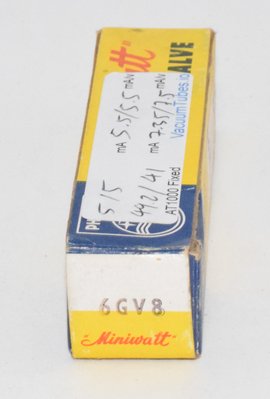
The 6GV8 was manufactured by a wide range of companies across the globe, including Philips (under the Miniwatt brand in Australia and Europe), Toshiba in Japan, Mullard, Valvo, Siemens, and numerous Eastern European manufacturers. The European designation ECL85 follows the Mullard–Philips naming convention: 'E' denotes a 6.3V heater, 'C' indicates a triode section, and 'L' indicates a power pentode output section. The '85' series number places it in the noval-base family of tubes.
While originally conceived for television applications, the 6GV8/ECL85 has found a second life in the audio community, where its combination of a high-mu triode driver and a capable power pentode in a single envelope makes it an appealing candidate for compact, low-to-medium power single-ended amplifier designs.
2. Technical Specifications and Design
General Data
| Parameter | Value |
|---|---|
| Tube Type | High-Mu Triode – Power Pentode (compound) |
| Base | Noval (B9A), 9-pin miniature |
| Envelope | Miniature glass, Outline section 6G |
| Mounting | Any position |
Heater Ratings
| Parameter | 6GV8 / ECL85 | 9GV8 / XCL85 | 10GV8 / LCL85 | 18GV8 / PCL85 |
|---|---|---|---|---|
| Heater Voltage (ac/dc) | 6.3 V | 9.5 V | 11.6 V | 18 V |
| Heater Current | 0.9 A (0.875 A per TDSL) | 0.6 A | 0.45 A | 0.3 A |
| Peak Heater-Cathode Voltage | ±220 V max | ±200 V max | ±200 V max | ±200 V max |
Note: The RCA manual lists heater current as 0.9 A, while TDSL reference data specifies 0.875 A. Both values are found in manufacturer literature; the slight discrepancy likely reflects rounding or measurement methodology differences between sources.
Interelectrode Capacitances
| Parameter | Value |
|---|---|
| Grid-to-Cathode (Cgk) | 3.0 pF |
| Anode-to-Cathode (Cak) | 2.5 pF |
| Grid-to-Anode (Cga) | 1.9 pF |
Additional capacitances from the RCA datasheet (6GW6/6DQ6B section, for reference): Grid No.1 to Plate: 0.5 pF; Grid No.1 to Cathode, Heater, Grid No.2, and Grid No.3: 17 pF; Plate to Cathode, Heater, Grid No.2, and Grid No.3: 7 pF.
Pinout (9LY Noval Base)
Viewed from the bottom of the socket:
| Pin | Connection |
|---|---|
| Pin 1 | Pentode Plate (Pp) |
| Pin 2 | Pentode Grid No.1 (G1p) — Control Grid |
| Pin 3 | Pentode Cathode / Triode Cathode (KT) |
| Pin 4 | Heater (H4) |
| Pin 5 | Heater (H5) |
| Pin 6 | Triode Plate (Pp-triode) |
| Pin 7 | Pentode Grid No.2 (G2p) — Screen Grid |
| Pin 8 | Pentode Grid No.3 (G3p) — Suppressor Grid (internally connected to cathode in some versions) |
| Pin 9 | Triode Grid (G1T) |
Note: The triode and pentode sections share a common cathode connection. The pin numbering follows the standard 9LY noval base diagram as shown in the RCA Receiving Tube Manual.
Maximum Ratings — Class A₁ Amplifier (Absolute Maximum Values)
| Parameter | Triode Unit | Pentode Unit |
|---|---|---|
| Plate Supply Voltage | 550 V | 550 V |
| Peak Plate Voltage | — | 2000 V |
| DC Plate Voltage | 250 V | 250 V |
| Grid No.2 (Screen-Grid) Supply Voltage | — | 550 V |
| Grid No.2 Voltage | — | 250 V |
| Peak Cathode Current | 200 mA | — |
| Average Cathode Current | 15 mA | 75 mA |
| Plate Dissipation | 0.5 W | 7 W |
| Grid No.2 Input | — | 2 W |
Typical Characteristics — Triode Section
Operating Point 1 (from TDSL reference data):
| Parameter | Value |
|---|---|
| Plate Voltage (Va) | 100 V |
| Grid No.1 Voltage (Vg1) | −0.85 V |
| Plate Current (Ia) | 10.0 mA |
| Plate Resistance (Ra) | 11,000 Ω |
| Transconductance (Sm / gm) | 5.5 mA/V |
| Amplification Factor (μ) | ~60 (calculated: μ = gm × rp = 5.5 × 11 = 60.5) |
Operating Point 2 (from RCA datasheet):
| Parameter | Condition 1 | Condition 2 |
|---|---|---|
| Plate Voltage | 100 V | 50 V |
| Grid No.1 Voltage | −0.8 V | −1 V |
| Amplification Factor | 50 | — |
| Plate Resistance (Approx.) | 7,600 Ω | — |
| Transconductance | 6,500 µmhos (6.5 mA/V) | — |
| Plate Current | 5 mA | 200 mA* |
| Grid No.1 Circuit Resistance (fixed bias) | 1 MΩ | |
| Grid No.1 Circuit Resistance (cathode bias) | 3.3 MΩ | |
* Measured by recurrent waveform method; maximum tube ratings must not be exceeded.
Typical Characteristics — Pentode Section
Class A₁ Single-Ended Amplifier (from TDSL reference data):
| Parameter | Value |
|---|---|
| Plate Voltage (Va) | 170 V |
| Screen Grid Voltage (Vg2) | 170 V |
| Grid No.1 Voltage (Vg1) | −15 V |
| Plate Current (Ia) | 41 mA |
| Screen Current (Ig2) | 2.7 mA |
| Plate Resistance (Ra) | 25,000 Ω |
| Transconductance (Sm / gm) | 7.5 mA/V |
| Output Impedance (Zout) | 4,000 Ω |
| Power Output (Pout) | 3.4 W |
Pentode Characteristics (from RCA datasheet):
| Parameter | Condition 1 | Condition 2 |
|---|---|---|
| Plate Voltage | 65 V | 170 V |
| Grid No.2 Voltage | 210 V | 170 V |
| Grid No.1 Voltage | −1 V | −15 V |
| Mu-Factor (Grid No.1 to Grid No.2) | — | 7 |
| Plate Resistance (Approx.) | — | ~25,000 Ω |
| Transconductance | — | 7,500 µmhos (7.5 mA/V) |
| Plate Current | 240 mA* | 41 mA |
| Grid No.2 Current | 50 mA* | 2.7 mA |
| Grid No.1 Circuit Resistance (fixed bias) | 1 MΩ | |
| Grid No.1 Circuit Resistance (cathode bias) | 2.2 MΩ | |
* Measured by recurrent waveform method.
Triode-Connected Pentode (from RCA datasheet, page 2):
| Parameter | Value |
|---|---|
| Plate Voltage | 150 V (triode) / 60 V / 250 V |
| Grid No.2 Voltage | 150 V |
| Grid No.1 Voltage | −22.5 V / 0 V / −22.5 V |
| Mu-Factor (Grid No.2 to Grid No.1) | 4.4 |
| Plate Resistance (Approx.) | — / — / 15,000 Ω |
| Transconductance | — / — / 7,100 µmhos |
| Plate Current | — / 390 mA* / 70 mA |
| Screen Current | — / 32 mA* / 2.1 mA |
| Grid No.1 Voltage for Ia = 1 mA | — / — / −42 V |
3. Applications and Usage
The 6GV8/ECL85 was originally designed for television receiver applications, where its dual-function architecture proved highly practical:
- Sync Amplifier / Separator: The high-mu triode section was commonly employed as a sync-pulse amplifier or separator in television circuits, taking advantage of its high gain (μ ≈ 50–60) and low plate dissipation rating.
- Video Output: The pentode section, with its 7-watt plate dissipation capability and respectable transconductance of 7.5 mA/V, served as a video output amplifier driving the CRT.
- Vertical Deflection: In some designs, the pentode section was used as a vertical-deflection output stage, while the triode served as the vertical oscillator or amplifier.
- Audio Output: The pentode section is capable of delivering approximately 3.4 watts of audio output power in Class A₁ single-ended configuration with a 4,000 Ω output impedance, making it suitable for modest audio amplifier designs.
- General-Purpose Amplification: The triode section's high amplification factor and moderate plate resistance make it useful as a voltage amplifier or driver stage in various circuits.
The tube's shared cathode between triode and pentode sections simplifies circuit design when the two sections are used in cascade, as the triode can directly drive the pentode's control grid with minimal additional components.
4. Sound Characteristics
The 6GV8/ECL85 has garnered attention in the DIY audio community for its distinctive sonic qualities, particularly when used in single-ended amplifier configurations. While subjective descriptions of tube sound always carry a degree of personal interpretation, several consistent observations emerge from builders and listeners:
- Warm and Musical Midrange: The pentode section, when operated in its intended Class A₁ configuration, produces a characteristically warm midrange that many listeners describe as engaging and musical. The moderate power output of approximately 3.4 watts naturally suits high-efficiency speakers, where the tube's tonal character is most apparent.
- Smooth Triode-Mode Operation: When the pentode section is triode-connected (screen tied to plate), the sound takes on a smoother, more refined character with reduced output power but lower distortion harmonics. The triode-connected pentode's plate resistance of approximately 15,000 Ω and transconductance of 7,100 µmhos yield a pleasant, liquid quality favored by some audiophiles.
- Detailed Highs Without Harshness: The relatively high transconductance of the pentode section (7.5 mA/V) contributes to good transient response and detail retrieval in the upper frequencies, without the sometimes aggressive or "spitty" quality associated with some beam power tubes.
- Intimate Soundstage: At 3.4 watts, the 6GV8 is firmly in the low-power, single-ended territory. Paired with appropriate high-efficiency speakers (95 dB/W/m or higher), it produces an intimate, three-dimensional soundstage that excels with small-ensemble acoustic music, jazz, and vocal recordings.
- Triode Section as Driver: The high-mu triode section (μ ≈ 50–60) provides sufficient gain to drive the pentode section directly, and its sonic contribution is generally described as transparent and neutral, allowing the pentode's character to dominate the overall sound signature.
- Comparison to EL84/6BQ5: Some builders compare the pentode section's sound favorably to the EL84, noting a slightly warmer and less aggressive character, though with somewhat less power output. The 6GV8's pentode section operates at lower voltages and currents than a typical EL84 circuit, contributing to its gentler sonic profile.
It should be noted that the sonic character of any tube is heavily influenced by circuit topology, operating point, output transformer quality, and associated components. The descriptions above represent general tendencies reported by multiple builders and should be taken as guidelines rather than absolutes.
5. Equivalent and Substitute Types
Direct Equivalents (Drop-In Replacements)
| Type | Notes |
|---|---|
| ECL85 | European designation for the 6GV8. Identical in all respects — same pinout, same ratings, same heater voltage (6.3 V) and current. Fully interchangeable. |
Different Heater Voltage Variants (NOT Direct Drop-In)
The following types are electrically identical to the 6GV8/ECL85 in all respects except for heater ratings. They require different heater supply voltages and cannot be substituted without modifying the heater circuit:
| Type | European Equivalent | Heater Voltage | Heater Current |
|---|---|---|---|
| 9GV8 | XCL85 | 9.5 V | 0.6 A |
| 10GV8 | LCL85 | 11.6 V | 0.45 A |
| 18GV8 | PCL85 | 18 V | 0.3 A |
The 18GV8/PCL85 is particularly common, as it was widely used in European television sets with series-string heater chains. If a suitable heater supply is available, these variants can be used interchangeably with the 6GV8 in terms of signal performance.
Related Types (Not Interchangeable)
- ECL82 / 6BM8: Another triode-pentode combination on a noval base, but with different characteristics, pinout, and ratings. Not a substitute.
- ECL86 / 6GW8: A later triode-pentode combination with different specifications. Not interchangeable.
6. Notable Characteristics
- Shared Cathode Design: The triode and pentode sections share a common cathode, which simplifies cascaded circuit designs but also means that cathode bias affects both sections simultaneously. Designers must account for the combined cathode current when calculating bias resistor values.
- High Triode Mu: With an amplification factor of approximately 50–60, the triode section provides substantial voltage gain in a single stage, often sufficient to drive the pentode section to full output without additional amplification stages.
- Generous Maximum Ratings: The pentode section's 550V plate supply voltage rating and 2000V peak plate voltage capability reflect its television heritage, where flyback pulses could generate very high peak voltages. These generous ratings provide comfortable safety margins in audio applications.
- Moderate Power Output: At 3.4 watts in Class A₁ single-ended pentode mode with a 4,000 Ω load impedance, the 6GV8 occupies a useful niche for small amplifiers driving efficient speakers.
- Low Screen Current: The pentode section draws only 2.7 mA of screen current at the typical operating point (170V plate, 170V screen, −15V bias), indicating efficient beam-forming and contributing to long tube life.
- Television-Grade Reliability: Designed for continuous operation in consumer television sets, the 6GV8 was built to withstand thermal cycling and extended operating hours, characteristics that translate well to audio applications.
- Compact Single-Envelope Design: Having both a driver triode and output pentode in one envelope allows for extremely compact amplifier designs — a complete single-ended amplifier channel can be built around a single 6GV8 plus a rectifier tube.
7. Usage in the Audio Community
The 6GV8/ECL85 has developed a dedicated following in the DIY audio community, particularly among builders who appreciate the elegance and simplicity of single-tube-per-channel amplifier designs. Its usage in audio can be categorized into several areas:
Single-Ended Amplifiers
The most common audio application for the 6GV8 is in single-ended (SE) amplifiers, where the triode section serves as the voltage amplifier/driver and the pentode section as the output stage. With approximately 3.4 watts of output power available from the pentode section into a 4,000 Ω primary impedance, these amplifiers are well-suited to high-efficiency speakers such as Lowther, Fostex, and Klipsch Heritage models. The complete amplifier channel requires only the single 6GV8 tube plus a power supply, making for exceptionally simple and elegant builds.
Pentode vs. Triode-Connected Operation
Audio builders frequently experiment with both pentode and triode-connected configurations for the output section. In pentode mode, the full 3.4 watts is available with higher damping factor considerations requiring negative feedback. In triode-connected mode (screen tied to plate), output power drops but distortion characteristics change favorably, with the dominant harmonic shifting more toward the second harmonic — generally considered more musically pleasing. The triode-connected pentode section shows a plate resistance of approximately 15,000 Ω and transconductance of 7,100 µmhos.
Ultralinear Operation
Some builders have experimented with ultralinear connection using output transformers with screen taps, achieving a compromise between the power of pentode mode and the linearity of triode mode. This approach can yield approximately 2–2.5 watts with improved distortion characteristics compared to pure pentode operation.
Headphone Amplifiers
The 6GV8's moderate power output and high triode gain make it an interesting candidate for headphone amplifier designs. The triode section can serve as a voltage amplifier, with the pentode section (often triode-connected) driving headphones through a small output transformer. The low plate dissipation of the triode section (0.5W maximum) and the manageable heat output of the pentode section make for practical desktop-sized headphone amplifiers.
Availability and Sourcing
The 6GV8/ECL85 remains reasonably available as new-old-stock (NOS) from various manufacturers. Philips Miniwatt examples from Australia and Europe are particularly sought after for their consistent quality and reputed sonic characteristics. Toshiba-manufactured Japanese examples are also available and well-regarded. The 18GV8/PCL85 variant is even more plentiful due to its widespread use in European television sets, and can be used with an appropriate 18V heater supply.
Prices for NOS 6GV8/ECL85 tubes remain moderate compared to more popular audio tubes like the EL34 or 6L6, making the 6GV8 an economical choice for experimenters. However, as with all NOS tubes, supply is finite and prices have been gradually increasing as audio hobbyists discover this versatile tube type.
Community Projects and Kits
Several DIY audio communities and kit manufacturers have developed amplifier designs around the 6GV8/ECL85, recognizing its appeal as a "one-tube-per-channel" solution. These designs range from simple, beginner-friendly projects to more sophisticated implementations with regulated power supplies and carefully optimized operating points. The tube's forgiving nature and generous maximum ratings make it an excellent choice for builders who are new to vacuum tube amplifier construction.
Comparison with the 6BM8/ECL82
In the audio community, the 6GV8/ECL85 is often compared to its more famous cousin, the 6BM8/ECL82. While the ECL82 has achieved greater popularity in audio circles — partly due to earlier adoption and more published designs — the ECL85 offers some advantages: higher pentode transconductance (7.5 mA/V vs. approximately 5.2 mA/V for the ECL82), higher power output capability, and a higher triode amplification factor. Builders who have compared both types often note that the ECL85 offers a slightly more authoritative bass response and greater dynamic headroom, while the ECL82 may have a slight edge in midrange sweetness. Both tubes remain excellent choices for compact, single-ended amplifier projects.