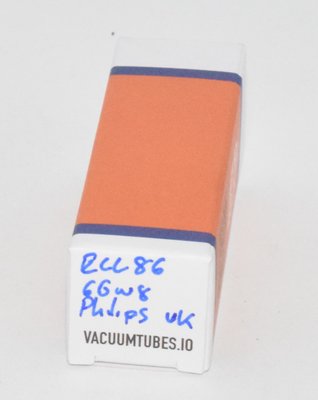
Introduction and History
The 6GW8, known in European designation as the ECL86, is a miniature compound (composite) vacuum tube containing a high-mu triode and a sharp-cutoff pentode within a single glass envelope. Developed during the late 1950s, this tube was designed to serve dual roles in a single package — preamplification via the triode section and power output via the pentode section — making it an elegant and cost-effective solution for compact audio equipment and television receivers.
The tube was manufactured by a wide range of companies across the globe, including Philips (Miniwatt), Mullard, Siemens, Telefunken, Toshiba, AWV (Super Radiotron) in Australia, and various Eastern European manufacturers such as Ei (Yugoslavia) and Tesla (Czechoslovakia). The ECL86 designation follows the Mullard–Philips European naming convention: 'E' for a 6.3V heater, 'C' for a triode, and 'L' for a sharp-cutoff output pentode, with '86' indicating the noval (B9A) base and the specific design generation.
Originally intended for use in preamplifier and audio output stages of audio equipment and television receivers, the 6GW8/ECL86 found widespread adoption in European radios, record players, and small integrated amplifiers throughout the 1960s and 1970s. Its ability to provide a complete audio amplifier channel with just one tube — triode for voltage gain and pentode for power output — made it particularly popular in portable and tabletop radios where space and cost were at a premium.
As noted in the RCA Receiving Tube Manual, the 6GW8/ECL86 is described as a "Miniature type used in preamplifier and audio output stages of audio equipment and television receivers."
Technical Specifications and Design
General Data
| Parameter | Value |
|---|---|
| Tube Type | High-Mu Triode – Sharp-Cutoff Pentode (Composite) |
| Base | Noval (B9A), 9-pin miniature |
| Envelope / Outline | Miniature glass, section 6G |
| Heater Voltage (ac/dc) | 6.3 volts |
| Heater Current | 0.7 amperes (per RCA datasheet); 0.66A per TDSL reference |
| Maximum Heater-Cathode Voltage | 100 peak, 100 average (volts) |
| European Equivalent | ECL86 |
| Military Designation | CV8297 |
Pin Configuration (9LZ Base — Bottom View)
| Pin | Connection |
|---|---|
| 1 | Grid (Triode) — GT |
| 2 | Cathode (Triode) — KT |
| 3 | Grid No.2 (Pentode) — G2P |
| 4 | Heater (H) |
| 5 | Heater (H) |
| 6 | Cathode, Grid No.3 (Pentode) — KP, G3P, Internal Shield (IS) |
| 7 | Internal Shield (IS) |
| 8 | Grid No.1 (Pentode) — G1P |
| 9 | Plate (Triode) — PT |
| Top Cap | None — Plate (Pentode) — PP is brought out to pin 6 area (see note) |
Note: The pentode plate (PP) connects to the top of the envelope structure. Refer to the pin diagram in the RCA datasheet for exact connections. Pin 7 serves as the internal shield (IS) connection, and pin 6 connects to the pentode cathode (KP) and grid No.3 (suppressor grid, G3P).
Maximum Ratings — Class A1 Amplifier (Design-Center Values)
| Parameter | Triode Unit | Pentode Unit | Units |
|---|---|---|---|
| Plate Supply Voltage | 550 | 550 | volts |
| Plate Voltage | 300 | 300 | volts |
| Grid No.2 (Screen-Grid) Supply Voltage | — | 550 | volts |
| Grid No.2 Voltage | — | 300 | volts |
| Grid No.1 (Control-Grid) Voltage, Negative-bias value | 1.3 | 1.3 | volts |
| Cathode Current | 4 | 55 | mA |
| Plate Dissipation | 0.5 | 9 | watts |
| Grid No.2 Input | — | 1.5 | watts |
Typical Characteristics — Class A1 Amplifier
| Parameter | Triode Unit | Pentode Unit | Units |
|---|---|---|---|
| Plate Voltage | 250 | 250 | volts |
| Grid No.2 Voltage | — | 250 | volts |
| Grid No.1 Voltage | −1.9 | −7 | volts |
| Amplification Factor (μ) | 100 | 21* | — |
| Plate Resistance (rp) | — | 45,000 | ohms |
| Transconductance (gm) | 1,600 | 10,000 | μmhos |
| Plate Current | 1.2 | 36 | mA |
| Grid No.2 Current | — | 6 | mA |
* Amplification factor of pentode unit is measured as Grid No.2 to Grid No.1.
Direct Interelectrode Capacitances
| Parameter | Value | Units |
|---|---|---|
| Grid to Plate (Cga) — Triode Unit | 1.4 | pF |
| Grid to Cathode (Cgk) — Triode Unit | 2.3 | pF |
| Plate to Cathode (Cak) — Triode Unit | 2.5 | pF |
Maximum Circuit Values
| Parameter | Triode Unit | Pentode Unit | Units |
|---|---|---|---|
| Grid No.1 Circuit Resistance (fixed-bias) | 1 | 0.5 | megohm |
For replacement purposes, the RCA manual notes: "For replacement use type 6GY6/6GX6."
Applications and Usage
The 6GW8/ECL86 was designed as a versatile compound tube for applications requiring both voltage amplification and power output in a single envelope. Its primary applications include:
- Audio Preamplifier and Output Stages: The triode section provides high-gain voltage amplification (μ = 100, gm = 1,600 μmhos), while the pentode section delivers power output with a transconductance of 10,000 μmhos and plate dissipation of up to 9 watts. This combination allows a complete audio channel to be built around a single tube.
- Television Receivers: Used in audio sections of both color and black-and-white television sets, where the triode served as the audio voltage amplifier and the pentode as the audio output stage.
- Radio Receivers: Extensively used in European AM/FM radio receivers, particularly in compact and portable designs where minimizing tube count was essential.
- Record Players and Phonograph Amplifiers: The tube's ability to provide a complete amplifier in one envelope made it ideal for integrated record player/amplifier units popular in the 1960s.
- Intercom Systems and Public Address Equipment: Small PA systems and intercom units frequently employed the 6GW8/ECL86 for its simplicity and adequate output power.
In typical audio output service, the pentode section operating in Class A1 can deliver approximately 3.5 to 4 watts of audio output power with a suitable output transformer. When operated in pentode mode with 300V on the plate and screen, output power can approach the upper limits of the tube's 9-watt plate dissipation rating. In triode-connected pentode mode, output power is reduced but distortion characteristics improve significantly.
Sound Characteristics
The 6GW8/ECL86 has developed a devoted following among audiophiles, particularly in Europe and Japan, for its distinctive sonic qualities:
Triode Section
The high-mu triode section (μ = 100) delivers a sound that is often described as detailed and articulate, with excellent resolution of fine musical textures. With its relatively high amplification factor and moderate transconductance of 1,600 μmhos, the triode section provides a clean, transparent gain stage that introduces minimal coloration. Audiophiles note that it offers a slightly warmer and more liquid midrange compared to the ubiquitous 12AX7/ECC83, while maintaining good high-frequency extension. The triode's low plate current of 1.2 mA at typical operating conditions contributes to a quiet, low-noise performance that is well-suited to phono preamplifier and line-stage duties.
Pentode Section
The pentode section, with its high transconductance of 10,000 μmhos and 9-watt plate dissipation, produces a sound that is characteristically lively, dynamic, and harmonically rich when operated in pentode mode. The sharp-cutoff characteristic ensures clean signal handling without the crossover artifacts that can plague remote-cutoff designs. In pentode mode, the sound tends to exhibit:
- Strong, punchy bass response with good damping when paired with an appropriate output transformer
- Forward, present midrange with a slight emphasis that gives vocals and instruments an engaging quality
- Extended but slightly bright treble that can be tamed with careful circuit design and negative feedback
- Good dynamic range relative to its modest power output, with a sense of liveliness and speed
When the pentode section is triode-connected (screen grid tied to plate), the character shifts dramatically toward a sweeter, more refined, and harmonically simpler presentation. Output power drops to approximately 1–1.5 watts, but the reduction in odd-order harmonics produces a sound that many listeners find more natural and musically satisfying, particularly for near-field listening with efficient loudspeakers.
Overall, the 6GW8/ECL86 is praised for its musicality and warmth, with a tonal balance that sits comfortably between the clinical precision of some modern miniature tubes and the lush romanticism of older octal types. The intimate, small-scale sound it produces is often described as ideal for late-night listening, jazz, vocal music, chamber music, and acoustic genres.
Equivalent and Substitute Types
| Type | Relationship | Notes |
|---|---|---|
| ECL86 | Direct equivalent | European designation for the same tube. Fully interchangeable with 6GW8. Manufactured by Philips, Mullard, Siemens, Telefunken, Valvo, and others. |
| CV8297 | Direct equivalent | British military (CV) designation for the ECL86/6GW8. Identical specifications. |
| 6GY6/6GX6 | Replacement type | Noted in the RCA manual as a replacement for the 6GW8. The 6GY6/6GX6 is a sharp-cutoff pentode (pentode section only, no triode) with different pinout — not a drop-in substitute but can serve the pentode function in some circuits. |
| 6BM8 / ECL82 | Similar but NOT interchangeable | Another triode-pentode composite on a noval base, but with different pinout, different characteristics (lower-mu triode, different pentode parameters), and different operating points. Often confused with the ECL86 but requires circuit modifications. |
Important: The only genuinely drop-in interchangeable types for the 6GW8 are the ECL86 and CV8297. Any other substitution requires careful verification of pinout compatibility and operating conditions.
Notable Characteristics
- Compound Design Efficiency: The integration of a high-mu triode and a sharp-cutoff pentode in a single noval envelope was a masterpiece of 1950s tube engineering. This allowed manufacturers to build complete audio amplifier channels with minimal component count, reducing cost and chassis space.
- High Pentode Transconductance: At 10,000 μmhos (10 mA/V), the pentode section offers exceptional sensitivity and gain for its class, enabling good power output with modest drive levels from the triode section.
- Generous Plate Dissipation: The 9-watt plate dissipation rating of the pentode section is substantial for a miniature noval tube, allowing meaningful audio output power in single-ended configurations.
- High Triode Mu: The triode section's amplification factor of 100 provides ample voltage gain for driving the pentode section directly, often eliminating the need for additional gain stages in simple amplifier designs.
- Sharp-Cutoff Pentode: The sharp-cutoff (as opposed to remote-cutoff) characteristic of the pentode section makes it well-suited to audio amplification, where linear signal handling is essential.
- Internal Shielding: The tube incorporates internal shielding between the triode and pentode sections, minimizing unwanted coupling and feedback between the two units — critical for stable operation when both sections are used in the same signal chain.
- Separate Cathodes: The triode and pentode sections have independent cathodes, allowing designers maximum flexibility in biasing and circuit topology. This also permits the two sections to be used in entirely different circuit functions if desired.
- Robust Construction: Particularly in premium European-manufactured examples (Philips Miniwatt, Mullard, Siemens), the 6GW8/ECL86 is known for long service life and consistent performance over time.
Usage in the Audio Community
The 6GW8/ECL86 has experienced a remarkable renaissance in the audiophile community, particularly since the early 2000s. While it was originally a workhorse tube in mass-market consumer electronics, it has been rediscovered and championed by a new generation of tube audio enthusiasts for several compelling reasons:
Single-Ended Amplifier Designs
The 6GW8/ECL86 is a favorite among builders of single-ended (SE) amplifiers, where its compound nature allows an extraordinarily simple signal path. A complete stereo amplifier can be built with just two 6GW8 tubes — one per channel — with the triode section serving as the input/driver stage and the pentode section as the output stage. This minimalist approach appeals to audiophiles who subscribe to the "less is more" philosophy, believing that fewer active stages result in greater transparency and musical purity.
Typical SE amplifier designs using the 6GW8/ECL86 produce approximately 3.5 to 4 watts in pentode mode or 1 to 1.5 watts in triode-connected mode. While these power levels are modest by modern standards, they are more than adequate for driving high-efficiency loudspeakers (93 dB/W/m and above), which are commonly paired with such amplifiers in audiophile systems.
Push-Pull Configurations
Some designers have employed pairs of 6GW8/ECL86 tubes in push-pull configurations, where the triode sections serve as the phase-splitter/driver and the pentode sections form the push-pull output stage. This approach can yield approximately 8 to 10 watts per channel — sufficient for a wider range of loudspeaker sensitivities while maintaining the tube's characteristic warmth and musicality.
Headphone Amplifiers
The 6GW8/ECL86 has found a particularly enthusiastic following in the headphone amplifier community. The pentode section's output power, even in triode-connected mode, is more than sufficient for driving most headphones, and the tube's inherent musicality and low noise floor make it an excellent choice for this intimate listening application. Several commercial and DIY headphone amplifier designs feature the ECL86 as their centerpiece.
DIY and Kit Amplifiers
The simplicity of 6GW8/ECL86-based amplifier designs has made them extremely popular in the DIY (Do-It-Yourself) tube audio community. Numerous circuit designs, construction guides, and complete kits are available online, making the ECL86 amplifier an ideal first project for newcomers to tube audio construction. The low tube count, modest power supply requirements, and forgiving circuit topology make these amplifiers accessible to builders of all skill levels.
Sought-After Brands and Variants
Among collectors and audiophiles, certain manufacturer variants of the 6GW8/ECL86 are particularly prized:
- Philips Miniwatt (Holland and Australia): Considered among the finest examples, with excellent build quality and a warm, detailed sound. Australian-made Philips Miniwatt examples are especially sought after.
- Mullard (UK): Prized for their rich, full-bodied midrange and smooth treble — quintessential "British" tube sound.
- Siemens and Telefunken (Germany): Valued for their precision, clarity, and extended frequency response. Often considered the most neutral-sounding variants.
- Toshiba (Japan): Japanese-made examples are well-regarded for their consistency and reliability, with a sound character that balances warmth and detail.
- Super Radiotron / AWV (Australia): Australian-made tubes, often manufactured on Philips tooling, are considered excellent and are actively collected.
- Ei (Yugoslavia): Among the last manufacturers to produce the ECL86, Ei tubes offer good value and respectable performance, though they are generally considered a step below the premium European brands.
Current Availability
As of the present day, the 6GW8/ECL86 is no longer in production by any major manufacturer. However, substantial quantities of New Old Stock (NOS) remain available from vintage tube dealers worldwide. Prices have risen steadily as the audiophile community's appreciation for this tube has grown, but it remains more affordable than many comparable audio tubes. The tube's original widespread production ensures that good-quality NOS examples can still be found at reasonable prices, making it an accessible entry point into the world of tube audio.
The 6GW8/ECL86 stands as a testament to the ingenuity of mid-20th-century tube design — a humble, mass-produced component that has been elevated to audiophile status by virtue of its inherent musical qualities and elegant simplicity. For those seeking an introduction to tube audio, or for experienced enthusiasts looking for a charming and musically satisfying amplifier, the 6GW8/ECL86 remains an outstanding choice.