Introduction and History
The 6HZ6 is a sharp-cutoff pentode vacuum tube originally designed by RCA for use as a sound detector in FM and television receivers. Classified as a miniature type, the 6HZ6 was developed during the era when color and black-and-white television sets were proliferating in American households, and manufacturers needed specialized tubes for the increasingly sophisticated receiver circuits of the time.
What distinguishes the 6HZ6 from many other pentodes of its era is its unique dual independent control grid arrangement. The tube features two separate control grids (Grid No.1 and Grid No.3), giving circuit designers additional flexibility in signal handling — a feature that proved particularly valuable in FM sound detection circuits where multiple signal paths needed to be managed simultaneously.
The 6HZ6 is functionally identical to the 5HZ6, differing only in heater ratings. The 5HZ6 operates with a 4.75V heater at 0.6A, while the 6HZ6 uses the standard 6.3V heater at 0.45A. This relationship was common in the tube industry, where manufacturers produced families of electrically identical tubes with different heater configurations to accommodate both series-string and parallel-heater receiver designs.
Technical Specifications and Design
Heater Ratings
| Parameter | 6HZ6 | 5HZ6 | Unit |
|---|---|---|---|
| Heater Voltage (ac/dc) | 6.3 | 4.75 | volts |
| Heater Current | 0.45 | 0.6 | amperes |
| Heater Warm-up Time (Average) | 11 | 11 | seconds |
| Heater-Cathode Voltage, Peak | ±200 max | ±200 max | volts |
| Heater-Cathode Voltage, Average | 100 max | 100 max | volts |
Direct Interelectrode Capacitances (Approximate)
| Parameter | Value | Unit |
|---|---|---|
| Grid No.1 to Plate | 0.023 | pF |
| Grid No.1 to Cathode, Heater, Grid No.2, Grid No.3, and Internal Shield | 8.2 | pF |
| Grid No.1 to Grid No.3 | 0.09 | pF |
| Grid No.3 to Plate | 1.6 | pF |
| Grid No.3 to Cathode, Heater, Grid No.1, Grid No.2, Plate, and Internal Shield | 7.2 | pF |
Maximum Ratings (Design-Maximum Values)
| Parameter | Value | Unit |
|---|---|---|
| Plate Voltage | 300 | volts |
| Grid No.2 (Screen-Grid) Supply Voltage | 300 | volts |
| Grid No.3 (Control-Grid) Voltage, Negative value (dc and peak ac) | 100 | volts |
| Grid No.3 (Control-Grid) Voltage, Positive value (dc and peak ac) | 25 | volts |
| Grid No.1 (Control-Grid) Voltage, Negative-bias value | 50 | volts |
| Grid No.1 (Control-Grid) Voltage, Positive-bias value | 0 | volts |
| Plate Dissipation | 1.7 | watts |
| Grid No.3 Input | 0.1 | watt |
| Grid No.2 Input (for Grid No.2 voltages up to 150V) | 1 | watt |
Maximum Circuit Values
| Parameter | Value | Unit |
|---|---|---|
| Grid No.3-Circuit Resistance | 0.68 | megohm |
| Grid No.1-Circuit Resistance (fixed-bias operation) | 0.22 | megohm |
| Grid No.1-Circuit Resistance (cathode-bias operation) | 0.47 | megohm |
Class A1 Amplifier Characteristics
| Parameter | Value | Unit |
|---|---|---|
| Plate Supply Voltage | 150 | volts |
| Grid No.3 Supply Voltage | 0 | volts |
| Grid No.2 Supply Voltage | 100 | volts |
| Grid No.1 Supply Voltage | 0 | volts |
| Cathode-Bias Resistor | 180 | ohms |
| Plate Resistance (Approx.) | 0.11 (110,000) | megohm (ohms) |
| Transconductance, Grid No.1 to Plate | 3400 (3.4 mA/V) | µmhos |
| Transconductance, Grid No.3 to Plate | 600 | µmhos |
| Plate Current | 3.2 | mA |
| Grid No.2 Current | 3.2 | mA |
| Grid No.3 Supply Voltage (Approx.) for plate current of 20 µA | −7 | volts |
| Grid No.1 Supply Voltage (Approx.) for plate current of 20 µA | −4.5 | volts |
FM Sound Detector Maximum Ratings (Design-Maximum Values)
The 6HZ6 has specific ratings for FM sound detector service, which differ from its general amplifier ratings in some respects. The plate voltage maximum remains 300 volts, and plate dissipation remains 1.7 watts. The Grid No.2 voltage is referenced to a curve on page 300 of the RCA manual for voltages between 150 and 300 volts.
Physical Construction
- Envelope: Miniature glass (T-6½ outline, section 5C)
- Base: 7-pin miniature (7EN basing)
- Socket: Requires miniature 7-contact socket
Pin Configuration (7EN Base — Bottom View)
| Pin | Connection |
|---|---|
| Pin 1 | Grid No.1 (G1) |
| Pin 2 | Cathode (K) and Internal Shield (IS) |
| Pin 3 | Heater (H) |
| Pin 4 | Heater (H) |
| Pin 5 | Plate (P) |
| Pin 6 | Grid No.2 — Screen Grid (G2) |
| Pin 7 | Grid No.3 (G3) |
Note: The internal shield is connected to the cathode at pin 2.
Applications and Usage
The 6HZ6 was primarily designed for the following applications:
FM Sound Detection
The tube's primary intended application was as a sound detector in FM circuits within television receivers. The dual control grid arrangement (Grid No.1 and Grid No.3) made it particularly well-suited for this role, as the two independent control grids could be driven by different signal sources — one carrying the FM signal and the other providing a reference or injection signal. This configuration enabled effective FM detection (demodulation) without requiring a separate detector stage.
Television Receiver Circuits
The 6HZ6 found widespread use in both color and black-and-white television receivers of the 1950s and 1960s. Its sharp-cutoff characteristic made it suitable for applications where a well-defined signal cutoff was needed, as opposed to remote-cutoff (variable-mu) types used in AGC-controlled stages.
Class A1 Amplification
With a transconductance of 3400 µmhos (Grid No.1 to Plate) and a plate resistance of approximately 110,000 ohms, the 6HZ6 could serve as a voltage amplifier in Class A1 service. The typical operating point specified by RCA uses a 150V plate supply, 100V screen supply, and a 180-ohm cathode-bias resistor, yielding equal plate and screen currents of 3.2 mA each.
General Signal Processing
The dual control grid feature opens up possibilities for signal mixing, gating, and modulation applications. Grid No.3 provides a secondary transconductance of 600 µmhos to the plate, allowing it to serve as a gain control or signal injection point independent of Grid No.1's primary signal path.
Sound Characteristics
The 6HZ6 was not originally designed as an audio tube, and its use in audio circuits is relatively uncommon compared to more popular audio pentodes. However, for those who have experimented with it in audio applications, several sonic characteristics can be noted:
Tonal Qualities
As a sharp-cutoff pentode with moderate transconductance (3400 µmhos), the 6HZ6 exhibits the typical pentode character — a somewhat brighter and more detailed sound compared to triode stages, with a more prominent upper-harmonic content. The relatively high plate resistance of 110,000 ohms means that the tube's gain is highly dependent on the load impedance, and careful circuit design is needed to achieve a balanced tonal response.
Harmonic Structure
Like most pentodes, the 6HZ6 tends to produce a mix of even and odd harmonics when driven into non-linearity, with odd harmonics being more prominent than in equivalent triode stages. This gives the tube a slightly edgier, more complex distortion character when overdriven. At low signal levels within its linear operating range, the tube can be quite clean and transparent.
Dynamic Response
The low operating currents (3.2 mA plate, 3.2 mA screen) and modest plate dissipation of 1.7 watts mean the 6HZ6 is best suited to small-signal voltage amplification duties rather than power output stages. Its sharp-cutoff characteristic provides a predictable and consistent gain response across its operating range, without the compression effect that remote-cutoff types exhibit.
Noise Performance
The internal shield connected to the cathode (pin 2) helps reduce hum and noise pickup, which is beneficial in sensitive audio preamplifier applications. The very low Grid No.1-to-Plate capacitance of just 0.023 pF also contributes to stability and reduced Miller effect, potentially yielding a wider bandwidth response in audio circuits.
Equivalent or Substitute Types
Direct Equivalent
- 5HZ6: This is the direct equivalent of the 6HZ6, identical in all respects except for heater ratings. The 5HZ6 operates at 4.75V heater voltage and 0.6A heater current, compared to the 6HZ6's 6.3V at 0.45A. The 5HZ6 is intended for series-string heater configurations. All other electrical characteristics, pinout, and maximum ratings are identical. These two types are directly interchangeable only if the heater supply voltage matches.
Functional Alternatives
Due to the 6HZ6's unique dual independent control grid configuration, there are few tubes that offer a truly equivalent functional replacement. Other sharp-cutoff pentodes in the miniature 7-pin format may be physically compatible but will lack the independent Grid No.3 control grid feature. Any substitution should be carefully evaluated against the specific circuit requirements, particularly in FM sound detector applications where the dual control grid functionality is essential.
Note: The 6HZ6 should not be confused with the 6HZ8, which is a different tube type entirely. Always verify the exact type number before substitution.
Notable Characteristics
Dual Independent Control Grids
The most distinctive feature of the 6HZ6 is its two independent control grids. Grid No.1 provides the primary signal input with a transconductance of 3400 µmhos to the plate, while Grid No.3 offers a secondary control path with 600 µmhos transconductance. This dual-control arrangement is relatively rare among receiving tubes and gives the 6HZ6 unique versatility in signal processing applications.
Sharp-Cutoff Characteristic
The sharp-cutoff design means the tube transitions rapidly from full conduction to cutoff as the grid voltage becomes more negative. The Grid No.1 cuts off plate current (to 20 µA) at approximately −4.5 volts, while Grid No.3 achieves the same cutoff at approximately −7 volts. This sharp characteristic is important in detector and switching applications.
Balanced Plate and Screen Currents
At the specified Class A1 operating point, the plate current and screen current are equal at 3.2 mA each. This 1:1 ratio is somewhat unusual and indicates a specific internal geometry optimized for the tube's intended FM detector application rather than for maximum gain or power output.
Internal Shielding
The 6HZ6 incorporates an internal shield connected to the cathode at pin 2. This shielding helps isolate the input and output circuits, reducing feedback and improving stability — particularly important in the high-frequency television circuits for which the tube was designed.
Very Low Input-to-Output Capacitance
The Grid No.1-to-Plate capacitance of just 0.023 pF is exceptionally low, even by pentode standards. This minimal feedback capacitance contributes to excellent high-frequency stability and makes the tube suitable for use at the intermediate frequencies common in television receivers (typically around 40 MHz for the sound IF).
Usage in the Audio Community
The 6HZ6 occupies a niche position in the audio community. It was never designed as an audio tube, and its relatively low plate dissipation of 1.7 watts and modest operating currents limit its usefulness in conventional audio amplifier designs. However, several factors make it of interest to experimenters and DIY audio enthusiasts:
Experimental Preamplifier Stages
The 6HZ6's moderate transconductance of 3400 µmhos and high plate resistance of 110,000 ohms make it a candidate for experimental voltage amplifier and preamplifier stages. Its sharp-cutoff characteristic provides predictable gain behavior, and the internal shielding helps keep noise levels low. Adventurous builders have used similar TV-era pentodes in phono preamplifiers and line-stage circuits, often with interesting sonic results that differ from the more commonly used audio pentodes like the EF86/6267.
Dual Control Grid Applications
The independent dual control grid feature opens up creative possibilities for audio experimenters. Grid No.3 can be used as a volume control input, a feedback injection point, or for mixing two audio signals within a single tube stage. This capability is rarely found in standard audio tubes and can simplify certain circuit topologies.
NOS Availability and Cost
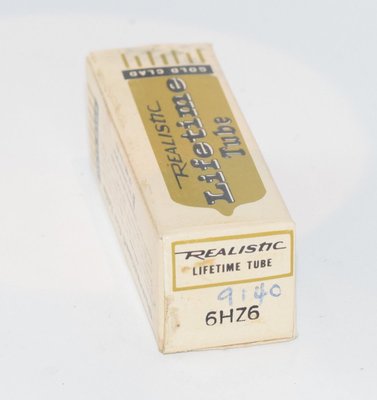
As a television-era tube that saw mass production, NOS (New Old Stock) 6HZ6 tubes are generally available from tube dealers, including examples from manufacturers such as Realistic (Radio Shack's house brand) and the major American manufacturers. Because the 6HZ6 is not a high-demand audio tube, NOS examples can often be found at reasonable prices compared to sought-after audio types, making it an economical choice for experimentation.
Guitar Amplifier Modifications
Some guitar amplifier modifiers and builders have experimented with pentodes like the 6HZ6 in preamp stages, seeking unusual tonal colors. The sharp-cutoff characteristic can produce a distinctive clipping behavior when overdriven, and the dual control grids offer possibilities for novel gain-staging and effects-loop configurations. However, such applications are highly experimental and not part of mainstream guitar amplifier design.
Limitations in Audio Use
It should be noted that the 6HZ6's 7-pin miniature base and specific pinout mean it cannot be directly substituted for more common audio pentodes without socket and circuit modifications. The tube's optimization for FM detection rather than audio amplification means that its operating points and load requirements may not align well with standard audio circuit topologies. Builders considering the 6HZ6 for audio use should design circuits specifically around its characteristics rather than attempting to adapt existing designs.