Introduction and History
The 6J5 is a general-purpose medium-mu triode that holds a distinguished place in vacuum tube history as essentially one half of the legendary 6SN7 dual triode. Introduced in the mid-1930s, the 6J5 was originally designed by RCA and manufactured by virtually every major tube producer including General Electric, Sylvania, Ken-Rad, Raytheon, Mullard, Ferranti, and many others worldwide.
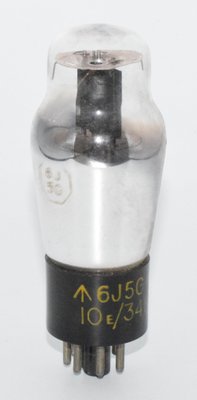
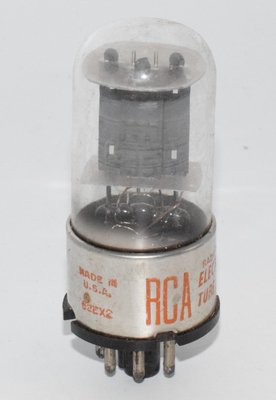
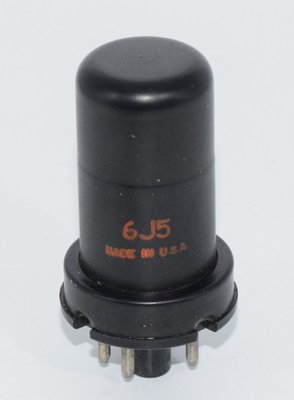
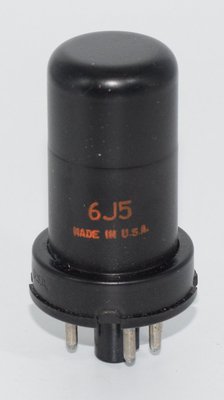
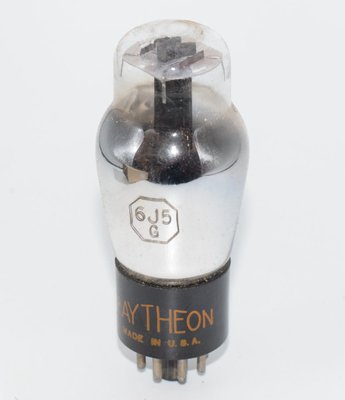
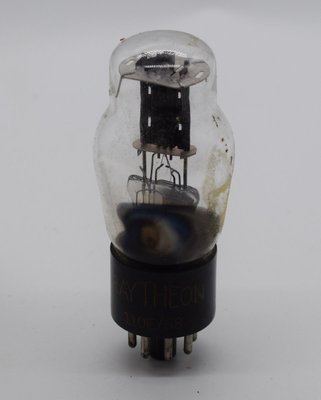
The tube was designed for use as a detector, amplifier, or oscillator, and its combination of high transconductance and medium amplification factor made it exceptionally versatile. It found widespread use in radio receivers, test equipment, military electronics during World War II, and early television sets. The 6J5 was first produced in the distinctive metal envelope (MT-8), and later appeared in glass versions designated 6J5G (shouldered glass, ST shape) and 6J5GT (tubular glass, T-9 envelope).
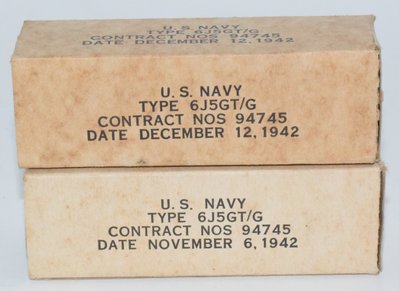
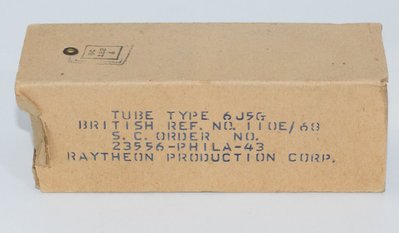
During WWII, the 6J5 was produced in enormous quantities under various military designations including VT94, VT94A, VT94B, VT94C, and VT94D in the United States, and VR67 in the United Kingdom. Its reliability and predictable performance made it a staple of military communications equipment, radar systems, and instrumentation. The British services catalogued it under CV (Common Valve) numbers including CV1067, CV1932, CV1933, and CV1934.
The 6J5's significance extends beyond its own type number — its electrical section became the basis for each half of the 6SN7GT dual triode, one of the most celebrated audio tubes ever produced. Understanding the 6J5 is therefore fundamental to understanding an entire family of medium-mu triodes that remain central to high-fidelity audio to this day.
Technical Specifications and Design
General Description
The 6J5 is a single general-purpose triode featuring a coated unipotential cathode. It offers a relatively high transconductance and a medium amplification factor, making it well suited to resistance-coupled service with high output voltage capabilities. It may be mounted in any position.
Heater Ratings
| Parameter | Value |
|---|---|
| Heater Voltage (AC or DC) | 6.3 Volts |
| Heater Current | 0.3 Ampere |
Maximum Ratings
| Parameter | Maximum Value |
|---|---|
| Plate Voltage | 300 Volts |
| Positive DC Grid Voltage | 0 Volts |
| Plate Dissipation | 2.5 Watts |
| Cathode Current | 20 Milliamperes |
| Heater-Cathode Voltage | 90 Volts |
| Grid Circuit Resistance | 1.0 Megohm |
Characteristics and Typical Operation (Class A1 Amplifier)
| Parameter | Condition 1 | Condition 2 |
|---|---|---|
| Plate Voltage | 90 Volts | 250 Volts |
| Grid Voltage | 0 Volts | -8 Volts |
| Amplification Factor (μ) | 20 | 20 |
| Plate Resistance (approx.) | 6,700 Ohms | 7,700 Ohms |
| Transconductance (gm) | 3,000 µmhos | 2,600 µmhos |
| Plate Current | 10 mA | 9 mA |
| Grid Voltage (approx.) for Ib = 10 µA | -7 Volts | -18 Volts |
Direct Interelectrode Capacitances
(With pin 1 connected to pin 8 at the socket)
| Capacitance | Value (Metal Envelope) | Range (All Variants) |
|---|---|---|
| Grid to Plate (Cga) | 3.4 µµF | 3.4–3.8 pF |
| Input (Cgk) | 3.4 µµF | 3.4–4.2 pF |
| Output (Cak) | 3.6 µµF | 3.6–5.0 pF |
Physical Construction
| Parameter | Detail |
|---|---|
| Cathode | Coated Unipotential (indirectly heated) |
| Envelope | MT-8, Metal Shell (original); also ST-12 glass (6J5G) and T-9 glass (6J5GT) |
| Base | B6-23, Small Wafer Octal 6-Pin (RTMA 6Q) |
| Mounting Position | Any |
Pin Connections (Octal Base — Bottom View)
| Pin | Connection |
|---|---|
| Pin 1 | Shell (metal envelope types) |
| Pin 2 | Heater |
| Pin 3 | Plate |
| Pin 4 | No Connection |
| Pin 5 | Grid |
| Pin 6 | No Connection |
| Pin 7 | Heater |
| Pin 8 | Cathode |
Note: On metal envelope types, Pin 1 (shell) should be connected to Pin 8 (cathode) at the socket for proper shielding and to achieve the specified interelectrode capacitance values.
Class A Resistance-Coupled Amplifier Data
The GE datasheet provides extensive resistance-coupled amplifier data at three B+ voltages (90V, 180V, and 300V) with various plate load and grid resistor combinations. Representative examples include:
- At Ebb = 180V with Rp = 0.24 MΩ, Rg = 0.51 MΩ, Rg1 = 0.1 MΩ: Gain of 15, Rk = 5,100 Ω, Eo = 30V RMS max output
- At Ebb = 300V with Rp = 0.24 MΩ, Rg = 0.51 MΩ, Rg1 = 0.1 MΩ: Gain of 15, Rk = 4,300 Ω, Eo = 44V RMS max output
- At Ebb = 300V with Rp = 0.51 MΩ, Rg = 1.0 MΩ, no Rg1: Gain of 19, Rk = 0 (zero-bias), Eo = 68V RMS max output
All Eo values are maximum RMS voltage output for 5% total harmonic distortion. Gain was measured at 2.0 Volts RMS output. For zero-bias data, generator impedance is negligible.
Applications and Usage
The 6J5 was designed as a truly general-purpose triode, and its applications reflect that versatility:
Original Design Applications
- Detector: The 6J5 excels as a grid-leak or plate detector in radio receivers, offering good sensitivity and low distortion.
- Voltage Amplifier: With an amplification factor of 20 and transconductance of 2,600–3,000 µmhos, the 6J5 provides excellent voltage gain in resistance-coupled stages. At 300V B+ with appropriate load resistors, it can deliver up to 68V RMS output.
- Oscillator: The tube's reliable characteristics and moderate plate resistance make it suitable for various oscillator circuits including Hartley, Colpitts, and crystal oscillator configurations.
- Phase Inverter: The 6J5 was commonly used as a cathodyne (split-load) phase inverter to drive push-pull output stages.
Military and Industrial Applications
During World War II, the 6J5 was used extensively in:
- Military radio transmitters and receivers
- Radar timing and pulse-shaping circuits
- Test and measurement instrumentation
- Telephone carrier equipment
- Industrial control systems
Audio Applications
- Preamplifier stages: Line-level and phono preamplifier circuits
- Driver stages: Driving power triodes such as the 2A3, 300B, 45, and 50 in single-ended configurations
- Buffer stages: Impedance matching between source components and power amplifiers
- DAC output stages: Tube-buffered digital-to-analog converter outputs
Sound Characteristics
The 6J5, being electrically identical to one half of the revered 6SN7, shares many of the same sonic qualities that have made the 6SN7 family a cornerstone of high-fidelity audio. However, many experienced listeners and amplifier designers note that the single-triode 6J5 can offer subtle advantages over its dual-triode sibling due to the absence of inter-section crosstalk and the potentially superior shielding of the metal envelope version.
Tonal Qualities
- Midrange richness: The 6J5 is widely praised for its lush, full-bodied midrange presentation. Vocals and acoustic instruments are rendered with a natural warmth and presence that many listeners find deeply engaging. The tube imparts a gentle harmonic richness without sounding artificially colored.
- Smooth, extended treble: The high-frequency response is characteristically smooth and free of harshness. The relatively low interelectrode capacitances (3.4 pF grid-to-plate, 3.4 pF input, 3.6 pF output in the metal version) contribute to good high-frequency performance, though the tube naturally rolls off the very highest frequencies in a musically pleasing manner.
- Solid bass foundation: With a plate resistance of approximately 7,700 ohms at typical operating conditions (250V plate, -8V grid), the 6J5 provides a reasonably low source impedance that helps maintain bass control and definition, particularly when driving subsequent stages or when used with appropriate load resistors.
- Dynamic presentation: The 6J5's combination of moderate mu (20) and good transconductance (2,600 µmhos at 250V) gives it a lively, dynamic quality. Transients are handled with authority, and the tube tracks dynamic contrasts naturally without compression.
- Low noise floor: The metal envelope version in particular benefits from excellent shielding, resulting in a very quiet noise floor. This makes the 6J5 metal especially attractive for high-gain phono stages and sensitive preamplifier applications.
Comparison by Envelope Type
Audiophiles often note differences between the metal, ST-glass (6J5G), and GT-glass (6J5GT) versions:
- 6J5 Metal: Generally considered the most neutral and detailed of the family, with the tightest bass and most controlled presentation. The metal shell provides inherent shielding. Favored for its precision and low noise.
- 6J5G (ST glass): Often described as having a slightly warmer, more romantic character compared to the metal version. The larger glass envelope and different internal geometry can contribute to a more spacious soundstage. Highly sought after by collectors and audiophiles.
- 6J5GT (GT glass): Typically falls between the metal and G versions sonically. Widely available and offers excellent value. Some late-production examples can sound slightly leaner than earlier versions.
Manufacturer Variations
As with most classic tube types, different manufacturers impart their own sonic signature:
- RCA: Known for a warm, musical presentation with excellent midrange bloom. RCA metal 6J5s are particularly prized.
- General Electric: Tends toward a more detailed, analytical sound with tight bass and clear highs.
- Sylvania: Often described as offering a good balance between warmth and detail, with a slightly forward midrange.
- Ken-Rad: Valued for a rich, full-bodied sound with particularly satisfying bass weight.
- Ferranti (CV1933): British-made examples are appreciated for their refined, elegant presentation.
Equivalent and Substitute Types
Direct Drop-In Replacements (Close/Identical Substitutes)
The following types are electrically identical or very closely matched to the 6J5 and can be used as direct replacements without circuit modification:
| Type | Notes |
|---|---|
| 6J5G | Glass ST-envelope version; electrically identical. Larger physical size — verify clearance. |
| 6J5GT | Glass T-9 tubular envelope version; electrically identical. Most common glass variant. |
| CV1067 | UK military designation; direct equivalent. |
| CV1932 | UK military designation; direct equivalent. |
| CV1933 | UK military designation; direct equivalent. Manufactured by Ferranti and others. |
| CV1934 | UK military designation; direct equivalent. |
| VR67 | UK Services designation; direct equivalent. |
| VT94 | US military designation; direct equivalent. |
| VT94A | US military designation; direct equivalent. |
| VT94B | US military designation; direct equivalent. |
| VT94C | US military designation; direct equivalent. |
| VT94D | US military designation; direct equivalent. |
Related Types — NOT Direct Drop-In Replacements
The following types are related but have different heater ratings (12.6V heater) and cannot be substituted without circuit modification:
| Type | Notes |
|---|---|
| 12J5 | 12.6V heater version. Same triode section but requires different heater supply. |
| 12J5GT | Glass version of 12J5. 12.6V heater — not interchangeable without modification. |
| CV534 | UK military designation for 12V heater variant. |
| CV535 | UK military designation for 12V heater variant. |
| VT135 | US military designation for 12V heater variant. |
| VT135A | US military designation for 12V heater variant. |
Relationship to the 6SN7 Family
The 6J5 is electrically equivalent to one section of the 6SN7GT dual triode. Two 6J5 tubes can replace a single 6SN7 in any circuit, provided appropriate socket adapters or rewiring is performed. This relationship is significant because it means the vast library of 6SN7 circuit designs can be adapted for 6J5 use, and vice versa. Some designers prefer using two 6J5 tubes over a single 6SN7 to eliminate inter-section crosstalk and to allow independent tube selection for each channel in stereo applications.
Notable Characteristics
The Metal Envelope Advantage
The original 6J5 was produced in the metal (MT-8) envelope, which provides inherent electrostatic shielding. This is particularly advantageous in sensitive amplifier stages where external interference could introduce hum or noise. The metal shell connects to Pin 1 and should be grounded through the cathode connection (Pin 8) at the socket for optimal shielding performance. The specified interelectrode capacitances on the GE datasheet are measured with this connection made.
Moderate Plate Resistance
The 6J5's plate resistance of approximately 7,700 ohms (at 250V, -8V bias) is moderate for a medium-mu triode. This provides a good balance between voltage gain capability and the ability to drive subsequent stages or loads without excessive high-frequency rolloff. The plate resistance drops to approximately 6,700 ohms at lower plate voltages (90V, 0V bias), where the transconductance increases to 3,000 µmhos.
Consistent Amplification Factor
The amplification factor of 20 remains remarkably stable across a wide range of operating conditions, as is typical of well-designed triodes. This consistency contributes to predictable circuit performance and simplifies design calculations.
Excellent Linearity
The plate characteristic curves of the 6J5 show well-spaced, evenly distributed curves that indicate excellent linearity. This is reflected in the resistance-coupled amplifier data, where the tube can deliver substantial output voltages at only 5% total harmonic distortion. The even spacing of the plate curves suggests that the harmonic distortion is predominantly second-harmonic, which is musically benign and characteristic of well-designed triodes.
Versatile Operating Range
The 6J5 can operate effectively across a wide range of plate voltages from below 90V to its maximum rating of 300V. This flexibility allows designers to optimize the operating point for specific applications — lower voltages for portable or battery-powered equipment, higher voltages for maximum output swing and dynamic range in high-fidelity applications.
Robust Construction
Military-grade 6J5 tubes (VT94 series, CV series, VR67) were built to exacting standards with enhanced vibration resistance and tighter parameter tolerances. These military variants are particularly prized by audio enthusiasts for their reliability and consistency.
Usage in the Audio Community
Preamplifier Applications
The 6J5 has experienced a significant renaissance in the high-fidelity audio community. Its most common modern application is as a preamplifier tube, where its combination of moderate gain (mu of 20), low noise (especially in the metal envelope version), and excellent linearity make it ideal for line-stage and phono-stage preamplifiers. Many boutique amplifier manufacturers and DIY builders have designed dedicated 6J5 preamplifiers that take advantage of the single-triode-per-envelope configuration to achieve optimal channel separation in stereo designs.
Driver Stage for Single-Ended Triode Amplifiers
One of the most celebrated applications of the 6J5 in modern audio is as a driver tube for single-ended triode (SET) power amplifiers. The 6J5's output voltage capability — up to 68V RMS at 300V B+ in resistance-coupled configuration — is more than sufficient to drive power triodes such as the 2A3 (requiring approximately 45V peak drive), the 300B (requiring approximately 70V peak drive with typical bias), and the 45 (requiring approximately 50V peak drive). The 6J5's inherent sonic qualities complement these classic power triodes beautifully, and many SET amplifier designs pair the 6J5 directly with a 2A3 or 300B output tube for a minimalist, two-stage amplifier topology.
Headphone Amplifiers
The 6J5 has found a devoted following in the headphone amplifier community. Its moderate gain and low output impedance (relative to higher-mu triodes) make it well-suited for driving headphones either directly through an output transformer or as a voltage gain stage preceding a solid-state or tube output buffer. Several popular DIY headphone amplifier designs feature the 6J5.
Tube Rolling and Collecting
The 6J5 is a favorite among tube rollers — enthusiasts who swap different tube brands and vintages to fine-tune the sound of their equipment. The wide variety of manufacturers and production eras available (from 1930s RCA metals to 1960s British CV-marked tubes) provides a rich palette of sonic flavors. Key collectible variants include:
- Early RCA metal 6J5 tubes with red lettering
- Ken-Rad VT-94 military metal tubes
- Sylvania 6J5G with chrome-dome top
- Ferranti CV1933 British military production
- General Electric Canada production
- National Union 6J5G with mesh plates
The 6J5 vs. 6SN7 Debate
A perennial topic of discussion in the audio community is whether two 6J5 tubes sound better than a single 6SN7. Proponents of the 6J5 argue that the single-triode construction eliminates inter-section crosstalk present in dual triodes, that the metal envelope provides superior shielding, and that the separate envelopes allow better thermal management. Proponents of the 6SN7 counter that the dual triode offers more compact construction, lower cost, and that any sonic differences are negligible. In practice, many high-end preamplifier designs offer the option of using either type through adapter sockets, allowing the end user to decide.
Modern Production and Availability
Unlike the 6SN7, the 6J5 is not currently in production by any major tube manufacturer. All available stock is NOS (New Old Stock) or used/tested vintage production. This scarcity has driven prices upward, particularly for premium brands and military-grade examples. However, the enormous quantities produced during WWII mean that good-quality NOS tubes remain available from specialist dealers, albeit at increasing prices. The tube's enduring popularity in audio applications ensures continued strong demand.
DIY Community
The 6J5 is extremely popular in the DIY (Do-It-Yourself) audio community. Its simple single-triode construction, well-documented characteristics, and forgiving operating parameters make it an excellent choice for builders of all experience levels. Numerous circuit designs, construction guides, and project forums are dedicated to 6J5-based amplifiers and preamplifiers. The tube's low heater current (0.3A) and modest B+ requirements mean that power supply design is straightforward, and the 2.5W plate dissipation limit keeps thermal management simple.