Introduction and History
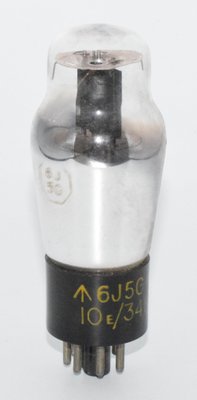
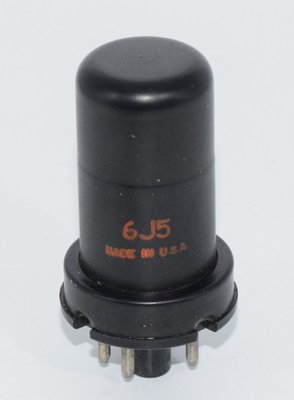
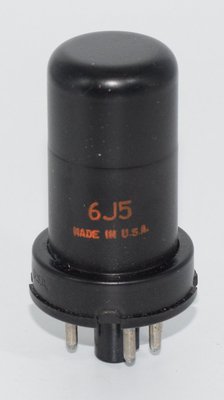
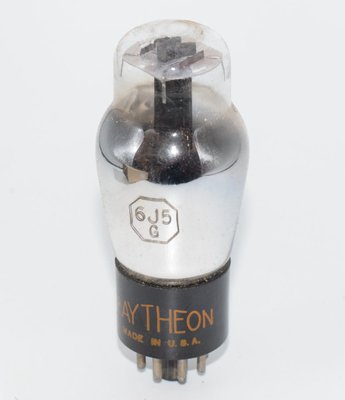
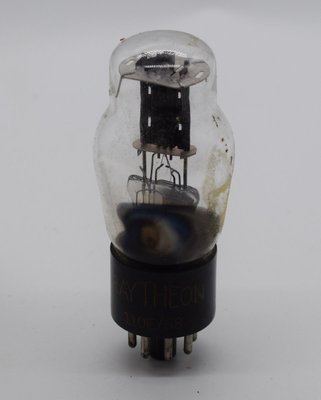
The 6J5G is a medium-mu triode vacuum tube (valve) originally introduced by RCA in 1937 as the 6J5, classified as a "Detector Amplifier Triode." The initial RMA release (#118) was dated June 22, 1937, with tentative data published on June 11, 1937. The 6J5G is the glass ST (shouldered) envelope version of the original metal-envelope 6J5, offering identical electrical characteristics in a larger, visually distinctive glass bulb.
The 6J5 family holds an important place in vacuum tube history as a foundational single-triode design. Rather than being derived from the 6SN7 dual triode — as is sometimes erroneously stated — the historical relationship is the reverse: the 6J5 predates the 6SN7 by several years. The 6SN7, introduced later, essentially contains two triode sections with characteristics similar to the 6J5 within a single envelope. The 6J5 itself can be understood as one half of what would become the 6SN7 dual triode.
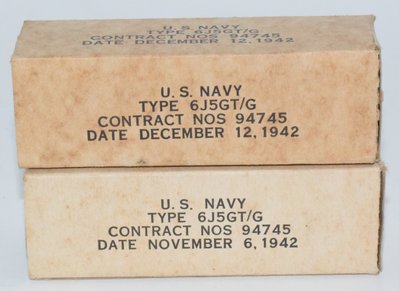
The tube was designed for use as a detector, amplifier, and oscillator in radio receivers and general-purpose electronic equipment. Its moderate amplification factor of 20, combined with good transconductance and reasonable plate resistance, made it an exceptionally versatile design. During World War II, the 6J5 family saw extensive military service, receiving numerous military designations including VT94, VT94A, VT94B, VT94C, VT94D, and the British service designations VR67, CV1067, CV1932, CV1933, and CV1934.
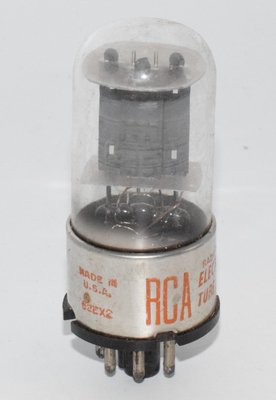
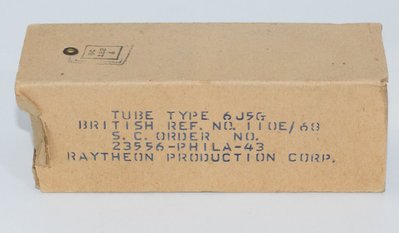
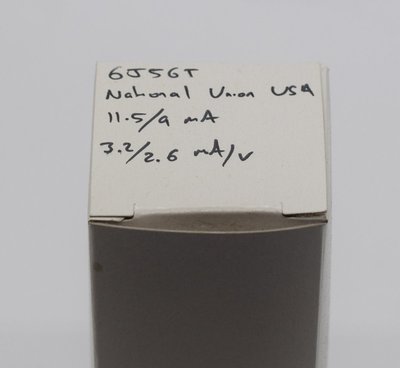
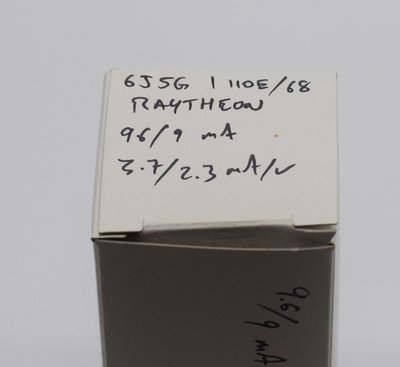
The 6J5G variant, with its attractive ST-shaped glass envelope, has become particularly prized by collectors and audiophiles. Manufacturers including RCA, Raytheon, Sylvania, Ken-Rad, National Union, and others produced the 6J5G in large quantities throughout the late 1930s and 1940s. Raytheon examples from 1943, in particular, are documented as surviving NOS (New Old Stock) specimens.
Technical Specifications and Design
Heater / Filament
| Parameter | Value |
|---|---|
| Heater Voltage (AC or DC) | 6.3 Volts |
| Heater Current | 0.3 Ampere (300 mA) |
| Cathode Type | Coated unipotential (indirectly heated) |
Maximum Ratings
| Parameter | Value |
|---|---|
| Maximum Plate Voltage | 300 Volts |
| Maximum Heater-Cathode Voltage | 90 Volts |
| Maximum Plate Dissipation | 2.5 Watts |
| Maximum Cathode Current | 20 mA |
| Maximum Positive DC Grid Voltage | 0 Volts |
| Maximum Grid Circuit Resistance | 1.0 Megohm |
Typical Operating Conditions and Characteristics — Class A1 Amplifier
The JETEC datasheet (Release No. 118A, December 15, 1950) provides two sets of typical operating conditions:
| Parameter | Condition 1 | Condition 2 |
|---|---|---|
| Heater Voltage | 6.3 V | 6.3 V |
| Heater Current | 300 mA | 300 mA |
| Plate Voltage | 90 V | 250 V |
| Grid Voltage | 0 V | −8 V |
| Plate Current | 10 mA | 9.0 mA |
| Plate Resistance (approx.) | 6700 Ohms | 7700 Ohms |
| Transconductance | 3000 µmhos | 2600 µmhos |
| Amplification Factor | 20 | 20 |
| Grid #1 Voltage for Ib = 10 µA | −7.0 V | −18 V |
Direct Interelectrode Capacitances
Measured with Pin #1 (shell) connected to Pin #8 (cathode):
| Capacitance | Value (per RCA tentative data) | Range (per TDSL reference) |
|---|---|---|
| Grid to Plate (Cgp) | 3.4 µµF | 3.4–3.8 pF |
| Grid to Cathode / Input (Cgk) | 3.4 µµF | 3.4–4.2 pF |
| Plate to Cathode / Output (Cpk) | 3.6 µµF | 3.6–5.0 pF |
Note: The 6J5G glass version may exhibit slightly different capacitance values compared to the metal-envelope 6J5 due to the absence of the internal metal shell shielding. The ranges given in the TDSL reference data reflect this variation across envelope types.
Physical Specifications
| Parameter | Value |
|---|---|
| Bulb Type | ST-12 glass envelope (6J5G); MT-8 metal (6J5) |
| Base | B6-23 Small Wafer Octal, 6-Pin |
| Maximum Overall Length | 2-5/8 inches |
| Maximum Diameter | 1-5/16 inches |
| Maximum Seated Height | 2-1/16 inches |
| Mounting Position | Any |
Pin Configuration (Bottom View of Base)
| Pin | Connection |
|---|---|
| Pin 1 | Shell (metal version; not connected on glass 6J5G) |
| Pin 2 | Heater |
| Pin 3 | Plate |
| Pin 4 | No Connection |
| Pin 5 | Grid |
| Pin 6 | No Connection |
| Pin 7 | Heater |
| Pin 8 | Cathode |
Important: The 6J5G does not use a top cap for the plate connection. All connections are made through the base pins. The base is a small wafer octal 6-pin type (B6-23 basing), meaning only 6 of the 8 possible pin positions are populated. Pins 4 and 6 are unused. On the metal-envelope 6J5, Pin 1 connects to the metal shell, which should be connected to cathode (Pin 8) for proper shielding and to achieve the specified interelectrode capacitance values.
Applications and Usage
The 6J5G was designed as a general-purpose detector amplifier triode and found widespread use across numerous applications:
- Radio Receivers: The tube's primary intended application was as a detector and audio voltage amplifier in superheterodyne radio receivers. Its moderate mu of 20 and good transconductance of 2600–3000 µmhos made it well-suited for these roles.
- Oscillator Service: The 6J5 family was commonly used as a local oscillator in radio receivers, where its reliable and stable characteristics were valued.
- Audio Preamplification: With its Class A1 amplifier characteristics, the 6J5G served as an effective voltage amplifier stage in audio circuits, providing a gain of approximately 20 with low distortion.
- Phase Splitter / Driver: The single-triode configuration made the 6J5G ideal for use as a phase splitter or driver stage ahead of push-pull output stages.
- Military Equipment: During World War II, the 6J5 family was used extensively in military communications equipment, radar systems, and test instruments. The numerous VT (Vacuum Tube) military designations — VT94, VT94A, VT94B, VT94C, VT94D — and British CV/VR designations attest to its widespread military adoption.
- Test Equipment: The tube's predictable and well-characterized behavior made it a staple in laboratory instruments and test equipment of the era.
- Industrial Electronics: The 6J5 found use in various industrial control circuits, timing circuits, and instrumentation.
The tube's maximum plate voltage rating of 300 volts and plate dissipation of 2.5 watts provided adequate headroom for most small-signal applications, while the 1.0 megohm maximum grid circuit resistance allowed flexible coupling arrangements.
Sound Characteristics
The 6J5G has earned a devoted following among audiophiles and tube audio enthusiasts who prize its sonic qualities. As a medium-mu triode with an amplification factor of 20, it occupies a sweet spot that balances gain with linearity, and its sound character reflects this balanced design philosophy.
Tonal Qualities
Listeners and amplifier designers consistently describe the 6J5G as possessing a warm, smooth, and naturally musical presentation. The tube is noted for:
- Midrange Richness: The 6J5G is frequently praised for its lush, full-bodied midrange. Vocals and acoustic instruments are rendered with a palpable sense of presence and body that many listeners find deeply engaging. The midrange has a slightly warm coloration that adds richness without obscuring detail.
- Smooth, Extended Treble: High frequencies are presented with a natural, unhurried quality — detailed but never harsh or fatiguing. The relatively low interelectrode capacitances (grid-to-plate of 3.4 pF) contribute to a clean high-frequency response for a triode of this era.
- Solid Bass Foundation: While not the last word in bass slam or extension, the 6J5G provides a well-controlled, tuneful low end. The moderate plate resistance of 7700 ohms (at 250V operating conditions) allows good coupling to subsequent stages without excessive bass roll-off.
- Natural Harmonic Structure: Like most well-designed triodes, the 6J5G produces predominantly even-order harmonics (primarily second harmonic) when driven into mild nonlinearity. This harmonic signature is perceived as musically pleasant and contributes to the tube's reputation for a "sweet" and "organic" sound.
- Excellent Imaging and Soundstage: When used in high-quality circuits, the 6J5G is noted for presenting a convincing three-dimensional soundstage with good depth and precise image placement.
- Low Microphonics: The ST glass envelope of the 6J5G, while larger than the metal version, generally provides good mechanical damping of the internal structure, resulting in relatively low microphonic sensitivity — an important quality for sensitive preamplifier applications.
Comparison with Related Types
Compared to one section of a 6SN7 dual triode (which shares similar electrical characteristics), many listeners report that the 6J5G sounds slightly more open and transparent. This is often attributed to the absence of a second triode section within the same envelope, eliminating potential crosstalk and shared cathode effects. The single-triode-per-envelope configuration is considered by some to be inherently superior for critical audio applications.
The ST glass envelope of the 6J5G is also considered by some enthusiasts to sound subtly different from the metal-envelope 6J5 or the later GT (tubular glass) 6J5GT, with the ST version often described as having a slightly warmer and more spacious presentation. Whether these differences are attributable to the envelope material, internal construction variations, or listener expectation remains a matter of debate.
Equivalent and Substitute Types
Close / Identical Substitutes (Drop-in Compatible)
The following types are electrically identical or very closely matched and can generally be substituted directly for the 6J5G:
| Type | Notes |
|---|---|
| 6J5 | Original metal-envelope version. Electrically identical; Pin 1 connects to internal metal shell. |
| 6J5GT | Tubular glass (T-9) envelope version. Electrically identical to the 6J5G. |
| CV1067 | British military (CV) designation equivalent. |
| CV1932 | British military (CV) designation equivalent. |
| CV1933 | British military (CV) designation equivalent. |
| CV1934 | British military (CV) designation equivalent. |
| VR67 | British services designation equivalent. |
| VT94 / VT94A / VT94B / VT94C / VT94D | US military designations for various manufacturer versions of the 6J5 family. |
Different Rating Substitutes (NOT Drop-in Replacements)
The following types are related but have different heater voltage requirements and cannot be used as direct drop-in replacements without circuit modification:
| Type | Notes |
|---|---|
| 12J5 | 12.6V heater version. Requires different heater supply; NOT a drop-in substitute for the 6J5G. |
| 12J5GT | 12.6V heater, tubular glass envelope. NOT a drop-in substitute. |
| CV534 | British military equivalent of the 12V heater version. NOT a drop-in substitute. |
| CV535 | British military equivalent of the 12V heater version. NOT a drop-in substitute. |
| VT135 / VT135A | US military designations for 12V heater versions. NOT drop-in substitutes. |
Related Types
The 6SN7 / 6SN7GT dual triode contains two triode sections with characteristics similar to the 6J5, but in a different pin configuration (standard octal 8-pin). Some audiophile amplifier designs use adapter sockets to allow a pair of 6J5G tubes to replace a single 6SN7, with each 6J5G handling one triode section. The 6C5 is another related single triode with the same amplification factor of 20 but with different construction details and a different base type (the 6C5 uses an older base configuration).
Notable Characteristics
- Small Wafer Octal 6-Pin Base: The 6J5G uses the B6-23 small wafer octal base with only 6 pins populated (Pins 1, 2, 3, 5, 7, and 8). This is a notable distinction from standard 8-pin octal tubes. The keyed octal base ensures correct insertion orientation.
- Single Triode Advantage: As a single triode per envelope, the 6J5G avoids the potential for inter-section crosstalk that can occur in dual-triode types like the 6SN7. This makes it theoretically superior for applications demanding the highest channel separation or lowest noise.
- Consistent Amplification Factor: The mu of 20 remains constant across both published operating conditions (90V and 250V plate voltage), demonstrating the tube's well-behaved characteristics across a wide operating range.
- Moderate Transconductance: The transconductance of 2600 µmhos (at 250V) to 3000 µmhos (at 90V) provides good gain capability while maintaining the linearity advantages inherent to medium-mu triode designs.
- Historical Significance: As one of the earliest octal-based single triodes (1937), the 6J5 family represents an important milestone in vacuum tube development. It bridged the gap between older tube designs and the more sophisticated types that followed.
- ST Envelope Aesthetics: The 6J5G's ST (shouldered) glass envelope is considered one of the most visually attractive tube shapes, with its distinctive rounded shoulder profile. This aesthetic quality adds to the tube's desirability among collectors and for visible amplifier builds.
- Robust Military Heritage: The extensive list of military designations (VT94 series, CV series, VR67) reflects the tube's proven reliability under demanding conditions. Military-specification examples are often sought after for their tighter manufacturing tolerances and quality control.
- Low Heater Power: At only 6.3V × 0.3A = 1.89 watts of heater power, the 6J5G is economical in terms of power supply demands, making it practical for use in multi-tube designs.
Usage in the Audio Community
The 6J5G has experienced a significant resurgence of interest in the audio community, driven by the broader revival of vacuum tube audio equipment and the specific appeal of single-triode-per-envelope designs.
Preamplifier Applications
The most common audio application for the 6J5G is as a voltage amplifier in preamplifier circuits. Its gain of 20 is well-suited for line-stage preamplification, providing enough amplification to drive power amplifier stages while maintaining excellent linearity. DIY audio enthusiasts have designed numerous preamplifier circuits around the 6J5G, often in simple single-stage or two-stage topologies that showcase the tube's inherent sonic qualities.
6SN7 Replacement Strategy
One of the most popular applications in the audiophile community involves using pairs of 6J5G tubes as replacements for 6SN7 dual triodes. Since the 6SN7 essentially contains two 6J5-equivalent triode sections, adapter sockets have been designed that allow two 6J5G tubes to plug into a single 6SN7 socket position. Enthusiasts report that this configuration often sounds superior to a single 6SN7, attributing the improvement to better isolation between the two triode sections, reduced inter-section capacitive coupling, and the potential for hand-matching individual tubes for optimal balance.
Headphone Amplifiers
The 6J5G has found a natural home in headphone amplifier designs. Its moderate output impedance and good linearity make it suitable for driving headphones either directly (with high-impedance headphones) or through a simple output stage. Several commercial and DIY headphone amplifier designs feature the 6J5G as the input/driver tube.
Driver Stage Applications
In power amplifier designs, the 6J5G serves effectively as a driver tube for output stages using tubes such as the 2A3, 300B, 45, EL34, or 6L6. Its amplification factor of 20 provides sufficient gain for most driver applications, and its low distortion characteristics ensure clean signal delivery to the output stage.
Tube Rolling and Collecting
The 6J5G is an active subject of "tube rolling" — the practice of swapping different manufacturer variants to find preferred sonic characteristics. Collectors and audiophiles seek out specific brands and production eras:
- RCA 6J5G: As the original manufacturer, RCA examples are highly regarded, particularly early production runs from the late 1930s.
- Raytheon 6J5G: Wartime Raytheon production (such as the documented 1943 NOS examples) is valued for military-grade construction quality.
- Ken-Rad 6J5G: Often praised for a particularly rich and warm tonal character.
- Sylvania 6J5G: Noted for clarity and detail, sometimes described as slightly more neutral than RCA or Ken-Rad examples.
- National Union 6J5G: Less common and sought after by collectors for their rarity.
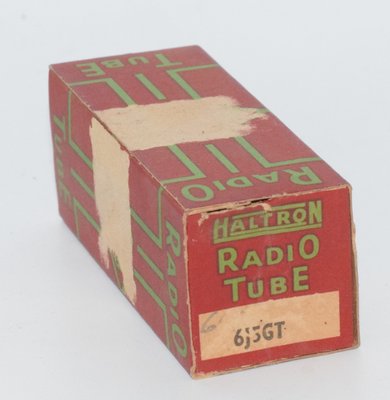
NOS (New Old Stock) examples in original packaging command premium prices, particularly for matched pairs intended for stereo preamplifier or dual-mono applications. The visual appeal of the ST glass envelope also makes the 6J5G a favorite for amplifier designs where the tubes are prominently displayed.
Commercial Products
Several boutique amplifier manufacturers have produced or continue to produce equipment designed around the 6J5G. These range from dedicated preamplifiers to integrated amplifiers and headphone amplifiers. The tube's availability as NOS stock, combined with its excellent sonic reputation, makes it a viable choice for commercial audio products, though designers must account for the diminishing supply of quality NOS examples.
Community Resources
The 6J5G is well-documented in online tube audio communities, with extensive discussion threads on forums dedicated to DIY audio, tube rolling, and vintage audio equipment. The original RCA and JETEC datasheets, including the average plate characteristics curves, remain essential references for circuit designers working with this tube. The plate characteristics chart published by RCA (drawing 92C-4771) showing curves at Ef = 6.3 volts is particularly useful for graphical load-line analysis in amplifier design.