1. Introduction and History
The 6J5GT is a medium-mu triode vacuum tube (valve) originally developed by RCA and first released in 1937 as the 6J5, documented in RMA release #118 dated June 22, 1937. Classified as a "Detector Amplifier Triode," the 6J5 was designed as a single-triode equivalent to one half of the popular 6SN7 dual triode, sharing essentially the same internal structure per section. The tube was conceived for use as a detector, amplifier, and oscillator in radio receivers and general-purpose electronic equipment.
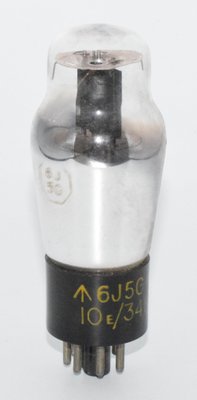
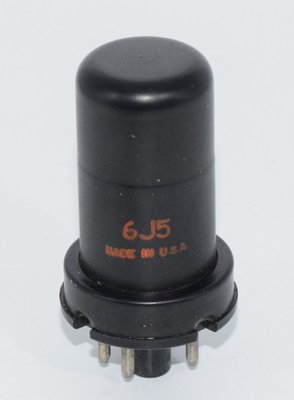
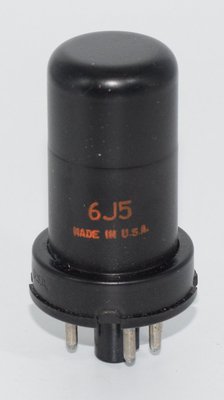
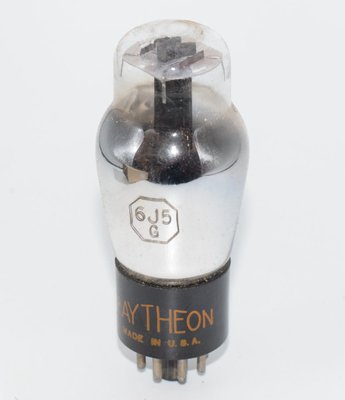
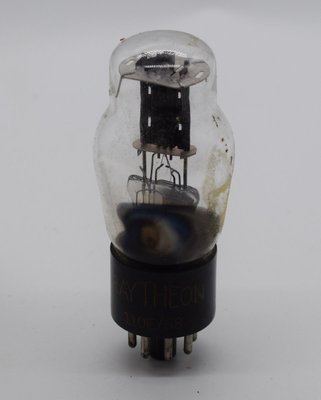
The 6J5 was initially released in a metal (MT-8) envelope, and the "GT" suffix denotes the later glass tubular version — the 6J5GT — which offered the same electrical characteristics in a more economical glass envelope with an octal base. The 6J5G variant used a larger "shouldered" ST-12 glass envelope. All three versions — 6J5 (metal), 6J5G, and 6J5GT — are electrically identical and fully interchangeable.
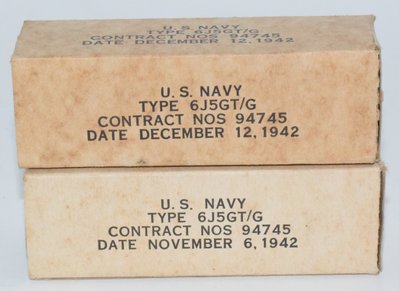
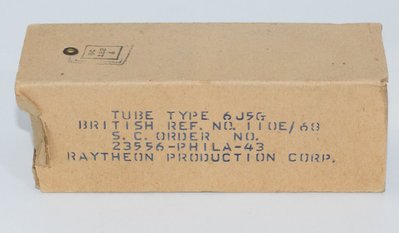
The 6J5GT saw extensive service during World War II in military communications equipment, radar systems, and test instruments. Its reliability, predictable characteristics, and modest heater current made it a workhorse of wartime electronics. Post-war, it continued in widespread civilian use in radio receivers, audio preamplifiers, and instrumentation. The JETEC (Joint Electron Tube Engineering Council) formally documented the type as JETEC Type 6J5 in Release No. 118A, dated December 15, 1950.
Today, the 6J5GT enjoys a devoted following among audiophiles and DIY tube audio enthusiasts who prize its clean, linear amplification characteristics and its suitability as a driver stage or line-level preamplifier tube.
2. Technical Specifications and Design
General Description
- Type: Triode — Detector Amplifier
- Cathode: Coated unipotential (indirectly heated)
- Envelope (Bulb): GT (glass tubular); the original 6J5 uses an MT-8 metal envelope
- Base: B6-23 Small Wafer Octal 6-Pin (Basing 6Q)
- Maximum Overall Length: 2-5/8 inches
- Maximum Diameter: 1-5/16 inches
- Maximum Seated Height: 2-1/16 inches
- Mounting Position: Any
Pin Configuration (Bottom View of Base)
| Pin Number | Connection |
|---|---|
| Pin 1 | Shell (metal envelope connection) |
| Pin 2 | Heater |
| Pin 3 | Plate (Anode) |
| Pin 4 | No Connection |
| Pin 5 | Grid (Control Grid) |
| Pin 6 | No Connection |
| Pin 7 | Heater |
| Pin 8 | Cathode |
Note: Pin 1 (shell) should be connected to pin 8 (cathode) for proper interelectrode capacitance specifications, as noted in the datasheet.
Heater Ratings
- Heater Voltage (AC or DC): 6.3 Volts
- Heater Current: 0.3 Ampere (300 mA)
- Maximum Heater-Cathode Voltage: 90 Volts
Maximum Ratings (Absolute)
- Maximum Plate Voltage: 300 Volts
- Maximum Plate Dissipation: 2.5 Watts
- Maximum Cathode Current: 20 mA
- Maximum Positive DC Grid Voltage: 0 Volts
- Maximum Grid Circuit Resistance: 1.0 Megohm
Direct Interelectrode Capacitances (Approximate)
With pin #1 (shell) connected to pin #8 (cathode):
| Capacitance | Datasheet Value | TDSL Range |
|---|---|---|
| Grid to Plate (Cga) | 3.4 µµF | 3.4–3.8 pF |
| Grid to Cathode / Input: g to (h+k+s) (Cgk) | 3.4 µµF | 3.4–4.2 pF |
| Plate to Cathode / Output: p to (h+k+s) (Cak) | 3.6 µµF | 3.6–5.0 pF |
Typical Operating Conditions and Characteristics — Class A1 Amplifier
The JETEC datasheet provides two sets of typical operating conditions:
| Parameter | Condition 1 | Condition 2 |
|---|---|---|
| Heater Voltage | 6.3 V | 6.3 V |
| Heater Current | 300 mA | 300 mA |
| Plate Voltage | 90 V | 250 V |
| Grid Voltage | 0 V | −8 V |
| Plate Resistance (approx.) | 6700 Ω | 7700 Ω |
| Transconductance (gm) | 3000 µmhos | 2600 µmhos |
| Plate Current | 10 mA | 9.0 mA |
| Amplification Factor (µ) | 20 | 20 |
| Grid #1 Voltage for Ib = 10 µA | −7.0 V | −18 V |
The amplification factor (µ) of 20 is consistent across both operating points, confirming the tube's medium-mu triode classification. The relationship µ = gm × rp holds: at 250V plate voltage, 2600 µmhos × 7700 Ω = 20.02, confirming the datasheet values.
3. Applications and Usage
The 6J5GT was designed as a general-purpose detector amplifier triode and found use across a remarkably wide range of applications:
- Radio Receivers: As an RF detector, audio voltage amplifier, and local oscillator in superheterodyne receivers. Its moderate gain and low distortion made it ideal for these roles.
- Audio Preamplification: The 6J5GT excels as a voltage amplifier stage in audio equipment, providing clean gain with low noise. Its single-triode construction eliminates crosstalk issues inherent in dual-triode types.
- Driver Stage: With its moderate mu of 20 and good linearity, the 6J5GT serves well as a driver for power output tubes such as the 6L6, 6V6, 2A3, and 300B.
- Phase Inverter / Phase Splitter: Used in cathodyne (split-load) and other phase-inverter topologies to drive push-pull output stages.
- Oscillator Circuits: The tube's predictable characteristics and moderate plate resistance make it suitable for various oscillator configurations.
- Military Equipment: Extensively used in WWII-era military radios, radar systems, and test equipment. The numerous military type designations (VT94, VT94A, VT94B, VT94C, VT94D, VR67) attest to its widespread military adoption.
- Test and Measurement: Used in laboratory instruments, signal generators, and measurement bridges where stable, linear amplification was required.
4. Sound Characteristics
The 6J5GT has earned a strong reputation in the audio community for its sonic qualities. Audiophiles and tube audio engineers commonly describe its sound character as follows:
- Clarity and Transparency: The 6J5GT is widely praised for its exceptionally clear and transparent midrange. As a single triode (rather than half of a dual triode), it benefits from the absence of inter-section coupling and crosstalk, which many listeners believe contributes to a purer, more focused sound.
- Smooth, Natural Tonality: The tube produces a smooth, unforced tonal quality that avoids the harshness sometimes associated with higher-mu triodes. Its moderate amplification factor of 20 means it is not being "pushed" as hard for gain, resulting in a relaxed, natural presentation.
- Excellent Linearity: The 6J5GT's plate characteristic curves are notably linear and evenly spaced, which translates to low harmonic distortion in practice. When distortion does occur, it is predominantly second-harmonic — the type most pleasing to the human ear — giving the tube its characteristically warm yet detailed sound.
- Solid Bass and Extended Highs: Compared to some higher-impedance small-signal triodes, the 6J5GT's relatively low plate resistance of 7700 Ω allows it to drive subsequent stages or coupling networks with authority, resulting in firm, well-controlled bass and good high-frequency extension.
- Dimensional Soundstage: Many listeners report that the 6J5GT produces an open, three-dimensional soundstage with good image specificity. This quality is often attributed to the single-triode-per-envelope construction, which provides superior isolation from power supply noise and microphonic effects.
- Quiet Operation: Well-made examples of the 6J5GT, particularly NOS (New Old Stock) military-grade specimens, are known for low noise floors and minimal microphonics, making them suitable for high-sensitivity phono and microphone preamplifier applications.
The sonic character of the 6J5GT is often compared favorably to one section of the 6SN7GT, which shares the same basic internal structure. Some audiophiles maintain that the single-triode 6J5GT sounds subtly superior to the equivalent 6SN7 section, attributing this to reduced internal coupling effects and potentially lower microphonics in the single-triode envelope.
5. Equivalent and Substitute Types
Direct Equivalents (Drop-in Replacements)
The following types are electrically identical and fully interchangeable with the 6J5GT:
| Type | Notes |
|---|---|
| 6J5 | Original metal envelope version (MT-8 bulb). Electrically identical; different physical envelope. |
| 6J5G | ST-12 shouldered glass envelope version. Electrically identical; larger glass bulb. |
| CV1067 | British military (CV register) equivalent. |
| CV1932 | British military (CV register) equivalent. |
| CV1933 | British military (CV register) equivalent. |
| CV1934 | British military (CV register) equivalent. |
| VR67 | British Services designation equivalent. |
| VT94 | US military designation. |
| VT94A | US military designation variant. |
| VT94B | US military designation variant. |
| VT94C | US military designation variant. |
| VT94D | US military designation variant. |
Related but NOT Drop-in Substitutes
The following types are related in function but have different heater requirements and are not direct replacements. They require significant circuit modifications (different heater supply voltage) and should not be treated as simple substitutes:
| Type | Key Difference |
|---|---|
| 12J5 | 12.6V / 0.15A heater. NOT a drop-in replacement — requires a 12.6V heater supply. |
| 12J5GT | 12.6V / 0.15A heater. NOT a drop-in replacement — requires a 12.6V heater supply. |
| CV534 | British CV register equivalent of the 12.6V heater version. |
| CV535 | British CV register equivalent of the 12.6V heater version. |
| VT135 / VT135A | US military designation for the 12.6V heater version. |
Important Note: The 12J5GT has a 12.6V, 0.15A heater that is not designed for parallel 6.3V operation. It cannot simply be wired for 6.3V use as a substitute for the 6J5GT. The heater is a single, non-center-tapped element rated for 12.6V only.
Functional Relationship to Dual Triodes
Each section of a 6SN7GT dual triode is essentially equivalent to a single 6J5GT. A pair of 6J5GTs can replace one 6SN7GT in circuits where space and socket availability permit, though the pinout is entirely different and rewiring is required.
6. Notable Characteristics
- Single Triode Advantage: As a single triode in its own envelope, the 6J5GT avoids the inter-section coupling and crosstalk that can affect dual-triode types. This makes it particularly attractive for high-fidelity audio applications and sensitive measurement circuits.
- Robust Military Heritage: The sheer number of military type designations (VT94 through VT94D, VR67, CV1067, CV1932–CV1934) reflects the tube's exceptional reliability and the confidence military engineers placed in its performance. Military-grade specimens were manufactured to tighter tolerances and often exhibit superior consistency.
- Excellent Linearity: The 6J5GT's plate characteristic curves, as shown in the RCA datasheet, display remarkably even spacing and good linearity across a wide operating range. This inherent linearity minimizes distortion without requiring heavy negative feedback.
- Low Plate Resistance: At 7700 Ω (at 250V plate, −8V grid), the 6J5GT has a relatively low plate resistance for a small-signal triode, enabling it to drive capacitive loads and long cable runs more effectively than higher-impedance types.
- Moderate Heater Power: At 6.3V × 0.3A = 1.89W, the heater power consumption is modest, making the 6J5GT practical in multi-tube designs without excessive power supply demands.
- Versatile Operating Range: The datasheet documents operation from as low as 90V plate voltage (with 0V grid bias, 10 mA plate current) to 250V (with −8V bias, 9 mA plate current), demonstrating the tube's flexibility across a wide range of supply voltages.
- Historical Significance: Released in 1937, the 6J5 was among the earliest octal-based triodes and helped establish the octal tube family that would dominate electronics through the 1950s. Its design influenced numerous subsequent triode types.
7. Usage in the Audio Community
The 6J5GT has experienced a significant resurgence of interest in the audio community, driven by the broader revival of vacuum tube audio equipment and a growing appreciation for single-triode designs:
Preamplifier Applications
The 6J5GT is a popular choice for line-stage preamplifiers, where its moderate gain (µ = 20), low distortion, and clean tonal character are highly valued. DIY builders frequently design dedicated 6J5GT preamps, often using two tubes — one per channel — to maintain complete channel separation. The single-triode-per-envelope construction is seen as an advantage over dual triodes like the 12AX7 or 6SN7, as it eliminates any possibility of inter-channel crosstalk within the tube itself.
Driver Stage for Single-Ended Amplifiers
The 6J5GT is frequently employed as a driver tube for single-ended triode (SET) amplifiers using output tubes such as the 2A3, 300B, 45, and 6B4G. Its gain of 20 is often sufficient to drive these power triodes to full output from a line-level source, and its low plate resistance ensures good coupling to the output stage. The tube's inherently low distortion complements the SET philosophy of minimal negative feedback.
Headphone Amplifiers
The 6J5GT has found a niche in tube headphone amplifier designs. Its low plate resistance and good current capability (up to 20 mA cathode current) allow it to drive headphones through an output transformer or coupling capacitor with satisfying results. Several commercial and DIY headphone amplifier designs feature the 6J5GT as the gain stage.
Phono Preamplifiers
High-quality NOS 6J5GT specimens with low noise and microphonics are sought after for phono preamplifier applications, where the tube's transparency and low-level detail retrieval are particularly appreciated. The moderate gain is well-suited to the first stage of an RIAA phono equalizer.
Tube Rolling and Collecting
The 6J5GT has become a popular tube for "tube rolling" — the practice of swapping different brands and vintages to explore sonic differences. Collectors and audiophiles seek out specific manufacturers and eras:
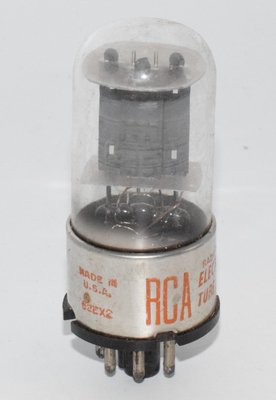
- RCA: Both metal and GT versions are highly regarded, with early metal-base examples (such as the 1942 Ken-Rad military stock) commanding premium prices.
- Ken-Rad: Wartime Ken-Rad 6J5GTs, particularly matched pairs from military stock, are prized for their robust construction and excellent sonics.
- Sylvania: Known for clarity and detail, Sylvania-made 6J5GTs are popular among those seeking a more analytical presentation.
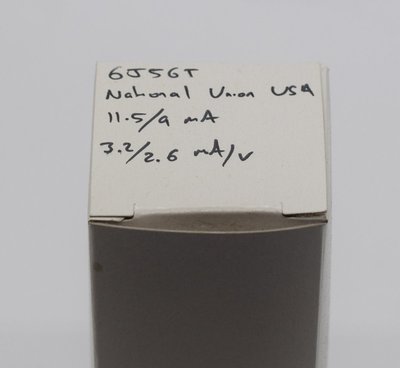
- National Union: US-made National Union examples are collected for their distinctive construction and warm tonal character.
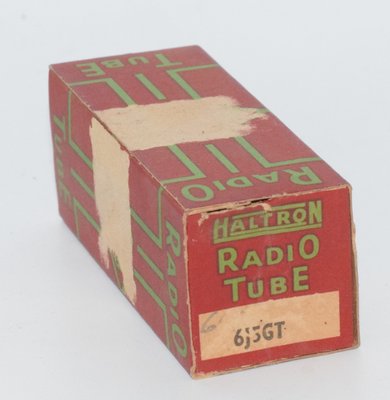
- Haltron (England): British-made examples, including those branded Haltron, Mullard, and Brimar, offer a different sonic flavor often described as warmer and more liquid than their American counterparts.
- Military-Grade (VT94, VR67, CV types): Military-specification tubes are particularly sought after for their tighter manufacturing tolerances, ruggedized construction, and typically superior longevity.
Matched Pairs
For stereo applications, matched pairs of 6J5GTs are in demand. Vendors offering NOS tubes matched to close tolerances for anode current and transconductance (such as the Ken-Rad NOS 1942 matched pairs matched to 5% for anode current and gm) command significant premiums. The single-triode construction actually simplifies matching compared to dual triodes, where both sections within each tube must also be balanced.
Conversion Adapters
Some audio enthusiasts use socket adapters to substitute a pair of 6J5GTs for a single 6SN7GT in existing amplifier designs. This approach allows experimentation with the single-triode sound character without permanent circuit modifications, though care must be taken to ensure proper wiring and adequate ventilation for the additional tube envelope.
The 6J5GT remains a compelling choice for audio applications more than 85 years after its introduction — a testament to the fundamental soundness of its design and the enduring appeal of well-engineered vacuum tube amplification.