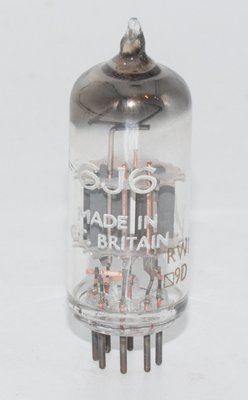
1. Introduction and History
The 6J6 is a miniature twin triode vacuum tube (valve) designed primarily for high-frequency amplifier, oscillator, and mixer applications. Introduced in the late 1940s as part of the post-war wave of miniature 7-pin (B7G) tubes, the 6J6 was developed to meet the growing demand for compact, high-performance tubes suitable for VHF and UHF equipment. Its two triode sections share a common cathode, making it particularly well-suited for push-pull amplifier configurations and balanced mixer circuits at frequencies up to several hundred megahertz.
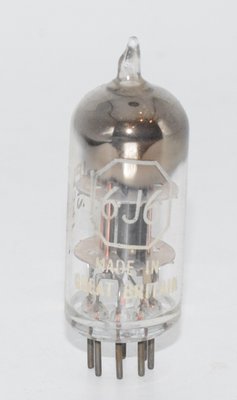
The 6J6 was manufactured by virtually every major tube producer of the era, including RCA, Sylvania, GE, Mullard, Philips, and Ericsson (LM). It saw widespread use in military and commercial communications equipment, early television receivers, and test instruments. The tube was produced under numerous military designations, including the CV858 (direct equivalent) and various JAN (Joint Army-Navy) specifications. Its reliability and excellent high-frequency performance made it a staple component throughout the 1950s and 1960s.
The closely related 6927 (also designated 6J6L) is a variant manufactured by Ericsson with slightly different ratings, sharing the same basic twin triode architecture with common cathode. Over the decades, the 6J6 family spawned numerous variants and improved versions, including the 6J6A (with tighter specifications), the 5964 (a lower-voltage industrial version), and the premium-grade 5844.
2. Technical Specifications and Design
Heater / Filament
| Heater Voltage (Vh) | 6.3 V |
| Heater Current (Ih) | 0.45 A |
Absolute Maximum Ratings (Each Section)
| Maximum Plate Voltage (Va max) | 300 V |
| Maximum Plate Dissipation (Pa max) | 1.5 W |
| Maximum Grid Voltage, positive value | +5 V (per 6927 datasheet; should be confirmed for standard 6J6) |
| Maximum Cathode Current | 17 mA (per 6927 datasheet) |
| Heater–Cathode Voltage | 100 V |
| Bulb Temperature, hottest point | 160 °C |
| Grid Circuit Resistance (Cathode Bias) | 0.5 MΩ |
Interelectrode Capacitances (Without External Shield)
| Grid to Cathode (Cgk) | 2.2 pF |
| Anode to Cathode (Cak) | 0.4 pF |
| Grid to Anode (Cga) | 1.6 pF |
These low interelectrode capacitances are a key feature of the 6J6, enabling effective operation at VHF and UHF frequencies.
Typical Operating Conditions – Class A1 (Each Section)
| Parameter | Condition 1 | Condition 2 | Units |
|---|---|---|---|
| Plate Supply Voltage (Va) | 100 | 150 (per 6927 data) | V |
| Plate Current (Ia) | 8.5 | 7.7 (per 6927 data) | mA |
| Cathode Bias Resistor (both sections) | 50 | 100 (per 6927 data) | Ω |
| Transconductance (gm / Sm) | 5,300 | 5,300 (per 6927 data) | µmhos (mA/V) |
| Amplification Factor (µ) | 38 | 38 | — |
| Plate Resistance (rp / Ra) | 7,100 | 7,200 (per 6927 data) | Ω |
| Equivalent Noise Resistance | — | 470 (per 6927 data) | Ω |
Class C Operation (Both Sections in Parallel)
| Plate Supply Voltage | 150 V |
| Grid Bias (Vg1) | -10.0 V |
| Plate Current | 30 mA |
| Power Output | 3.5 W |
Physical and Mechanical Data
| Base Type | Miniature 7-pin (B7G / RETMA E7-1) |
| Bulb / Envelope | EIA T 5½ (miniature glass) |
| Mounting Position | Any |
| Maximum Diameter | ¾ inch (approx. 19 mm) |
Pin Configuration (Bottom View)
| Pin | Connection |
|---|---|
| 1 | Plate of Section 2 |
| 2 | Plate of Section 1 |
| 3 | Heater |
| 4 | Heater |
| 5 | Grid of Section 1 |
| 6 | Grid of Section 2 |
| 7 | Cathode (common to both sections) |
The common cathode connection on pin 7 is a defining characteristic of the 6J6, distinguishing it from dual triodes with separate cathodes such as the 12AT7/ECC81 family.
3. Applications and Usage
The 6J6 was designed as a versatile high-frequency twin triode, and its applications span a wide range of circuits:
- VHF/UHF Mixers and Converters: With both grids and plates connected in parallel, the 6J6 can serve as a mixer at frequencies as high as 600 MHz (per the Ericsson datasheet for the 6927 variant). This was one of its primary intended applications in early television tuners and communications receivers.
- Push-Pull Amplifiers: The common cathode architecture makes the 6J6 ideal for push-pull RF and IF amplifier stages, where the two sections can be driven in antiphase with minimal external components.
- Oscillators: The tube's high transconductance (5,300 µmhos) and low interelectrode capacitances make it an excellent choice for VHF oscillator circuits, including Colpitts and Hartley configurations.
- Cascode Amplifiers: The two triode sections can be configured as a cascode (grounded-cathode/grounded-grid) amplifier, providing high gain with reduced Miller effect at VHF frequencies.
- Balanced Modulators and Demodulators: The matched twin triode sections with common cathode are well-suited for balanced modulator and product detector circuits.
- Computer and Instrumentation Circuits: In early digital computers and test equipment, the 6J6 was used in flip-flop, gate, and switching circuits, taking advantage of the closely matched sections and common cathode.
- Class C RF Power Amplifiers: With both sections in parallel, the 6J6 can deliver up to 3.5 W of RF power output at 150 V plate supply, suitable for low-power transmitter stages.
4. Sound Characteristics
While the 6J6 was not originally designed for audio amplification, it has found a niche among audiophiles and DIY tube audio enthusiasts who appreciate its unique sonic qualities:
- Clarity and Detail: The 6J6's relatively high transconductance of 5,300 µmhos and moderate amplification factor of 38 give it a lively, detailed sound with excellent transient response. The tube tends to reveal micro-details in recordings without sounding analytical or harsh.
- Midrange Presence: Users frequently describe the 6J6 as having a forward, engaging midrange character. Vocals and acoustic instruments are rendered with a sense of immediacy and presence that is characteristic of medium-mu triodes.
- Tonal Balance: The 6J6 is generally described as having a slightly warm but neutral tonal balance. It lacks the extreme lushness of some high-mu dual triodes but avoids the clinical sterility sometimes associated with low-mu types. The low plate resistance of approximately 7,100 Ω contributes to good bass control and damping when used as a driver stage.
- Dynamics: The tube's relatively generous plate dissipation of 1.5 W per section (for a miniature triode) and good linearity contribute to a dynamic, punchy presentation. Push-pull configurations using the common cathode can deliver surprisingly robust dynamics for such a small tube.
- Noise Performance: With an equivalent noise resistance of approximately 470–500 Ω, the 6J6 offers respectable noise performance, though it is not in the same league as purpose-designed low-noise audio tubes like the 5879 or 12AX7 types. In phono stages or very high-gain applications, careful tube selection may be necessary.
- Harmonic Character: When driven into mild distortion, the 6J6 produces predominantly even-order harmonics (second harmonic dominant), which is perceived as musically pleasant. The common cathode design means that push-pull operation naturally cancels even harmonics, yielding a cleaner output with primarily odd-order residuals—a characteristic that some listeners find more "solid-state-like" but others appreciate for its accuracy.
The sonic character can vary noticeably between manufacturers. NOS Mullard and Philips UK examples are often praised for a slightly richer, more refined midrange, while American-made Sylvania and RCA tubes tend to be described as more open and extended in the treble. Military-grade JAN tubes from any manufacturer are generally preferred for their tighter tolerances and better section matching.
5. Equivalent and Substitute Types
Direct / Identical Substitutes
| Type | Notes |
|---|---|
| CV858 | UK military designation; direct equivalent, fully interchangeable. |
| ECC91 | European (Mullard/Philips) designation for the same tube type. Pin-compatible and electrically identical. |
Close Substitutes (Different Ratings — NOT Direct Drop-In)
The following types share the same basic twin triode with common cathode architecture and B7G base, but have different electrical ratings, tighter tolerances, or modified characteristics. They should not be treated as direct drop-in replacements without verifying circuit compatibility:
| Type | Notes |
|---|---|
| 6J6A | Improved version with tighter specifications and controlled heater warm-up. Generally usable in 6J6 circuits but check heater surge current requirements. |
| 6927 / 6J6L | Ericsson variant with maximum plate voltage of 220 V (vs. 300 V for standard 6J6), plate dissipation of 1.4 W, and heater current of 0.33 A (vs. 0.45 A). Not a direct substitute due to lower heater current and reduced voltage ratings. |
| 5964 | Lower-voltage industrial version with reduced maximum ratings. Popular in audio applications. |
| 5844 | Premium-grade, low-noise selected version with tighter parameter spreads. |
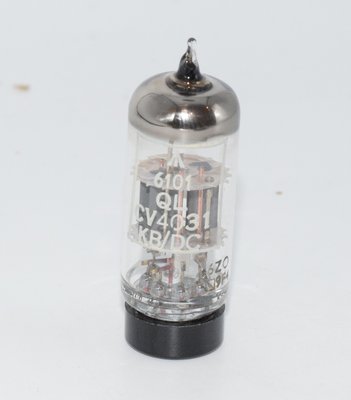
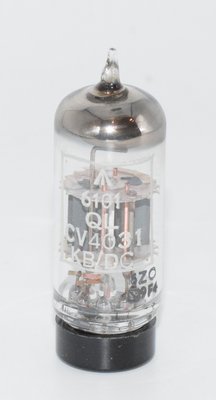
| 6101 / CK6101 | Ruggedized/reliable version for military and industrial use. |
| 6030 | Similar twin triode variant with different ratings. |
| 6045 | Related type; verify ratings before substitution. |
| 6099 | Related type; verify ratings before substitution. |
| 6535 | Related type; verify ratings before substitution. |
| 1216 | Related type with different ratings. |
| M8081 | UK premium military designation; related but verify specifications. |
| CV4031 / CV5046 / CV8160 / CV8231 | Various UK military designations for related types in the 6J6 family. |
| 6CC31 | Related European type. |
| T2M05 | Related type designation. |
Important: The 6J6 is not interchangeable with separate-cathode dual triodes such as the 12AT7/ECC81, 12AU7/ECC82, or 12AX7/ECC83, despite all being miniature dual triodes. The common cathode architecture and different pinout make them entirely incompatible.
6. Notable Characteristics
- Common Cathode Design: The single shared cathode (pin 7) is the 6J6's most distinctive feature. This simplifies push-pull circuit design by eliminating the need for a phase-splitter in some configurations, but it also means the two sections cannot be biased independently. This is a fundamental architectural difference from the more common separate-cathode dual triodes.
- Exceptional High-Frequency Performance: The combination of low interelectrode capacitances (Cgk = 2.2 pF, Cak = 0.4 pF, Cga = 1.6 pF) and high transconductance (5,300 µmhos) gives the 6J6 an excellent high-frequency figure of merit. The tube can operate effectively as a mixer at frequencies up to 600 MHz.
- Moderate Amplification Factor: With µ = 38, the 6J6 falls in the medium-mu category, providing a useful balance between voltage gain and linearity. This makes it versatile across amplifier, oscillator, and mixer applications.
- Low Plate Resistance: The plate resistance of approximately 7,100 Ω is relatively low for a miniature triode, contributing to good output impedance characteristics and effective driving of subsequent stages or moderate impedance loads.
- Robust Construction: The miniature B7G envelope and rugged internal construction made the 6J6 suitable for military and airborne applications. Many surviving NOS examples are JAN-qualified tubes that meet stringent vibration and shock specifications.
- Section Matching: Because both triode sections share a common cathode and are constructed on a single mount assembly, the 6J6 typically exhibits excellent section-to-section matching—an important characteristic for balanced circuit applications.
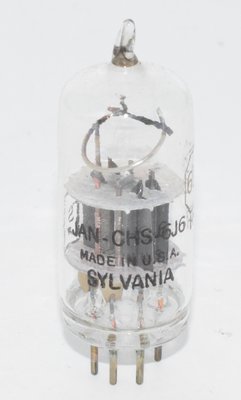
- Manufacturer Variations: NOS 6J6 tubes are available from numerous manufacturers including Sylvania, RCA, GE, Mullard, Philips UK, and others. Construction details vary between manufacturers—some early examples feature clear glass envelopes (such as the JAN CHS Sylvania variant), while later production typically uses the standard grey or coated glass. Internal construction differences (plate material, grid winding pitch, getter type) can result in subtle performance variations.
7. Usage in the Audio Community
The 6J6 occupies an interesting niche in the tube audio world. While it was never a mainstream audio tube in the way that the 12AX7 or 6SN7 became, it has attracted a dedicated following among DIY builders and boutique amplifier designers:
Headphone Amplifiers
The 6J6's moderate gain (µ = 38), low plate resistance (~7,100 Ω), and compact size make it an appealing choice for headphone amplifier designs. The common cathode architecture allows for elegant push-pull headphone amplifier circuits using a single tube per channel. Several popular DIY headphone amplifier projects have been designed around the 6J6, taking advantage of its ability to drive headphones with impedances ranging from 32 Ω to 600 Ω with appropriate output coupling.
Preamplifier and Line Stage Applications
Audio experimenters have used the 6J6 in line-level preamplifier stages, where its high transconductance provides good gain and its low plate resistance ensures effective driving of long interconnect cables or low-impedance loads. The tube's bandwidth extends well beyond the audio range, resulting in excellent high-frequency extension and phase linearity within the 20 Hz–20 kHz audio band.
Phono Stages
With an equivalent noise resistance of approximately 470–500 Ω, the 6J6 can be used in phono preamplifier circuits, particularly for moving-magnet cartridges. While not the quietest tube available, carefully selected examples (especially military-grade JAN or premium types like the 5844) can deliver acceptable noise performance in this demanding application.
Buffer and Driver Stages
The 6J6's low output impedance makes it effective as a buffer or driver stage in tube DAC output stages and hybrid amplifier designs. Its ability to deliver reasonable current (up to 8.5 mA per section in typical Class A1 operation) while maintaining linearity makes it suitable for driving power tubes or solid-state output stages.
Availability and Collecting
NOS (New Old Stock) 6J6 tubes remain relatively plentiful and affordable compared to more sought-after audio tubes. This is largely because the 6J6 was produced in enormous quantities for military and commercial applications, and its niche status in audio means demand has remained moderate. Collectors and users particularly prize:
- Mullard and Philips UK production — valued for their refined sonic character and consistent quality.
- Sylvania JAN CHS clear glass — early production with distinctive clear glass envelopes, sought after for both sonic quality and aesthetic appeal.
- CV858 and CV4031 military-grade — Mullard UK production to tight military specifications, offering excellent section matching and reliability.
- RCA red-print — early RCA production with distinctive red lettering, considered by some to offer the best balance of detail and warmth.
The 6J6's affordability and availability make it an excellent tube for experimentation. Builders can acquire matched pairs or even matched sets without the significant expense associated with premium audio tubes, making it an ideal candidate for those exploring tube audio design on a budget.
Design Considerations for Audio Use
When designing audio circuits around the 6J6, engineers should keep several factors in mind:
- The common cathode means both sections share the same bias point. Independent bias adjustment of the two sections is not possible without external circuit techniques.
- The maximum plate voltage of 300 V provides adequate headroom for most audio applications, though the plate dissipation limit of 1.5 W per section must be respected.
- The grid circuit resistance should not exceed 0.5 MΩ with cathode bias, which is generally not a limitation in audio circuits.
- Heater current draw of 0.45 A should be accounted for in power supply design, particularly in multi-tube designs.
- The tube can be mounted in any position, offering flexibility in chassis layout.