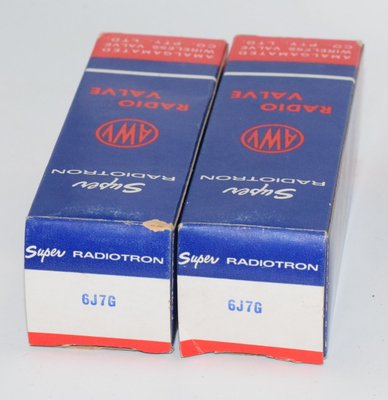
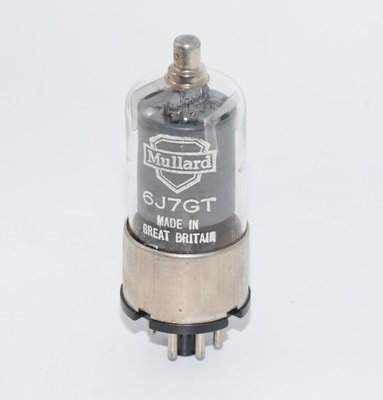
1. Introduction and History
The 6J7 is a sharp-cutoff pentode vacuum tube originally designed for radio-frequency amplification, biased detection, and high-gain audio amplification. Introduced during the golden age of American radio engineering in the 1930s, the 6J7 belongs to the family of octal-based small-signal pentodes that became the backbone of countless radio receivers, test instruments, and early audio equipment.
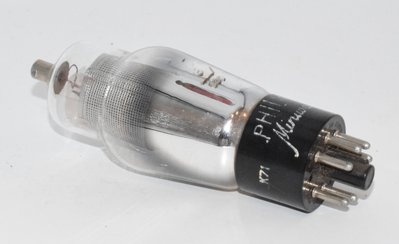
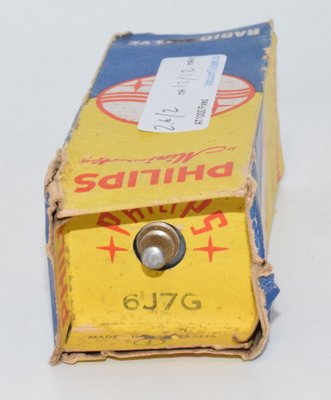
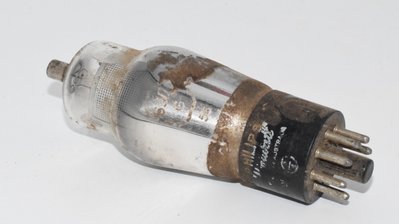
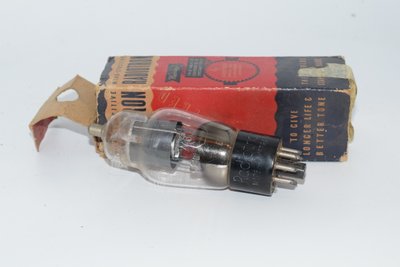
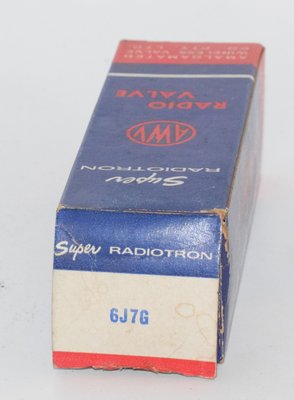
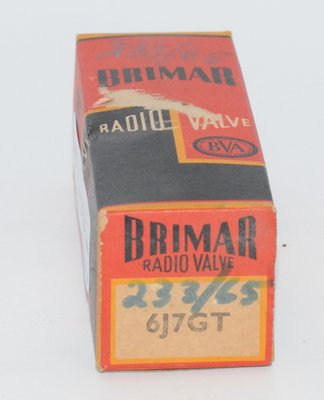
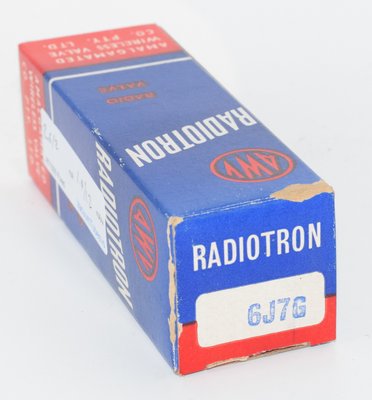
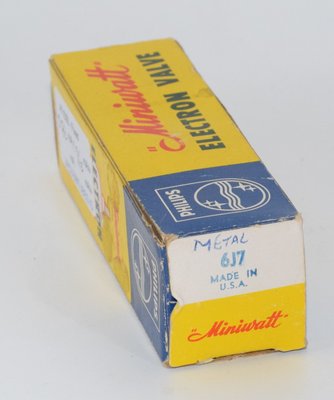
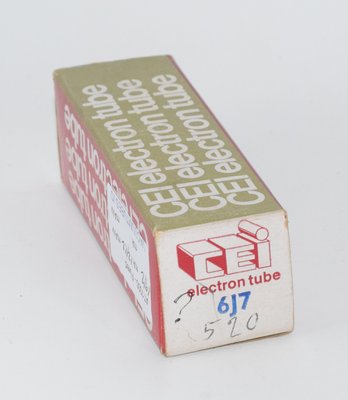
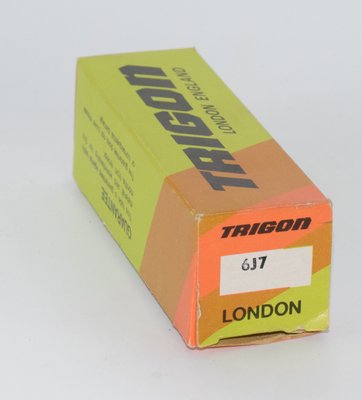
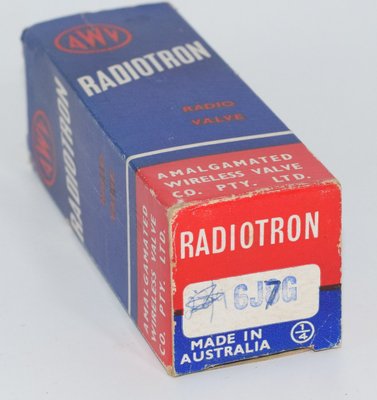
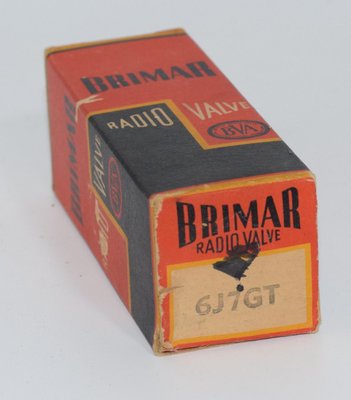
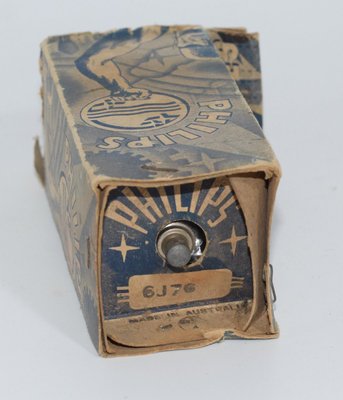
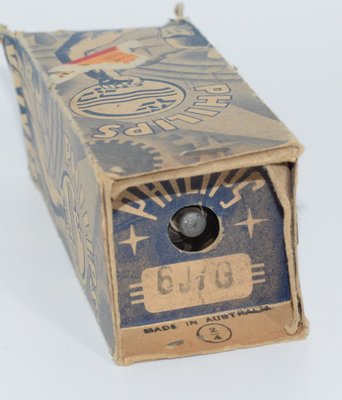
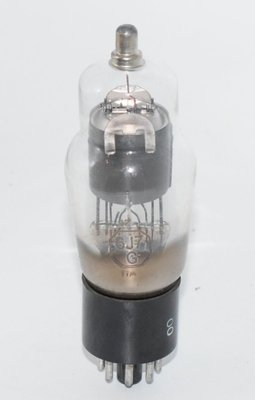
Manufactured by virtually every major tube producer — including General Electric (Ken-Rad division), RCA, Sylvania, Philips Miniwatt, CEI Holland, and Trigon — the 6J7 enjoyed widespread adoption due to its versatile performance characteristics. It was produced in several envelope variants: the original metal-shell 6J7, the glass-envelope 6J7-G, and the shouldered glass 6J7-GT. According to the General Electric datasheet, the electrical ratings and characteristics of the 6J7 are the same as those of the 6J7-G, 6J7-GT, and 6C6 (its predecessor on the older 6-pin base).
The tube saw extensive military service during World War II, receiving multiple CV (Common Valve) designations in British service and VT (Vacuum Tube) designations in American military nomenclature. Its reliability and predictable sharp-cutoff characteristic made it a natural choice for military communications equipment and instrumentation.
2. Technical Specifications and Design
General Construction
| Cathode | Coated Unipotential (indirectly heated) |
| Heater Voltage (A-C or D-C) | 6.3 Volts |
| Heater Current | 0.3 Ampere |
| Envelope | MTT-8 Metal Shell |
| Base | B7-22 Small Wafer Octal 7-Pin Phenolic |
| Top Cap | Ci-4 Miniature with Wafer (Grid Number 1) |
| Mounting Position | Any |
Maximum Ratings
| Parameter | Triode Connection § | Pentode Connection | Units | ||
|---|---|---|---|---|---|
| Design Center | Absolute | Design Center | Absolute | ||
| Plate Voltage | 250 | 275 | 300 | 330 | Volts |
| Screen (Grid 2) Voltage | — | — | 125 | 140 | Volts |
| Screen Supply Voltage | — | — | 300 | 330 | Volts |
| External Grid Bias Voltage | Never Positive | Never Positive | |||
| Plate Dissipation | 1.75 | 1.93 | 0.75 | 0.83 | Watts |
| Screen Dissipation | — | — | 0.10 | 0.11 | Watt |
| D-C Heater-Cathode Voltage | 90 | 100 | 90 | 100 | Volts |
§ Triode connection: Grid number 2 and grid number 3 connected to plate.
Direct Interelectrode Capacitances
(With shell and internal shield connected to cathode)
| Parameter | Triode § | Pentode | Units |
|---|---|---|---|
| Grid to Plate | 2.0 | 0.005 Max | µµf |
| Input | 5 | 7 | µµf |
| Output | 14 | 12 | µµf |
Characteristics and Typical Operation — Class A Amplifier
Triode Connection §
| Parameter | Condition 1 | Condition 2 | Units |
|---|---|---|---|
| Heater Voltage | 6.3 | 6.3 | Volts |
| Plate Voltage | 180 | 250 | Volts |
| Screen Voltage | 180 | 250 | Volts |
| Suppressor Voltage | 180 | 250 | Volts |
| Grid Bias Voltage | −5.3 | −8 | Volts |
| Amplification Factor (µ) | 20 | 20 | — |
| Plate Resistance | 0.0110 | 0.0105 | Megohm |
| Transconductance (gm) | 1800 | 1900 | Micromhos |
| Plate Current | 5.3 | 6.5 | Milliamperes |
Pentode Connection
| Parameter | Condition 1 | Condition 2 | Units |
|---|---|---|---|
| Heater Voltage | 6.3 | 6.3 | Volts |
| Plate Voltage | 100 | 250 | Volts |
| Screen Voltage | 100 | 100 | Volts |
| Suppressor Voltage | 0 | 0 | Volts |
| Grid Bias Voltage | −3 | −3 | Volts |
| Plate Resistance | 1.0 | >1.0 | Megohm |
| Transconductance (gm) | 1185 | 1225 | Micromhos |
| Grid Bias for Cathode-Current Cutoff | −7 | −7 | Volts |
| Plate Current | 2.0 | 2.0 | Milliamperes |
| Screen Current | 0.5 | 0.5 | Milliampere |
§ Triode connection: Grid number 2 and grid number 3 connected to plate.
Note: The d-c resistance in the grid circuit should not exceed 1.0 megohm under rated maximum conditions. Suppressor-grid connected to cathode at socket terminal in pentode mode.
Pin-Out (Bottom View — RMA 7R)
| Pin 1 | Shell and Internal Shield |
| Pin 2 | Heater |
| Pin 3 | Plate |
| Pin 4 | Grid Number 2 (Screen) |
| Pin 5 | Grid Number 3 (Suppressor) |
| Pin 7 | Heater |
| Pin 8 | Cathode |
| Top Cap | Grid Number 1 (Control Grid) |
Note that Pin 6 is absent — this is a 7-pin octal base. The control grid (Grid 1) is brought out to a top cap connection, which provides superior shielding from other electrode leads and minimizes stray capacitance — a critical feature for RF and high-gain applications.
Physical Dimensions
The metal-envelope 6J7 (MTT-8 shell) has a maximum diameter of 1-5/32 inches and a maximum seated height of approximately 3-1/8 inches (RMA 8-4 outline). The overall maximum height including pins is approximately 3-5/16 inches.
3. Applications and Usage
The 6J7 was designed primarily as a radio-frequency amplifier pentode, but its sharp-cutoff characteristic and high gain made it suitable for a wide range of applications:
- RF Amplification: The tube's extremely low grid-to-plate capacitance in pentode mode (0.005 µµf maximum) made it ideal for RF voltage amplifier stages in superheterodyne receivers, where minimal feedback between output and input is essential for stability.
- IF Amplification: Widely used in intermediate-frequency amplifier stages of radio receivers.
- Biased Detector: The sharp cutoff characteristic allowed the 6J7 to function effectively as a plate detector with controlled bias.
- High-Gain Audio Preamplification: In pentode mode, the very high plate resistance (>1.0 Megohm) and respectable transconductance (1225 µmhos at 250V plate, 100V screen) yielded high voltage gain, making it useful as a first-stage audio amplifier in microphone preamplifiers and phonograph amplifiers.
- Triode-Connected Audio Stages: With grids 2 and 3 tied to the plate, the 6J7 operates as a medium-mu triode (µ = 20) with a transconductance of 1800–1900 µmhos and plate resistance of approximately 10.5–11 kΩ. This configuration was popular in audio circuits where lower noise and more linear operation were desired.
- Test Equipment: The 6J7 appeared in oscilloscope vertical amplifiers, vacuum-tube voltmeters (VTVMs), and signal generators.
- Military Communications: Extensively used in WWII-era military radio equipment for both Allied forces, evidenced by its numerous military type designations (VT91, VT91A, VT74, ARP16, and multiple CV numbers).
Class A Resistance-Coupled Amplifier Data
The GE datasheet provides extensive resistance-coupled amplifier design data for the 6J7 at supply voltages of 90V, 180V, and 300V. For example, with a plate load resistor (Rp) of 0.24 Megohm, a grid resistor (Rg1) of 0.24 Megohm, and Ebb = 300 Volts, the tube delivers a voltage gain of 102 with a signal grid resistor (Rsg) of 1.2 kΩ and output voltage (Eo) of 78 Volts RMS at 5% total harmonic distortion. These figures demonstrate the 6J7's capability as a high-gain voltage amplifier stage.
4. Sound Characteristics
The 6J7, while originally an RF tube, has earned a distinctive reputation among audio enthusiasts who have explored its sonic qualities in preamplifier and driver circuits:
- Triode Mode: When triode-connected (µ = 20), the 6J7 exhibits a warm, smooth midrange character with a natural, unhurried quality. The relatively low amplification factor and moderate plate resistance (approximately 10.5 kΩ) contribute to a sound that is often described as rich and full-bodied without being overly colored. The triode-connected 6J7 shares sonic DNA with other medium-mu triodes of its era, offering a vintage warmth that is prized in microphone preamplifiers and phono stages.
- Pentode Mode: In pentode configuration, the 6J7 delivers significantly higher gain but with a character that can be more forward and detailed in the upper midrange. The very high plate resistance (>1.0 Megohm) means that the tonal balance is heavily influenced by the plate load resistor value, giving the circuit designer considerable control over the final voicing. Some listeners note a slightly more "wiry" or "present" quality compared to triode operation, which can be advantageous for adding clarity and articulation.
- General Tonal Signature: The 6J7 is generally regarded as having a classic pre-war American tube sound — slightly darker and more romantic than later miniature pentodes like the EF86. Bass response is solid if not the tightest, and the top end rolls off gently, which many find musically pleasing. The sharp-cutoff characteristic means the tube handles signal dynamics in a predictable, linear fashion without the compression effects associated with remote-cutoff (variable-mu) types.
- Noise Performance: As an RF pentode with a top-cap grid connection, the 6J7 benefits from excellent shielding of the control grid lead. The metal-shell version in particular offers very good noise performance for its era, though it does not quite match the hum and noise specifications of later purpose-built audio pentodes like the EF86/6267.
- Microphonics: The metal-envelope 6J7 is generally less microphonic than its glass-envelope counterparts (6J7-G, 6J7-GT), making it the preferred choice for vibration-sensitive audio applications. However, all variants should be mounted with appropriate vibration isolation in critical audio circuits.
5. Equivalent or Substitute Types
Close / Identical Substitutes (Drop-In Replacements)
| Type | Notes |
|---|---|
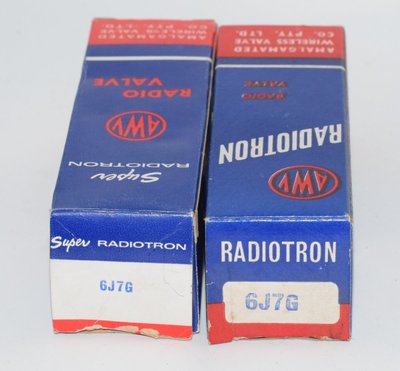
| 6J7G | Glass-envelope version; electrically identical to the 6J7. Same pinout and ratings. |
| 6J7GT | Shouldered glass-envelope version; electrically identical. Same pinout and ratings. |
| ARP16 | British military designation; identical tube. |
| CV1074 | British CV designation; identical to 6J7. |
| CV1935 | British CV designation; identical to 6J7. |
| CV1936 | British CV designation; identical to 6J7. |
| CV1937 | British CV designation; identical to 6J7. |
| VT74 (RAF) | RAF military designation; identical tube. |
| VT91 | US military designation; identical to 6J7. |
| VT91A | US military designation; identical to 6J7. |
Different Rating Substitutes (NOT Direct Drop-In)
The following types are functionally similar but have differences in ratings, pinout, or bias requirements. They should not be used as direct replacements without circuit modification:
| Type | Notes |
|---|---|
| EF36 / VR56 / CV1056 | British equivalent sharp-cutoff pentode. Similar characteristics but different pin assignments and European base conventions may apply. Check pinout carefully. |
| EF37A / CV1404 | Improved low-noise version of the EF36 family. Different ratings and pinout details. |
| CV358 | British CV designation for a related type; not a direct substitute. |
| CV5080 | Related type with different specifications. |
| 5A157D | Related type; verify specifications before substitution. |
| OM5 / OM5A / OM5B | Philips designations for related pentode types; different ratings. |
| 12J7GT | 12.6V heater version of the 6J7. Electrically similar but requires a 12.6V heater supply (0.15A) instead of 6.3V. Can be used in series-heater circuits. Not interchangeable without heater supply modification. |
The 6C6 is the pre-octal predecessor of the 6J7, using the older 6-pin base. While electrically very similar, it requires a different socket and is not physically interchangeable.
6. Notable Characteristics
- Sharp Cutoff: The 6J7 features a sharp-cutoff (also called "remote" or "non-variable-mu") grid characteristic, with cathode-current cutoff occurring at approximately −7 volts grid bias. This makes it suitable for applications requiring linear amplification and clean signal handling, as opposed to variable-mu types (like the 6K7) used for AGC-controlled stages.
- Top-Cap Grid Connection: The control grid is brought out through a top cap (Ci-4 miniature with wafer), which physically separates the high-impedance input lead from the output and power leads at the base. This arrangement dramatically reduces grid-to-plate capacitance to just 0.005 µµf maximum in pentode mode, enabling stable high-frequency operation without neutralization.
- Metal Envelope with Internal Shield: The original 6J7 uses an MTT-8 metal shell that serves as an integral electrostatic shield. Pin 1 connects to both the shell and the internal shield, and these should be connected to cathode for proper shielding and to achieve the rated interelectrode capacitances.
- Dual-Mode Operation: The 6J7 is equally at home as a pentode (high gain, high plate resistance) or as a triode (lower gain, lower distortion, lower plate resistance). The triode connection — with screen and suppressor tied to the plate — yields µ = 20, gm = 1800–1900 µmhos, and rp = 10.5–11 kΩ, making it a versatile building block.
- Plate Dissipation Difference: Note the significant difference in maximum plate dissipation between triode mode (1.75W design center, 1.93W absolute) and pentode mode (0.75W design center, 0.83W absolute). This is because in triode mode, the screen and suppressor currents flow through the plate circuit, while in pentode mode the screen has its own separate dissipation limit of 0.10W (0.11W absolute).
- Extensive Military Heritage: The sheer number of military designations (VT74, VT91, VT91A, ARP16, CV1074, CV1935, CV1936, CV1937) attests to the tube's reliability and importance in wartime electronics. Military-specification examples are often sought by collectors and audio enthusiasts for their typically tighter manufacturing tolerances.
- Low Operating Currents: In pentode mode, the 6J7 draws only 2.0 mA plate current and 0.5 mA screen current at typical operating conditions, making it an efficient choice for battery-operated or portable equipment.
7. Usage in the Audio Community
While the 6J7 was never designed as a dedicated audio tube, it has found a devoted following among DIY audio builders, vintage equipment restorers, and boutique amplifier manufacturers:
Vintage Equipment Restoration
The 6J7 appears in the preamplifier and driver stages of numerous vintage amplifiers, radio receivers, and public address systems from the 1930s through the 1950s. Restorers of equipment by manufacturers such as RCA, Zenith, Philco, and Western Electric frequently need 6J7 tubes. The availability of NOS (New Old Stock) examples from manufacturers including GE/Ken-Rad, Philips Miniwatt, CEI Holland, and Trigon ensures that these classic designs can be maintained in original condition.
DIY Preamplifier Projects
The 6J7 is a popular choice for DIY preamplifier projects, particularly:
- Phono Preamplifiers: The high gain available in pentode mode makes the 6J7 suitable for moving-magnet phono stages. Triode-connected, it offers a lower-gain but lower-noise alternative. The resistance-coupled amplifier data provided in the GE datasheet gives builders a solid starting point for component selection.
- Microphone Preamplifiers: The top-cap grid connection and metal-shell shielding make the 6J7 attractive for microphone preamp designs where noise rejection is important. The tube's vintage character adds a desirable coloration for recording applications.
- Line-Stage Preamplifiers: In triode mode with µ = 20, the 6J7 provides moderate gain suitable for line-level applications. The relatively low plate resistance of approximately 10.5 kΩ allows it to drive reasonable cable capacitances and subsequent stage input impedances without excessive high-frequency rolloff.
Guitar Amplifier Applications
Some boutique guitar amplifier builders have incorporated the 6J7 into preamp designs seeking a pre-war vintage tone. The sharp-cutoff characteristic provides a clean, articulate response at lower signal levels that transitions into a distinctive clipping character when overdriven. The top-cap connection adds a visual vintage aesthetic that appeals to players and collectors.
Headphone Amplifiers
The 6J7 in triode mode, with its moderate mu of 20 and manageable plate resistance, has been used in headphone amplifier designs. While it lacks the drive capability for low-impedance headphones without a subsequent output stage, it pairs well with high-impedance headphones (300Ω and above) in simple, minimalist circuit topologies.
Collectibility and Market
NOS 6J7 tubes remain reasonably available and moderately priced compared to more sought-after audio types. Military-specification versions (VT91, CV-marked tubes) command a modest premium. The metal-envelope original 6J7 is generally preferred by audio users for its superior shielding and lower microphonics, while the glass-envelope 6J7G and 6J7GT variants are popular with builders who appreciate the visual glow of exposed tube elements. Manufacturers represented in the NOS market include GE/Ken-Rad, RCA, Sylvania, National Union, Philips Miniwatt, CEI Holland, Trigon, Mullard, and various wartime contractors.
Practical Considerations for Audio Use
- The grid circuit DC resistance should not exceed 1.0 Megohm under rated maximum conditions.
- The top-cap grid connection requires a shielded lead for best noise performance; use high-quality shielded wire with minimal capacitance.
- For lowest hum, use DC heater supply or an elevated AC heater supply with a hum-balance potentiometer. The maximum DC heater-cathode voltage is 90V (design center) / 100V (absolute).
- Coupling capacitors should be adjusted to give the desired frequency response, and cathode resistor (Rk) and screen dropping resistor (Rsg) should be adequately bypassed for full gain.
- When substituting between metal (6J7) and glass (6J7G, 6J7GT) versions, be aware that the metal shell provides grounding/shielding that the glass versions lack — an external shield may be needed with glass types in sensitive circuits.