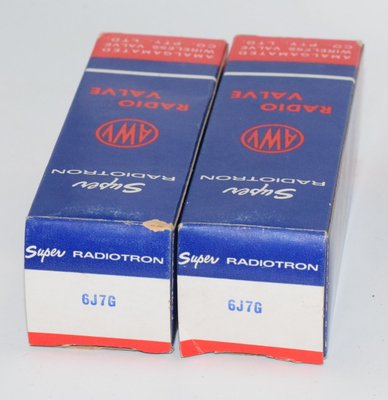
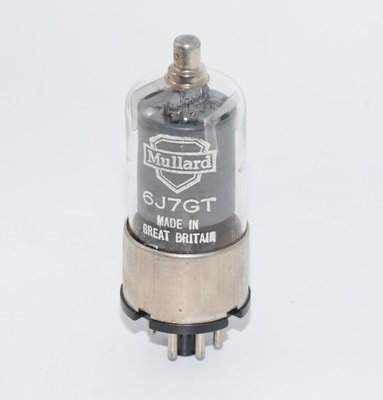
Introduction and History
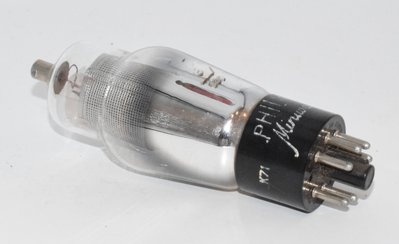
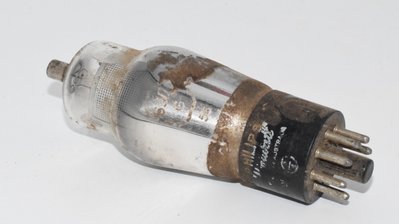
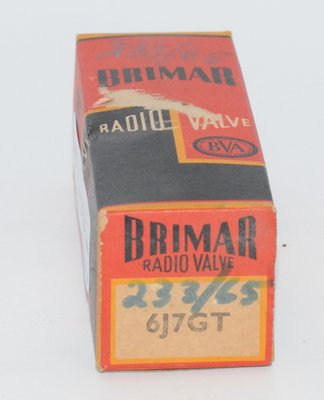
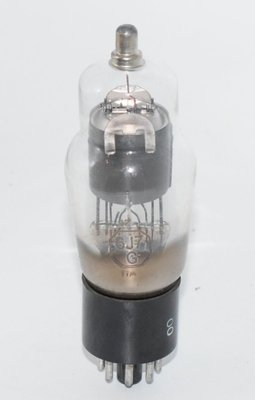
The 6J7G is a sharp-cutoff triple-grid (pentode) detector amplifier valve, originally developed in the late 1930s as part of the American octal tube family. It was designed as a high-gain voltage amplifier and detector for use in radio receivers, test equipment, and audio preamplifier stages. The 'G' suffix denotes the shouldered glass (ST-12) envelope style, distinguishing it from the later 6J7GT tubular glass variant and the original metal-envelope 6J7.
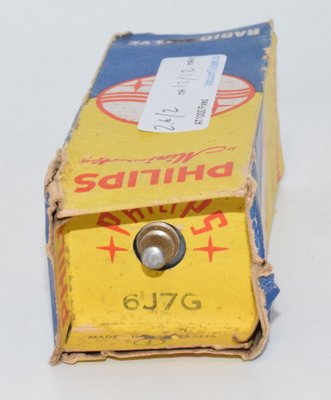
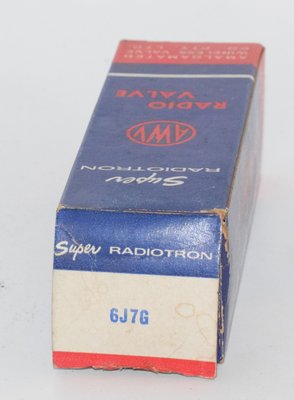
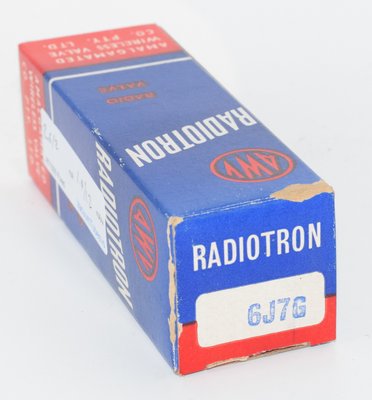
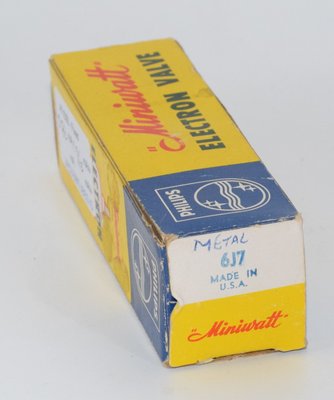
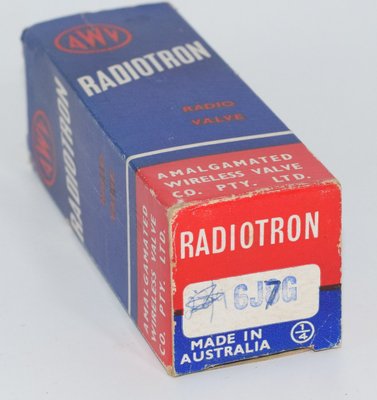
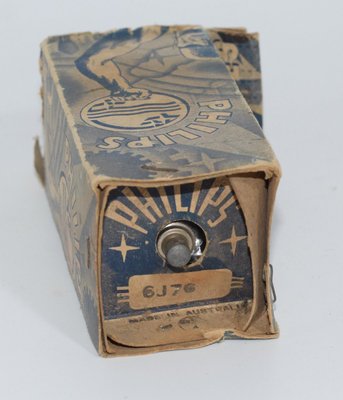
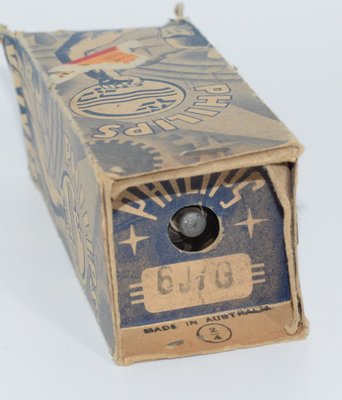
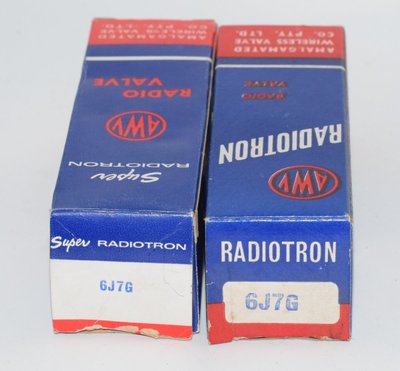
The Radiotron 6J7-G datasheet published by Amalgamated Wireless Valve Co. Pty. Ltd. (AWV) of Sydney, Australia, dated May 1945, superseded earlier data sheets from May 1940. The datasheet notes that types 57, 6J7-G, and 1603 are similar, differing electrically only in heater rating. The 6J7G was manufactured by numerous companies worldwide, including RCA, Sylvania, Ken-Rad, Philips Miniwatt, Mullard, and AWV's own Super Radiotron brand. It became a staple of radio and audio equipment design throughout the 1940s and 1950s and continues to enjoy a following among audio enthusiasts today.
Technical Specifications and Design
General Characteristics
| Tube Type | Sharp-cutoff pentode (triple-grid detector amplifier) |
| Cathode | Coated Unipotential (indirectly heated) |
| Heater Voltage | 6.3 volts (AC or DC) |
| Heater Current | 0.3 amperes |
| Bulb | ST-12 |
| Cap | Skirted Miniature (grid connection on top cap) |
| Base | Small Shell Octal 7-Pin |
| Mounting Position | Any |
Physical Dimensions
| Maximum Overall Length | 4-15/32 inches |
| Maximum Seated Height | 3-29/32 inches |
| Maximum Diameter | 1-9/16 inches |
Pin Configuration (Bottom View, G-7B Octal Base)
| Pin 1 | Internal Shield |
| Pin 2 | Heater |
| Pin 3 | Plate |
| Pin 4 | Screen (Grid 2) |
| Pin 5 | Suppressor (Grid 3) |
| Pin 7 | Heater |
| Pin 8 | Cathode |
| Top Cap | Grid (Control Grid 1) |
Note: Pin 6 is unused. The control grid is brought out to a top cap to minimize stray capacitance, which is critical for high-frequency and detector applications.
Direct Interelectrode Capacitances
Pentode Connection
| Grid to Plate | 0.007 max. µµF |
| Input | 4.6 µµF |
| Output | 12.0 µµF |
Triode Connection
| Grid to Plate | 1.8 µµF |
| Grid to Cathode | 3.6 µµF |
| Plate to Cathode | 17.0 µµF |
Maximum Ratings — R-F Amplifier, Class A1 (Design-Centre Values)
| Plate Voltage | 300 max. volts |
| Screen Voltage | 250 max. volts |
| Screen Supply Voltage | 300 max. volts |
| Grid Voltage | 0 min. volts |
| Plate Dissipation | 1.4 max. watts |
| Screen Dissipation | 0.35 max. watts |
Typical Operating Conditions — R-F Amplifier, Class A1
| Parameter | Condition 1 | Condition 2 | Units |
|---|---|---|---|
| Plate Voltage | 100 | 250 | volts |
| Screen Voltage | 100 | 100 | volts |
| Grid Voltage | −3 | −3 | volts |
| Suppressor | Connected to cathode at socket | ||
| Plate Resistance | 1.0 | + | megohms |
| Transconductance | 1185 | 1225 | µmhos |
| Grid Bias (approx.) | −7 | −7 | volts |
| Plate Current | 2.0 | 2.0 | mA |
| Screen Current | 0.5 | 0.5 | mA |
Maximum Ratings — Pentode Power Amplifier
| Plate Voltage | 300 max. volts |
| Screen Voltage | 250 max. volts |
| Screen Supply Voltage | 300 max. volts |
| Grid Voltage | 0 min. volts |
| Plate Dissipation | 1.4 max. watts |
| Screen Dissipation | 0.35 max. watts |
Typical Operating Conditions — Pentode Power Amplifier
| Parameter | Condition 1 | Condition 2 | Units |
|---|---|---|---|
| Plate Voltage | 250 | 250 | volts |
| Screen Voltage | 100 | 175 | volts |
| Grid Voltage | −3.5 | −4 | volts |
| Suppressor | Connected to cathode at socket | ||
| Cathode Bias Resistor | 600 | 440 | ohms |
| Peak A-F Grid Volts | 2.5 | 4 | volts |
| Zero-Sig. Plate Current | 2.2 | 7.5 | mA |
| Max.-Sig. Plate Current | 3.3 | — | mA |
| Zero-Sig. Screen Current | 0.7 | 1.6 | mA |
| Max.-Sig. Screen Current | 0.9 | — | mA |
| Transconductance | 1870 (approx.) | µmhos | |
| Load Resistance | 55000 | 25000 | ohms |
| Max.-Signal Power Output | 0.55 | 0.65 | watts |
Triode Power Amplifier (Screen and Suppressor Connected to Plate)
| Plate Voltage | 250 max. volts |
| Grid Voltage | 0 min. volts |
| Plate & Screen Dissipation (total) | 1.75 max. watts |
Typical Triode Power Amplifier Operations
| Parameter | Condition 1 | Condition 2 | Units |
|---|---|---|---|
| Plate Voltage | 180 | 250 | volts |
| Grid Voltage | −5.5 | −8.0 | volts |
| Cathode Bias Resistor | 1000 | 1350 | ohms |
| Zero-Signal Plate Current | 5.5 | 6.5 | mA |
| Amplification Factor | 20 | 20 | |
| Plate Resistance | 11000 | 10500 | ohms |
| Transconductance | 1800 | 1900 | µmhos |
| Load Resistance | 25000 | 22000 | ohms |
| Second Harmonic Distortion | 5 | 5 | % |
| Power Output | 0.113 | 0.275 | watts |
Typical Operating Conditions as Biased Detector
| Parameter | Cond. 1 | Cond. 2 | Cond. 3 | Cond. 4 | Units |
|---|---|---|---|---|---|
| Plate Supply Voltage | 100 | 100 | 250 | 250 | volts |
| Screen Voltage | 12 | 30 | 50 | 100 | volts |
| Grid Voltage | −1.2 | −1.8 | −2.0 | −4.3 | volts |
| Cathode Bias Resistor | 18000 | 10000 | 3000 | 10000 | ohms |
| Suppressor | Connected to cathode at socket | ||||
| Zero-Sig. Cathode Current | 0.065 | 0.185 | 0.65 | 0.43 | mA |
| Plate Load Resistor | 1.0 | 0.25 | 0.25 | 0.5 | megohms |
| Coupling Condenser | 0.01 | 0.01 | 0.03 | 0.03 | µF |
| Grid Resistor | 1.0 | 0.5 | 0.25 | 0.25 | megohms |
| R-F Signal (RMS) | 1.06 | 1.6 | 1.18 | 1.37 | volts |
Applications and Usage
The 6J7G was designed as a versatile triple-grid valve suitable for a wide range of applications:
- R-F and I-F Amplification: The extremely low grid-to-plate capacitance of 0.007 µµF maximum in pentode connection made the 6J7G ideal for radio-frequency and intermediate-frequency amplifier stages. Its sharp-cutoff characteristic allowed precise gain control via AGC (automatic gain control) circuits in radio receivers.
- Audio Voltage Amplification: With a transconductance of approximately 1225 µmhos at 250V plate and 100V screen, and very high plate resistance (in excess of 1 megohm in pentode mode), the 6J7G provides substantial voltage gain when used as an audio preamplifier. It was commonly employed as the first audio voltage amplifier stage in radio receivers and audio equipment.
- Detector Service: The datasheet provides extensive data for biased detector operation at various supply voltages. The 6J7G was widely used as a grid-leak or biased detector in superheterodyne receivers.
- Pentode Power Amplifier: Though limited to modest power output (0.55 to 0.65 watts maximum signal power), the 6J7G could serve as a small pentode power amplifier for headphone or low-power speaker applications.
- Triode Power Amplifier: With screen and suppressor tied to the plate, the 6J7G operates as a triode with an amplification factor (µ) of 20, plate resistance of approximately 10,500–11,000 ohms, and transconductance of 1800–1900 µmhos. In this configuration it can deliver up to 0.275 watts at 250V plate with 5% second harmonic distortion.
- Oscillator and Mixer Stages: The 6J7G found use in oscillator circuits and as a mixer/converter in some receiver designs.
- Test Equipment: Its high gain and stable characteristics made it suitable for use in voltmeters, signal generators, and other laboratory instruments.
The datasheet notes several important design considerations: the grid circuit resistance should not exceed 1 megohm as a pentode or triode power amplifier, or 3 megohms as a conventional r-f or i-f amplifier. Where circuit constants permit plate current not exceeding 1 mA, the grid circuit resistance may be as high as 10 megohms, though reduced heater voltage operation is essential in such cases. In circuits where the cathode is not directly connected to the heater, the potential difference between heater and cathode should be kept as low as possible.
Sound Characteristics
The 6J7G occupies an interesting position in the audio world, as its sonic character varies dramatically depending on whether it is used in pentode or triode mode:
Pentode Mode
In its native pentode configuration, the 6J7G exhibits the classic characteristics of a high-gain sharp-cutoff pentode preamplifier tube. The very high plate resistance (exceeding 1 megohm) means the tube's output impedance is dominated by the plate load resistor, and the gain is essentially the product of transconductance and load resistance. Audiophiles describe the pentode-mode sound as:
- Highly detailed and revealing: The high gain and sharp cutoff characteristic mean the tube amplifies subtle details in the signal with great fidelity, though this can also expose noise and source imperfections.
- Extended and airy treble: The low interelectrode capacitances (particularly the 0.007 µµF grid-to-plate capacitance) contribute to excellent high-frequency response, giving the sound an open, extended quality in the upper registers.
- Slightly lean midrange: Compared to triode-connected operation, the pentode mode can sound somewhat thinner through the midrange, with less of the harmonic richness that triode enthusiasts prize.
- Higher noise floor: As with most pentodes, partition noise between the screen and plate current streams adds a slight hiss that can be audible in very quiet passages, particularly in high-gain phono or microphone preamplifier applications.
Triode Mode
When triode-connected (screen and suppressor tied to plate), the 6J7G transforms into a medium-mu triode with a µ of 20 and plate resistance of around 10,500 ohms. In this configuration, the sound character changes markedly:
- Warm and harmonically rich: The triode connection produces predominantly second-harmonic distortion (the datasheet specifies 5% at full output), which listeners perceive as warmth and musical richness.
- Smooth, liquid midrange: The lower plate resistance and triode linearity contribute to a smooth, flowing midrange that is particularly flattering to vocals and acoustic instruments.
- Reduced noise: Eliminating the screen current partition noise results in a noticeably quieter tube, making triode mode preferable for the most demanding low-level audio applications.
- Slightly rolled-off treble: The increased grid-to-plate capacitance in triode mode (1.8 µµF versus 0.007 µµF in pentode) can cause some high-frequency roll-off depending on the source impedance, contributing to a perception of smoothness and warmth.
General Sonic Character
Overall, the 6J7G is regarded as a tube with a classic, vintage voice. Its ST-12 glass envelope and older construction techniques give it a character that many listeners find more organic and natural-sounding than later miniature equivalents. The tube's relatively modest transconductance compared to later high-gm pentodes means it is not as "aggressive" sounding, lending a gentleness and refinement to the audio signal that is highly valued in vintage and boutique audio equipment.
Equivalent and Substitute Types
Close/Identical Substitutes (Direct Drop-In Replacements)
| Type | Notes |
|---|---|
| 6J7 | Metal envelope version; electrically identical, different physical envelope |
| 6J7GT | Tubular glass (T-9) envelope version; electrically identical |
| ARP16 | British military designation |
| CV1074 | British military CV designation |
| CV1935 | British military CV designation |
| CV1936 | British military CV designation |
| CV1937 | British military CV designation |
| VT74 (RAF) | RAF designation |
| VT91 | US military designation |
| VT91A | US military designation |
Different Rating Substitutes (NOT Direct Drop-In — Check Specifications)
The following types are functionally similar but may differ in pinout, heater ratings, bias requirements, or other specifications. They should not be substituted without verifying circuit compatibility:
| Type | Notes |
|---|---|
| EF36 | European equivalent; similar characteristics but verify pin connections |
| EF37A | Improved European version with lower noise and microphonics |
| VR56 | British services designation for EF36 |
| CV1056 | British CV designation |
| CV1404 | British CV designation |
| CV358 | British CV designation |
| CV5080 | British CV designation |
| OM5, OM5A, OM5B | Philips designations; verify specifications before substitution |
| 5A157D | Verify specifications before substitution |
| 12J7GT | 12.6V heater version — NOT interchangeable without heater circuit modification |
The datasheet also notes that types 57 and 1603 are similar to the 6J7-G, differing electrically only in heater rating.
Notable Characteristics
- Top-Cap Grid Connection: The control grid is brought out to a top cap rather than a base pin. This was a deliberate design choice to minimize the grid-to-plate capacitance to an extraordinarily low 0.007 µµF maximum in pentode mode, which was essential for stable high-frequency amplification. This design feature also reduces stray coupling and improves shielding effectiveness.
- Internal Shield: Pin 1 connects to an internal shield, which should be grounded (typically by connecting to cathode at the socket) for optimal shielding and minimum hum pickup. The close fitting of the shield to the cathode is noted as important for proper operation.
- Versatile Operating Modes: Few tubes of this era offered such a comprehensive range of documented operating modes — from RF amplifier to detector to pentode power amplifier to triode power amplifier — all in a single, compact envelope.
- Sharp Cutoff Characteristic: Unlike remote-cutoff (variable-mu) pentodes such as the 6K7, the 6J7G has a sharp cutoff characteristic. This means the tube transitions relatively abruptly from conducting to non-conducting as the grid voltage is made more negative, making it suitable for detector and oscillator service but less ideal for AGC-controlled RF stages where smooth gain reduction is needed.
- Modest Power Dissipation: With a maximum plate dissipation of only 1.4 watts and screen dissipation of 0.35 watts, the 6J7G runs cool and has excellent longevity when operated within its ratings.
- High Amplification Factor in Triode Mode: The µ of 20 in triode connection, combined with a plate resistance of approximately 10,500 ohms and transconductance of 1900 µmhos, makes the triode-connected 6J7G a useful medium-mu triode comparable in some respects to a small triode like the 6C5, though with different characteristics.
- Australian Manufacturing Heritage: The Radiotron 6J7-G was a significant product of Australia's wartime and post-war electronics industry, manufactured by Amalgamated Wireless Valve Co. (AWV) in Sydney. AWV-branded Super Radiotron tubes, along with Philips Miniwatt and Mullard Australian production, represent a notable chapter in the history of vacuum tube manufacturing in the Southern Hemisphere.
Usage in the Audio Community
The 6J7G enjoys a dedicated following in the audio community, where it is used in several distinct applications:
Vintage Radio Restoration
The most common use of the 6J7G today is in the restoration and maintenance of vintage radio receivers from the late 1930s through the 1950s. Many classic superheterodyne receivers used the 6J7G as a first audio amplifier, detector, or oscillator stage. Restorers seek out NOS (New Old Stock) examples from reputable manufacturers such as AWV Super Radiotron, Philips Miniwatt, Ken-Rad, and Mullard to maintain the original character and performance of these vintage sets.
Guitar Amplifiers
Some boutique guitar amplifier builders have incorporated the 6J7G into preamp designs, attracted by its high gain in pentode mode and its warm, vintage character. The top-cap grid connection adds a visual element of vintage authenticity that appeals to players and collectors. The tube's sharp-cutoff characteristic provides a distinctive clipping behavior when overdriven, transitioning from clean to distorted in a manner that some players find musically expressive.
Hi-Fi Preamplifiers
Audiophile preamplifier designers have used the 6J7G in both pentode and triode-connected configurations. In pentode mode, the high gain (transconductance of 1225 µmhos with plate resistance exceeding 1 megohm) allows for simple, single-stage phono preamplifier designs with sufficient gain for moving-magnet cartridges. In triode mode, the lower noise and richer harmonic character make it suitable for line-stage preamplifiers where sonic quality takes priority over maximum gain.
Headphone Amplifiers
The 6J7G's modest power output capability — up to 0.275 watts in triode mode or 0.65 watts in pentode mode — makes it surprisingly well-suited for headphone amplifier applications. Several DIY headphone amplifier designs feature the 6J7G as a driver or output stage for high-impedance headphones, where its gentle, refined sound character is particularly appreciated for long listening sessions.
Microphone Preamplifiers
Recording engineers and studio equipment builders have used the 6J7G in microphone preamplifier designs, particularly for applications where a vintage tonal character is desired. The triode-connected mode is generally preferred for this application due to its lower noise floor, though careful attention must be paid to heater-cathode voltage management and vibration isolation to minimize hum and microphonics.
Collecting and Tube Rolling
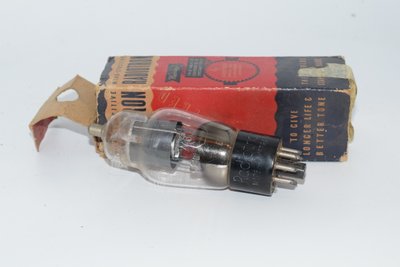
The 6J7G is actively collected, with NOS examples from premium manufacturers commanding significant prices. Australian-made Super Radiotron and Philips Miniwatt examples are particularly sought after, as are early RCA and Ken-Rad production. Tube rollers — enthusiasts who swap different brands and vintages of the same tube type to compare sonic differences — find the 6J7G to be a rewarding tube to explore, as manufacturing differences between brands and eras produce audible variations in tonal character, noise floor, and microphonic behavior. Matched pairs are available for applications requiring balanced or push-pull configurations.
DIY Community
The 6J7G remains popular in the DIY audio community due to its relatively affordable price (compared to more fashionable preamp tubes), its well-documented specifications, and its versatility. The comprehensive datasheet from AWV, with its detailed operating conditions for multiple configurations, provides an excellent foundation for circuit design. The tube's forgiving nature and wide range of usable operating points make it accessible to builders of varying experience levels.