1. Introduction and History
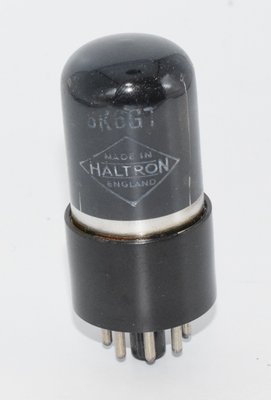
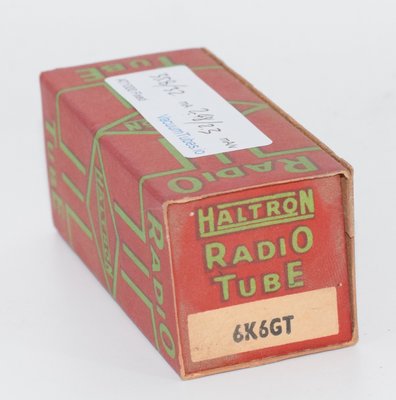
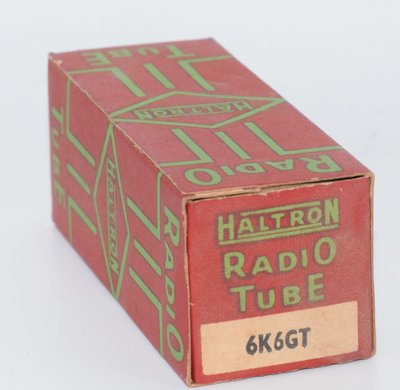
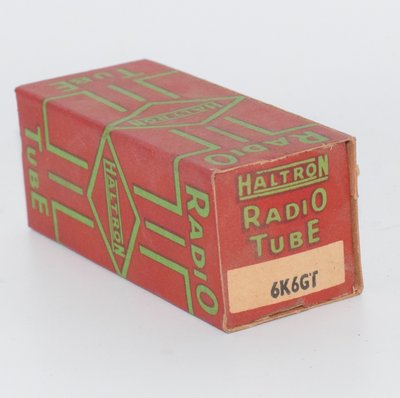
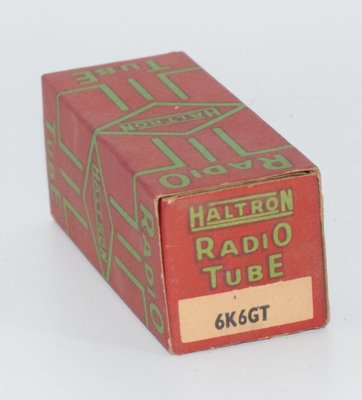
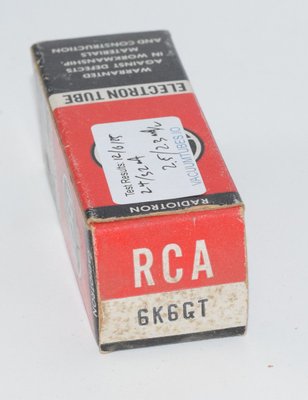
The 6K6GT is a power amplifier pentode designed for audio output service, introduced in the late 1930s as part of the GT (Glass Tubular) family of receiving tubes. It was formally released through RMA (Radio Manufacturers Association) release #134, dated April 11, 1938, and later documented in JETEC specification J5-6K6GT dated May 12, 1953. The tube was manufactured by numerous companies including RCA, Hytron Corporation of Salem, Massachusetts, Sylvania, and later by international producers such as Haltron in England.
The 6K6GT is essentially the GT-envelope version of the earlier type 41 tube, sharing identical ratings and characteristics but housed in a smaller T-9 glass bulb with a small octal base instead of the older 6-pin base. This transition was part of the industry-wide move toward the standardized octal basing system that simplified manufacturing and improved reliability. The Hytron datasheet explicitly states that the 6K6GT "has ratings and characteristics identical to those of the type 41."
Throughout the 1940s and 1950s, the 6K6GT found widespread use in radio receivers, public address systems, intercoms, and small amplifiers. Its modest power output and reasonable efficiency made it an ideal choice for consumer electronics of the era, and it remains a tube of interest to vintage audio enthusiasts and DIY amplifier builders today.
2. Technical Specifications and Design
Physical Characteristics
| Parameter | Value |
|---|---|
| Tube Type | Power Amplifier Pentode |
| Cathode | Coated unipotential (indirectly heated) |
| Envelope (Bulb) | T-9 (T-9D per Hytron) |
| Base | Octal (intermediate shell octal) — B6-81, B7-7, B6-84, or B7-59 |
| Maximum Diameter | 1-9/32 inches |
| Maximum Overall Length | 3-5/16 inches |
| Maximum Seated Height | 2-3/4 inches |
| Mounting Position | Any |
Pin Connections (Octal Base, Bottom View)
| Pin | Connection |
|---|---|
| Pin 1 | No Connection (omitted on some base variants) |
| Pin 2 | Heater |
| Pin 3 | Plate |
| Pin 4 | Grid #2 (Screen) |
| Pin 5 | Grid #1 (Control Grid) |
| Pin 7 | Heater |
| Pin 8 | Cathode, Grid #3 (Suppressor) |
Heater Ratings
| Parameter | Value |
|---|---|
| Heater Voltage | 6.3 Volts |
| Heater Current | 0.4 Ampere (400 mA) |
Note: The voltage between heater and cathode should be kept at a minimum if direct connection is not possible. Maximum heater-cathode voltage ratings are: heater negative with respect to cathode — 200V total DC and peak; heater positive with respect to cathode — 100V DC, 200V total DC and peak.
Maximum Ratings (Class A1 Amplifier)
| Parameter | Value |
|---|---|
| Maximum Plate Voltage | 315 Volts |
| Maximum Grid #2 (Screen) Voltage | 285 Volts |
| Maximum Plate Dissipation | 8.5 Watts |
| Maximum Grid #2 Dissipation | 2.8 Watts |
| Maximum Grid #1 Circuit Resistance (Fixed Bias) | 0.1 Megohm |
| Maximum Grid #1 Circuit Resistance (Cathode Bias) | 0.5 Megohm |
Interelectrode Capacitances (Approximate)
| Parameter | Value |
|---|---|
| Grid to Plate (g1 to p) | 0.5 pF |
| Input: g1 to (h+k+g2+g3) | 5.5 pF |
| Output: p to (h+k+g2+g3) | 6.0 pF |
Typical Operating Conditions — Class A1 Single-Ended Pentode
| Parameter | Condition 1 | Condition 2 | Condition 3 |
|---|---|---|---|
| Plate Voltage | 100 V | 250 V | 315 V |
| Grid #2 Voltage | 100 V | 250 V | 250 V |
| Grid #1 Voltage | -7 V | -18 V | -21 V |
| Peak A-F Grid #1 Voltage | 7 V | 18 V | 21 V |
| Zero-Signal Plate Current | 9 mA | 32 mA | 25.5 mA |
| Maximum-Signal Plate Current | 9.5 mA | 33 mA | 28 mA |
| Zero-Signal Grid #2 Current | 1.6 mA | 5.5 mA | 4.0 mA |
| Maximum-Signal Grid #2 Current | 3 mA | 10 mA | 9 mA |
| Plate Resistance (Approx.) | 104,000 Ω | 90,000 Ω | 110,000 Ω |
| Transconductance | 1,500 µmhos (1.5 mA/V) | 2,300 µmhos (2.3 mA/V) | 2,100 µmhos (2.1 mA/V) |
| Load Resistance | 12,000 Ω | 7,600 Ω | 9,000 Ω |
| Maximum-Signal Power Output | 0.35 W | 3.4 W | 4.5 W |
| Total Harmonic Distortion (Approx.) | 11% | 11% | 15% |
Typical Operating Conditions — Class A1 Push-Pull Pentode
| Parameter | Fixed Bias | Cathode Bias |
|---|---|---|
| Plate Voltage | 285 V | 285 V |
| Grid #2 Voltage | 285 V | 285 V |
| Grid #1 Voltage | -25.5 V | — |
| Cathode Resistor | — | 400 Ω (shared) |
| Peak A-F Grid #1 Voltage | 51 V | 51 V |
| Zero-Signal Plate Current (both tubes) | 55 mA | 55 mA |
| Maximum-Signal Plate Current (both tubes) | 72 mA | 61 mA |
| Zero-Signal Grid #2 Current (both tubes) | 9 mA | 9 mA |
| Maximum-Signal Grid #2 Current (both tubes) | 17 mA | 13 mA |
| Plate-to-Plate Load Resistance | 12,000 Ω | 12,000 Ω |
| Maximum-Signal Power Output (both tubes) | 10.5 W | 9.8 W |
| Total Harmonic Distortion | 6% | 4% |
Triode-Connected Operation
When triode-connected (screen grid tied to plate), the 6K6GT exhibits the following average characteristics:
| Parameter | Value |
|---|---|
| Plate Voltage | 250 Volts |
| Grid Voltage | -18 Volts |
| Plate Current | 37.5 mA |
| Transconductance | 2,700 µmhos (2.7 mA/V) |
| Amplification Factor (µ) | 6.8 |
| Plate Resistance (Approx.) | 2,500 Ω |
| Grid Voltage for Ib = 0.5 mA (Approx.) | -48 Volts |
Additional Hytron Datasheet Operating Points
The Hytron datasheet provides additional operating conditions that complement the JETEC data:
| Parameter | Condition 1 | Condition 2 | Condition 3 | Condition 4 (Max) |
|---|---|---|---|---|
| Plate Voltage | 125 V | 167.5 V | 180 V | 250 V |
| Grid Voltage | -10 V | -12.5 V | -13.5 V | -18.0 V |
| Screen Voltage | 125 V | 167.5 V | 180 V | 250 V |
| Plate Current | 11 mA | 17 mA | 18.5 mA | 32 mA |
| Screen Current | 2 mA | 3 mA | 3 mA | 5.5 mA |
| Plate Resistance (Approx.) | 100,000 Ω | 85,000 Ω | 81,000 Ω | 68,000 Ω |
| Mutual Conductance | 1,525 µmhos | 1,800 µmhos | 1,850 µmhos | 2,200 µmhos |
| Amplification Factor (Approx.) | 150 | 150 | 150 | 150 |
| Load Resistance | 11,000 Ω | 9,500 Ω | 9,000 Ω | 7,600 Ω |
| Power Output | 0.65 W | 1.25 W | 1.5 W | 3.4 W |
The Hytron data also notes that a bias of -16.5 volts and a load of 7,000 ohms will give a power output of 3.2 watts with 7% total harmonic distortion at the 250V maximum operating point.
Vertical Deflection Amplifier Ratings (Triode Connected)
The 6K6GT was also rated for use as a vertical deflection amplifier in television receivers:
| Parameter | Value |
|---|---|
| Maximum DC Plate Voltage | 315 V |
| Maximum Peak Positive Voltage (Absolute Maximum) | 1,200 V |
| Maximum Plate Dissipation | 7 W |
| Maximum Peak Negative Grid Voltage | 250 V |
| Maximum Average Cathode Current | 25 mA |
| Maximum Peak Cathode Current | 75 mA |
| Maximum Grid Circuit Resistance (Cathode Bias) | 2.2 Megohms |
3. Applications and Usage
The 6K6GT was designed as a versatile power amplifier pentode suitable for a wide range of applications:
- Audio Output Stage: The primary application was as an audio power output tube in radio receivers, phonograph amplifiers, and small public address systems. It could be used singly for modest power requirements or in push-pull pairs for higher output.
- Single-Ended Amplifiers: In single-ended configuration at 250V plate and screen, the 6K6GT delivers 3.4 watts of output power into a 7,600-ohm load. At the higher 315V plate voltage with 250V screen, output increases to 4.5 watts into a 9,000-ohm load.
- Push-Pull Amplifiers: A pair of 6K6GTs in push-pull class A1 can deliver 10.5 watts with fixed bias or 9.8 watts with cathode bias, both into a 12,000-ohm plate-to-plate load at 285V. The push-pull configuration significantly reduces distortion — down to 4-6% compared to 11-15% in single-ended mode.
- Television Vertical Deflection: The tube was rated for use as a vertical deflection output amplifier in television receivers when triode-connected, capable of handling peak positive plate voltages up to 1,200V.
- Triode-Connected Operation: With the screen tied to the plate, the 6K6GT operates as a triode with a mu of 6.8, transconductance of 2,700 µmhos, and plate resistance of only 2,500 ohms — characteristics that make it attractive for audio applications where lower distortion is preferred over maximum power.
The datasheet recommends transformer or impedance-coupled input systems. If resistance coupling is used, the DC resistance in the grid return must be limited to 1 megohm for self-biased conditions and 0.1 megohm for fixed-bias conditions, provided the heater voltage does not exceed rated value by more than 10% under all operating conditions.
4. Sound Characteristics
The 6K6GT occupies an interesting sonic niche among small power pentodes, and its sound character varies significantly depending on whether it is operated in pentode or triode mode:
Pentode Mode
In pentode configuration, the 6K6GT is generally described as having a lively, detailed sound with good presence and clarity in the midrange. The high plate resistance (68,000–110,000 ohms depending on operating point) means that the tube's output impedance is dominated by the load resistance, and the damping factor is relatively low. This results in a somewhat "loose" bass response that some listeners find musical and others find lacking in authority. The upper midrange and treble tend to be well-articulated with a slight brightness that can bring out detail in recordings.
At lower power levels (below about 1 watt), the 6K6GT in pentode mode can sound surprisingly refined, with a sweetness that belies its modest specifications. As power output increases toward the rated maximum, distortion rises noticeably — the datasheet figures of 11-15% THD at full output in single-ended mode are quite audible and contribute to a compressed, harmonically rich character that some find appealing for certain musical genres.
Triode Mode
Triode-connected, the 6K6GT transforms into a much more linear device. The low plate resistance of 2,500 ohms provides significantly better damping of the output transformer and loudspeaker, resulting in tighter, more controlled bass. The midrange takes on a warmer, more liquid quality that is characteristic of directly-heated triodes, though with the convenience of an indirectly-heated cathode. The overall sound in triode mode is smoother and more refined, though at the cost of reduced power output.
General Character
Compared to its more famous contemporaries like the 6V6GT, the 6K6GT is often described as having a slightly thinner, more transparent sound with less of the 6V6's characteristic warmth and midrange bloom. It lacks the raw power and authority of larger output pentodes like the 6L6 or EL34, but compensates with an intimacy and directness that works well in near-field listening situations and with high-efficiency speakers. The tube responds well to quality output transformers and power supply design, rewarding careful implementation with a surprisingly engaging musical presentation.
Vintage audio enthusiasts note that different manufacturers' versions of the 6K6GT can sound noticeably different — RCA production is often considered smooth and balanced, while some European-made examples (such as Haltron) may exhibit slightly different tonal characteristics due to variations in construction and materials.
5. Equivalent or Substitute Types
The following types are close or identical substitutes for the 6K6GT:
| Type | Notes |
|---|---|
| 6K6 | Metal-envelope version with identical electrical characteristics. Direct substitute; the only difference is the metal shell versus glass envelope. |
| CV1938 | British military designation (CV = Common Valve) equivalent to the 6K6GT. Direct plug-in replacement. |
| CV1940 | Another British military CV designation equivalent to the 6K6GT. Direct plug-in replacement. |
| VT152 | US military designation for the 6K6GT. Identical specifications. |
| VT152A | US military designation variant. Identical specifications to the 6K6GT. |
| Type 41 | The predecessor tube with identical electrical ratings and characteristics, but with a 6-pin base instead of octal. Requires a different socket — not a direct plug-in substitute without an adapter. The Hytron datasheet notes that characteristic curves for the type 41 apply to the 6K6GT. |
Important Note: The 6K6GT should not be confused with the 6K6 metal type in terms of physical interchangeability in tight chassis layouts, as the metal envelope has different dimensions and thermal characteristics. Electrically, however, they are identical. The 6V6GT, while sometimes suggested as a substitute, has different bias requirements and higher power capability — it is not a direct equivalent and should not be used as a drop-in replacement without circuit modifications.
6. Notable Characteristics
- Amplification Factor of 150: The Hytron datasheet consistently lists an amplification factor of approximately 150 across all pentode operating conditions, which is typical for a beam-less power pentode of this era and contributes to its high gain characteristics.
- Versatile Operating Range: The 6K6GT can operate effectively across a wide range of plate voltages from 100V to 315V, making it adaptable to various power supply configurations. At just 100V on both plate and screen, it still delivers 0.35 watts — useful for portable or battery-operated equipment.
- Dual-Mode Operation: The ability to operate in both pentode and triode modes gives designers flexibility. In triode mode, the amplification factor drops dramatically to 6.8, but transconductance actually increases to 2,700 µmhos, and the plate resistance falls to a very manageable 2,500 ohms.
- Low Heater Power: At only 2.52 watts heater power (6.3V × 0.4A), the 6K6GT is economical in terms of filament transformer requirements, making it practical for small amplifier designs.
- Internal Suppressor Grid: The suppressor grid (grid #3) is internally connected to the cathode at pin 8, simplifying external wiring. This is a true pentode design, not a beam power tube.
- Cathode Bias Advantage in Push-Pull: Interestingly, the push-pull cathode bias configuration shows lower distortion (4% THD) than fixed bias (6% THD), despite producing slightly less power (9.8W vs. 10.5W). This is due to the self-regulating nature of cathode bias providing automatic balance between the two tubes.
- Grid Resistance Limitations: The tube has relatively strict grid resistance limits — 0.1 megohm for fixed bias and 0.5 megohm for cathode bias in class A1 service. Designers must account for this when choosing driver stage coupling methods.
7. Usage in the Audio Community
The 6K6GT occupies a modest but dedicated niche in the modern audio community, appreciated by builders and listeners who value simplicity, affordability, and the particular sonic character of small vintage pentodes.
DIY and Hobbyist Amplifiers
The 6K6GT is a popular choice for first-time tube amplifier builders due to several practical advantages: the tubes are still readily available as NOS (New Old Stock) from manufacturers like RCA and Haltron at reasonable prices; the modest power supply requirements (315V maximum plate voltage) reduce the complexity and danger of the power supply design; and the tube's forgiving nature makes it tolerant of minor design imperfections. A simple single-ended 6K6GT amplifier can be built with just a few components and will deliver 3-4 watts of usable power — more than sufficient for high-efficiency speakers in a small room.
Single-Ended (SE) Amplifiers
Single-ended 6K6GT amplifiers are built by enthusiasts who appreciate the simplicity and characteristic sound of SE topology. With 3.4 watts available at 250V operation or up to 4.5 watts at 315V, these amplifiers pair well with speakers of 93 dB/W/m sensitivity or higher. Many builders operate the 6K6GT in triode mode in SE amplifiers, accepting the lower power output in exchange for reduced distortion and the more linear, harmonically simple sound that triode operation provides.
Push-Pull Amplifiers
Push-pull 6K6GT amplifiers delivering approximately 10 watts represent a practical and affordable approach to vintage-style tube amplification. The 12,000-ohm plate-to-plate load requirement is well-served by commonly available output transformers. At nearly 10 watts with only 4% THD in cathode-biased push-pull, a pair of 6K6GTs can drive a wide range of speakers with musical authority.
Vintage Radio Restoration
A significant portion of 6K6GT demand comes from the vintage radio restoration community. The tube was used in countless radio receivers from the late 1930s through the 1950s, and restorers seek NOS examples to return these radios to original specification. The availability of NOS tubes from multiple manufacturers — including RCA (USA), Haltron (England), and others — ensures that restorers can find suitable replacements.
Guitar Amplifiers
While not as widely used in guitar amplifiers as the 6V6 or 6L6, the 6K6GT has found a following among players seeking lower-wattage practice amplifiers with vintage character. The tube's tendency toward harmonic richness at higher drive levels, combined with its modest power output, makes it suitable for bedroom and studio amplifiers where early breakup is desirable. Some boutique amp builders have incorporated the 6K6GT into small combo amplifiers specifically targeting this market.
Availability and Pricing
As of recent years, NOS 6K6GT tubes remain available from vintage tube dealers at moderate prices compared to more sought-after types like the 6V6GT or 6L6. RCA-branded NOS examples from the USA are commonly found, as are Haltron-branded tubes from England. The tube is not currently in production by any manufacturer, so the supply is entirely NOS or used/tested vintage stock. Builders are advised to purchase from reputable dealers who test tubes on calibrated equipment, as decades of storage can affect emission and other parameters.
Pairing with Driver Tubes
In the audio community, the 6K6GT is commonly driven by dual triodes such as the 6SN7, 6SL7, 12AX7, or 12AU7, depending on the gain requirements of the circuit. The tube's grid bias requirements (-7V to -21V depending on operating point) are easily achieved with standard driver stages. For push-pull amplifiers, a phase splitter such as a cathodyne or long-tailed pair using a 6SN7 or 12AX7 provides adequate drive with good balance.