1. Introduction and History
The 6L7 is a pentagrid converter tube, also known as a heptode or pentagrid mixer tube, that was developed during the 1930s and became widely used throughout the 1940s and 1950s. The tube designation follows the RCA numbering system where the "6" indicates a 6.3-volt heater design common in American consumer electronics.
The 6L7 was primarily designed for use in superheterodyne radio receivers as a combined mixer and local oscillator tube. This dual-function capability made it an economical choice for radio manufacturers, as it eliminated the need for separate mixer and oscillator tubes in many circuit designs. The tube gained popularity in both domestic and military applications, with numerous manufacturers producing variants including RCA, Ken-Rad, Sylvania, and Philips.
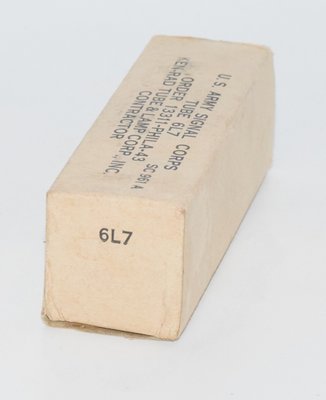
The Ken-Rad USA 1943 NOS (New Old Stock) example represents a high-quality American-made specimen from the peak of vacuum tube manufacturing during World War II, when production standards were rigorous due to military specifications.
2. Technical Specifications and Design
Basic Parameters
- Tube Type: Pentagrid Converter (Heptode)
- Heater Voltage: 6.3V AC
- Heater Current: 0.45A
- Maximum Plate Voltage: 330V
- Maximum Screen Voltage: 330V
- Plate Dissipation: 2.5W
- Base Type: Octal (8-pin)
Structural Design
The 6L7 contains seven active elements within a single glass envelope, which accounts for its "heptode" designation. The internal structure includes:
- Cathode: Indirectly heated oxide-coated cathode for reliable emission
- Control Grid (Grid 1): The primary signal input grid for RF mixing
- Screen Grid (Grid 2): Provides beam formation and voltage regulation
- Suppressor Grid (Grid 3): Reduces secondary emission from the plate
- Oscillator Grid (Grid 4): Receives the local oscillator signal
- Oscillator Cathode (Grid 5): Acts as the oscillator cathode
- Plate: Collects electrons and produces the output signal
Operating Characteristics
The 6L7 operates with typical plate current of 5-8mA under normal operating conditions. The mutual conductance (gm) is approximately 2,000-2,500 micromhos, indicating moderate amplification capability. The amplification factor (μ) is approximately 65, allowing for reasonable voltage gain in mixer applications.
The tube exhibits good linearity in the mixing function, making it suitable for AM radio reception where distortion must be minimized. The oscillator section provides stable, low-noise local oscillator injection for frequency conversion.
3. Applications and Usage
Original Commercial Applications
The 6L7 was extensively used in:
- AM Radio Receivers: The primary application, serving as mixer and oscillator in superheterodyne designs
- Military Communications Equipment: Used in field radios and aircraft radio systems during WWII and beyond
- Early Television Tuners: Some TV receiver designs employed the 6L7 in VHF tuning circuits
- Shortwave Receivers: Amateur radio and commercial shortwave reception equipment
Modern Audio Community Usage
In contemporary audio applications, the 6L7 has found renewed interest among vintage audio enthusiasts and tube audio equipment builders:
- Vintage Radio Restoration: Essential for accurate restoration of 1940s-1950s radio receivers
- Tube Audio Experimentation: Hobbyists and DIY audio builders use 6L7s in experimental mixer and frequency-conversion circuits
- Audiophile Radio Projects: Vintage radio enthusiasts prize well-maintained examples for restoration projects
- Educational Applications: Radio technician training and vacuum tube education programs utilize the 6L7 to demonstrate pentagrid converter operation
- Collector Interest: Vintage tube collectors seek NOS examples, particularly American-made specimens like Ken-Rad units, as representative examples of mid-century tube manufacturing quality
While the 6L7 is rarely used in new audio designs due to the prevalence of solid-state technology, its robust design and reliable performance have made it a sought-after component for those restoring period-correct vintage audio equipment or building retro-styled tube radio receivers.
4. Sound Characteristics
Mixer Characteristics
The 6L7's sonic signature in mixer applications is characterized by clean, transparent frequency conversion with minimal harmonic distortion. The pentagrid design provides excellent isolation between the RF input and the oscillator circuit, resulting in low injection noise that doesn't color the audio output.
In radio receiver applications, the 6L7 contributes to the warm, slightly compressed character typical of 1940s-1950s radio receivers. The tube's moderate plate dissipation and operating point result in a gentle compression of loud signals, which many vintage audio enthusiasts find musically pleasing compared to more linear modern components.
Frequency Response
The 6L7 exhibits a relatively flat frequency response across the AM broadcast band (530-1700 kHz) and into the lower shortwave frequencies. The tube's internal capacitances and the external circuit design typically result in a slight presence peak in the upper midrange, which contributes to the clarity and articulation characteristic of vintage radio receivers using this tube.
Noise Characteristics
Well-maintained NOS examples like the Ken-Rad 1943 specimen exhibit exceptionally low noise floors. The robust oxide cathode and carefully controlled electrode spacing provide quiet operation with minimal hum and microphonic noise. This low-noise characteristic makes the 6L7 particularly valued for sensitive radio reception and weak-signal applications.
Tonal Character
The 6L7 imparts a subtle warmth to signals passing through it, with smooth, non-fatiguing character in the midrange. The tube's natural compression and harmonic content create a cohesive, unified sound that many describe as "musical" or "organic." This quality has made vintage receivers using 6L7s prized by radio enthusiasts who appreciate the listening experience of period equipment.
5. Equivalent or Substitute Types
Direct Equivalents
- 6A7: An earlier pentagrid converter with similar characteristics but slightly different operating parameters
- 6L7G: Glass envelope variant of the 6L7 (the "G" designation indicates glass rather than metal construction)
- 6L7M: Metal envelope variant, functionally identical to the 6L7
- 6L7GT: "GT" (Great Tubular) designation indicating improved construction, equivalent performance
International Equivalents
- ECH35 (Philips/Mullard): European pentagrid converter with similar characteristics
- ECH42: Later European design with improved characteristics, can substitute in many applications
- 6K7: Soviet equivalent with comparable specifications
Functional Alternatives
In some circuit designs, the 6L7 can be replaced with combinations of separate mixer and oscillator tubes, such as a 6SA7 (pentagrid converter with different characteristics) or discrete 6J7 mixer with 6C5 oscillator combination. However, these substitutions may require circuit modifications and do not provide the same compact, single-tube solution.
Substitution Notes
When substituting equivalent tubes, careful attention must be paid to pin configurations and operating voltages. While most direct equivalents are pin-compatible, variations in gain and noise characteristics may require circuit adjustments for optimal performance. The 6A7, while functionally similar, has slightly different gain characteristics and should be evaluated in specific applications before permanent substitution.
6. Notable Characteristics
Manufacturing Quality
The Ken-Rad 1943 example represents the pinnacle of American tube manufacturing during the WWII era. Ken-Rad (Kendall Radio Tube Company) was renowned for producing tubes to military specifications, resulting in exceptional reliability and consistent performance. The 1943 production date places this tube during the peak of wartime manufacturing standards.
Reliability and Longevity
The 6L7 demonstrates exceptional longevity when properly operated. Many specimens from the 1940s remain fully functional today, with proper storage and handling. The robust construction, generous plate dissipation ratings, and conservative operating points contribute to remarkable reliability.
Availability and Collectibility
Original NOS 6L7s, particularly American-made examples from Ken-Rad, Sylvania, and RCA, remain reasonably available in the vintage tube market. However, prices have increased as vintage radio restoration has become more popular. NOS examples command premium prices compared to used tubes, reflecting their preserved condition and guaranteed functionality.
Identification Features
Authentic 6L7 tubes can be identified by:
- Octal base with eight pins in the standard RCA configuration
- Manufacturer markings printed or etched on the glass envelope
- Date codes indicating manufacturing period (Ken-Rad examples often feature clear date codes)
- Internal structure visible through the glass showing the characteristic pentagrid electrode arrangement
- Weight and construction quality indicating manufacturing era
Performance Verification
Testing a 6L7 requires a tube tester capable of pentagrid converter measurement. Proper testing should verify:
- Cathode emission capability
- Absence of internal shorts or leakage
- Oscillator function and stability
- Mixer linearity and gain
- Plate current under specified load conditions
NOS tubes should test at or near 100% of original specifications, while used examples may show some degradation depending on service history.