Introduction and History
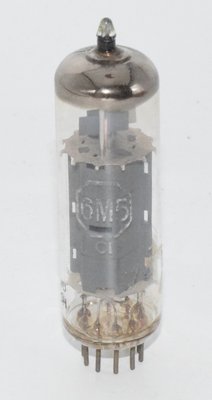
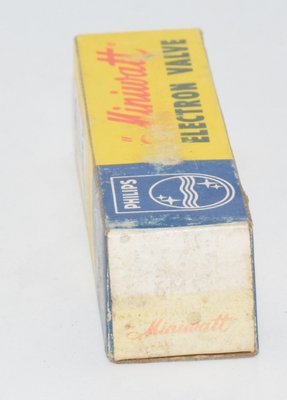
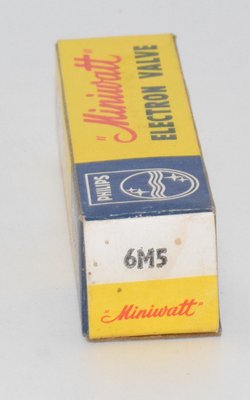
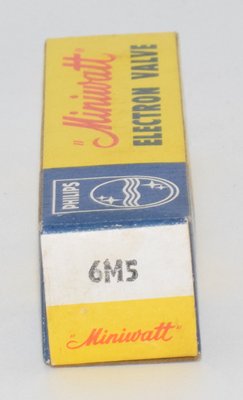
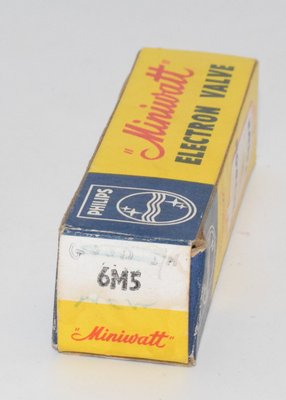
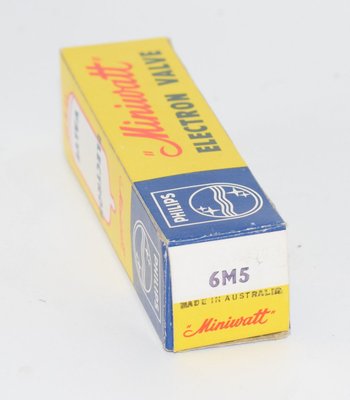
The 6M5 is an output pentode vacuum tube (valve) manufactured primarily by Philips Miniwatt in Australia. It is the Australian designation for the European-coded EL80, a miniature output pentode designed for use in audio output stages, particularly in radio receivers and small amplifiers. The tube was developed during the 1950s as part of the Philips/Mullard family of miniature Noval-based valves, reflecting the industry-wide transition from octal to miniature envelope designs during the post-war era.
The 6M5 designation follows the Australian/Philips Miniwatt numbering convention, where the '6' indicates a 6.3V heater voltage and the alphanumeric suffix identifies the tube type. This tube was widely used in Australian-made radio and television equipment, where Philips Miniwatt was a dominant valve supplier. The 6M5/EL80 occupies an interesting niche as a medium-power output pentode — more capable than small-signal pentodes but smaller and lower-powered than the larger audio output types like the EL34 or 6L6.
It is important to distinguish the 6M5/EL80 from the closely related but not directly interchangeable E80L (also designated 6227 in some systems). The E80L is a Philips SQ (Special Quality) variant designed for professional equipment with a rated life exceeding 10,000 hours, featuring enhanced shock and vibration resistance, gold-plated pins, and tighter manufacturing tolerances. While sharing a similar internal structure, the E80L has different ratings and operating conditions, and should not be considered a drop-in substitute for the 6M5/EL80.
Technical Specifications and Design
The 6M5 is electrically identical to the EL80. The following specifications are based on the EL80 datasheet parameters. Where values are drawn from the related E80L professional-grade datasheet (which shares the same basic structure but has different ratings), this is noted explicitly.
Heater / Filament
| Parameter | Value |
|---|---|
| Heater Voltage (Vf) | 6.3 V |
| Heater Current (If) | 0.75 A (per early EL80/E80L datasheets); 0.7 A (per later E80L revision)* |
| Heating Method | Indirect, AC or DC; series or parallel supply |
*Note: The Philips datasheet for the E80L shows two different heater current values across revisions — 0.75 A in the 1957 edition and 0.7 A in the 1962 edition. The 6M5/EL80 is generally listed at 0.75 A. Builders should confirm against the specific manufacturer's datasheet for their production batch.
Electrode Structure
The 6M5 is a pentode with five active electrodes: cathode (k), control grid (g1), screen grid (g2), suppressor grid (g3), and anode (a). The suppressor grid (g3) is brought out to a separate pin, allowing it to be connected to the cathode externally or used for special circuit functions.
Typical Operating Conditions (Single-Ended Output Stage)
The following values are referenced from the E80L datasheet, which shares the same fundamental design. The 6M5/EL80 is expected to have very similar operating parameters:
| Parameter | Value (Va=200V) | Value (Va=250V) |
|---|---|---|
| Anode Voltage (Va) | 200 V | 250 V |
| Screen Grid Voltage (Vg2) | 200 V | 250 V* |
| Suppressor Grid Voltage (Vg3) | 0 V | 0 V |
| Cathode Resistor (Rk) | 130 Ω | 270 Ω |
| Anode Current (Ia) | 30 mA | 24 mA |
| Screen Grid Current (Ig2) | 4.1 mA | 3.3 mA |
| Mutual Conductance (S / gm) | 9.0 mA/V | — mA/V |
| Internal Resistance (Ri / rp) | 90 kΩ (approx.) | 52 kΩ (approx.) |
| Amplification Factor g2-g1 (μg2g1) | 21.5 | 21.5 |
| Load Resistance (Ra~) | 7 kΩ | 10 kΩ |
| Output Power (Wo) | 2.7 W | 2.8 W |
| Total Distortion (dtot) | 10% | 10% |
*At 250V operation, the screen grid is fed through a supply voltage (Vbg2) of 250V with a 1 kΩ series resistor (Rg2).
Push-Pull Class AB Operation (Two Tubes)
| Parameter | Value (Va=200V) | Value (Va=250V) |
|---|---|---|
| Anode Voltage (Va) | 200 V | 250 V |
| Screen Grid Voltage (Vg2) | 200 V | 250 V |
| Cathode Resistor (Rk) | 130 Ω | 150 Ω |
| Load Resistance (Raa~) | 9 kΩ | 9 kΩ |
| Output Power (Wo) | 5.7 W | 9.0 W |
| Total Distortion (dtot) | 3.0% | 4.5% |
| Anode Current per tube (Ia) | 2×20.6 mA (quiescent) to 2×24.6 mA | 2×23.5 mA (quiescent) to 2×29.5 mA |
| Input Voltage (Vi) for full output | 5.2 Veff (RMS) | 7.8 Veff (RMS) |
Capacitances
| Parameter | Typical Value | Range |
|---|---|---|
| Anode to all other elements except g1 (Ca) | 7.0 pF | 6.5–7.5 pF |
| Grid No.1 to all other elements except anode (Cg1) | 11.0 pF | 10.2–11.8 pF |
| Anode to Grid No.1 (Cag1) | — | < 0.1 pF |
| Grid No.1 to heater (Cg1f) | — | < 0.25 pF |
| Cathode to heater (Ckf) | 7.0 pF | — |
Maximum Ratings (Absolute Limits)
| Parameter | Maximum Value |
|---|---|
| Anode Voltage (cold condition) (Vao) | 600 V |
| Anode Voltage (Va) | 300 V |
| Anode Dissipation (Wa) | 8 W |
| Screen Grid Voltage (cold condition) (Vg2o) | 600 V |
| Screen Grid Voltage (Vg2) | 300 V |
| Screen Grid Dissipation (Wg2) | 2.6 W |
| Negative Grid No.1 Voltage (-Vg1) | 100 V |
| Negative Grid No.3 Voltage (-Vg3) | 100 V |
| Cathode Current (Ik) | 50 mA |
| Voltage between Heater and Cathode (Vkf) | 120 V |
| Bulb Temperature (tbulb) | 225 °C |
| Grid No.1 Circuit Resistance (Rg1) — with automatic bias | 1 MΩ |
| Circuit Resistance Cathode-Heater (Rkf) | 20 kΩ |
Cut-Off Characteristics
At Va = 200 V, Vg2 = 200 V, Vg3 = 0 V, with Vg1 = -14 V, the anode current is less than 0.2 mA, indicating effective cut-off.
End-of-Life Criteria
The tube is considered at end of life when one or more of the following conditions are met:
- Ia ≤ 21 mA
- Ig2 ≤ 2.0 mA
- S ≤ 6.0 mA/V
- -Ig1 ≥ 1 μA
Physical Characteristics
| Parameter | Value |
|---|---|
| Base Type | Noval (9-pin miniature) |
| Envelope | Miniature glass, max diameter 22 mm, max height 72–78 mm |
| Mounting | Any position |
Pin Configuration (Noval Base, Bottom View)
| Pin | Connection |
|---|---|
| 1 | Suppressor Grid (g3) / Shield (s) |
| 2 | Grid No.1 (Control Grid) (g1) |
| 3 | Cathode (k) |
| 4 | Heater (f) |
| 5 | Heater (f) |
| 6 | Shield / Screen (s) |
| 7 | Anode (a) |
| 8 | Screen Grid (g2) |
| 9 | Suppressor Grid (g3) |
Note: Pins 1 and 9 are both connected to the suppressor grid/shield. Pin 6 serves as an internal shield connection. The exact pinout should be verified against the specific manufacturer's datasheet for the 6M5/EL80, as minor variations may exist between production runs.
Applications and Usage
The 6M5/EL80 was designed primarily as an output pentode for use in:
- Radio receivers: As the audio output stage in AM and FM radio sets, particularly those manufactured in Australia by companies using Philips Miniwatt components.
- Television receivers: As audio output tubes in TV sets, where the compact Noval envelope and moderate power output were well-suited to the application.
- Small public address systems: Where modest power output (2–3 W single-ended, 5–9 W push-pull) was sufficient.
- Instrument amplifiers: In low-power practice amplifiers and similar applications.
The tube's relatively high mutual conductance of 9.0 mA/V makes it sensitive to input signals, requiring only modest drive levels. In single-ended configuration with a 7 kΩ load at 200V, it delivers 2.7 W of output power. In push-pull Class AB with two tubes at 250V, output power reaches 9.0 W at 4.5% total distortion — sufficient for domestic listening.
The related E80L professional variant was specifically designed for use in professional broadcast equipment, studio installations, and instrumentation where long life (10,000+ hours), low microphonics, and resistance to shock (500 g) and vibration (2.5 g at 50 Hz for 32 hours) were critical requirements. The E80L featured gold-plated Noval pins and was manufactured to much tighter tolerances.
Sound Characteristics
The 6M5/EL80 is not among the most widely discussed tubes in audiophile circles, but those who have used it report a distinctive sonic character:
- Midrange clarity: Like many Philips-designed pentodes, the 6M5 exhibits a clear, articulate midrange that is well-suited to vocal reproduction and acoustic instruments. The relatively high transconductance contributes to a detailed, responsive sound.
- Controlled bass: The moderate power output and relatively high plate resistance (approximately 90 kΩ in pentode mode) mean that bass response is dependent on the output transformer quality. With a well-designed transformer, bass is tight and controlled rather than loose or boomy.
- Bright but not harsh treble: The 6M5 tends toward a slightly forward, detailed treble presentation. In pentode mode, this can occasionally verge on brightness, but ultralinear or triode-strapped configurations tame this tendency.
- Dynamic responsiveness: The high gm of 9.0 mA/V gives the tube excellent transient response and dynamic sensitivity, making it feel lively and immediate in amplifier circuits.
- Harmonic character: In pentode mode, the distortion spectrum includes both even and odd harmonics, giving a more complex tonal character than pure triode operation. When triode-connected (screen tied to anode), the harmonic structure shifts toward predominantly even-order harmonics, producing a warmer, more euphonic sound at the expense of output power.
- Low noise: Philips Miniwatt production of the 6M5 is generally regarded as having good noise performance, with low hum and microphonic levels — particularly the SQ-grade E80L variant, which specifies hum voltage referred to grid No.1 of less than 0.25 mV.
Overall, the 6M5 is characterized as a clean, detailed-sounding pentode that rewards careful circuit design and quality output transformers. It does not have the lush, warm character of larger beam tetrodes like the 6L6 or EL34, but offers a precision and clarity that appeals to listeners who value transparency.
Equivalent or Substitute Types
Direct Equivalents (Drop-In Replacements)
| Type | Notes |
|---|---|
| EL80 | The European Pro-Electron designation for the same tube. Fully interchangeable with the 6M5. Manufactured by Philips, Mullard, Valvo, Amperex, and others. |
Related but NOT Direct Substitutes
| Type | Notes |
|---|---|
| E80L | Philips SQ (Special Quality) professional-grade version. Similar internal structure but different ratings and operating conditions. Features gold-plated pins and enhanced construction for 10,000+ hour life. The heater current differs between revisions (0.7 A vs 0.75 A). Not a drop-in replacement — circuit adjustments may be needed. |
| 6227 | An alternative designation sometimes associated with the E80L. Same caution applies — different ratings from the standard 6M5/EL80. Not a drop-in replacement. |
Important: While the E80L and 6227 share the same Noval base and similar physical dimensions, their operating parameters differ sufficiently that they should not be substituted without reviewing and potentially modifying the circuit's bias conditions, operating voltages, and cathode resistor values.
Notable Characteristics
- Australian heritage: The 6M5 designation is specifically associated with Philips Miniwatt Australia production. These tubes are increasingly sought after by collectors and enthusiasts of Australian vintage electronics.
- Compact form factor: The Noval miniature envelope (max 22 mm diameter × 72–78 mm height) makes the 6M5 significantly smaller than octal output tubes, allowing more compact amplifier designs.
- High transconductance: At 9.0 mA/V, the 6M5 has excellent sensitivity, requiring relatively little drive voltage to reach full output. This simplifies driver stage design.
- Versatile operating modes: The tube can be operated in pentode, ultralinear (with a tapped output transformer), or triode-strapped configurations, each offering different power/distortion trade-offs.
- Separate suppressor grid: The suppressor grid (g3) is brought out to its own pins (1 and 9), allowing it to be used for signal injection, mixing, or special switching functions in addition to the standard cathode connection.
- High voltage standoff: With a maximum anode voltage of 300 V (600 V in cold condition), the tube has generous voltage headroom for various circuit topologies.
- Moderate anode dissipation: The 8 W maximum anode dissipation places this tube in the small-to-medium power category, suitable for applications where 2–9 watts of audio output is sufficient.
- Excellent life expectancy: The professional E80L variant is rated for 10,000 hours under specified conditions (Vf = 6.3 V, Va = 200 V, Vg2 = 200 V, Rk = 130 Ω, Vkf = 120 V), suggesting that the standard 6M5/EL80 also offers good longevity in properly designed circuits.
Usage in the Audio Community
The 6M5/EL80 occupies a niche position in the audio community. It is not as widely used as mainstream output tubes like the EL84, EL34, or 6L6, but it has attracted a dedicated following among DIY audio builders and vintage equipment restorers:
DIY Amplifier Projects
The 6M5 is occasionally used in small single-ended (SE) amplifier projects where its 2.7 W output is paired with high-efficiency speakers. The tube's high transconductance means it can be driven directly by a single gain stage, enabling minimalist two-stage amplifier designs. Some builders have experimented with triode-strapping the 6M5 for lower distortion at reduced power, finding the resulting sound quality to be refined and detailed.
Push-Pull Amplifiers
In push-pull Class AB configuration, a pair of 6M5 tubes can deliver up to 9.0 W at 250V — enough for a satisfying domestic listening experience with moderately efficient speakers. The 9 kΩ plate-to-plate load impedance is readily accommodated by standard output transformers. The relatively low distortion of 3.0% at 5.7 W (200V operation) or 4.5% at 9.0 W (250V operation) makes push-pull 6M5 amplifiers competitive with other small pentode designs.
Vintage Equipment Restoration
The primary demand for 6M5 tubes comes from restorers of Australian vintage radios and televisions. Philips Miniwatt Australia NOS (New Old Stock) examples are available from specialty dealers and are valued for their consistent quality and authentic period correctness in restorations.
The E80L Connection
The professional-grade E80L variant has generated more interest in high-end audio circles due to its SQ designation, gold-plated pins, and reputation for exceptional build quality. Some audiophiles have designed amplifiers specifically around the E80L, taking advantage of its low noise floor (hum voltage < 0.25 mV referred to g1), tight parameter matching, and long operational life. These E80L-based designs are not directly applicable to the standard 6M5/EL80 without circuit modifications, but they demonstrate the potential of this tube family in audio applications.
Availability and Pricing
The 6M5 is available primarily as NOS stock from Philips Miniwatt Australia. Supply is limited compared to more common tube types, and prices reflect the relative scarcity and collector interest. The E80L professional variant commands higher prices due to its SQ designation and perceived superior quality. Builders considering the 6M5 for new projects should secure adequate stock, as ongoing production does not exist.
Recommended Companion Tubes
For amplifier designs using the 6M5 as an output tube, common driver/preamplifier tubes include the EF86 (low-noise pentode), ECC83/12AX7 (high-mu dual triode), or ECC82/12AU7 (medium-mu dual triode), depending on the gain requirements of the circuit. The 6M5's high transconductance means that even moderate-gain driver stages can provide sufficient swing for full output.