1. Introduction and History
The 6N7GT is a medium-mu dual triode vacuum tube designed for use as a Class AB or Class B power amplifier, phase inverter, or driver stage. Introduced in the late 1930s, the 6N7GT belongs to a family of dual triodes that were among the earliest tubes specifically engineered for push-pull audio output service in a single envelope. The type was developed as a refinement of the original 6N7 metal-envelope tube, with the 'GT' suffix denoting the smaller 'Glass Tubular' envelope that became standard during the wartime rationalization of tube types.
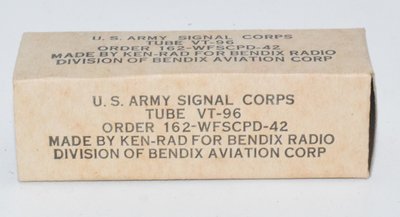
The 6N7 family was widely manufactured by major American and European companies including RCA, Sylvania, Philips, Ken-Rad, National Union, and others. It saw extensive use in military communications equipment during World War II, where it was designated VT96 by the U.S. Signal Corps. The British military equivalents carried the CV (Common Valve) designations CV1285, CV1956, CV1957, and CV1958. Its rugged construction and reliable performance in push-pull configurations made it a staple of military radio transmitters, receivers, and public address systems of the era.
The 6N7GT is notable for its internal construction: the two triode sections share a common cathode connection, which distinguishes it from many other dual triodes (such as the 6SN7) where the cathodes are independent. This shared cathode arrangement has important implications for circuit design, as it limits certain configurations but simplifies others, particularly push-pull driver and output stages.
2. Technical Specifications and Design
Heater / Filament
| Parameter | Value |
|---|---|
| Heater Voltage (Vh) | 6.3 V |
| Heater Current (Ih) | 0.8 A |
| Heater Type | Indirectly heated cathode |
Maximum Ratings (Per Section, Unless Noted)
| Parameter | Value |
|---|---|
| Maximum Plate Voltage (Va max) | 300 V * |
| Maximum Plate Dissipation (Pa max, per plate) | 2.5 W * |
| Maximum Cathode Current (total, both sections) | 25 mA * |
| Maximum Peak Plate Current (per plate) | 50 mA * |
* These maximum ratings are drawn from commonly referenced manufacturer datasheets (RCA, Sylvania). Users should verify against the specific manufacturer's datasheet for their production lot, as slight variations exist between manufacturers.
Typical Operating Characteristics (Class A1 Amplifier, Per Section)
| Parameter | Value |
|---|---|
| Plate Voltage (Va) | 250 V * |
| Grid Voltage (Vg1) | −20 V to −30 V * |
| Plate Current (Ia, per section) | ~6–8 mA * |
| Amplification Factor (μ) | ~35 * |
| Transconductance (gm) | ~2,600 µmho (2.6 mA/V) * |
| Plate Resistance (rp) | ~13,500 Ω * |
* These characteristic values are typical for Class A1 operation at 250V plate voltage. The amplification factor, transconductance, and plate resistance values are approximate and vary with operating point. Values are drawn from commonly available RCA and Sylvania data; confirm against the specific manufacturer's published curves for precision design work.
Grid Bias Range
The grid bias for the 6N7GT typically ranges from approximately −15 V to −40 V depending on the plate voltage and operating class. For Class A1 operation at 250V plate supply, a bias of around −20 V is typical. For Class AB2 or Class B push-pull operation, the bias is adjusted to near cutoff, typically around −30 V to −40 V. These values should be confirmed against the specific manufacturer's datasheet for the intended operating conditions.
Physical Construction
| Parameter | Detail |
|---|---|
| Base Type | Octal (International Octal, 8-pin) |
| Envelope Type | GT (Glass Tubular) — T-9 envelope |
| Mounting Position | Any (designed for universal mounting) |
| Overall Length | Approximately 80–90 mm (3.1–3.5 inches) * |
| Maximum Diameter | Approximately 32 mm (1.25 inches) * |
* Physical dimensions are approximate and may vary slightly between manufacturers.
Pin-Out (Octal Base, Bottom View)
| Pin | Connection |
|---|---|
| Pin 1 | No Connection (or shell/shield in some versions) |
| Pin 2 | Heater |
| Pin 3 | Plate 1 (Section 1 Anode) |
| Pin 4 | Grid 1 (Section 1 Control Grid) |
| Pin 5 | Cathode (Common to both sections) |
| Pin 6 | Grid 2 (Section 2 Control Grid) |
| Pin 7 | Heater |
| Pin 8 | Plate 2 (Section 2 Anode) |
Important Note: The two triode sections share a common cathode (Pin 5). This is a critical design consideration — unlike dual triodes such as the 6SN7GT, the cathodes cannot be biased independently. Circuit designers must account for this shared cathode when implementing differential or independently-biased configurations.
3. Applications and Usage
The 6N7GT was designed primarily for the following applications:
- Push-Pull Audio Driver: The most common application. The dual triode structure with common cathode is ideally suited for driving push-pull output stages. A single 6N7GT can serve as a phase splitter and driver for a pair of output tubes such as 6L6, 6V6, or 2A3 types.
- Class AB/B Push-Pull Output: With both sections operating in push-pull, the 6N7GT can deliver modest audio output power (approximately 3–5 watts depending on operating conditions), suitable for small public address systems, intercoms, and communications equipment.
- Phase Inverter: The matched dual triode sections make it well-suited for split-load (cathodyne) or paraphase phase inverter circuits.
- Military Communications: As VT96, the tube was extensively used in military radio equipment during WWII, serving in transmitter driver stages, modulator circuits, and audio amplifier sections of field radios and shipboard communications systems.
- Oscillator and Multivibrator Circuits: The dual triode configuration was also used in timing circuits, multivibrators, and low-frequency oscillators in test equipment and industrial controls.
- Voltage Amplifier: With a mu of approximately 35, each section provides reasonable voltage gain for general-purpose amplification duties.
4. Sound Characteristics
The 6N7GT occupies an interesting niche in the world of audio tubes. While it was never as celebrated as the 6SN7 or 12AX7 in mainstream hi-fi circles, those who have explored it in audio circuits report distinctive tonal qualities:
- Warm and Rich Midrange: The 6N7GT is frequently described as having a lush, warm midrange character that is typical of pre-war triode designs. Vocals and acoustic instruments are rendered with a natural, organic quality that many listeners find deeply engaging.
- Smooth, Non-Fatiguing Treble: The high-frequency response is generally characterized as smooth and gently rolled off compared to more modern dual triodes. This gives the tube a relaxed, non-aggressive presentation that is well-suited to long listening sessions.
- Solid but Not Overpowering Bass: The bass response is described as warm and full, though perhaps not as tightly controlled as more modern tube types. In well-designed circuits, the low end has a pleasant weight and body.
- Vintage Character: The overall sonic signature is unmistakably "vintage" — the 6N7GT imparts a character reminiscent of 1930s and 1940s radio and early hi-fi equipment. This quality is prized by enthusiasts seeking an authentic period sound.
- Dynamic Presentation: When used as a driver tube, the 6N7GT can deliver surprisingly dynamic and punchy performance, particularly in push-pull configurations where the common cathode coupling provides a natural form of signal balancing.
- Manufacturer Variations: As with many vintage tubes, there are notable sonic differences between manufacturers. RCA-produced 6N7GT tubes (including those marked with the SC278A military designation) are often considered among the finest, with a particularly refined and balanced sound. Philips/Amperex production is also highly regarded for its clarity and detail.
It should be noted that the shared cathode design introduces some inherent coupling between the two sections, which can affect the sonic character in ways that are circuit-dependent. In some topologies, this coupling contributes to a cohesive, unified sound; in others, it may introduce subtle coloration that the designer must account for.
5. Equivalent or Substitute Types
The following types are genuinely interchangeable with the 6N7GT, sharing the same pinout, electrical characteristics, and common cathode configuration:
| Type | Notes |
|---|---|
| 6N7 | Original metal-envelope version. Electrically identical; physically different (metal shell vs. glass). Direct substitute in circuits where socket clearance permits. |
| 6N7G | Larger 'G' (globe or shouldered) glass envelope version. Electrically identical to the 6N7GT. Direct plug-in replacement; may require more physical clearance due to larger envelope. |
| 6N7 (SELECTED) | A selected/tested grade of the standard 6N7, typically matched sections or tighter tolerances. Direct substitute. |
| CV1285 | British military equivalent (Common Valve designation). Electrically identical; direct substitute. |
| CV1956 | British military equivalent. Direct substitute for 6N7GT. |
| CV1957 | British military equivalent. Direct substitute for 6N7GT. |
| CV1958 | British military equivalent. Direct substitute for 6N7GT. |
| VT96 | U.S. military designation (Signal Corps). Electrically identical to the 6N7/6N7GT. Often found as ruggedized military production with tighter quality control. |
Important Substitution Warnings
The 6N7GT is NOT a substitute for the 6SN7GT despite both being octal-based dual triodes. The 6N7GT has a common cathode for both sections, different pinout assignments, and different electrical characteristics. Substituting one for the other will result in incorrect operation or potential damage.
Similarly, the 6N7GT should not be confused with the 6SC7 or other dual triodes that may appear superficially similar but have different internal structures and pinouts.
6. Notable Characteristics
- Common Cathode Design: The most distinctive feature of the 6N7GT is its shared cathode between both triode sections. This is both a limitation and an advantage — it simplifies push-pull driver circuits but prevents independent cathode biasing of the two sections. Designers must work within this constraint, which makes the tube less versatile than independent-cathode dual triodes but uniquely suited to certain topologies.
- Rugged Military Heritage: Tubes produced under the VT96 and CV designations were manufactured to stringent military specifications, resulting in exceptionally robust and long-lived examples. NOS military-grade 6N7GT tubes are prized for their reliability and consistency.
- Pre-War Design Philosophy: The 6N7GT represents a design philosophy from the late 1930s when tube engineers were exploring ways to integrate multiple functions into single envelopes. Its architecture reflects the priorities of that era: simplicity, reliability, and suitability for the push-pull circuits that dominated audio amplifier design.
- Moderate Power Handling: With a plate dissipation of approximately 2.5W per section (5W total), the 6N7GT sits in a useful middle ground — capable of more output than small-signal dual triodes but not a true power tube. This makes it an excellent driver for medium-power output stages.
- Heater Current: At 0.8A heater current (6.3V), the 6N7GT draws somewhat more heater power than many comparable dual triodes. Power supply design should account for this, particularly in equipment using multiple tubes.
- Envelope Variations: The 6N7 family spans three envelope styles — metal (6N7), large glass (6N7G), and glass tubular (6N7GT). All are electrically identical, but the physical differences can affect microphonics and heat dissipation. The GT envelope generally offers a good compromise between the shielding of the metal version and the lower microphonics sometimes attributed to the larger glass types.
- Historical Significance: The 6N7 was one of the first dual triodes designed specifically for push-pull audio service, predating the more famous 6SN7 by several years. It represents an important step in the evolution of audio tube design.
7. Usage in the Audio Community
While the 6N7GT has never achieved the mainstream popularity of the 6SN7GT or 12AX7 in the modern audio community, it has developed a dedicated following among DIY audio enthusiasts, vintage audio restorers, and adventurous audiophiles:
DIY Amplifier Projects
The 6N7GT has found a home in the DIY tube audio community, where builders appreciate its unique characteristics and relative affordability compared to more sought-after vintage dual triodes. It is commonly used in:
- Single-ended triode (SET) amplifiers: With both sections paralleled, the 6N7GT can serve as a driver for SET amplifiers using 2A3, 300B, or 45 output tubes. The common cathode simplifies paralleling.
- Push-pull driver stages: The tube's original intended application remains one of its strongest uses. A single 6N7GT can drive a pair of output tubes in push-pull, providing phase splitting and voltage gain in one envelope.
- Headphone amplifiers: The moderate power capability of the 6N7GT makes it suitable for direct-drive headphone amplifier designs, where it can deliver sufficient power for most headphone loads without requiring an output stage.
- Preamplifier stages: Some builders use the 6N7GT as a line-level preamplifier, taking advantage of its warm tonal character and moderate gain.
Vintage Equipment Restoration
The 6N7GT is essential for the restoration of vintage radio equipment from the late 1930s and 1940s. Restorers of military communications equipment (particularly WWII-era Signal Corps radios) require these tubes to maintain authenticity and proper operation. The availability of NOS military-grade VT96 and CV-designated tubes makes this feasible, though supplies are gradually diminishing.
Availability and Pricing
NOS (New Old Stock) 6N7GT tubes remain available from vintage tube dealers, though stocks are finite and declining. Military-grade examples (VT96, CV1285) are particularly sought after for their quality and consistency. Pricing remains moderate compared to more famous audio tubes, making the 6N7GT an attractive option for experimenters and builders on a budget. RCA-produced examples, including those with the SC278A military marking, and Philips USA production are among the most desirable from a collector and audiophile perspective.
Community Perception
Within the audio community, the 6N7GT is regarded as a "hidden gem" — a tube that offers genuine sonic merit and historical interest at a fraction of the cost of more hyped types. Its common cathode design is seen as both a challenge and an opportunity: it requires thoughtful circuit design but rewards the effort with a distinctive and engaging sound character. Enthusiasts who have explored the 6N7GT often become strong advocates, appreciating its unique place in the lineage of audio tubes and its ability to deliver a genuinely vintage sonic experience.
The tube's association with the golden age of radio and early high-fidelity audio gives it a romantic appeal that resonates with collectors and historians of audio technology. For those willing to design around its common cathode architecture, the 6N7GT offers a rewarding and distinctive alternative to the more commonly used dual triodes in modern tube audio.