Introduction and History
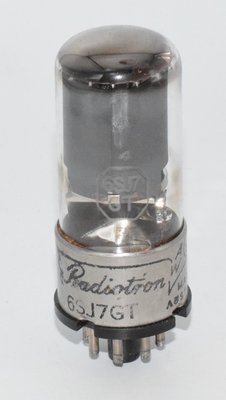
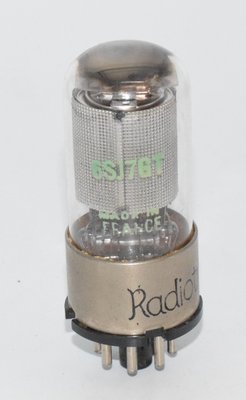
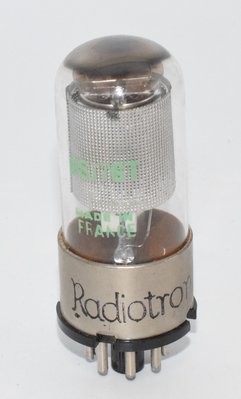
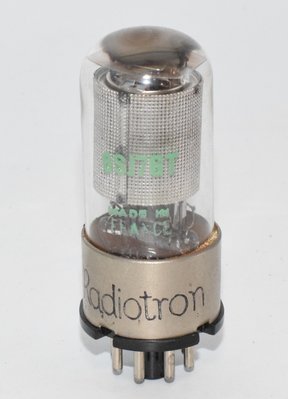
The 6SJ7GT is a sharp-cutoff pentode vacuum tube introduced by RCA in the late 1930s as part of the American octal tube family. Classified as a high-gain voltage amplifier pentode, the 6SJ7GT was designed primarily for use in radio receiver IF and RF amplifier stages, audio preamplifier circuits, and general-purpose voltage amplification applications. The "GT" suffix denotes the glass tubular (T-9 bulb) envelope variant, distinguishing it from the original 6SJ7 metal-shell version.
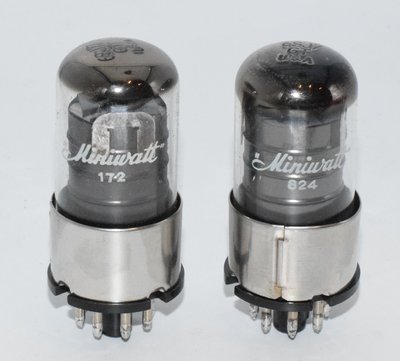
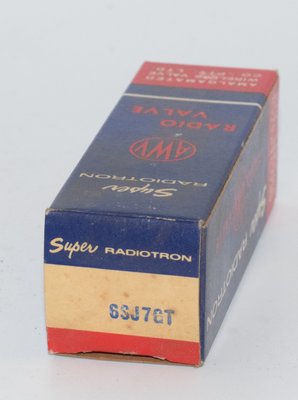
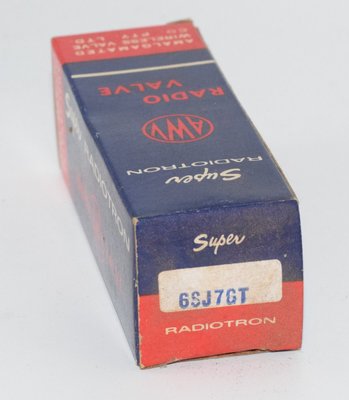
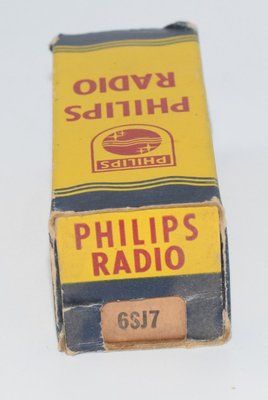
The 6SJ7 family was developed during a period of rapid standardization in the American tube industry. RCA's Tube Department in Harrison, New Jersey published the definitive datasheet for both the 6SJ7 and 6SJ7GT on June 15, 1948, consolidating earlier specifications. The tube was manufactured by numerous companies worldwide, including RCA, Sylvania, GE, Ken-Rad, Tung-Sol, AWV (Amalgamated Wireless Valve Company) in Australia under the "Super Radiotron" brand, Miniwatt, and Radiotron France. Its sharp-cutoff characteristic — meaning the tube cuts off plate current abruptly as the grid voltage becomes more negative — made it ideal for applications requiring linear amplification without the variable-mu behavior needed for AGC circuits.
The 6SJ7GT saw extensive service in both civilian and military electronics during World War II, receiving the military designation VT-116A. Its reliability, high gain, and versatile operating characteristics ensured its continued production well into the 1960s, and it remains a sought-after tube among audiophiles and vintage radio restorers today.
Technical Specifications and Design
Heater Data
| Parameter | Value |
|---|---|
| Heater Voltage | 6.3 V (AC or DC) |
| Heater Current | 0.3 A |
| Cathode Type | Unipotential (indirectly heated) |
Maximum Ratings — Pentode Connection (Class A₁ Amplifier)
| Parameter | Value |
|---|---|
| Maximum Plate Voltage | 300 V |
| Maximum Grid No.2 (Screen) Voltage | 125 V |
| Maximum Grid No.2 Supply Voltage | 300 V |
| Maximum Plate Dissipation | 2.5 W |
| Maximum Grid No.2 Dissipation | 0.7 W |
| Grid No.1 (Control Grid) Voltage — Positive Bias | 0 V max. |
| Peak Heater-Cathode Voltage (heater negative) | 90 V max. |
| Peak Heater-Cathode Voltage (heater positive) | 90 V max. |
Maximum Ratings — Triode Connection (Grids No.2 and No.3 Connected to Plate)
| Parameter | Value |
|---|---|
| Maximum Plate Voltage | 250 V |
| Maximum Plate Dissipation (Total) | 2.5 W |
| Grid No.1 Voltage — Positive Bias | 0 V max. |
| Peak Heater-Cathode Voltage | 90 V max. |
Typical Operating Conditions — Pentode Connection
| Parameter | Condition 1 | Condition 2 |
|---|---|---|
| Plate Voltage | 100 V | 250 V |
| Grid No.3 (Suppressor) | Connected to cathode at socket | |
| Grid No.2 Voltage | 100 V | 100 V |
| Grid No.1 Voltage | −3 V | −3 V |
| Plate Resistance (Approx.) | 0.7 MΩ (700,000 Ω) | >1 MΩ (1,000,000 Ω) |
| Transconductance (gm) | 1,575 µmhos | 1,650 µmhos |
| Grid No.1 Bias for Ib = 10 µA | −8 V | −8 V |
| Plate Current | 2.9 mA | 3.0 mA |
| Grid No.2 Current | 0.9 mA | 0.8 mA |
Typical Operating Conditions — Triode Connection
| Parameter | Condition 1 | Condition 2 |
|---|---|---|
| Plate Voltage | 180 V | 250 V |
| Grid No.1 Voltage | −6 V | −8.5 V |
| Amplification Factor (µ) | 19 | 19 |
| Plate Resistance (Approx.) | 8,250 Ω | 7,600 Ω |
| Transconductance (gm) | 2,300 µmhos | 2,500 µmhos |
| Plate Current | 6.0 mA | 9.2 mA |
Maximum Circuit Values
| Parameter | Value |
|---|---|
| Grid No.1 Circuit Resistance | 1 MΩ max. |
Direct Interelectrode Capacitances (6SJ7GT, with external shield connected to cathode)
| Parameter | Pentode Connection | Triode Connection* |
|---|---|---|
| Grid No.1 to Plate (Cga) | 0.005 µµf max. | 2.8 µµf |
| Input (Cgk) | 7 µµf | 3.4 µµf |
| Output (Cak) | 7 µµf | 11 µµf |
* Triode connection: Grid No.2 and Grid No.3 connected to plate.
Note: The TDSL reference data lists capacitances as Cgk = 2.15 pF, Cak = 0.9 pF, and Cga = 3.5 pF. These values may reflect different measurement conditions or a different reference standard. The RCA datasheet values listed above are measured with the external shield connected to cathode for the 6SJ7GT.
Physical and Mechanical Data
| Parameter | 6SJ7 (Metal) | 6SJ7GT (Glass) |
|---|---|---|
| Bulb Type | Metal Shell, MT8G | T-9 |
| Base | Small-Wafer Octal 8-Pin | Small-Wafer Octal 8-Pin, Sleeve |
| Basing Designation | 8N | GT-8N |
| Maximum Overall Length | 2-5/8" | 3-5/16" |
| Maximum Seated Length | 2-1/16" | 2-3/4" |
| Maximum Diameter | 1-5/16" | 1-5/16" |
| Mounting Position | Any | Any |
Pin Configuration (Octal Base — Bottom View)
| Pin | Connection |
|---|---|
| Pin 1 | 6SJ7: Shell / 6SJ7GT: Base Sleeve |
| Pin 2 | Heater |
| Pin 3 | Grid No.3 (Suppressor) |
| Pin 4 | Grid No.1 (Control Grid) |
| Pin 5 | Cathode |
| Pin 6 | Grid No.2 (Screen) |
| Pin 7 | Heater |
| Pin 8 | Plate (Anode) |
Applications and Usage
The 6SJ7GT was designed as a versatile sharp-cutoff pentode suitable for a wide range of applications:
- Audio Preamplification: The tube's high gain and relatively low noise characteristics made it a popular choice for the first voltage amplifier stage in audio equipment, including radio receivers, phonograph preamplifiers, and public address systems. With a transconductance of 1,650 µmhos in pentode mode and plate resistance exceeding 1 megohm at 250V plate / 100V screen, the tube can deliver very high voltage gain when used with appropriate plate load resistors.
- IF and RF Amplification: The sharp-cutoff characteristic made the 6SJ7GT well-suited for intermediate frequency amplifier stages in superheterodyne receivers where AGC was not required or was applied differently. The extremely low grid-to-plate capacitance (0.005 µµf max in pentode mode) minimized unwanted feedback at high frequencies.
- Triode-Connected Amplification: When connected as a triode (screen and suppressor tied to plate), the 6SJ7GT offers an amplification factor of 19, plate resistance of approximately 7,600 Ω (at 250V), and transconductance of 2,500 µmhos — characteristics that make it useful as a driver stage or low-level audio amplifier with lower distortion than pentode operation.
- Oscillator Circuits: The tube was used in various oscillator configurations in test equipment and signal generators.
- Military Electronics: Under the designation VT-116A, the 6SJ7GT served in numerous military radio and electronic warfare systems during World War II.
- Guitar Amplifiers: The 6SJ7GT found use in early guitar amplifier designs as a preamp tube, contributing to the characteristic tone of certain vintage amplifiers.
Sound Characteristics
The 6SJ7GT has earned a distinctive reputation among audiophiles and guitar amplifier enthusiasts for its particular sonic qualities. As with all vacuum tubes, the sound character varies depending on whether the tube is operated in pentode or triode mode, and the specific circuit topology employed.
Pentode Mode
In pentode configuration, the 6SJ7GT delivers very high voltage gain with a sound that is often described as:
- Detailed and articulate: The high plate resistance and gain reveal micro-details in the audio signal, giving recordings a sense of clarity and resolution.
- Slightly forward in the midrange: Like many sharp-cutoff pentodes of its era, the 6SJ7GT can impart a subtle midrange emphasis that adds presence and immediacy to vocals and instruments.
- Extended but somewhat bright treble: The pentode connection can produce a top end that some listeners find lively and airy, while others may perceive it as slightly edgy compared to triode-connected alternatives. This brightness can be tamed with careful circuit design and appropriate plate load selection.
- Harmonically complex: Pentode operation generates a richer harmonic spectrum, including both even and odd harmonics, which contributes to a more "textured" sound compared to pure triode stages.
Triode Mode
When triode-connected, the 6SJ7GT takes on a markedly different character:
- Warm and smooth: The lower plate resistance (7,600–8,250 Ω) and reduced gain produce a warmer, more rounded tonal quality with predominantly even-order harmonic distortion.
- Natural midrange: The amplification factor of 19 provides moderate gain with excellent linearity, resulting in a natural, unforced presentation of midrange frequencies.
- Reduced noise: Triode connection generally results in lower noise levels compared to pentode operation, making it attractive for high-sensitivity phono stages and microphone preamplifiers.
- Slightly less dynamic: The trade-off for the smoother sound is somewhat reduced dynamic contrast compared to pentode mode.
Manufacturer Variations
Audiophiles note significant sonic differences between 6SJ7GT tubes from different manufacturers. RCA examples are generally regarded as having a balanced, neutral presentation. Ken-Rad versions are often praised for a richer, more full-bodied midrange. Sylvania tubes tend to be described as having a cleaner, more detailed top end. Australian AWV Super Radiotron examples are less commonly encountered but are valued by collectors for their robust construction and reportedly smooth, refined sound.
Equivalent and Substitute Types
The following tubes are close or identical substitutes for the 6SJ7GT:
| Type | Relationship | Notes |
|---|---|---|
| 6SJ7 | Identical electrically | Metal envelope version. Same pinout, same electrical characteristics. Direct drop-in substitute; only the physical envelope differs. |
| CV591 | Identical (British military) | British military designation equivalent to the 6SJ7/6SJ7GT. |
| CV592 | Identical (British military) | Another British military designation for the same tube type. |
| VT-116A | Identical (US military) | US military designation for the 6SJ7GT. |
| EF36 | Similar characteristics | European equivalent with similar sharp-cutoff pentode characteristics, but uses a different pinout. Not a direct plug-in replacement without socket adapter or rewiring. |
| 6SJ7-WGT | Ruggedized version | Military-grade version with enhanced vibration resistance. Electrically identical, direct substitute. |
Important Note: The 6SJ7GT should not be confused with the 6SK7GT, which is a remote-cutoff (variable-mu) pentode with different operating characteristics, even though it shares the same pinout. While the 6SK7GT will physically fit the same socket, its variable-mu characteristic makes it unsuitable as a substitute in circuits designed for the sharp-cutoff behavior of the 6SJ7GT.
Notable Characteristics
- Sharp-Cutoff Behavior: The 6SJ7GT's defining characteristic is its sharp cutoff — plate current drops to 10 µA at approximately −8V grid bias (with 250V plate, 100V screen). This makes the tube ideal for applications requiring a well-defined cutoff point and linear amplification over its operating range, as opposed to variable-mu types used in AGC-controlled stages.
- Extremely Low Grid-to-Plate Capacitance: At 0.005 µµf maximum in pentode connection (with shield grounded), the 6SJ7GT offers outstanding isolation between input and output circuits, minimizing Miller effect and enabling stable high-frequency operation.
- Dual-Mode Versatility: The ability to operate effectively in both pentode and triode modes gives circuit designers significant flexibility. In pentode mode, the tube delivers high gain with very high plate resistance (exceeding 1 MΩ). In triode mode, it offers moderate gain (µ = 19) with much lower plate resistance (7,600 Ω), enabling different impedance matching and tonal characteristics.
- High Grid Circuit Resistance Tolerance: The maximum grid circuit resistance of 1 MΩ allows the use of high-impedance input circuits, making the tube compatible with crystal pickups, high-impedance microphones, and other high-impedance sources common in vintage audio equipment.
- Flexible Mounting: The tube can be mounted in any position, providing mechanical design flexibility.
- Robust Construction: The GT glass envelope, while larger than the metal version (3-5/16" maximum overall length vs. 2-5/8"), provides good visibility of the internal structure and is generally considered more resistant to certain types of mechanical stress than the metal envelope.
- Low Power Consumption: With a heater drawing only 0.3A at 6.3V (1.89W heater power) and total plate plus screen dissipation limited to 3.2W, the 6SJ7GT is an economical tube suitable for battery-operated or portable equipment.
Usage in the Audio Community
The 6SJ7GT occupies a unique and valued position in the modern audio community, serving roles in both vintage restoration and new-build audio projects.
Vintage Audio Restoration
The 6SJ7GT was used in the preamplifier and voltage amplifier stages of many classic radio receivers, console phonographs, and early high-fidelity equipment from the 1940s and 1950s. Restorers of equipment from manufacturers such as RCA, Zenith, Philco, and others frequently seek quality NOS (New Old Stock) 6SJ7GT tubes to maintain original circuit performance. The tube's availability from multiple manufacturers — including RCA, Sylvania, GE, Ken-Rad, Tung-Sol, AWV Super Radiotron (Australia), Miniwatt, and Radiotron (France) — means that restorers have a reasonable selection of NOS options, though premium examples command increasingly high prices.
Guitar Amplifiers
The 6SJ7GT was used in several early guitar amplifier designs, most notably certain pre-war and wartime-era amplifiers. Its sharp-cutoff characteristic produces a distinctive clipping behavior when overdriven — transitioning from clean to distorted more abruptly than remote-cutoff types. This creates a tight, focused overdrive character that some guitarists find particularly appealing for blues and early rock tones. Some boutique amplifier builders have incorporated the 6SJ7GT into new designs specifically to capture this vintage tonal quality.
DIY and Custom Audio Projects
The 6SJ7GT is a popular choice among DIY audio enthusiasts for several reasons:
- Phono Preamplifiers: The tube's high gain in pentode mode makes it suitable for RIAA phono preamplifier stages, where it can provide sufficient gain for moving-magnet cartridges with relatively simple circuit topologies. Triode-connected operation is often preferred in these applications for its lower noise floor.
- Microphone Preamplifiers: The 6SJ7GT has been used in both vintage and modern microphone preamplifier designs. Its high gain and relatively low microphonics (particularly in well-made NOS examples) make it suitable for this demanding application.
- Line-Level Preamplifiers: In triode mode, the 6SJ7GT makes an excellent line-stage amplifier with moderate gain and good linearity, suitable for driving power amplifier stages.
- Headphone Amplifiers: Some DIY builders have successfully employed the 6SJ7GT in triode mode as a voltage gain stage in hybrid or all-tube headphone amplifier designs.
Tube Rolling and Collecting
The 6SJ7GT has developed a following among tube collectors and "tube rollers" — audiophiles who swap different tube brands and vintages to fine-tune the sound of their equipment. Key variants sought by collectors include:
- RCA Red Label: Considered the benchmark reference, known for balanced, neutral sound.
- Ken-Rad (early production): Valued for rich, warm midrange character and robust construction.
- Sylvania Green Label: Appreciated for clarity and extended high-frequency response.
- AWV Super Radiotron (Australia): Relatively rare outside Australia, prized for excellent build quality and smooth sonic character.
- Radiotron France: European-made examples with their own distinctive sonic signature, sought by collectors for their rarity and quality.
- Miniwatt USA: Another variant encountered in the NOS market, with matched pairs being particularly valued for stereo applications.
Practical Considerations for Audio Use
When using the 6SJ7GT in audio applications, several practical considerations should be kept in mind:
- Microphonics: As with all high-gain small-signal tubes, the 6SJ7GT can be susceptible to microphonic behavior — mechanical vibrations causing audible noise. Using vibration-dampening tube sockets and careful chassis mounting can mitigate this issue. The metal-envelope 6SJ7 is generally less microphonic than the GT glass version due to its more rigid construction.
- Shielding: The 6SJ7GT requires an external shield can for optimal performance, particularly in high-gain applications. The shield should be connected to the cathode circuit (via pin 1, the base sleeve) for proper electrostatic shielding, as specified in the datasheet.
- Suppressor Grid Connection: Grid No.3 (suppressor, pin 3) must be connected to the cathode at the socket for pentode operation. For triode connection, both Grid No.2 (pin 6) and Grid No.3 (pin 3) should be connected to the plate (pin 8).
- Bias Stability: The sharp-cutoff characteristic means that small changes in bias voltage produce significant changes in plate current. Careful bias design with appropriate cathode resistor bypassing is essential for stable, low-noise operation.