1. Introduction and History
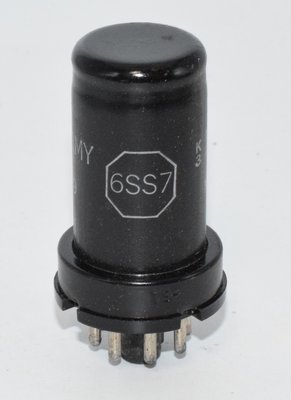
The 6SS7 is a triple-grid super-control (remote-cutoff) amplifier pentode manufactured in a single-ended metal envelope. Introduced by RCA's Radiotron Division, the tube first appeared in tentative data sheets dated May 1, 1941, placing its development squarely in the pre-war era of American electronics. The tube was assigned the military designation VT-199 and saw wartime production by manufacturers including RCA, Ken-Rad, and Bendix Radio, reflecting its importance in military communications equipment during World War II.
The 6SS7 was designed as a high-gain RF and IF amplifier stage with variable-mu (super-control) characteristics, allowing automatic gain control (AGC) to be applied smoothly without the crossover distortion that sharp-cutoff pentodes would exhibit. Its metal shell construction provided inherent electrostatic shielding, reducing the need for external screening in sensitive receiver front-end stages. The tube uses a coated unipotential cathode and operates from a standard 6.3-volt heater supply, making it compatible with the vast majority of American radio equipment of the era.
While the 6SS7 never achieved the ubiquity of types like the 6SK7 or 6BA6, it carved out a niche in specialized military and communications applications where its particular combination of low interelectrode capacitances and super-control characteristics were advantageous.
2. Technical Specifications and Design
Heater Ratings
| Heater Voltage | 6.3 volts (AC or DC) |
| Heater Current | 0.15 amperes |
| Cathode Type | Coated Unipotential Cathode |
Maximum Ratings (Amplifier Service)
| Plate Voltage | 300 volts max. |
| Screen Voltage | 100 volts max. |
| Screen Supply Voltage | 300 volts max. |
| Grid Voltage (Control Grid) | 0 volts min. (must not go positive) |
| Plate Dissipation | 2.25 watts max. |
| Screen Dissipation | 0.35 watts max. |
Typical Operating Conditions – Class A1 Amplifier
| Parameter | Condition 1 | Condition 2 |
|---|---|---|
| Plate Voltage | 100 volts | 250 volts |
| Screen Voltage | 100 volts | 100 volts |
| Grid Voltage | −1 volt | −3 volts |
| Suppressor | Connected to cathode at socket | |
| Plate Resistance (rp) | 0.12 megohm | 1.0 megohm (approx.) |
| Transconductance (gm) | 1930 µmhos | 1850 µmhos |
| Grid Bias for Transconductance of 10 µmhos (approx.) | −35 volts | −35 volts |
| Plate Current | 12.2 mA | 9 mA |
| Screen Current | 3.1 mA | 2 mA |
Note: The amplification factor (µ) is not explicitly stated in the RCA datasheet. Based on the relationship µ = gm × rp, at the 250V plate condition: µ ≈ 1850 µmhos × 1.0 MΩ = 1850. At the 100V condition: µ ≈ 1930 × 0.12 MΩ = approximately 232. These derived values should be confirmed against additional manufacturer data, as the plate resistance at the 250V operating point is listed as approximate.
Direct Interelectrode Capacitances
| Grid to Plate | 0.004 µµf max. |
| Input | 5.5 µµf |
| Output | 7.0 µµf |
The extremely low grid-to-plate capacitance of 0.004 µµf (picofarads) maximum is a standout specification, indicating excellent internal shielding between the control grid and plate structures. This makes the 6SS7 highly resistant to unwanted feedback at radio frequencies.
Physical Specifications
| Bulb | Metal Shell, MT-8 |
| Base | Small Wafer Octal, 8-Pin |
| Maximum Overall Length | 2-5/8 inches |
| Maximum Seated Height | 2-1/16 inches |
| Maximum Diameter | 1-5/16 inches |
| Mounting Position | Any |
Pin Configuration (Bottom View, 8N Octal)
| Pin 1 | Shell (connected to cathode) |
| Pin 2 | Heater |
| Pin 3 | Suppressor Grid (G3) |
| Pin 4 | Control Grid (G1) |
| Pin 5 | Cathode |
| Pin 6 | Screen Grid (G2) |
| Pin 7 | Heater |
| Pin 8 | Plate |
Important Notes from the datasheet:
- The shell (Pin 1) is connected to the cathode.
- In circuits where the cathode is not directly connected to the heater, the potential difference between heater and cathode should be kept as low as possible.
3. Applications and Usage
The 6SS7 was designed primarily for use as an RF (radio frequency) and IF (intermediate frequency) amplifier in superheterodyne radio receivers and communications equipment. Its super-control (variable-mu, remote-cutoff) grid characteristic made it ideally suited for stages requiring smooth automatic gain control (AGC/AVC).
Primary Applications
- RF Amplifier Stages: The tube's extremely low grid-to-plate capacitance (0.004 µµf max.) made it excellent for RF amplification, minimizing the risk of oscillation and unwanted feedback even at higher frequencies.
- IF Amplifier Stages: The high transconductance of up to 1930 µmhos provided substantial gain in IF strips, while the remote-cutoff characteristic allowed wide-range AGC without distortion.
- Military Communications Equipment: Under its VT-199 designation, the 6SS7 was used in various military radio receivers and communications systems during World War II. Production by Bendix Radio, RCA, and Ken-Rad during 1941–1945 confirms its military significance.
- Mixer/Converter Stages: While not its primary application, the pentode structure could be employed in certain frequency conversion circuits.
Design Considerations
The suppressor grid (Pin 3) is intended to be connected to the cathode at the socket, which is the standard configuration for pentode operation. The screen grid requires careful decoupling and should not exceed 100 volts, with a maximum dissipation of only 0.35 watts. The screen supply voltage can be as high as 300 volts when a suitable dropping resistor is used, but the actual screen voltage at the tube must remain within the 100-volt limit.
The relatively modest heater current of 0.15 amperes (less than 1 watt of heater power) made the 6SS7 economical in terms of power supply demands, an important consideration in battery-operated military field equipment and in multi-tube receivers where total heater current was a design constraint.
4. Sound Characteristics
The 6SS7 is not commonly encountered in audio amplifier circuits, as it was designed primarily for RF/IF service. However, when employed in audio applications or evaluated in the signal chain of vintage radio receivers, certain sonic qualities can be attributed to it:
- Clean and Linear at Low Signal Levels: The super-control grid structure, while designed for AGC purposes, produces a very linear transfer characteristic at low bias voltages (near −1 to −3 volts). This translates to low distortion and a clean, transparent sound when the tube is operated within its intended Class A1 region.
- Smooth Compression Under AGC: As the grid bias is driven more negative (simulating strong-signal AGC action), the gain reduction is gradual and progressive rather than abrupt. This produces a natural, smooth compression effect that some audio experimenters find musically pleasing, somewhat analogous to the behavior of variable-mu compressor tubes like the 6386.
- High Gain with Moderate Noise: The transconductance of 1850–1930 µmhos provides substantial voltage gain. The metal envelope contributes to low hum pickup, though the tube's noise figure is typical of remote-cutoff pentodes — adequate for radio service but not optimized for the lowest-noise audio preamplifier applications.
- Neutral Tonal Character: Unlike some audio-specific tubes that are prized for euphonic coloration, the 6SS7 tends toward a neutral, uncolored presentation. It does not add significant warmth or harmonic richness on its own, making it more of a "wire with gain" in character — a quality that can be desirable in certain high-fidelity design philosophies.
- Soft Clipping Behavior: When overdriven, the remote-cutoff characteristic produces a very gradual onset of clipping, with predominantly odd-order harmonics increasing smoothly. This is in contrast to sharp-cutoff pentodes, which transition more abruptly into distortion.
5. Equivalent or Substitute Types
| Type | Relationship | Notes |
|---|---|---|
| CV1993 | Direct equivalent | British military (CV) designation for the 6SS7. Electrically and physically identical; direct plug-in replacement. |
| VT-199 | Direct equivalent | U.S. military (Signal Corps) designation for the 6SS7. Identical tube with military markings and typically tighter quality control/selection. |
Important: The 6SS7 should not be confused with the more common 6SK7 or 6SG7, which are also remote-cutoff RF pentodes in metal envelopes with octal bases. While these tubes serve similar functions, they have different electrical characteristics (different transconductance, plate resistance, and current ratings) and are not direct substitutes. The pinout of the 6SS7 follows the standard octal RF pentode convention, but operating parameters differ sufficiently that substitution with other types should only be attempted after careful comparison of all specifications and circuit requirements.
Note: Some sources may suggest other possible substitutes, but only CV1993 and VT-199 are verified as genuinely identical/interchangeable types. Any other substitution should be confirmed against manufacturer cross-reference data.
6. Notable Characteristics
- Exceptionally Low Grid-to-Plate Capacitance: At 0.004 µµf maximum, the 6SS7 offers outstanding isolation between input and output circuits. This is among the lowest figures for octal-based RF pentodes and speaks to the quality of the internal shielding provided by the metal envelope and internal shield structures.
- Wide AGC Range: The grid bias required to reduce transconductance to 10 µmhos is approximately −35 volts (from a nominal operating bias of −1 to −3 volts). This provides a gain control range of roughly 45–50 dB, which is excellent for receiver AGC systems.
- Metal Envelope Construction: The MT-8 metal shell provides inherent electrostatic shielding without requiring an external shield can. The shell is internally connected to the cathode (Pin 1), ensuring proper grounding of the shield. This construction also provides superior mechanical ruggedness compared to glass envelope equivalents.
- Low Heater Power: At only 0.945 watts (6.3V × 0.15A), the 6SS7 is economical in heater power consumption, making it suitable for equipment where total power budget is constrained.
- Versatile Mounting: The tube can be mounted in any position, providing maximum flexibility in equipment layout design.
- Wartime Production Quality: Tubes produced under the VT-199 military designation by manufacturers such as Bendix Radio and RCA during WWII were subject to stringent military quality control standards, and NOS (New Old Stock) examples of these military-grade tubes are particularly prized by collectors for their reliability and consistency.
- Heater-Cathode Voltage Precaution: The datasheet specifically warns that in circuits where the cathode is not directly connected to the heater, the potential difference between heater and cathode should be kept as low as possible. This suggests sensitivity to heater-cathode leakage or breakdown, a consideration that must be observed in circuit design.
7. Usage in the Audio Community
The 6SS7 occupies a niche position in the audio community. It was never designed as an audio tube, and it does not appear in the classic audio amplifier designs of the golden age. However, it has found some specialized applications and interest among audio enthusiasts:
Vintage Radio Restoration
The primary intersection of the 6SS7 with the audio world is through vintage radio restoration. Collectors and restorers of WWII-era military communications receivers seek NOS 6SS7/VT-199 tubes to maintain the original complement of their equipment. In these receivers, the 6SS7 serves in the RF and IF stages that directly affect the overall audio quality of the received signal. A well-matched set of 6SS7 tubes in the IF strip of a military receiver can noticeably improve sensitivity, selectivity, and ultimately the clarity of the audio output.
Experimental Audio Circuits
A small community of DIY audio experimenters has explored using remote-cutoff pentodes like the 6SS7 in unconventional audio applications:
- Variable-Gain Preamplifiers: The super-control characteristic can be exploited to create a voltage-controlled amplifier (VCA) for audio, where a DC control voltage on the grid adjusts gain smoothly. This principle is used in some vintage-style compressor and limiter designs.
- Tremolo and Effects Circuits: Guitar amplifier builders and effects designers have experimented with remote-cutoff pentodes to create smooth tremolo effects, where a low-frequency oscillator modulates the bias of the 6SS7 to produce amplitude modulation of the audio signal.
- Microphone Preamplifiers: The high transconductance and low capacitances make the 6SS7 a candidate for experimental microphone preamp designs, though purpose-built audio tubes like the 6SJ7 (sharp-cutoff version) are generally preferred for this application.
Collectibility
NOS 6SS7 tubes, particularly those with military VT-199 markings or from desirable manufacturers like RCA, Ken-Rad, and Bendix Radio, are collected by tube enthusiasts. The Bendix Radio production from 1942 is especially sought after due to Bendix's reputation for high-quality military tube manufacturing. While not commanding the premium prices of famous audio tubes like the 12AX7 or 6L6, quality NOS 6SS7 specimens are becoming increasingly scarce and are valued by collectors of wartime electronics.
Limitations in Audio Use
It should be noted that the 6SS7 has significant limitations for audio applications:
- The maximum plate dissipation of only 2.25 watts limits its use to small-signal voltage amplification stages.
- The remote-cutoff characteristic, while useful for AGC, means the tube does not have the sharpest possible cutoff — this can result in slightly higher residual current and associated noise compared to sharp-cutoff types at very high bias levels.
- The relatively low screen voltage limit of 100 volts constrains the available operating conditions and may limit achievable voltage swing in some audio circuit topologies.
- Limited availability of NOS stock and the absence of current production make it impractical for new commercial audio designs.
Despite these limitations, the 6SS7 remains an interesting and historically significant tube type that continues to serve in vintage equipment restoration and occasionally inspires creative audio experimentation among dedicated tube enthusiasts.