1. Introduction and History
The 6V4, known in Europe by its Mullard-Philips designation EZ80, is a miniature full-wave vacuum rectifier tube designed for use in medium-power supply circuits. Developed in the early 1950s as part of the Philips/Mullard noval (B9A) tube family, the 6V4 was created to replace older octal-based rectifiers such as the 6X5GT in compact, modern equipment designs. Its introduction coincided with the broader industry transition from octal to noval (9-pin miniature) tube bases, which allowed for smaller chassis layouts and improved high-frequency performance in associated circuitry.
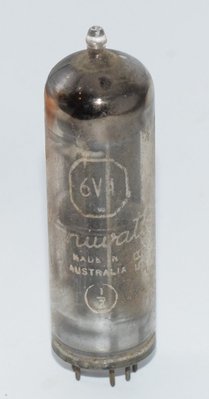
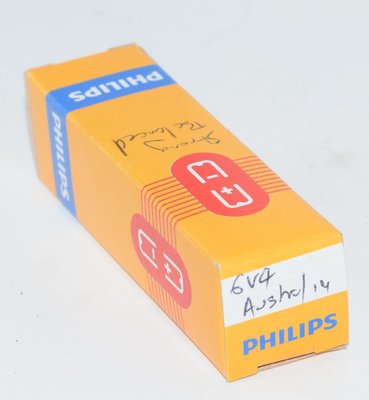
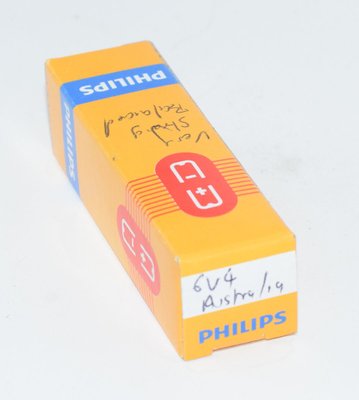
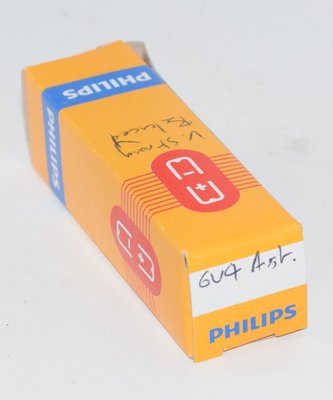
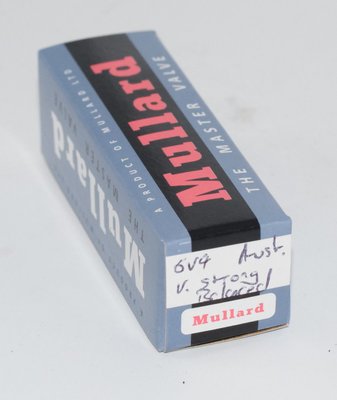
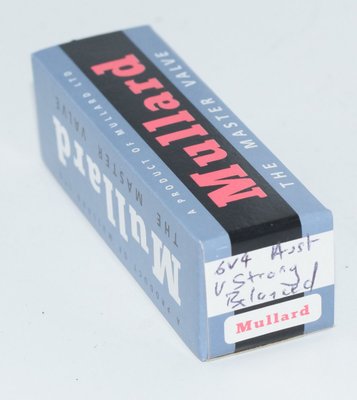
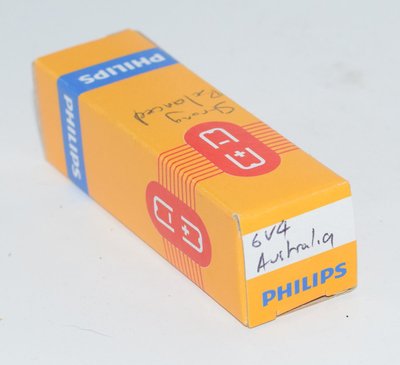
The 6V4/EZ80 was manufactured extensively by Mullard (UK and Australia), Philips Miniwatt (Netherlands and Australia), Valvo (Germany), Amperex (Netherlands/USA), Trigon, and numerous other European and Australian manufacturers. It became a staple rectifier in European hi-fi amplifiers, radio receivers, and small instrument power supplies throughout the 1950s and 1960s. Philips Miniwatt Australia and Mullard Australia were particularly prolific producers, and their examples remain sought after by collectors and audio enthusiasts today.
The tube's moderate current capability and gentle turn-on characteristics made it an ideal companion for amplifiers using tubes like the EL84/6BQ5 and ECC83/12AX7, and it found widespread use in classic amplifier designs from manufacturers such as Leak, Rogers, Quad, and many others.
2. Technical Specifications and Design
Heater / Filament
| Parameter | Value |
|---|---|
| Heater Voltage (Vh) | 6.3 V (verified) |
| Heater Current (Ih) | 0.6 A (verified) |
| Heater Type | Indirectly heated cathode |
Maximum Ratings
| Parameter | Value |
|---|---|
| Maximum RMS Plate Voltage (per plate) | 350 V * |
| Maximum Peak Inverse Voltage (PIV) | 1000 V * |
| Maximum DC Output Current | 90 mA * |
| Maximum Peak Plate Current (per plate) | 350 mA * |
| Maximum Reservoir Capacitor (capacitor-input filter) | 50 µF * |
* These values are consistent with widely published EZ80/6V4 datasheet information from Mullard and Philips sources. Users should confirm against their specific manufacturer's datasheet for the exact production variant in use.
Typical Operating Conditions (Capacitor-Input Filter)
| Parameter | Value |
|---|---|
| RMS Plate Voltage (per plate) | 250 V * |
| DC Output Voltage | ~280 V * |
| DC Output Current | 90 mA * |
| Reservoir Capacitor | 50 µF * |
Tube Classification
The 6V4/EZ80 is a full-wave rectifier diode (dual-diode) — it does not have a control grid and therefore does not have amplification factor (µ), transconductance (gm), plate resistance (rp), or grid bias specifications. These parameters apply only to amplifying tubes (triodes, pentodes, etc.) and are not applicable to rectifier tubes.
Physical Construction
| Parameter | Detail |
|---|---|
| Base Type | Noval (B9A) — 9-pin miniature (verified) |
| Envelope Type | Miniature glass envelope (typically T-9 / ~20mm diameter) |
| Mounting Position | Any (universal mounting) |
| Overall Length | Approximately 56 mm (excluding pins) * |
| Maximum Diameter | Approximately 22.5 mm * |
Note: Some early production examples, particularly from Philips Miniwatt Australia, featured a "large bottle" envelope variant, which is now considered rare and collectible.
Pin-Out (Noval B9A Base — Bottom View)
| Pin | Connection |
|---|---|
| Pin 1 | No connection (or internal shield in some variants) |
| Pin 2 | Internal connection (verified — do not connect externally) |
| Pin 3 | Plate 1 (Anode 1) |
| Pin 4 | Heater |
| Pin 5 | Heater |
| Pin 6 | Internal connection (verified — do not connect externally) |
| Pin 7 | Plate 2 (Anode 2) |
| Pin 8 | Internal connection (verified — do not connect externally) |
| Pin 9 | Internal connection (verified — do not connect externally) |
Cathode connection: The cathode is typically brought out to a separate point — in most EZ80/6V4 pinout references, the cathode is connected to pin 1 (some datasheets show pin 8 as cathode; users must verify against the specific manufacturer datasheet for their production variant). Pins 2, 6, 8, and 9 are internal connections and must not be connected to external circuitry (verified).
Important: Due to the presence of four internal connection pins, care must be taken during circuit design and socket wiring. Connecting external signals or voltages to pins 2, 6, 8, or 9 may damage the tube or cause unreliable operation.
3. Applications and Usage
The 6V4/EZ80 was designed primarily as a power supply rectifier for equipment requiring moderate B+ current. Its principal applications include:
- Hi-Fi Audio Amplifiers: The most common application, particularly in European push-pull amplifiers using EL84/6BQ5 output tubes. The 6V4 provides the rectified high-voltage DC supply for both the output stage and the preceding voltage amplifier stages.
- Radio Receivers: Used in the power supply sections of AM/FM radio receivers, particularly higher-quality European models from the 1950s and 1960s.
- Preamplifiers: Employed in standalone preamplifier power supplies where current demands are modest but clean, well-regulated DC is required.
- Test Equipment and Instruments: Found in laboratory instruments and test equipment power supplies where its moderate current rating was sufficient.
- Organ Amplifiers and Musical Instrument Equipment: Used in some European-designed electronic organ amplifiers and similar musical instrument applications.
The 6V4 is typically used with a center-tapped power transformer secondary in a conventional full-wave rectifier configuration. Each plate connects to one end of the transformer secondary, and the cathode provides the positive DC output. The tube can be used with either capacitor-input or choke-input filter networks, though maximum current ratings differ between these configurations.
4. Sound Characteristics
While rectifier tubes do not directly amplify the audio signal, they have a profound and well-documented influence on the sonic character of a tube amplifier. The 6V4/EZ80 is widely regarded by audiophiles and amplifier designers for the following tonal qualities:
- Soft, Gentle Power Delivery: Like all thermionic rectifiers, the 6V4 exhibits a degree of internal resistance and a "soft" voltage recovery characteristic compared to solid-state diodes. This results in a subtle dynamic compression effect — often described as a gentle "sag" — that many listeners find musically pleasing and natural-sounding.
- Warm and Smooth Midrange: Amplifiers using the 6V4 are frequently described as having a warm, liquid midrange quality. The tube's impedance characteristics contribute to a slightly softer transient response in the power supply, which translates to a perceived smoothness in the audio presentation.
- Refined Treble: The 6V4 is noted for producing a treble range that is detailed but never harsh or aggressive. Compared to solid-state rectification, the high frequencies tend to be slightly more relaxed and forgiving, which is particularly valued when listening to string instruments and vocals.
- Controlled but Not Overdamped Bass: The bass response in 6V4-equipped amplifiers is generally described as tuneful and well-defined, though perhaps not as tightly controlled as with solid-state rectification. This characteristic is often preferred for acoustic music, jazz, and classical genres where a natural, organic bass presentation is desired.
- Dynamic Expressiveness: The slight supply voltage variation under dynamic signal demands gives 6V4-rectified amplifiers a quality often described as "breathing" or "alive." Transients are handled gracefully rather than with clinical precision, contributing to a sense of musical engagement.
- Low Noise: Well-made examples of the 6V4, particularly NOS (New Old Stock) Mullard and Philips Miniwatt specimens, are known for very low noise and hum, contributing to a quiet, black background from which musical details emerge clearly.
It is worth noting that the sonic differences between various NOS brands of 6V4 are generally subtle but discernible to experienced listeners. Mullard-made examples are often considered the gold standard for warmth and musicality, while Philips Miniwatt versions are praised for a slightly more neutral and transparent presentation.
5. Equivalent or Substitute Types
| Type | Equivalence | Notes |
|---|---|---|
| EZ80 | Direct equivalent | European Mullard-Philips designation for the same tube. Completely interchangeable — identical pinout, ratings, and characteristics. |
| 6V4 | — | American RETMA designation for the EZ80. Same tube. |
Related but NOT Directly Interchangeable Types
| Type | Relationship | Key Differences |
|---|---|---|
| EZ81 / 6CA4 | Similar noval rectifier, higher current | The EZ81 has a higher maximum DC output current (150 mA vs. 90 mA) and different maximum voltage ratings. While it shares the same noval base and a similar pinout, it is not a drop-in replacement without verifying that the power transformer and filter circuit can accommodate the different characteristics. In some circuits designed for the EZ80, an EZ81 may work but will deliver a higher B+ voltage due to lower internal resistance, potentially exceeding voltage ratings of filter capacitors or other components. |
| 6X5GT | Functionally similar, different base | Octal-based full-wave rectifier with similar current ratings. Not interchangeable due to different base type (octal vs. noval) and pinout. |
| EZ90 / 6X4 | Smaller noval rectifier | Lower current rating (70 mA). Different pinout. Not a direct substitute. |
| GZ34 / 5AR4 | Higher-power noval rectifier | Much higher current capability (250 mA). Different pinout and significantly different internal resistance. Not interchangeable. |
Important: When substituting rectifier tubes, always verify the pinout, maximum voltage and current ratings, and internal resistance characteristics. An incorrect substitution can result in excessive B+ voltage (risking damage to filter capacitors and other tubes) or insufficient current delivery.
6. Notable Characteristics
- Internal Connection Pins: One of the most distinctive features of the 6V4/EZ80 is that four pins (2, 6, 8, and 9) are designated as internal connections. This is unusual for noval tubes and requires careful attention during circuit design and troubleshooting. These pins must not be connected to any external circuit.
- Gentle Warm-Up Behavior: The 6V4 has a relatively gradual warm-up characteristic, which provides a natural "soft start" for the amplifier's B+ supply. This slow rise in voltage is beneficial for the longevity of electrolytic filter capacitors and downstream tubes, reducing thermal and electrical stress during power-on.
- Moderate Internal Resistance: The 6V4's internal resistance is higher than that of more robust rectifiers like the GZ34/5AR4, which contributes to its characteristic sound but also means it produces more voltage drop under load. This must be accounted for in power supply design.
- Compact Form Factor: The noval base and miniature glass envelope made the 6V4 ideal for compact amplifier designs, a significant advantage over the larger octal rectifiers it was designed to replace.
- Large Bottle Variants: Early production runs, particularly from Philips Miniwatt Australia, included a "large bottle" variant with a taller, wider glass envelope. These are now rare and command premium prices among collectors. They are electrically identical to standard-envelope versions.
- Robust Construction: Mullard and Philips examples are known for their excellent build quality and long service life. Many NOS examples from the 1950s and 1960s still test as "strong" on valve testers decades later, a testament to the quality of their construction.
- Low Microphony: As a rectifier, microphony is less critical than in amplifying stages, but the 6V4's solid construction means it contributes minimal mechanical noise to the power supply, which is beneficial in high-sensitivity audio applications.
7. Usage in the Audio Community
The 6V4/EZ80 enjoys a dedicated following in the audio community, valued both for its practical utility and its contribution to amplifier sound quality.
Classic Amplifier Restorations
The 6V4 is an essential component in the restoration of many classic European hi-fi amplifiers. Designs from Leak (such as the Stereo 20), Rogers, and various European manufacturers specified the EZ80/6V4 as the rectifier tube. Restorers seek out quality NOS examples to maintain the original sonic character and reliability of these vintage amplifiers.
DIY and Custom Amplifier Builds
The 6V4 is a popular choice among DIY tube amplifier builders, particularly for projects based on EL84/6BQ5 push-pull output stages drawing up to 90 mA of B+ current. Its moderate current rating makes it well-suited to small-to-medium power amplifiers in the 10–15 watt range. Many published DIY amplifier designs specify the EZ80/6V4, and it is frequently recommended on audio forums for builders seeking a "classic European" sound.
Tube Rolling
Audiophiles who own amplifiers designed for the 6V4 often engage in "tube rolling" — comparing different brands and production eras of the 6V4/EZ80 to find their preferred sonic signature. Commonly compared brands include:
- Mullard (UK production): Considered the benchmark for warmth and musicality. Blackburn-factory Mullard EZ80s with the characteristic shield logo are highly prized.
- Mullard (Australian production): Well-regarded and often more affordable than UK-made examples. Known for consistent quality and good sound.
- Philips Miniwatt (Australian production): Frequently encountered and well-respected. Some audiophiles consider these slightly more neutral than Mullard-branded equivalents, though they were often made in the same factories.
- Philips (Heerlen, Netherlands): Dutch-made examples with the SQ (Special Quality) designation are particularly sought after for their tight manufacturing tolerances and excellent performance.
- Amperex (Heerlen): Essentially Philips-made tubes with Amperex branding, these are valued for their quality and are sometimes found with the "Bugle Boy" label.
- Valvo (Hamburg): German-made examples known for precision and reliability.
- Trigon: NOS Trigon-branded 6V4/EZ80 tubes are available and offer a cost-effective alternative to premium Mullard and Philips examples.
Comparison with Solid-State Rectification
A common topic of discussion in the audio community is whether to retain the 6V4 tube rectifier or replace it with solid-state diodes. While silicon diodes offer lower voltage drop, faster recovery, and indefinite lifespan, many audiophiles strongly prefer the 6V4 for its contribution to the amplifier's overall sound character. The consensus among tube audio enthusiasts is that the 6V4 provides a more organic, musical, and three-dimensional sound compared to solid-state rectification, particularly in low-to-medium power amplifiers where its characteristics are most audible.
Market Availability and Pricing
As of the current market, NOS 6V4/EZ80 tubes remain reasonably available, though premium examples (particularly UK Mullard and Philips SQ variants) command increasingly high prices. Australian-made Mullard and Philips Miniwatt examples offer excellent value, providing genuine quality construction at more accessible price points. The rare "large bottle" Philips Miniwatt Australian variant is a collector's item and commands a significant premium. Current production of the EZ80/6V4 is limited, making NOS stocks the primary source for quality examples, and prudent audiophiles are advised to secure spares while availability remains reasonable.
Recommended Applications in Modern Audio
The 6V4/EZ80 is particularly well-suited to:
- Push-pull EL84/6BQ5 stereo amplifiers (10–15 watts per channel)
- Single-ended EL84 amplifiers with modest current requirements
- Preamplifier power supplies where a tube-rectified supply is desired for sonic reasons
- Headphone amplifiers based on European tube complements
- Any application requiring a well-behaved, musical-sounding rectifier with up to 90 mA DC output capability