1. Introduction and History
The 6W6-GT is a beam power pentode originally designed by General Electric for service as a triode-connected or pentode-connected vertical-deflection amplifier in television receivers. First appearing in the late 1940s and documented in GE's ET-T1339 data bulletin (dated January 1956, superseding earlier editions from 1953), the 6W6-GT quickly found a secondary role as an audio-frequency power output tube. GE's own literature notes that "it is also extremely useful as an audio-frequency power-output tube" capable of "delivering relatively large power output at low plate supply voltages" while featuring "high power sensitivity and high plate efficiency."
The 6W6-GT belongs to a family of three electrically identical tubes differing only in heater ratings: the 6W6-GT (6.3V heater), the 12W6-GT (12.6V heater), and the 25W6-GT (25.0V heater). The 12W6-GT variant features a controlled heater warm-up characteristic (11 seconds to reach 80% of rated heater voltage), making it especially suited for television receivers employing 600-milliampere series-connected heater strings. All three types share identical plate characteristics, transconductance, and power output capabilities.
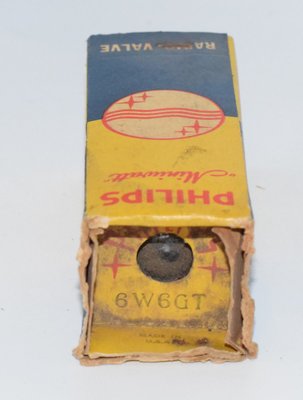
Manufactured by General Electric, RCA, Sylvania, Philips (Miniwatt), and other major tube producers, the 6W6-GT was widely used throughout the 1950s and into the 1960s in both television sets and budget audio equipment. Its ability to deliver meaningful power output from modest supply voltages made it a practical choice for compact and economical designs. Today, the 6W6-GT enjoys a modest but dedicated following among DIY audio enthusiasts and vintage equipment restorers who appreciate its unique sonic character and the availability of NOS (New Old Stock) examples, including specimens from Philips Miniwatt.
2. Technical Specifications and Design
General Electrical Data
| Parameter | 6W6-GT | 12W6-GT | 25W6-GT |
|---|---|---|---|
| Cathode Type | Coated, Unipotential (Indirectly Heated) | ||
| Heater Voltage (AC or DC) | 6.3 V | 12.6 V | 25.0 V |
| Heater Current | 1.2 A | 0.6 A | 0.3 A |
| Heater Warm-up Time | — | 11 seconds | — |
Direct Interelectrode Capacitances (Approximate, Without External Shield)
| Capacitance | Value |
|---|---|
| Grid-Number 1 to Plate | 0.8 µµF |
| Input | 15 µµF |
| Output | 9.0 µµF |
Maximum Ratings — Class A₁ Amplifier Service (Design-Center Values)
| Parameter | Value |
|---|---|
| Plate Voltage | 300 V (330 V per TDSL data) |
| Screen Voltage (Grid Number 2) | 150 V (165 V per TDSL data) |
| Plate Dissipation | 10 W (12.0 W per TDSL data) |
| Screen Dissipation | 1.25 W (1.35 W per TDSL data) |
| Maximum DC Cathode Current | 65 mA |
| Grid-Number 1 Circuit Resistance (Fixed Bias) | 0.1 MΩ |
| Grid-Number 1 Circuit Resistance (Cathode Bias) | 0.5 MΩ |
Note: The GE datasheet (ET-T1339) specifies Class A₁ amplifier maximum ratings of 300V plate and 150V screen with 10W plate dissipation. The TDSL cross-reference database lists slightly higher absolute maximum values of 330V plate, 165V screen, 12.0W plate dissipation, and 1.35W screen dissipation. Designers should consult the specific manufacturer's datasheet for the tubes they are using, as ratings may vary slightly between manufacturers.
Maximum Ratings — Vertical-Deflection Amplifier Service
| Parameter | Triode Connection | Pentode Connection |
|---|---|---|
| DC Plate Voltage | 300 V | 300 V |
| Peak Positive Pulse Plate Voltage | 1200 V (Absolute Max) | 1500 V (Absolute Max) |
| Screen Voltage | — | 150 V |
| Peak Negative Grid-Number 1 Voltage | 250 V | 250 V |
| Plate Dissipation | 7.5 W | 7.0 W |
| Screen Dissipation | — | 1.0 W |
| DC Cathode Current | 60 mA | 60 mA |
| Peak Cathode Current | 180 mA | 180 mA |
Characteristics and Typical Operation — Class A₁ Amplifier (Pentode Connection)
| Parameter | Condition 1 (Low Voltage) | Condition 2 (Higher Voltage) |
|---|---|---|
| Plate Voltage | 110 V | 200 V |
| Screen Voltage | 110 V | 125 V |
| Grid-Number 1 Voltage | −7.5 V | — (Cathode Bias) |
| Cathode-Bias Resistor | — | 180 Ω |
| Peak AF Grid-Number 1 Voltage | 7.5 V | 8.5 V |
| Plate Resistance (approx.) | 13,000 Ω | 28,000 Ω |
| Transconductance (gm) | 8,000 µmhos (8.0 mA/V) | 8,000 µmhos (8.0 mA/V) |
| Zero-Signal Plate Current | 49 mA | 46 mA |
| Maximum-Signal Plate Current | 50 mA | 47 mA |
| Zero-Signal Screen Current | 4.0 mA | 2.2 mA |
| Maximum-Signal Screen Current | 10 mA | 8.5 mA |
| Load Resistance | 2,000 Ω | 4,000 Ω |
| Total Harmonic Distortion (approx.) | 10% | 10% |
| Maximum-Signal Power Output | 2.1 W | 3.8 W |
Average Characteristics — Triode Connection (Screen Tied to Plate)
| Parameter | Value |
|---|---|
| Plate Voltage | 225 V |
| Grid-Number 1 Voltage | −30 V |
| Amplification Factor (µ) | 6.2 |
| Plate Resistance (rp) | 1,600 Ω |
| Transconductance (gm) | 3,800 µmhos (3.8 mA/V) |
| Plate Current | 22 mA |
| Grid-Number 1 Voltage for Ib = 0.5 mA (approx.) | −42 V |
| Peak Plate Voltage (Vertical Deflection) | 1,200 V |
Physical and Mechanical Details
| Parameter | Detail |
|---|---|
| Base Type | Octal (B6-81 or B7-7, Intermediate Shell Octal; or B6-84 / B7-59, Short Intermediate Shell Octal) |
| Envelope | T-9, Glass |
| Outline | RETMA 9-11 or 9-41 |
| Mounting Position | Any |
| Maximum Overall Length | 3-5/16 inches (approx.) |
| Maximum Seated Height | 2-3/8 inches (approx.) |
| Maximum Diameter | 1-9/16 inches (approx.) |
Pin Connections (RETMA 7AC Basing — Bottom View)
| Pin | Connection |
|---|---|
| Pin 1 | No Connection (omitted on bases B6-81 and B6-84) |
| Pin 2 | Heater |
| Pin 3 | Plate |
| Pin 4 | Grid Number 2 (Screen) |
| Pin 5 | Grid Number 1 (Control Grid) |
| Pin 6 | — (not used) |
| Pin 7 | Heater |
| Pin 8 | Cathode and Beam Plates |
3. Applications and Usage
Original Applications
The 6W6-GT was primarily designed for two applications:
- Television Vertical-Deflection Amplifier: This was the tube's primary intended application. In both triode and pentode configurations, the 6W6-GT could handle the high peak pulse plate voltages (up to 1,200V in triode mode, 1,500V in pentode mode) required for vertical scanning circuits. The tube's ability to handle large peak cathode currents (180 mA) while maintaining modest average dissipation made it well-suited for the sawtooth waveforms used in vertical deflection.
- Audio-Frequency Power Output: GE explicitly recognized the 6W6-GT's utility as an audio output tube. In pentode mode with a 200V plate supply and 125V screen, the tube delivers 3.8 watts into a 4,000-ohm load. At the lower operating point of 110V plate and screen, it still produces a useful 2.1 watts into a 2,000-ohm load. These characteristics made it ideal for table radios, console radios, and compact amplifiers where moderate power output was sufficient.
Typical Circuit Configurations
Single-Ended Pentode: The most common audio configuration uses the 6W6-GT in pentode mode with cathode bias (180Ω cathode resistor) at 200V plate and 125V screen. This delivers 3.8W of output power — enough for a small room at comfortable listening levels. The 4,000Ω optimum load impedance is easily matched with standard output transformers.
Single-Ended Triode: With the screen tied to the plate, the 6W6-GT operates as a triode with a low plate resistance of only 1,600Ω, an amplification factor of 6.2, and transconductance of 3,800 µmhos. The low plate resistance provides excellent damping factor and a more linear transfer characteristic, though power output is reduced compared to pentode operation. The triode connection is biased at −30V on the grid with 225V on the plate.
Push-Pull: A pair of 6W6-GTs in push-pull can deliver approximately 7–8 watts in pentode mode, providing enough power for most domestic listening applications. Push-pull operation significantly reduces even-order harmonic distortion compared to the single-ended configuration.
4. Sound Characteristics
The 6W6-GT occupies an interesting sonic niche that has earned it a small but appreciative following among tube audio enthusiasts. Its sound character varies significantly depending on whether it is operated in pentode or triode mode:
Pentode Mode
In pentode configuration, the 6W6-GT delivers a sound that is often described as lively and forward, with a pronounced midrange presence. The relatively high transconductance of 8,000 µmhos combined with the 13,000–28,000Ω plate resistance gives the tube a characteristic pentode "bite" that can be engaging with vocal and guitar-driven music. The 10% total harmonic distortion figure at full output (as specified in the datasheet) indicates that the tube is being pushed hard at its rated power, and the distortion spectrum is dominated by odd-order harmonics typical of beam pentodes. At lower power levels — say, below 1 watt — distortion drops considerably and the sound becomes cleaner and more refined.
Listeners frequently note that the 6W6-GT in pentode mode has a slightly brighter and more detailed top end compared to the ubiquitous 6V6-GT, though with somewhat less bass authority. The midrange has a warm, slightly "woody" quality that flatters acoustic instruments and vocals. The sound has been compared to a smaller, more intimate version of the 6L6 family — not surprising given the beam power pentode topology shared across these types.
Triode Mode
When triode-connected (screen tied to plate), the 6W6-GT transforms into a remarkably sweet-sounding output tube. The low plate resistance of 1,600Ω provides excellent damping and control over the loudspeaker, resulting in tighter bass and a more cohesive, integrated sound. The amplification factor of 6.2 is quite low, placing the triode-connected 6W6-GT in similar territory to directly heated triodes in terms of its gain characteristics.
In triode mode, the harmonic distortion spectrum shifts toward predominantly second-harmonic content, which the ear perceives as warmth and richness rather than harshness. The sound becomes more liquid and three-dimensional, with a natural decay on notes that audiophiles often describe as "organic." The trade-off is reduced power output, but for near-field listening or with efficient speakers (95 dB/W/m or higher), the triode-connected 6W6-GT can be deeply satisfying.
Overall Character
Across both modes, the 6W6-GT tends to present a slightly smaller, more intimate soundstage compared to larger output tubes. It excels at conveying the texture and nuance of small ensemble recordings — jazz trios, chamber music, solo vocals with simple accompaniment. The tube's relatively modest power output means it is best paired with efficient loudspeakers, where its tonal qualities can shine without being pushed into harsh clipping. Many listeners describe the 6W6-GT as having a "vintage" or "nostalgic" quality that evokes the golden age of radio — warm, inviting, and slightly romanticized, without the clinical precision of modern solid-state amplification.
5. Equivalent or Substitute Types
| Type | Relationship | Notes |
|---|---|---|
| 12W6-GT | Direct equivalent (different heater) | 12.6V / 0.6A heater. Electrically identical in all other respects. Controlled heater warm-up (11 seconds). Direct substitute if heater supply matches. |
| 25W6-GT | Direct equivalent (different heater) | 25.0V / 0.3A heater. Electrically identical in all other respects. Designed for series-string heater circuits. |
| 6W6-G | Earlier glass envelope version | The "G" (ST-shape glass) version preceded the "GT" (tubular glass) version. Electrically identical but physically larger. Pin-compatible. |
| 6V6-GT | Similar but NOT a direct substitute | The 6V6-GT is a more common beam power tetrode with similar power output (~4.5W SE) but different operating points, different bias requirements, and different pin functions. Not a drop-in replacement without circuit modifications. The 6V6-GT has a higher amplification factor and different screen current characteristics. |
Important: The 6W6-GT should not be casually substituted for the 6V6-GT or vice versa without careful review of bias conditions, screen voltage, and load impedance requirements. While both are beam power tubes in octal envelopes delivering similar power levels, their operating parameters differ significantly.
6. Notable Characteristics
- Exceptional Low-Voltage Performance: One of the 6W6-GT's most distinctive features is its ability to deliver useful power output at very low plate supply voltages. At only 110V on both plate and screen, the tube still produces 2.1 watts — a remarkable figure that made it invaluable in AC/DC radio receivers and other equipment with limited power supply voltage.
- High Transconductance: The 8,000 µmhos transconductance in pentode mode is notably high for a tube of this power class, contributing to high power sensitivity. This means the tube requires very little grid drive voltage (only 7.5–8.5V peak) to reach full output, simplifying driver stage requirements.
- Low Triode Plate Resistance: In triode connection, the 1,600Ω plate resistance is remarkably low, providing excellent output transformer damping and speaker control. This is lower than many dedicated audio triodes of similar power rating.
- Beam Plate Construction: The beam plates (connected internally to the cathode at pin 8) focus the electron stream into dense sheets, suppressing secondary emission from the plate without requiring a physical suppressor grid. This beam power design contributes to the tube's high efficiency and favorable distortion characteristics.
- Versatile Mounting: The tube can be mounted in any position, providing flexibility in chassis layout design.
- High Peak Voltage Capability: The ability to withstand peak plate voltages of 1,200V (triode) to 1,500V (pentode) in deflection service demonstrates the robust construction of the tube's internal elements, which also contributes to reliability in audio applications.
- Moderate Heater Power: At 6.3V and 1.2A, the heater draws 7.56 watts — moderate for an output tube of this class, making it practical for battery-eliminator and transformer-powered designs alike.
7. Usage in the Audio Community
DIY and Hobbyist Amplifier Projects
The 6W6-GT has found a dedicated niche in the DIY tube audio community, particularly among builders who enjoy exploring lesser-known tube types. Its appeal lies in several practical factors: NOS tubes remain relatively affordable compared to the heavily demanded 6V6-GT and 6L6-GC types; the tube's high sensitivity means simple driver circuits (often a single 12AX7 or 12AU7 dual triode) suffice; and the low plate voltage requirements allow the use of smaller, less expensive power transformers.
Popular DIY projects include:
- Single-Ended (SE) amplifiers: A single 6W6-GT per channel, typically driven by one section of a 12AX7 or 12AT7, delivering 2–4 watts depending on operating point and mode (triode vs. pentode). These are often built as "desktop" or "bedroom" amplifiers for use with efficient bookshelf speakers.
- Push-Pull amplifiers: A pair of 6W6-GTs per channel in Class A or Class AB₁ push-pull, capable of approximately 7–10 watts. These designs offer enough power for moderate-efficiency speakers in typical domestic rooms.
- Triode-connected SE amplifiers: Taking advantage of the tube's excellent triode characteristics (µ = 6.2, rp = 1,600Ω), these designs appeal to SET (Single-Ended Triode) enthusiasts who value the sonic purity of triode operation but prefer the convenience and economy of indirectly heated tubes.
Vintage Equipment Restoration
The 6W6-GT appears in numerous vintage radio receivers and television sets from the late 1940s through the 1960s. Restorers of these sets need reliable replacement tubes, and the availability of NOS examples from manufacturers like Philips Miniwatt, GE, RCA, and Sylvania ensures that these vintage pieces can be kept in operating condition. The Philips Miniwatt USA NOS examples are particularly sought after for their consistent quality and reportedly smooth sonic character.
Guitar and Instrument Amplifiers
While not as widely used in guitar amplifiers as the 6V6-GT or 6L6-GC, the 6W6-GT has attracted interest from boutique amp builders and experimenters. Its characteristic midrange presence and slightly compressed feel at full output can be musically useful for blues, jazz, and low-volume practice amplifiers. The high transconductance means the tube responds quickly and dynamically to playing technique, while the natural compression at the limits of its power envelope provides a smooth, singing sustain.
Headphone Amplifiers
The 6W6-GT's ability to deliver clean power at low voltages makes it an interesting candidate for high-end headphone amplifiers. In triode mode at reduced plate voltages, the tube can drive high-impedance headphones (300–600Ω) directly or through a small output transformer, delivering the warmth and dimensionality of tube amplification in a personal listening context.
Community Perception
Within the audio community, the 6W6-GT is generally regarded as an underappreciated gem — a tube that offers genuine sonic merit at a fraction of the cost of more fashionable types. It lacks the cachet of a 2A3 or 300B, and it doesn't have the universal recognition of the 6V6-GT, but those who have built amplifiers around it consistently report pleasant surprise at its musical capabilities. The tube is particularly valued by listeners who prioritize midrange clarity and tonal warmth over raw power output, and by builders who appreciate the engineering elegance of achieving good performance from simple, economical circuits.
The ongoing availability of NOS stock, combined with the tube's forgiving nature (it is relatively tolerant of component variations and does not require exotic output transformers), makes the 6W6-GT an excellent choice for first-time tube amplifier builders and experienced hobbyists alike.