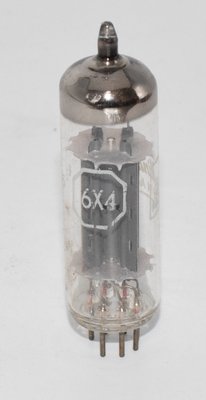
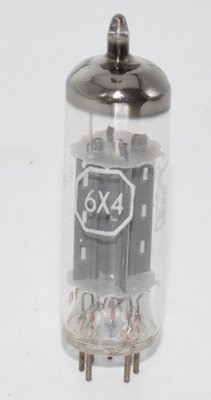
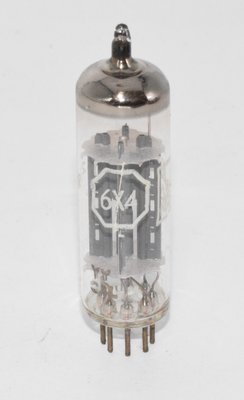
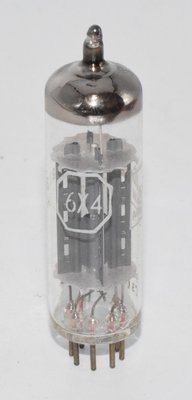
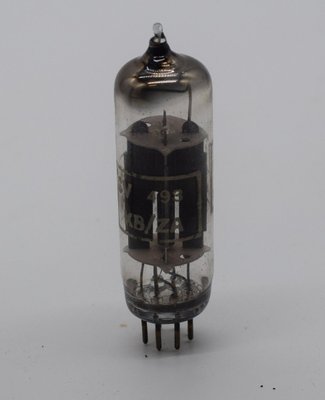
Introduction and History
The 6X4 is a miniature indirectly-heated full-wave vacuum rectifier tube designed for use in compact radio receivers, small amplifiers, and test equipment. Introduced in the late 1940s, it was one of the first miniature rectifier tubes to gain widespread adoption, replacing larger octal-based rectifiers like the 6X5GT in new designs. The Brimar (STC) Application Report VAD/501.5, issued in March 1950 by Standard Telephones and Cables Pty. Ltd., documents the tube as a Brimar valve intended for use in receivers operated either from AC mains or from a 6-volt storage battery in conjunction with a vibrator unit.
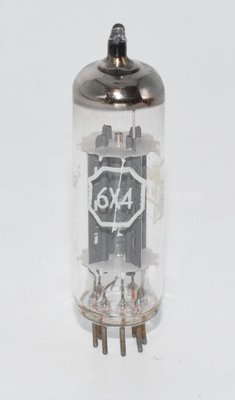
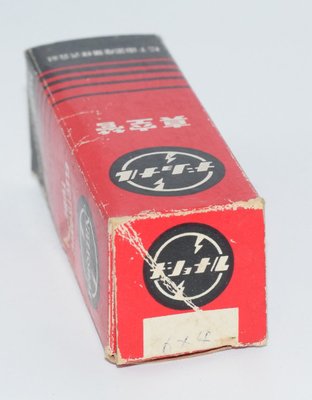
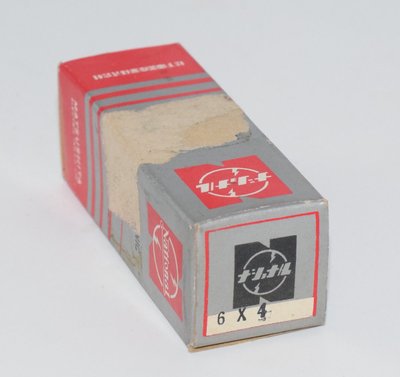
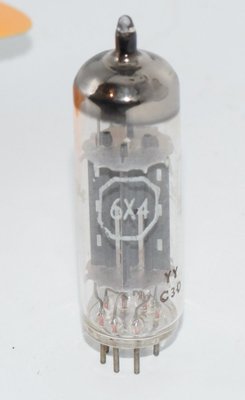
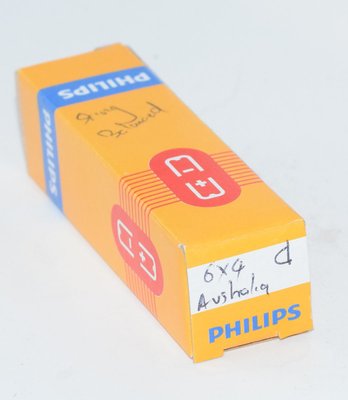
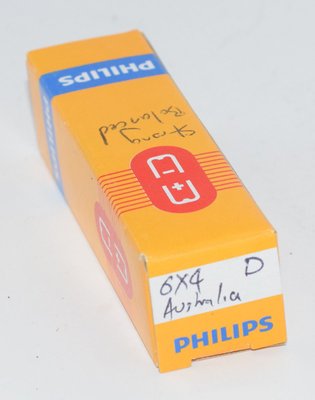
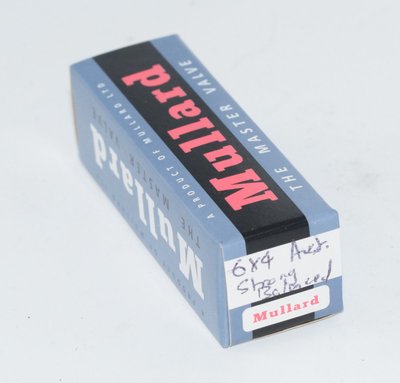
The 6X4 was manufactured by virtually every major tube producer worldwide, including RCA, Sylvania, GE, Mullard, Philips Miniwatt, Brimar, Amperex, Matsushita (National), and many others. Its European designation is EZ90, and it was widely produced in Australia by Philips Miniwatt and Mullard, as well as in Japan by Matsushita/National. The tube's compact size, low heater current, and adequate output current made it the standard rectifier for countless consumer and light-duty professional applications throughout the 1950s and 1960s.
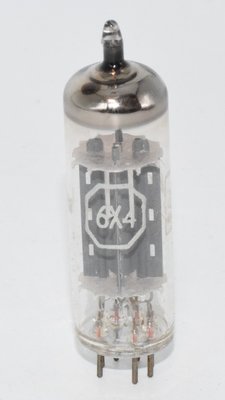
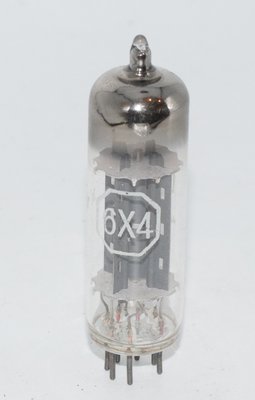
The 6X4 comprises two half-wave high vacuum rectifier units sharing a common cathode connection separate from the heater connection. The units are mounted in a standard T5½ miniature glass bulb and fitted with a B7G (miniature 7-pin) base. This separate cathode design was a significant advantage over earlier directly-heated rectifiers, as it allowed for more flexible circuit design and eliminated the need for a separate heater winding in many applications.
Technical Specifications and Design
General Characteristics
| Parameter | Value |
|---|---|
| Tube Type | Full-wave vacuum rectifier (twin diode) |
| Cathode Type | Indirectly-heated oxide-coated cathode |
| Heater Voltage | 6.3 volts |
| Heater Current (nominal) | 0.6 amperes |
| Max. DC Heater-Cathode Potential | 450 volts |
Physical Dimensions
| Parameter | Value |
|---|---|
| Envelope Type | T5½ miniature glass bulb |
| Base Type | B.V.A. Standard B7G (Miniature 7-pin) |
| Max. Overall Length | 2-5/8 inches (66.7 mm) |
| Max. Diameter | 3/4 inch (19 mm) |
| Max. Seated Height | 2-3/8 inches (60.3 mm) |
Pin Connections (B7G Base, Bottom View)
| Pin | Connection |
|---|---|
| Pin 1 | Plate #2 |
| Pin 2 | No connection |
| Pin 3 | Heater |
| Pin 4 | Heater |
| Pin 5 | No connection |
| Pin 6 | Plate #1 |
| Pin 7 | Cathode |
Maximum Ratings (Each Diode Unit)
| Parameter | Value |
|---|---|
| Max. Peak Inverse Voltage | 1250 volts |
| Max. Peak Plate Current | 210 mA |
Maximum Ratings — Full-Wave Rectifier with Condenser (Capacitor) Input Filter
| Parameter | Value |
|---|---|
| Max. AC Plate Voltage (rms) per Plate | 325 volts |
| Min. Effective Limiting Resistance per Plate | 250 ohms |
| Max. Reservoir Condenser | 40 µF |
| Max. DC Output Current | 70 mA |
Maximum Ratings — Full-Wave Rectifier with Choke Input Filter
| Parameter | Value |
|---|---|
| Max. AC Plate Voltage (rms) per Plate | 450 volts |
| Min. Input Choke Inductance | 8 henries |
| Max. DC Output Current | 70 mA |
Note: As a rectifier tube, the 6X4 does not have amplification factor (µ), transconductance (gm), or grid bias specifications — these parameters apply only to amplifying tubes. The 6X4 has no control grid.
Typical Operating Conditions — Full-Wave Rectifier, Condenser Input Filter
| Parameter | Condition 1 | Condition 2 | Condition 3 | Condition 4 |
|---|---|---|---|---|
| Heater Voltage | 6.3 V | 6.3 V | 6.3 V | 6.3 V |
| AC Plate Voltage (rms) per Plate | 250 V | 275 V | 300 V | 325 V |
| Limiting Resistance per Plate* | 250 Ω | 250 Ω | 250 Ω | 250 Ω |
| Reservoir Condenser | 4 µF | 4 µF | 4 µF | 4 µF |
| DC Output Current | 70 mA | 70 mA | 70 mA | 70 mA |
| DC Output Voltage | 237 V | 270 V | 300 V | 333 V |
* The limiting resistance values shown are minimum values necessary to limit the peak plate current to the value specified under Maximum Ratings. They may be omitted in the form of an actual resistor only where the effective regulation of the power transformer (including primary and secondary) presents a source impedance of an equal or higher value.
Typical Operating Conditions — Full-Wave Rectifier, Choke Input Filter
| Parameter | Condition 1 | Condition 2 | Condition 3 |
|---|---|---|---|
| Heater Voltage | 6.3 V | 6.3 V | 6.3 V |
| AC Plate Voltage (rms) per Plate | 250 V | 350 V | 450 V |
| Input Choke Inductance | 8 H | 8 H | 8 H |
| DC Output Current | 70 mA | 70 mA | 70 mA |
| DC Output Voltage* | 190 V | 280 V | 375 V |
* These figures do not allow for any DC voltage drop in the input choke.
Applications and Usage
The 6X4 was designed as a general-purpose full-wave rectifier for power supplies requiring moderate DC output current. Its primary applications include:
- Radio Receivers: The 6X4 was the standard rectifier in countless AM and FM radio receivers of the 1950s and 1960s, providing the B+ supply voltage for the receiver's amplifier and detector stages.
- Small Audio Amplifiers: Many low-to-medium power tube amplifiers used the 6X4 as their power supply rectifier, particularly designs drawing up to 70 mA of total B+ current.
- Test Equipment: Oscilloscopes, signal generators, and other bench instruments frequently employed the 6X4 for their internal power supplies.
- Vibrator Power Supplies: As noted in the Brimar datasheet, the 6X4 was specifically intended for use with vibrator units in equipment powered from 6-volt storage batteries, making it suitable for mobile and automotive radio applications.
- Preamplifiers and Tuners: Hi-fi preamplifiers and FM tuners of the golden age of audio frequently used the 6X4 as their rectifier, as these units typically drew well within the tube's 70 mA current capability.
The datasheet specifies two primary modes of operation: with a condenser (capacitor) input filter, where the maximum AC plate voltage is 325 volts rms per plate, and with a choke input filter, where the maximum AC plate voltage can be increased to 450 volts rms per plate. The choke input filter configuration provides better voltage regulation under varying load conditions, while the capacitor input filter yields higher no-load DC output voltage.
An important design consideration highlighted in the Brimar application report is the requirement for limiting resistance. A minimum of 250 ohms per plate is specified for capacitor input filter operation to limit peak plate current to the maximum rating of 210 mA. This resistance can be provided by the transformer's own winding resistance if it is sufficient, or by adding external series resistors. The maximum reservoir condenser is specified as 40 µF; if a larger value is used, the limiting resistance should be increased accordingly, or the load current reduced.
Sound Characteristics
As a rectifier tube, the 6X4 does not directly amplify the audio signal, yet it plays a crucial role in shaping the sonic character of the equipment it powers. Audiophiles and experienced engineers have long recognized that the choice of rectifier tube can subtly but meaningfully influence the overall sound of an amplifier or preamplifier.
The 6X4 is generally characterized by the following sonic attributes:
- Soft and Gradual Power-Up: Like all indirectly-heated rectifiers, the 6X4 provides a gentle, progressive rise in B+ voltage as the cathode reaches operating temperature. This "soft start" characteristic is kinder to filter capacitors and downstream tubes, and contributes to the tube's reputation for reliability.
- Natural Sag and Compression: Under dynamic signal conditions, the 6X4's internal resistance causes a slight voltage sag in the B+ supply when current demand increases. This creates a subtle, natural compression effect that many listeners find musically pleasing — the sound "breathes" with the dynamics of the music rather than remaining rigidly stiff.
- Warm and Smooth Presentation: Equipment powered by the 6X4 is often described as having a warm, smooth, and slightly rounded tonal quality compared to the same circuit powered by solid-state rectification. The tube's voltage drop and dynamic impedance contribute to a less aggressive, more relaxed presentation.
- Moderate Internal Impedance: The 6X4 has a moderate forward resistance (visible in the plate current vs. plate voltage characteristic curve), which provides enough "give" in the power supply to impart tube-like character without excessive voltage drop or poor regulation.
- Quiet Operation: Well-made examples of the 6X4, particularly NOS specimens from quality manufacturers like Mullard, Philips Miniwatt, and Brimar, are known for low noise and hum levels, making them suitable for sensitive preamplifier applications.
Different manufacturers' versions of the 6X4 can exhibit subtle sonic differences due to variations in cathode coating composition, plate structure, and internal geometry. Australian-made Philips Miniwatt and Mullard examples, as well as Japanese Matsushita/National tubes, are all sought after by collectors and audio enthusiasts for their consistent quality and quiet operation.
Equivalent and Substitute Types
Direct Equivalents (Drop-in Replacements)
| Type | Notes |
|---|---|
| EZ90 | European (Mullard/Philips) designation — identical tube, same pinout and ratings |
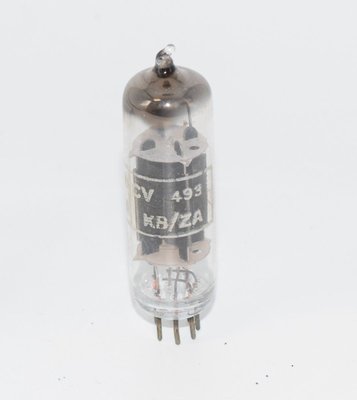
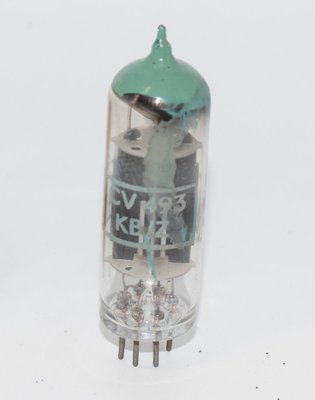
| CV493 | UK military designation — identical to 6X4, selected/tested to military standards |
| CV8203 | UK military designation — equivalent to 6X4 |
| CV8223 | UK military designation — equivalent to 6X4 |
| CV8237 | UK military designation — equivalent to 6X4 |
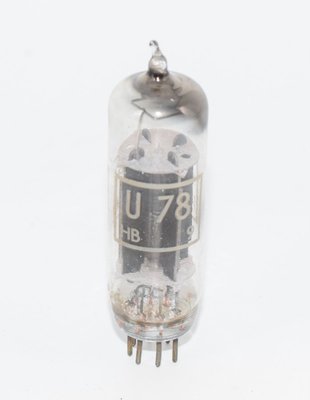
| U78 | Mullard/UK commercial designation — equivalent to 6X4 |
Related Types (NOT Direct Drop-in Replacements)
| Type | Notes |
|---|---|
| 6063 | Similar type but with different ratings — verify specifications before substituting |
| 12X4 | 12.6-volt heater version — NOT interchangeable without heater circuit modification. Uses 12.6V at 0.3A heater instead of 6.3V at 0.6A |
Note: The 6X4 should not be confused with the 6X5GT, which is an octal-based rectifier with different pinout and somewhat different ratings, though it serves a similar function. While some circuits can be adapted from one to the other, they are not pin-compatible.
Notable Characteristics
- High Peak Inverse Voltage: The 6X4's PIV rating of 1250 volts provides a generous safety margin in typical applications, where the peak inverse voltage across each diode section in a full-wave rectifier circuit is approximately 2.83 times the rms AC input voltage per plate.
- Separate Cathode: Unlike directly-heated rectifiers (such as the 5Y3GT), the 6X4's indirectly-heated cathode is brought out to a separate pin (Pin 7). This allows the cathode to be at a different potential from the heater, with a maximum heater-cathode voltage rating of 450 volts DC. This feature simplifies power supply design and allows the heater to be powered from a common winding shared with other tubes.
- Compact Miniature Envelope: The T5½ bulb and B7G base make the 6X4 significantly smaller than octal-based rectifiers, enabling more compact equipment designs.
- Reservoir Condenser Limitation: The maximum reservoir (first filter) capacitor is specified as 40 µF for capacitor input filter operation. This is an important design constraint — exceeding this value without increasing the series limiting resistance can result in excessive peak charging currents that may damage the tube's cathode coating over time.
- Versatile Filter Options: The tube can operate with either capacitor input or choke input filters, with significantly different maximum voltage ratings for each configuration (325V rms vs. 450V rms per plate, respectively). The choke input filter allows higher AC input voltages because it limits the peak current through the rectifier.
- Manufacturer Variations: NOS (New Old Stock) 6X4 tubes are available from numerous manufacturers. Australian-made examples from Philips Miniwatt and Mullard are particularly well-represented in the collector market, with both D-getter and later production variants available. Japanese production from Matsushita (National) is also commonly encountered.
Usage in the Audio Community
The 6X4 / EZ90 enjoys enduring popularity in the audio community, serving as the rectifier of choice in a wide variety of applications:
Vintage Equipment Restoration
The 6X4 is found in countless vintage receivers, tuners, and preamplifiers from manufacturers such as Fisher, Scott, Marantz, McIntosh, Dynaco, Eico, and many others. Restorers of this equipment require reliable replacement tubes, and the 6X4 remains readily available in both NOS and current production forms. The tube's ubiquity in vintage equipment means it is one of the most commonly needed rectifier types for restoration work.
DIY and Boutique Amplifier Projects
The 6X4 is a popular choice for DIY tube amplifier builders, particularly for low-power single-ended designs and preamplifier projects. Its 70 mA maximum output current is well-suited to powering small amplifiers using tubes like the 6V6, 6AQ5, or EL84 in single-ended configuration, as well as preamplifier circuits using 12AX7, 12AU7, or 6SN7 tubes. The tube's modest heater current of 0.6 amperes is easy to accommodate in power transformer designs.
Headphone Amplifiers
The growing popularity of tube-based headphone amplifiers has given the 6X4 a new lease on life. Many boutique and DIY headphone amplifier designs use the 6X4 as their rectifier, as the current requirements of headphone amplifiers are typically well within the tube's capabilities. The tube rectifier's soft-start characteristic and subtle dynamic compression are considered desirable attributes in this application.
Guitar Amplifiers
While less common than the 5Y3GT or GZ34 in guitar amplifier applications, the 6X4 does appear in some smaller practice amplifiers and recording amplifiers. Its natural sag characteristic is appreciated by guitarists who value a responsive, touch-sensitive playing feel.
Tube Rolling and Collecting
Audio enthusiasts who engage in "tube rolling" — swapping different brands and vintages of the same tube type to find preferred sonic characteristics — actively seek out premium examples of the 6X4. Particularly prized are NOS examples from Mullard (Australia), Philips Miniwatt (Australia), Brimar (UK), and Matsushita/National (Japan). Early production tubes with D-shaped getters are especially sought after by collectors, as they are associated with older manufacturing processes and are perceived by some listeners to offer superior sonic qualities.
Comparison with Solid-State Rectification
Many audio enthusiasts prefer the 6X4 tube rectifier over solid-state diode replacements in vintage and new-build equipment. While silicon diode plug-in replacements exist for the 6X4 socket, purists argue that these change the sonic character of the equipment by eliminating the tube's natural voltage drop, soft-start behavior, and dynamic impedance characteristics. The choice between tube and solid-state rectification remains one of the enduring debates in the audio community, with the 6X4 frequently at the center of these discussions in the context of smaller amplifiers and preamplifiers.