1. Introduction and History
The 6Y7G is a twin triode power amplifier vacuum tube introduced in the late 1930s by Tung-Sol Lamp Works Inc. of Newark, New Jersey. The original Tung-Sol datasheet is dated March 6, 1939, placing this tube squarely in the golden era of pre-war American radio tube development. It was designed primarily for service as a Class B power amplifier, though it also found use as a voltage amplifier and phase inverter.
The 6Y7G is closely related to the earlier Type 79 tube. According to Tung-Sol's own documentation, "with the exception of capacitances its ratings and characteristics are identical with those of the 79." The 79 was a popular dual triode of the mid-1930s designed for similar Class B audio output service in battery-eliminator and AC-powered radio receivers. The 6Y7G essentially repackaged the 79's electrical design into the more modern octal-base format with an ST-12 glass envelope, offering improved shielding characteristics and updated interelectrode capacitance values.
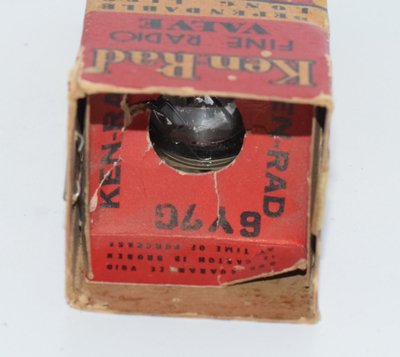
The tube was manufactured by several American companies during the late 1930s and 1940s, including Tung-Sol, Ken-Rad, and others. It was primarily used in mid-power radio receivers and small public address systems of the era. While never as ubiquitous as some of its contemporaries, the 6Y7G represents an interesting chapter in the evolution of dual-triode power tubes and the transition from the older base styles to the octal platform.
2. Technical Specifications and Design
General Description
- Type: Twin Triode Power Amplifier
- Cathode: Unipotential (indirectly heated)
- Envelope: ST-12 Glass Bulb
- Base: Small 8-Pin Octal (G-8B)
- Mounting: Vertical recommended
Physical Dimensions
- Maximum Diameter: 1-7/8 inches (approximately 47.6 mm)
- Maximum Seated Height: 4-1/8 inches (approximately 104.8 mm)
- Maximum Overall Height (with pins): 3-9/16 inches to top of glass (approximately 90.5 mm from shoulder) — total maximum length approximately 4-1/8 inches seated
- Base Diameter: 1.165 inches maximum
Heater Ratings
- Heater Voltage: 6.3 Volts (AC or DC)
- Heater Current: 0.6 Ampere
Maximum Ratings
- Maximum Plate Voltage: 250 Volts
- Maximum Peak Plate Current (per plate): 90 mA
- Maximum Average Plate Dissipation: 11.5 Watts (total for both sections)
Pin Configuration (Bottom View of Socket)
The 6Y7G uses the standard octal base (G-8B). Based on the Tung-Sol datasheet basing diagram:
- Pin 1: No Connection (or shell/key)
- Pin 2: Heater
- Pin 3: Plate (Triode 1)
- Pin 4: Grid (Triode 2)
- Pin 5: Grid (Triode 1)
- Pin 6: Plate (Triode 2)
- Pin 7: Heater
- Pin 8: Cathode (K) — common to both triodes
Note: Triode 2 is the triode section having its grid brought out to Pin 4. Triode 1 is the triode section having its grid brought out to Pin 5. The cathode is common (unipotential) for both sections.
Class B₂ Amplifier Operating Conditions
| Parameter | Condition 1 | Condition 2 | Unit |
|---|---|---|---|
| Plate Voltage | 180 | 250 (max) | Volts |
| Grid Bias | 0 | 0 | Volts |
| Zero-Signal Plate Current (per plate) | 3.8 | 5.3 | mA |
| Effective Load Resistance (plate to plate) | 7,000 | 14,000 | Ohms |
| Average Power Input (grid to grid) | 380 | 380 | Milliwatts |
| Power Output (approx.) | 5.5 | 8.0 | Watts |
Resistance-Coupled Amplifier and Phase Inverter Operating Conditions
| Parameter | Cond. 1 | Cond. 2 | Cond. 3 | Cond. 4 | Unit |
|---|---|---|---|---|---|
| Plate Supply Voltage | 100 | 100 | 250 | 250 | Volts |
| Plate Load Resistor | 0.1 | 0.5 | 0.1 | 0.5 | Megohm |
| Cathode Resistor | 2,000 | 6,000 | 1,200 | 3,000 | Ohms |
| Voltage Gain | 30 | 35 | 35 | 43 | — |
Direct Interelectrode Capacitances (with shield)
| Capacitance | Triode 2 | Triode 1 | Unit |
|---|---|---|---|
| Grid to Cathode | 3.6 | 3.6 | µµF (pF) |
| Plate to Cathode | 4.6 | 4.6 | µµF (pF) |
| Grid to Plate | 2.6 | 2.6 | µµF (pF) |
Inter-Section Capacitances (with shield)
| Capacitance | Value | Unit |
|---|---|---|
| Grid 1 to Grid 2 | 0.3 | µµF (pF) |
| Plate 1 to Plate 2 | 1.7 | µµF (pF) |
| Grid 1 to Plate 2 | 0.12 | µµF (pF) |
| Grid 2 to Plate 1 | 0.12 | µµF (pF) |
Derived Characteristics
Note: The Tung-Sol datasheet for the 6Y7G does not explicitly list amplification factor (µ), transconductance (gm), or plate resistance (rp) as standalone figures. However, since Tung-Sol states that the 6Y7G's ratings and characteristics are identical to the Type 79 (except for capacitances), the following values from Type 79 datasheets are applicable and should be confirmed against a complete Type 79 datasheet:
- Amplification Factor (µ): Approximately 4.2 (typical for Type 79; should be verified)
- Transconductance (gm): Approximately 2,300 µmhos (typical for Type 79; should be verified)
- Plate Resistance (rp): Approximately 1,825 Ohms (typical for Type 79; should be verified)
The voltage gain figures provided in the resistance-coupled amplifier data (30–43 depending on operating conditions) are consistent with a relatively low-mu triode with moderate transconductance.
3. Applications and Usage
The 6Y7G was designed for three primary applications:
Class B₂ Power Amplifier
This was the tube's primary intended application. In Class B₂ operation, both triode sections work in push-pull with zero grid bias, with grid current flowing during the positive signal excursion. At 250 volts on the plates with a 14,000-ohm plate-to-plate load, the 6Y7G delivers approximately 8.0 watts of audio output power. At a more modest 180-volt supply, it still produces a respectable 5.5 watts with a 7,000-ohm load. The required driving power of 380 milliwatts (grid to grid) means a preceding driver stage with reasonable power capability is needed — typically a triode driver with an interstage transformer.
Voltage Amplifier
Either or both triode sections can be used as resistance-coupled voltage amplifiers. With a 250-volt supply and 0.5-megohm plate load resistor, a single section achieves a voltage gain of 43. Even at a reduced 100-volt supply, gains of 30–35 are achievable, making the tube useful as a general-purpose amplifying stage in radio receivers and audio equipment.
Phase Inverter
The dual-triode construction with matched sections makes the 6Y7G well-suited for split-load (cathodyne) or other phase-inverter topologies used to drive push-pull output stages. The symmetrical construction of the two triode sections ensures good balance between the inverted and non-inverted outputs.
Historical Context
In practice, the 6Y7G appeared in mid-range radio receivers of the late 1930s and early 1940s, particularly in sets where a single tube was needed to provide both phase inversion and power output, or where a compact Class B output stage was desired. It was also used in small public address amplifiers and intercommunication systems of the era.
4. Sound Characteristics
The 6Y7G, being a low-mu power triode operating in Class B, has a sonic character that is distinct from the more commonly discussed Class A triode tubes. While there is limited modern audiophile commentary specifically on the 6Y7G due to its relative obscurity, its characteristics can be assessed based on its electrical design and the experiences of those who have built amplifiers around it and its equivalent, the Type 79:
Tonal Qualities
- Warm and Direct: As a low-mu triode (µ ≈ 4.2), the 6Y7G exhibits the characteristically warm, harmonically rich sound associated with triode operation. The low amplification factor means less internal feedback and a more direct signal path, contributing to a sense of immediacy and presence.
- Midrange Presence: Low-mu triodes of this era tend to have a pronounced and engaging midrange. The 6Y7G is no exception — vocals and acoustic instruments are rendered with a natural, slightly forward quality that many listeners find appealing.
- Class B Characteristics: When operated in its intended Class B mode, the 6Y7G will exhibit some crossover distortion artifacts, particularly at low signal levels. This can manifest as a slight graininess or hardness compared to pure Class A operation. However, at moderate to full power levels, the push-pull Class B operation produces a surprisingly clean and dynamic sound with good transient response.
- Harmonic Profile: In Class B push-pull, even-order harmonics are largely cancelled, leaving predominantly odd-order harmonic distortion. This gives the sound a somewhat different character compared to single-ended triode amplifiers — less "lush" but potentially more articulate and punchy.
- Bass Response: The relatively low plate resistance of the triode sections provides good damping factor when properly loaded, resulting in reasonably controlled bass response for a tube of this era and power class. However, at 5.5–8 watts output, deep bass authority is naturally limited.
- Dynamic Range: Class B operation provides better efficiency than Class A, allowing the 6Y7G to deliver dynamic peaks with authority relative to its power rating. The 8-watt output at 250 volts is quite respectable for a single dual-triode.
Comparison to Modern Favorites
The 6Y7G's sound sits in an interesting middle ground — it has the warmth and harmonic richness of a triode but the efficiency and dynamic punch of Class B operation. It lacks the ultra-refined, liquid smoothness of a 300B in single-ended Class A, but offers more power and a more energetic presentation. Listeners who appreciate the sound of vintage push-pull triode amplifiers from the 1930s and 1940s will find the 6Y7G's character familiar and engaging.
5. Equivalent or Substitute Types
Direct Equivalent
- Type 79: The most direct equivalent. Tung-Sol explicitly states that the 6Y7G's ratings and characteristics are identical to the 79, with the exception of interelectrode capacitances. However, the Type 79 uses a 6-pin base (not octal), so it is not a direct plug-in replacement. An adapter or socket change would be required. The electrical parameters are interchangeable.
Similar Types
- 6Y7: The metal-envelope version designation, if produced. Some references list the 6Y7G as the glass-envelope variant of a 6Y7 type, though the glass ST-12 version appears to have been the primary production form.
- 53: An earlier dual triode with similar Class B power amplifier service, but with a different base type (6-pin) and somewhat different characteristics. Not a direct substitute.
- 6N7 / 6N7G: Another octal-based dual triode power amplifier of the same era. While similar in concept, the 6N7 has different electrical characteristics (different mu, plate resistance, and operating points) and is not a drop-in replacement. The 6N7 has a common cathode connection but different pin assignments and ratings.
Important Note: There are no widely recognized, exact plug-in equivalents for the 6Y7G in the octal family. The tube is relatively unique in its specific combination of characteristics. Any substitution should be carefully evaluated against the circuit requirements, and the pin connections must be verified.
6. Notable Characteristics
Unipotential Cathode Design
The 6Y7G features a unipotential (common) cathode shared between both triode sections. This simplifies circuit design for push-pull applications, as both sections share a single cathode connection (Pin 8). However, it also means that individual cathode biasing of each section is not possible — the tube is inherently designed for zero-bias Class B operation or common-cathode configurations.
Relationship to the Type 79
The explicit equivalence to the Type 79 is one of the 6Y7G's most notable features. It represents a direct modernization of an established design into the octal format, with the primary improvement being reduced interelectrode capacitances thanks to the octal base's better shielding provisions. The inter-section capacitances are notably low: Grid 1 to Grid 2 is only 0.3 pF, and the grid-to-opposite-plate capacitances are just 0.12 pF each, indicating good internal shielding between sections.
Zero-Bias Class B Operation
The 6Y7G operates in Class B with zero grid bias, which greatly simplifies the bias supply requirements. The zero-signal plate current is modest — only 3.8 mA per plate at 180V and 5.3 mA per plate at 250V — meaning the tube draws very little power at idle, with current increasing proportionally with signal level. This was an important consideration in the battery-powered and efficiency-conscious designs of the era.
Grid Drive Requirements
As a Class B₂ amplifier, the 6Y7G requires grid current to flow during positive signal peaks. The average power input of 380 milliwatts (grid to grid) is significant and necessitates a driver stage capable of delivering this power — typically through an interstage transformer. This is a key design consideration that differentiates it from Class A or Class AB₁ tubes that require no grid driving power.
Versatility
Despite being primarily a power tube, the 6Y7G's ability to function as a voltage amplifier with gains up to 43 and as a phase inverter makes it a versatile component. A single 6Y7G could theoretically serve as both the phase inverter and power output stage in a minimalist amplifier design, though in practice the Class B output application was most common.
Rarity
The 6Y7G is a relatively uncommon tube today. It was produced in moderate quantities during a limited production window (primarily late 1930s through the mid-1940s), and it was superseded by more popular dual-triode and beam-power tube designs. NOS (New Old Stock) examples from manufacturers like Ken-Rad and Tung-Sol surface occasionally in the collector and vintage radio markets.
7. Usage in the Audio Community
Vintage Radio Restoration
The primary demand for the 6Y7G in the audio community comes from vintage radio restorers. Collectors and enthusiasts restoring late-1930s and early-1940s radio receivers that originally used the 6Y7G need this specific tube to maintain authenticity. Given its relative scarcity, finding good NOS examples can be a challenge, and tested, functional specimens command a premium among serious restorers.
DIY and Experimental Amplifier Projects
The 6Y7G has attracted some interest from the DIY tube amplifier community, particularly among builders who enjoy working with obscure and unusual tube types. Its appeal lies in several factors:
- Simplicity: The zero-bias Class B operation eliminates the need for a bias supply, simplifying the power supply design.
- Single-Tube Output Stage: A single 6Y7G provides a complete push-pull output stage, reducing tube count and cost.
- Reasonable Power: At 5.5–8 watts, the 6Y7G provides enough power to drive efficient speakers (90+ dB sensitivity) to satisfying listening levels in a domestic setting.
- Vintage Character: Builders seeking the authentic sound of 1930s-era radio amplification find the 6Y7G delivers a genuinely period-correct sonic character.
Challenges for Modern Use
Several factors limit the 6Y7G's adoption in the modern audio community:
- Driver Requirements: The Class B₂ operation requires a driver capable of delivering 380 milliwatts of power into the grids, typically necessitating an interstage driver transformer. Quality interstage transformers are expensive and difficult to source.
- Crossover Distortion: Class B operation inherently produces crossover distortion, which is generally considered undesirable in high-fidelity applications. While this can be mitigated with careful circuit design and biasing slightly into Class AB, it remains a concern for critical listeners.
- Limited Supply: As a tube that has been out of production for over 70 years, the supply of NOS 6Y7G tubes is finite and dwindling. There is no current production from any manufacturer.
- Output Transformer Matching: The 7,000–14,000 ohm plate-to-plate load impedance requirement means that standard output transformers designed for more common tubes may not be optimal. Custom or carefully selected transformers are needed.
Collector Interest
Among tube collectors, the 6Y7G holds interest as a representative of the transitional period between pre-octal and octal tube designs. The ST-12 glass envelope with its distinctive shouldered shape is aesthetically pleasing, and examples from different manufacturers (Tung-Sol, Ken-Rad, and others) show variations in construction and labeling that appeal to collectors. The tube's direct lineage from the Type 79 also makes it interesting from a historical perspective, documenting the industry's migration to the octal base standard.
Niche Audiophile Applications
A small but dedicated group of audiophiles has explored the 6Y7G in low-powered triode amplifier builds, often paired with high-efficiency horn speakers or vintage full-range drivers. In these systems, the 6Y7G's triode character — warm midrange, natural dynamics, and vintage tonal quality — can be showcased effectively. Some builders have experimented with operating the tube in Class A push-pull (with appropriate bias modifications) to eliminate crossover distortion while sacrificing some output power, yielding a sweeter, more refined sound at the expense of efficiency.
The 6Y7G remains a tube for the adventurous builder and the dedicated vintage audio enthusiast rather than a mainstream audiophile choice. Its charm lies in its historical significance, its elegant simplicity of operation, and the warm, characterful sound it produces — a genuine voice from the golden age of radio.