1. Introduction and History
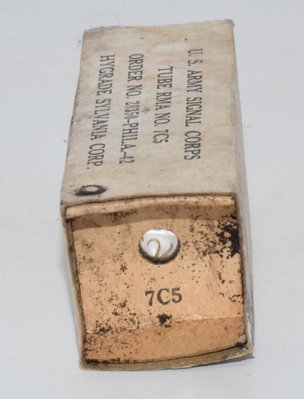
The 7C5 is a medium-power triode vacuum tube that emerged during the golden age of tube amplifier development in the 1940s. Developed primarily for use in audio power amplification and small radio receiver applications, the 7C5 represents a significant milestone in affordable, compact tube design. The tube was manufactured by major American tube makers including Sylvania, RCA, Philips, and others, with production spanning from the early 1940s through the 1980s.
The 7C5 designation follows the RCA numbering system established in the 1930s, where the first digit (7) indicates the heater voltage requirement of 6.3 volts AC. The tube became particularly popular in portable and compact radio receivers, as well as in small guitar and audio amplifiers where its power output and efficiency made it ideal for space-constrained designs.
Historically, the 7C5 gained prominence during World War II and the immediate post-war era, when consumer electronics manufacturers sought efficient, reliable tubes for mass production. Its popularity persisted through the 1950s and 1960s, making it one of the more commonly produced tubes of its era. Original NOS (New Old Stock) examples, such as the Sylvania USA 1942 variant mentioned in historical records, are now highly sought after by vintage audio enthusiasts and restoration professionals.
2. Technical Specifications and Design
Basic Electrical Parameters
Heater Specifications:
- Heater Voltage: 6.3V AC (nominal)
- Heater Current: 600mA (0.6A)
- Heater Type: Directly heated cathode
Plate (Anode) Characteristics:
- Maximum Plate Voltage: 330V DC
- Maximum Plate Dissipation: 5.5W
- Typical Plate Voltage (operating): 250-300V
- Plate Resistance (rp): Approximately 1,000-1,200 ohms
Grid Characteristics:
- Maximum Grid Voltage: -45V (grid bias range)
- Grid Bias (typical operating): -10 to -15V
- Grid Resistance: 0.5 megohm maximum
Output Power Capability:
- Maximum Output Power: Approximately 2-3 watts in typical push-pull configuration
- Single-ended Output Power: Approximately 1-1.5 watts
- Power Sensitivity: Excellent for low-power applications
Physical Design and Construction
The 7C5 employs a octal base (8-pin configuration) with a glass envelope containing a triode structure. The tube measures approximately 2.5 inches in height and 1 inch in diameter, making it compact enough for portable applications. The internal construction features:
- Cathode: Thoriated tungsten filament providing excellent emission characteristics and long operational life
- Plate: Graphite-coated structure designed to handle moderate power dissipation efficiently
- Grid: Precisely wound helical structure allowing fine control of electron flow
- Envelope: Borosilicate glass with clear viewing of internal structures
The octal base pinout is as follows:
- Pin 1: Plate
- Pin 2: Grid
- Pin 3: Cathode
- Pin 4: Not connected (NC)
- Pin 5: Not connected (NC)
- Pin 6: Plate (secondary)
- Pin 7: Heater
- Pin 8: Heater
Amplification Factor and Performance Metrics
- Amplification Factor (μ): Approximately 15-17
- Transconductance (gm): Approximately 5,000-5,500 micromhos
- Output Impedance: 800-1,200 ohms
- Frequency Response: Excellent from 20Hz to 20kHz (audio bandwidth)
- Noise Figure: Very low, suitable for audio preamplification
3. Applications and Usage
Historical Applications
The 7C5 found widespread use throughout the mid-20th century in diverse applications:
- Portable Radio Receivers: As a power tube in battery-powered and AC-powered portable radios, the 7C5 provided sufficient output power without excessive heat generation or power consumption
- Table Model Radios: Compact home radio receivers utilized the 7C5 as a final power stage
- Public Address Systems: Small PA amplifiers incorporated 7C5 tubes for modest power output in compact packages
- Intercom Systems: Industrial and institutional intercom equipment frequently employed 7C5 tubes
- Phonograph Amplifiers: Compact record player amplifiers used 7C5s for driving speakers
Modern Audio Applications
In contemporary audio, the 7C5 has experienced a renaissance among vintage audio enthusiasts and musicians:
- Guitar Amplifiers: Boutique and vintage guitar amp manufacturers incorporate 7C5 tubes for their characteristic warm, responsive tone in low-to-medium power applications (typically 5-15 watts)
- Vintage Equipment Restoration: Restorers of classic radio receivers and audio equipment regularly source 7C5 tubes as direct replacements for original units
- Tube Audio Experimentation: Audio hobbyists and DIY enthusiasts design custom amplifiers utilizing 7C5 tubes for their favorable power-to-size ratio and sonic characteristics
- Retro Audio Projects: Enthusiasts building vintage-inspired audio equipment value the 7C5 for its authentic period characteristics
- Microphone Preamplifiers: Some boutique microphone and preamp designs employ 7C5 tubes for their low-noise characteristics and smooth frequency response
4. Sound Characteristics of the 7C5
Tonal Quality
The 7C5 is renowned in the audio community for its distinctive sonic signature, which contributes significantly to its continued popularity among audiophiles and musicians. The tube exhibits several characteristic sound qualities:
Warmth and Midrange Presence: The 7C5 delivers a naturally warm, slightly compressed midrange character that many describe as "organic" and "musical." This characteristic makes it particularly appealing for vocal reproduction and guitar amplification. The tube's natural compression tendency means that transients are slightly softened, creating a smooth, forgiving character that works well with vintage microphones and instruments.
Harmonic Coloration: The 7C5 imparts subtle harmonic coloration to the signal passing through it. Rather than the clinical transparency preferred in modern high-fidelity design, the 7C5 adds pleasant even-order harmonics that many listeners perceive as adding "glue" and musicality to the sound. This characteristic is particularly noticeable when the tube is driven moderately hard, where it begins to gently compress and add harmonic richness.
Frequency Response Characteristics: The 7C5 exhibits a slightly rolled-off high-frequency response compared to solid-state alternatives, with a gentle presence peak in the upper midrange (around 2-4kHz). The bass response is clean and articulate, without excessive boom or bloat. This frequency balance contributes to the tube's suitability for both music reproduction and speech applications.
Dynamic Response: Despite its modest power output, the 7C5 demonstrates excellent dynamic responsiveness. It handles dynamic passages with grace, neither compressing excessively during peaks nor losing detail during quiet passages. The tube's natural compression is gradual and musical rather than abrupt, making it forgiving of poorly recorded material while remaining transparent to well-produced sources.
Headroom and Saturation Characteristics: The 7C5 has a relatively gentle saturation curve, meaning it begins to gracefully compress and add harmonic character well before reaching hard clipping. This characteristic makes it ideal for guitar amplification, where controlled distortion and overdrive are desirable. Musicians often describe 7C5-based amplifiers as having a "singing" quality that encourages expressive playing.
Sonic Comparison to Similar Tubes
When compared to the 6V6 (its American equivalent), the 7C5 exhibits virtually identical sonic characteristics, as they share the same internal design and specifications. Compared to the EL84 (a popular European power tube), the 7C5 offers slightly less edge and aggression, with a warmer, more forgiving character. Versus the 6L6, the 7C5 is considerably more compact and adds more harmonic coloration, making it less suitable for clean, transparent applications but more appealing for vintage and retro audio aesthetics.
5. The 7C5 in the Audio Community
Vintage Audio Restoration and Collecting
The 7C5 holds a special place in the vintage audio restoration community. Enthusiasts and professional restorers actively seek original equipment manufacturer (OEM) tubes, with particular emphasis on NOS (New Old Stock) examples from respected manufacturers like Sylvania, RCA, and Philips. The 1942 Sylvania variant mentioned in historical records is particularly prized for its wartime construction quality and sonic characteristics.
Collectors recognize that tube choice significantly impacts the sound of vintage equipment. Original tubes from the equipment's manufacturing era are considered essential for authentic restoration. The 7C5, being relatively common and affordable compared to rarer tube types, has become a gateway tube for many entering the vintage audio hobby. Many restoration projects begin with 7C5-equipped radios or amplifiers, making it one of the most frequently encountered tubes in restoration work.
Guitar Amplifier Community
The 7C5 has achieved cult status among guitar amplifier enthusiasts and boutique amp designers. Companies like Fender (in some vintage Champ models), Gibson, and various boutique manufacturers have utilized 7C5 tubes in guitar amplifiers. Modern amp designers, particularly those focused on vintage-inspired and low-wattage designs, actively specify 7C5 tubes for their sonic characteristics.
The tube's modest power output (1-3 watts, depending on configuration) makes it ideal for bedroom-level and studio recording applications where full-volume playing is impractical. Musicians and producers value 7C5-based amplifiers for their ability to achieve overdrive and harmonic richness at achievable volume levels. The tube's natural compression and harmonic generation make it particularly suited to blues, rock, and alternative music genres.
Online communities dedicated to tube amplifier design and modification frequently discuss 7C5 specifications and sonic characteristics. DIY amp builders consider the 7C5 an excellent choice for learning tube amplifier design due to its moderate power requirements and forgiving operating characteristics.
Audiophile and High-Fidelity Applications
While not typically employed in high-end audiophile systems requiring ultimate transparency, the 7C5 has found a niche in the "vintage audio" and "retro-fi" movements. Audiophiles interested in 1940s-1950s sound reproduction actively seek 7C5-equipped equipment. Some boutique audio manufacturers have designed new equipment specifically around 7C5 tubes, targeting listeners who prefer the sonic character of vintage tube designs.
The tube's low noise floor and smooth frequency response make it suitable for microphone preamplification in vintage-inspired recording equipment. Some professional recording studios maintain 7C5-equipped vintage gear as part of their sonic palette, using these tubes for specific applications where their characteristic warmth and coloration enhance recordings.
DIY and Hobbyist Community
The DIY audio community has embraced the 7C5 enthusiastically. Numerous published designs exist for 7C5-based amplifiers, ranging from simple single-ended designs producing 1-2 watts to more sophisticated push-pull configurations yielding 4-6 watts. These designs appeal to hobbyists because:
- The tube is relatively inexpensive and readily available
- Power supply requirements are modest, simplifying design
- The tube operates at reasonable temperatures, reducing cooling requirements
- Designs are forgiving of component tolerances and construction variations
- The sonic results are immediately gratifying, even in simple circuits
Online forums, audio publications, and tube enthusiast websites regularly feature 7C5 projects and discussions. The tube serves as an excellent introduction to tube amplifier design for newcomers to the hobby.
Market Availability and Pricing
The 7C5 remains readily available from tube retailers, though pricing varies considerably based on manufacturer, age, and condition. NOS examples from respected manufacturers command premium prices, with rare variants like the 1942 Sylvania tubes reaching $30-50+ per tube. Used, tested examples are more affordable, typically ranging from $5-15 per tube, making the 7C5 accessible to budget-conscious enthusiasts.
The availability of affordable examples, combined with the tube's musical characteristics, has made it increasingly popular among younger audio enthusiasts entering the hobby. This has created a stable, active market for 7C5 tubes, ensuring continued availability from both NOS stock and modern reproduction sources.
6. Equivalent or Substitute Types
Direct Equivalents
6V6: The 6V6 is the closest American equivalent to the 7C5, sharing identical electrical specifications and internal design. The only difference is the heater voltage rating (6.3V for both), making them true interchangeable equivalents. In practical applications, 6V6 and 7C5 tubes are sonically and electrically identical.
6V6G and 6V6GT: These variants of the 6V6 differ only in envelope design (G = glass, GT = glass tubular), not in electrical characteristics. They are fully compatible with 7C5 applications.
European Equivalents
EL84: While not a direct equivalent, the EL84 is a popular European power tube often substituted in 7C5 applications. The EL84 operates at higher voltages (up to 550V plate voltage) and produces slightly more power (up to 5W single-ended). Sonically, the EL84 is somewhat more aggressive and has less harmonic coloration than the 7C5. Substitution requires circuit modifications.
EL91: A lesser-known European equivalent with similar power output and operating characteristics to the 7C5. Rarely encountered in modern applications.
Functional Alternatives (Different Characteristics)
6L6: A more powerful American tube (up to 30W in push-pull) with higher plate voltage requirements. While not a direct substitute, 6L6 tubes can be used in some 7C5 applications with circuit modifications. The 6L6 offers more headroom and less harmonic coloration.
5881/6L6 Variants: Military-spec versions of the 6L6 with similar power output and different sonic characteristics.
Modern Production Alternatives
Modern tube manufacturers including Electro-Harmonix, Tung-Sol, JJ Electronics, and others produce 7C5 and 6V6 tubes. These modern examples generally match the specifications of vintage originals but may exhibit slightly different sonic characteristics. Many audio enthusiasts prefer vintage NOS tubes for their perceived superior sound, though modern tubes offer improved reliability and consistency.
7. Notable Characteristics and Operational Considerations
Reliability and Longevity
The 7C5 is renowned for exceptional reliability and long operational life. Well-manufactured examples, particularly those from established manufacturers like Sylvania and RCA, routinely achieve 5,000+ hours of operation. The tube's thoriated tungsten filament provides excellent emission stability, and the robust internal construction withstands thermal cycling and electrical stress effectively.
NOS (New Old Stock) examples that have been properly stored often exhibit minimal degradation, with many 70+ year-old tubes performing as specified. This longevity contributes to the 7C5's popularity in restoration work and vintage equipment collecting.
Operating Temperature and Heat Generation
The 7C5 operates at moderate temperatures, with the glass envelope reaching approximately 150-180°C during normal operation. This relatively cool operation compared to higher-power tubes makes the 7C5 suitable for equipment with limited cooling provisions. The moderate heat generation also reduces stress on surrounding components, contributing to overall equipment reliability.
Microphonics and Vibration Sensitivity
Quality 7C5 tubes exhibit low microphonic characteristics, meaning they produce minimal noise when subjected to vibration. This characteristic, combined with the tube's low inherent noise floor, makes it suitable for audio applications requiring low noise performance. Some premium NOS tubes are specifically selected for low-microphonic characteristics and command higher prices.
Bias and Operating Point Sensitivity
The 7C5 exhibits reasonable tolerance to bias point variations, making it relatively forgiving in amplifier designs. However, optimal sonic performance is achieved with proper bias adjustment. Class AB biasing typically provides the best balance between power output and harmonic character.
Interchangeability Considerations
When substituting 7C5 tubes with alternatives, several factors must be considered:
- Plate Voltage: Substitute tubes must operate within the designed plate voltage range of the equipment
- Bias Requirements: Grid bias voltage must be appropriate for the substitute tube
- Output Impedance: Output transformer impedance must match the tube's output impedance
- Heater Current: The power supply must provide adequate heater current (600mA for 7C5)
Conclusion
The 7C5 represents a significant achievement in tube design—a power tube that balances compact size, moderate power output, and exceptional sonic characteristics. From its origins in 1940s radio receivers to its contemporary role in vintage audio restoration and boutique guitar amplifier design, the 7C5 has proven itself a versatile and enduring component.
For audio enthusiasts, the 7C5 offers an accessible entry point into tube audio, whether through restoring vintage equipment, building DIY amplifiers, or exploring the sonic characteristics that made tube amplification beloved by generations of musicians and audio professionals. The tube's warm, musical character, combined with its reliability and affordability, ensures continued relevance in an increasingly digital audio landscape.
Whether you're a vintage audio collector, a guitarist seeking tonal inspiration, or an audio hobbyist exploring tube amplifier design, the 7C5 deserves consideration. Its proven track record, sonic appeal, and practical availability make it one of the most rewarding tubes to work with in the audio enthusiast's toolkit.