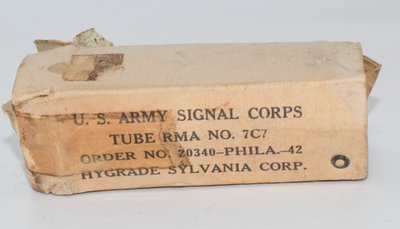
1. Introduction and History
The 7C7 is a sharp-cutoff RF pentode vacuum tube introduced in the late 1930s as part of the Loktal (Lock-In) tube family developed by Sylvania Electric Products. The Loktal series was Sylvania's proprietary answer to the octal tube family, featuring a distinctive lock-in base design that provided superior mechanical stability and resistance to vibration — a significant advantage in both mobile and military applications.
The 7C7 is the Loktal-base equivalent of the well-known 6SJ7 (octal-base sharp-cutoff pentode). It was designed primarily for use as an RF amplifier, IF amplifier, and detector stage in radio receivers, though its characteristics also made it suitable for audio preamplifier and low-level voltage amplifier applications. The tube was manufactured primarily by Sylvania, though other manufacturers including Philco and some European firms produced compatible versions.
The Loktal base system was conceived to address several shortcomings of the octal base: the pins were sealed directly into the glass envelope (eliminating the separate bakelite base), the center pin provided a positive locking mechanism in the socket, and the shorter internal lead lengths improved high-frequency performance. While the Loktal system never fully displaced the octal standard, it found widespread use in consumer radios of the late 1930s and 1940s, particularly in Philco receivers.
Production of the 7C7 continued through the 1940s and into the early 1950s, after which the Loktal format gradually fell out of favor as miniature 7-pin and 9-pin tubes became dominant. Today, the 7C7 is primarily encountered as NOS (New Old Stock) and is of interest to vintage radio restorers and a niche group of audiophiles who appreciate its unique sonic qualities.
2. Technical Specifications and Design
General Description
- Type: Sharp-cutoff RF pentode
- Loktal equivalent of: 6SJ7 (octal), 6SJ7GT
- Base: 8-pin Loktal (Lock-In) base
- Envelope: T9 glass envelope (tubular, approximately 1-1/8" diameter)
- Mounting position: Any
- Overall length: Approximately 3-3/16" (81 mm) — confirm against manufacturer datasheet
- Seated height: Approximately 2-5/8" (67 mm) — confirm against manufacturer datasheet
Heater Ratings
- Heater voltage (Eh): 6.3 V
- Heater current (Ih): 0.3 A
- Heater type: Indirectly heated cathode
Maximum Ratings (Absolute Maximum Values)
- Maximum plate voltage (Eb max): 300 V
- Maximum screen grid voltage (Ec2 max): 150 V
- Maximum plate dissipation (Pb max): 2.5 W — some sources list 3.0 W; verify against Sylvania datasheet
- Maximum screen grid dissipation (Pc2 max): 0.5 W
- Maximum cathode current: 10 mA
- Maximum heater-cathode voltage: ±100 V
Typical Operating Conditions (as Amplifier, Class A)
| Parameter | Condition 1 | Condition 2 |
|---|---|---|
| Plate voltage (Eb) | 250 V | 100 V |
| Screen voltage (Ec2) | 100 V | 50 V |
| Grid voltage (Ec1) | -3 V | -3 V |
| Plate current (Ib) | 3.0 mA | 1.2 mA |
| Screen current (Ic2) | 0.8 mA | 0.4 mA |
| Transconductance (gm) | 1,650 µmhos (µS) | — |
| Plate resistance (rp) | ~0.7 MΩ (700 kΩ) | — |
| Amplification factor (µ) | ~1,150 | — |
Note: The amplification factor and plate resistance values for sharp-cutoff pentodes are inherently high and can vary significantly with operating conditions. The values above are typical for the stated operating point and should be confirmed against the Sylvania or RCA (for the equivalent 6SJ7) datasheet.
Interelectrode Capacitances (Typical)
- Grid-to-plate (Cgp): ≤ 0.005 pF
- Input capacitance (Cin): ~6.0 pF
- Output capacitance (Cout): ~7.0 pF
Note: Exact capacitance values may differ slightly between Loktal and octal versions due to different internal lead dress. Confirm against Sylvania 7C7 datasheet.
Pin-Out (8-Pin Loktal Base, Bottom View)
| Pin | Connection |
|---|---|
| Pin 1 | Shell (internal shield) / No connection on some versions |
| Pin 2 | Heater |
| Pin 3 | Plate (Anode) |
| Pin 4 | Screen grid (Grid 2) |
| Pin 5 | Suppressor grid (Grid 3) — internally connected to cathode on some versions |
| Pin 6 | Cathode |
| Pin 7 | Heater |
| Pin 8 | Control grid (Grid 1) |
Important: The Loktal pin-out is NOT the same as the octal pin-out of the 6SJ7. The 7C7 cannot be plugged into an octal socket, and vice versa, without an adapter. Always verify pin connections against the specific manufacturer's datasheet before wiring, as some sources show minor variations in the shell/shield connection.
Internal Construction
The 7C7 features a conventional pentode structure with an indirectly heated oxide-coated cathode, a helical wound control grid (Grid 1), a screen grid (Grid 2), and a suppressor grid (Grid 3). The suppressor grid is typically connected internally to the cathode, though some variants bring it out to a separate pin for flexibility. The tube includes an internal electrostatic shield connected to pin 1 (shell), which should be grounded for optimal RF shielding and minimum hum pickup.
3. Applications and Usage
The 7C7 was designed for multiple roles in radio receiver circuits:
- RF amplifier: The sharp-cutoff characteristic and low grid-to-plate capacitance made it well-suited for radio-frequency amplification stages in AM broadcast receivers.
- IF amplifier: Commonly used in intermediate frequency amplifier stages at 455 kHz, where its high gain and sharp cutoff provided excellent selectivity.
- Detector/AVC: Used as a plate detector or in automatic volume control circuits.
- Audio voltage amplifier: The high amplification factor and moderate transconductance made it suitable as a first audio voltage amplifier stage, particularly in radio receivers where it could serve as the audio preamplifier following the detector.
- Oscillator: Occasionally used in local oscillator circuits in superheterodyne receivers.
- Test equipment: Found in some vintage test instruments, oscilloscopes, and signal generators where its stable characteristics were valued.
The 7C7 was most commonly found in Philco radio receivers from the late 1930s and 1940s, as Philco was the primary adopter of the Loktal tube system. It also appeared in some Sylvania-branded receivers and a handful of other manufacturers' products.
4. Sound Characteristics
While the 7C7 was not originally designed as an "audio tube," those who have used it in audio preamplifier circuits report distinctive sonic qualities:
- Clarity and detail: The sharp-cutoff pentode characteristic provides a clean, articulate sound with excellent resolution of fine detail. Users frequently describe the 7C7 as having a "clear window" quality that reveals subtle nuances in recordings.
- Midrange presence: Like its octal cousin the 6SJ7, the 7C7 is noted for a slightly forward, engaging midrange that gives vocals and acoustic instruments a sense of immediacy and presence.
- Treble character: The high-frequency response is generally described as smooth and extended without harshness, though some listeners note a slight "vintage" warmth compared to later miniature pentodes like the EF86.
- Low noise: When properly implemented with the internal shield grounded, the 7C7 can achieve very low noise levels, making it suitable for phono preamplifier and microphone preamplifier applications. The Loktal base construction, with its sealed-in pins, can contribute to lower microphonic noise compared to some octal equivalents.
- Dynamic character: The tube is described as having a lively, dynamic quality with good transient response. The sharp-cutoff characteristic means it transitions cleanly from quiet passages to loud ones without the compression that remote-cutoff types might introduce.
- Harmonic signature: As a pentode, the 7C7 produces a more complex harmonic spectrum than triodes, with both even and odd harmonics present. When operated in pentode mode, the sound can be slightly "edgier" than triode operation. Some builders wire the screen grid to the plate through a resistor to achieve pseudo-triode operation, which softens the harmonic content and produces a warmer, more triode-like tone.
Overall, the 7C7 is considered to have a tonal character very similar to the 6SJ7, with some listeners claiming the Loktal construction provides a marginal improvement in microphonic behavior and a slightly tighter, more controlled sound — though such differences are subtle and debated.
5. Equivalent or Substitute Types
| Type | Base | Notes |
|---|---|---|
| 6SJ7 | Octal (8-pin) | Direct electrical equivalent. Different base — requires socket adapter or rewiring. Metal envelope version. |
| 6SJ7GT | Octal (8-pin) | Glass-envelope version of 6SJ7. Same electrical characteristics. Different base. |
| 6SJ7Y | Octal (8-pin) | Glass version variant. Same electrical specs. Different base. |
| EF36 | Octal (International Octal) | British/European equivalent of 6SJ7. Similar characteristics but verify pin-out carefully as International Octal differs from American Octal. |
| VT-116 | Octal | Military designation for the 6SJ7. Different base from 7C7. |
| 1620 | Octal | Selected/premium version of 6SJ7 for low-noise applications. Different base. |
Important notes on substitution:
- The 7C7 uses a Loktal base while the 6SJ7 uses an octal base. These are physically incompatible — you cannot simply swap one for the other without a socket adapter or circuit modification.
- Loktal-to-octal adapters do exist and are occasionally available from specialty suppliers, allowing a 6SJ7 to be used in a 7C7 socket (or vice versa). Ensure the adapter correctly maps all pin connections.
- Electrically, the 7C7 and 6SJ7 are essentially identical and can be considered direct equivalents in terms of circuit design parameters.
- Do not substitute the 7C7 with the 7A7 (which is the Loktal equivalent of the 6SK7, a remote-cutoff pentode). While physically compatible with the same socket, the 7A7 has a different cutoff characteristic that will affect circuit behavior, particularly in audio applications.
6. Notable Characteristics
- Loktal base advantages: The Lock-In base design provides excellent mechanical stability. The tube locks positively into its socket and cannot work loose due to vibration — a significant advantage in portable radios, automotive applications, and any environment subject to mechanical shock. The sealed glass-to-pin construction also reduces moisture ingress and improves long-term reliability.
- Low microphonics: The rigid Loktal construction and internal mounting contribute to lower microphonic sensitivity compared to many octal tubes. This makes the 7C7 particularly attractive for high-gain audio preamplifier stages where microphonic noise can be problematic.
- Internal shield: The built-in electrostatic shield (connected to pin 1) provides effective screening of the control grid from external electric fields, reducing hum pickup and improving stability in high-gain circuits. This shield should always be grounded for best performance.
- Sharp cutoff: Unlike its remote-cutoff sibling the 7A7 (equivalent to 6SK7), the 7C7 has a sharp-cutoff characteristic, meaning its gain drops off rapidly as the grid voltage becomes more negative. This makes it preferred for audio applications where linear amplification is desired, as opposed to AGC-controlled RF stages where remote cutoff is advantageous.
- Availability: As a Loktal type, the 7C7 is less commonly encountered than the ubiquitous 6SJ7. NOS examples are available from specialty tube dealers, primarily from Sylvania production. Loktal sockets are also less common than octal sockets and may need to be sourced from vintage parts suppliers.
- Collector interest: The Loktal tube family has a dedicated following among vintage radio collectors, partly due to the distinctive appearance of the tubes and their association with the Philco brand. The 7C7 is a moderately sought-after type in this community.
7. Usage in the Audio Community
The 7C7's role in the modern audio community is niche but enthusiastic. Here are the primary ways it is encountered and used:
Vintage Radio Restoration
The most common use of the 7C7 today is in the restoration of vintage Philco and other Loktal-equipped radio receivers from the late 1930s and 1940s. Restorers seek NOS 7C7 tubes to maintain originality in these classic sets. The tube's reliability and long shelf life as NOS stock make it well-suited for this purpose.
DIY Preamplifier Projects
A small but dedicated group of DIY audio enthusiasts have built preamplifiers and phono stages around the 7C7, attracted by several factors:
- Equivalence to the 6SJ7: The extensive body of 6SJ7 preamplifier designs can be directly adapted for the 7C7 with only a socket change. Classic designs like the RCA phono preamplifier circuit using the 6SJ7 translate directly.
- Lower microphonics: The Loktal construction is perceived as offering a microphonic advantage, which is particularly valuable in phono stages where high gain is required.
- Unique aesthetic: The Loktal tube has a distinctive visual appearance that appeals to builders who want their equipment to stand out from the crowd of octal and miniature tube designs.
- Cost advantage: NOS 7C7 tubes are sometimes available at lower prices than premium NOS 6SJ7 metal tubes, offering a cost-effective alternative with equivalent performance.
Microphone Preamplifiers
Some boutique microphone preamplifier builders have experimented with the 7C7 as an input stage, taking advantage of its high gain and low noise characteristics. The sharp-cutoff pentode topology provides substantial voltage gain in a single stage, reducing the number of gain stages required and potentially simplifying the signal path.
Guitar Amplifier Modifications
While not a mainstream choice, some guitar amplifier experimenters have used the 7C7 in preamp stages, particularly in custom builds where the Loktal aesthetic and slightly different tonal character are desired. The pentode's harmonic richness can contribute to a complex, textured overdrive character when pushed into distortion.
Headphone Amplifiers
The 7C7 has appeared in a handful of DIY headphone amplifier designs, typically as a voltage amplifier stage driving a cathode follower output or a small power tube. Its high gain allows for simple circuit topologies with minimal components in the signal path.
Practical Considerations for Audio Builders
- Socket sourcing: Loktal sockets are less readily available than octal sockets. NOS ceramic Loktal sockets are preferred for audio applications; used sockets salvaged from vintage radios are also an option but should be inspected for worn contacts.
- Tube matching: For stereo applications, matched pairs of 7C7 tubes may be difficult to find. Builders should test and select tubes for matched gain and noise characteristics.
- Operating point optimization: For audio use, the 7C7 is typically operated at lower plate voltages (100–250 V) with screen voltages of 50–100 V. Careful selection of the operating point can optimize linearity and minimize distortion.
- Pentode vs. triode strapping: Many audio builders prefer to connect the screen grid to the plate (through a suitable resistor) to operate the 7C7 as a triode. This reduces gain but significantly lowers distortion and output impedance, producing a warmer, more "tube-like" sound that many audiophiles prefer.
- Decoupling: Adequate screen grid decoupling is essential for low-noise operation in pentode mode. A high-quality capacitor of 10–47 µF on the screen supply, combined with a suitable dropping resistor, is recommended.
Disclaimer: While every effort has been made to ensure the accuracy of the specifications presented in this article, builders and engineers should always verify critical values against original manufacturer datasheets (Sylvania, RCA equivalent 6SJ7 data) before designing circuits. Some specifications noted above are derived from 6SJ7 data and applied to the 7C7 based on their established equivalence; minor differences may exist between specific production runs and manufacturers.