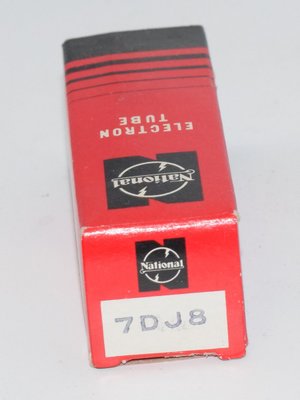
Introduction and History
The 7DJ8, also known by its European designation PCC88, is a high-transconductance double triode vacuum tube originally developed for use as a cascode amplifier in television receiver tuners. Released in the late 1950s — with the Rogers Electronic Tubes datasheet dated October 10, 1958, from JEDEC release #2382 (February 9, 1959) — the 7DJ8 was engineered to provide high gain with exceptionally low noise at VHF frequencies. It belongs to the same family as the celebrated 6DJ8/ECC88, but is distinguished by its higher heater voltage of 7 volts (as opposed to 6.3V), making it specifically suited for series-string heater configurations common in television sets of the era.
The tube was manufactured by numerous companies across the globe, including Amperex, Mullard, Philips, Matsushita (Japan), Siemens, and Rogers (Canada). The 'P' prefix in the European designation PCC88 indicates a 300 mA series-string heater design, while the 'CC' denotes a double triode intended for VHF/UHF applications. The '88' suffix places it firmly in the high-performance signal tube family alongside the ECC88, UCC88, and related types.
While originally a television component, the 7DJ8/PCC88 has found a devoted following in the high-fidelity audio community, where its high transconductance, low noise characteristics, and musical tonality have made it a sought-after tube for preamplifiers, headphone amplifiers, and phono stages.
Technical Specifications and Design
General Description
The 7DJ8 is described in the manufacturer datasheet as a "Double triode with high transconductance and low noise for use as cascode amplifier in tuners for television receivers." The tube contains two separate triode sections internally configured for cascode operation: a grounded-cathode input section and a grounded-grid output section.
Mechanical Data
| Parameter | Value |
|---|---|
| Cathode | Coated, unipotential |
| Base | E 9-1 (Noval / B9A) |
| Bulb | T 6½ |
| Outline | 6-2 |
| Basing | 9 DE |
| Mounting Position | Any |
| Maximum Diameter | ⅞ inch |
| Maximum Seated Height | 2 7/16 inches |
Heater Data
| Parameter | Value |
|---|---|
| Heater Voltage | 7 volts |
| Heater Current | 300 mA |
Note: The TDSL reference database lists the heater voltage as 7.6V. The Rogers/JEDEC datasheet specifies 7 volts. This discrepancy may reflect different manufacturers' specifications or nominal vs. design-center values. Users should confirm the heater voltage for their specific manufacturer's version.
Pinout (9-Pin Noval Base, Bottom View)
| Pin | Element | Section |
|---|---|---|
| 1 | Plate | Grounded-grid output section |
| 2 | Grid | Grounded-grid output section |
| 3 | Cathode | Grounded-grid output section |
| 4 | Heater | — |
| 5 | Heater | — |
| 6 | Plate | Grounded-cathode input section |
| 7 | Grid | Grounded-cathode input section |
| 8 | Cathode | Grounded-cathode input section |
| 9 | Internal Shield | — |
Maximum Ratings (Each Section, Design Center Values)
| Parameter | Value |
|---|---|
| Plate Voltage (cold cathode) | 550 volts max. |
| Plate Voltage | 130 volts max. |
| Plate Dissipation | 1.8 watts max. |
| Cathode Current | 25 mA max. |
| Negative Grid Voltage | 50 volts max. |
| Grid Circuit Resistance | 1 megohm max. |
| Voltage Between Cathode and Heater (grounded-cathode section) | 80 volts rms max. |
| Peak Voltage Between Cathode and Heater (grounded-grid section, cathode positive w.r.t. heater) | 180 volts max. |
| DC Component of Cathode to Heater Voltage (grounded-grid section) | 130 volts max. |
| Circuit Resistance Between Heater and Cathode | 20,000 ohms max. |
Typical Characteristics (Each Section)
| Parameter | Value |
|---|---|
| Plate Voltage | 90 volts |
| Grid Bias | −1.3 volts |
| Plate Current | 15 mA |
| Transconductance (gm) | 12,500 micromhos (12.5 mA/V) |
| Amplification Factor (μ) | 33 |
| Plate Resistance (rp) | ~2,640 ohms (calculated: μ/gm = 33/0.0125) |
| Equivalent Noise Resistance | 300 ohms |
Note: The plate resistance of approximately 2,640 ohms is calculated from the relationship rp = μ / gm. This value should be confirmed against additional manufacturer data if critical precision is required.
Direct Interelectrode Capacitances
Grounded-Cathode Section (Input Section, Pins 6-7-8)
| Parameter | Without External Shield | With External Shield |
|---|---|---|
| Grid to all other elements except plate (Cgk) | 3.3 μμF | 3.3 μμF |
| Plate to all other elements except grid (Cak) | 1.8 μμF | 2.5 μμF |
| Plate to grid (Cga) | 1.4 μμF | 1.4 μμF |
| Grid to heater | 0.13 μμF | 0.13 μμF |
Grounded-Grid Section (Output Section, Pins 1-2-3)
| Parameter | Without External Shield | With External Shield |
|---|---|---|
| Cathode to all other elements except plate | 6.0 μμF | 6.0 μμF |
| Plate to all other elements except cathode | 2.8 μμF | 3.7 μμF |
| Plate to grid | 1.4 μμF | 1.4 μμF |
| Cathode to heater | 2.7 μμF | 2.7 μμF |
| Plate to cathode | 0.18 μμF | 0.16 μμF |
Between Grounded-Cathode and Grounded-Grid Sections
| Parameter | Without External Shield | With External Shield |
|---|---|---|
| Plate to plate | max. 0.045 μμF | 0.015 μμF |
| Grid (grounded-cathode section) to plate (grounded-grid section) | max. 0.005 μμF | 0.005 μμF |
Important Design Notes
The manufacturer datasheet includes a critical remark: "In order not to exceed the maximum permissible plate voltage when the cascode amplifier is controlled, it is necessary to use a voltage divider for the grid of the grounded-grid section. With grid current biasing for the grounded-cathode section the plate voltage across this section should not exceed 75 volts in the not-controlled condition."
Applications and Usage
Original Television Applications
The 7DJ8/PCC88 was primarily designed for cascode RF amplifier service in VHF television tuners. In this configuration, the grounded-cathode section (pins 6-7-8) serves as the input amplifier, while the grounded-grid section (pins 1-2-3) provides the output stage. This cascode arrangement delivers high gain with excellent isolation between input and output, minimizing the Miller effect and providing stable operation at VHF frequencies. The internal shield (pin 9) further enhances inter-section isolation.
The 300 mA heater current was specifically chosen for series-string heater circuits, eliminating the need for a heater transformer in AC/DC television receivers — a significant cost and weight saving in consumer electronics of the 1950s and 1960s.
RF and Communications
Beyond television, the 7DJ8 found use in VHF communications receivers, FM tuner front-ends, and laboratory instrumentation where low-noise amplification at high frequencies was required. The exceptionally low equivalent noise resistance of 300 ohms made it competitive with the best available tubes for sensitive receiver applications.
Audio Applications
The 7DJ8 has been widely adopted in audio circuits including:
- Preamplifier voltage gain stages — where its high transconductance provides excellent gain with low noise
- Phono preamplifiers — the low equivalent noise resistance makes it suitable for amplifying the tiny signals from phono cartridges
- Headphone amplifiers — the relatively high plate current capability and low plate resistance allow it to drive headphones effectively
- Line-stage amplifiers — used in both commercial and DIY high-fidelity equipment
- Buffer stages — the low output impedance makes it an excellent buffer
Sound Characteristics
The 7DJ8/PCC88 has developed a reputation in the audiophile community for a distinctive sonic signature that sits in an interesting space between analytical precision and musical warmth. Here is how experienced listeners and audio engineers typically characterize its sound:
Tonal Balance and Character
The 7DJ8 is generally described as having a slightly warmer and more relaxed presentation compared to its 6.3V sibling, the 6DJ8/ECC88. While the electrical parameters are essentially identical between the two types, many listeners report subtle differences that they attribute to the different heater voltage and current characteristics. The 7DJ8 tends to present a smooth, refined midrange with good detail retrieval that avoids the sometimes clinical or forward quality that certain 6DJ8 variants can exhibit.
Frequency Extremes
The high transconductance of 12,500 micromhos contributes to excellent high-frequency extension and air, while the low plate resistance ensures solid bass control and authority. The treble is typically described as extended but not aggressive — detailed without being etched or fatiguing. Bass response benefits from the tube's ability to deliver current, resulting in a presentation that is taut and well-defined rather than loose or bloomy.
Dynamics and Imaging
The low noise floor (300 ohms equivalent noise resistance) translates directly into excellent micro-dynamic resolution. Subtle details, ambient cues, and low-level information emerge clearly from a black background. Soundstage presentation is typically described as wide and well-organized, with precise imaging that places instruments convincingly in space.
Manufacturer Variations
As with most vintage tube types, sonic character varies by manufacturer:
- Matsushita (Japan) — Known for a clean, neutral presentation with good extension at both frequency extremes. NOS examples are well-regarded for their consistency and reliability.
- Amperex (Holland) — Prized for a rich, dimensional midrange with a slightly warm character. Bugle Boy and orange globe variants are particularly sought after.
- Mullard (UK) — Valued for a lush, full-bodied sound with excellent midrange texture and a slightly romantic character.
- Siemens (Germany) — Appreciated for precision, clarity, and excellent transient response with a more analytical character.
Comparison to the 6DJ8/ECC88
Many audiophiles who have compared the 7DJ8 directly against the 6DJ8 in equipment that can accommodate both (with appropriate heater voltage adjustment) report that the 7DJ8/PCC88 tends to sound slightly more composed and less "hot" in the upper frequencies, with a marginally more forgiving character that some find more musically engaging for extended listening sessions.
Equivalent and Substitute Types
Close / Identical Substitutes (Direct Drop-In Replacements)
| Type | Notes |
|---|---|
| PCC88 | European designation for the 7DJ8. Electrically and physically identical. |
| CV10403 | British military (CV) designation equivalent to the 7DJ8/PCC88. Direct replacement. |
Different Rating Substitutes (NOT Direct Drop-In)
The following tubes share the same pinout and similar internal construction but have different heater voltages or other rating differences. They are NOT drop-in replacements without circuit modification:
| Type | Key Difference | Notes |
|---|---|---|
| 6DJ8 | 6.3V heater at 365 mA | Same family, lower heater voltage. Most common variant. Requires heater circuit modification. |
| ECC88 | 6.3V heater at 300 mA | European designation equivalent to 6DJ8. Not a drop-in for 7DJ8. |
| 21DJ8 | 21V heater | Same family, much higher heater voltage for different series-string configurations. |
| UCC88 | Different heater voltage | Same family with 'U' prefix indicating yet another heater voltage variant. |
| 6N23P (6Н23П) | 6.3V heater, Soviet manufacture | Russian equivalent of the 6DJ8/ECC88 family. Similar characteristics but different heater voltage. |
| CV5358 | 6.3V heater | British military equivalent in the 6DJ8/ECC88 family. |
Important Warning: While the 7DJ8 shares the same noval base and similar electrical characteristics with the 6DJ8/ECC88 family, substituting one for the other requires changing the heater supply voltage. Using a 7DJ8 in a circuit designed for a 6DJ8 (6.3V heater) will result in an under-heated cathode, poor emission, and degraded performance. Conversely, applying 7V to a 6DJ8 will overheat the cathode and dramatically shorten tube life. Always verify heater voltage compatibility before substitution.
Notable Characteristics
- Exceptionally High Transconductance: At 12,500 micromhos (12.5 mA/V), the 7DJ8 offers one of the highest transconductance values among small-signal triodes. This translates to high voltage gain capability and excellent high-frequency performance.
- Very Low Noise: The equivalent noise resistance of only 300 ohms makes the 7DJ8 one of the quietest small-signal tubes available, rivaling many modern low-noise transistors in sensitive applications.
- Internal Shield: Pin 9 connects to an internal electrostatic shield between the two triode sections, providing excellent isolation — critical for cascode operation and beneficial in audio circuits where crosstalk between sections must be minimized.
- Low Plate Voltage Operation: With a maximum plate voltage of only 130 volts (operating) and typical operation at 90 volts, the 7DJ8 is a low-voltage tube by traditional standards. This makes it well-suited to modern low-voltage designs but requires careful attention to operating points.
- Moderate Amplification Factor: The μ of 33 provides a good balance between gain and linearity, making the tube versatile across various circuit topologies.
- Series-String Heater Design: The 300 mA / 7V heater was designed for series-string operation, meaning the heater is robust and well-suited to regulated DC heater supplies — a common practice in low-noise audio applications.
- Cascode Voltage Precaution: The datasheet specifically warns that a voltage divider must be used for the grounded-grid section's grid bias when operating in cascode mode, and that the grounded-cathode section's plate voltage should not exceed 75 volts in the uncontrolled condition.
Usage in the Audio Community
A Hidden Gem in the 6DJ8 Family
The 7DJ8/PCC88 occupies a unique and advantageous position in the audio community. Because the vast majority of audiophile attention (and pricing pressure) has been focused on the 6DJ8/ECC88 and its premium variants (E88CC/6922, CCa, E188CC/7308), the 7DJ8 has historically been available at significantly lower prices despite offering essentially identical performance characteristics. Savvy audiophiles and DIY builders have long recognized this value proposition.
Equipment Compatibility
Several audio equipment manufacturers have designed their products to accept the 7DJ8/PCC88 either as a primary tube type or as an alternative to the 6DJ8. Equipment with adjustable or switchable heater supplies can often accommodate both types. Some notable applications include:
- DIY Preamplifiers: Many DIY audio projects based on the 6DJ8 topology can be easily adapted for the 7DJ8 by adjusting the heater supply. The Aikido, SRPP, and mu-follower topologies are all popular choices.
- Headphone Amplifiers: The 7DJ8's combination of high transconductance and low output impedance makes it excellent for driving headphones, particularly in OTL (output-transformerless) designs.
- Phono Stages: The 300-ohm equivalent noise resistance makes the 7DJ8 an outstanding choice for MC and MM phono preamplifiers where signal-to-noise ratio is paramount.
- Hybrid Amplifiers: Some hybrid designs (tube input/driver with solid-state output) use the 7DJ8 as a voltage amplifier or phase splitter.
Tube Rolling and Collecting
The 7DJ8/PCC88 is actively sought by tube rollers — audiophiles who swap different tube brands and vintages to fine-tune the sound of their equipment. Because the PCC88 was manufactured in enormous quantities for the television industry, NOS (New Old Stock) examples remain relatively available from manufacturers including Matsushita, Amperex, Mullard, Philips, Siemens, Valvo, and others. Matsushita-manufactured 7DJ8 tubes from Japan are particularly noted in the market for their consistent quality and musical performance.
Practical Considerations for Audio Use
When using the 7DJ8 in audio circuits, designers and hobbyists should keep several points in mind:
- Heater Supply: A regulated DC heater supply is recommended for the lowest noise floor, particularly in phono stage applications. The 7V / 300 mA requirement is easily met with modern voltage regulators.
- Operating Point: The typical operating point of 90V plate voltage with −1.3V grid bias and 15 mA plate current provides an excellent starting point for audio circuits. The steep transconductance curve means that small changes in bias can produce significant changes in operating current.
- Plate Voltage Limits: The 130V maximum plate voltage must be respected. This is lower than many other small-signal triodes and requires careful power supply design.
- Cathode-to-Heater Voltage: In circuits where the cathode is elevated significantly above ground, the 80V rms maximum cathode-to-heater voltage (for the grounded-cathode section) must be observed.
- Internal Shield: Pin 9 (internal shield) should be connected to ground or to the appropriate circuit ground point for optimal noise performance and inter-section isolation.
Market Position
The 7DJ8/PCC88 represents one of the best values in the high-transconductance dual triode market. While premium 6DJ8 variants like the Amperex 6922 or Siemens CCa can command prices of $50–$200+ per tube, equivalent-quality PCC88 tubes from the same manufacturers can often be found at a fraction of the cost. For the audio enthusiast willing to accommodate the 7V heater requirement, the 7DJ8 offers world-class performance at a remarkably accessible price point.