1. Introduction and History
The 7F7 is a high-mu (high amplification factor) dual triode vacuum tube designed for use as a resistance-coupled amplifier or phase inverter. Manufactured by Sylvania and other American tube makers, the 7F7 was introduced in the early 1940s as part of the Loctal (Lock-In) tube family — a base design developed by Sylvania that aimed to provide a more secure and vibration-resistant connection than the earlier octal base system.
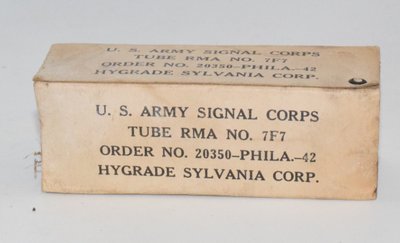
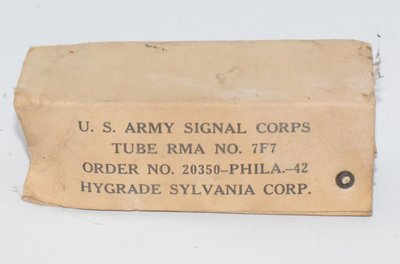
The Lock-In base design featured pins that locked mechanically into the socket, making the 7F7 particularly well-suited for military and mobile applications where vibration and shock were concerns. Indeed, the 7F7 saw significant use during World War II, receiving the military designation VT-189 and being procured in large quantities by the U.S. Army Signal Corps. The British equivalent designation is CV893.
The 7F7 is the Lock-In base equivalent of the more widely known 6SL7GT octal-base dual triode. While the two tubes share nearly identical electrical characteristics, they are not directly interchangeable due to their different base configurations. The 7F7 uses the 8-pin Lock-In (Loctal) base, while the 6SL7GT uses the standard octal base. Both tubes contain two independent high-mu triode sections sharing a common heater.
The Loctal tube family, while technically superior in terms of mechanical reliability, ultimately lost the marketplace battle to the octal and later miniature (noval) tube families. As a result, the 7F7 is less commonly encountered today than its 6SL7GT counterpart, though it remains available as new-old-stock (NOS) from various suppliers, particularly Sylvania-manufactured examples from the 1940s era.
2. Technical Specifications and Design
Physical Specifications
| Base | Lock-In 8 Pin (Loctal, 8AC-L-0) |
| Bulb | T9 |
| Maximum Overall Length | 2-25/32 inches |
| Maximum Seated Height | 2-1/4 inches |
| Mounting Position | Any |
Absolute Maximum Ratings
| Heater Voltage AC or DC (Nominal) | 7.0 Volts |
| Heater Current | 0.32 Ampere |
| Maximum Plate Voltage | 300 Volts |
| Maximum Plate Dissipation per Plate | 1.0 Watt |
| Minimum Grid Voltage | 0 Volt |
| Maximum Heater-Cathode Voltage | 90 Volts |
Direct Interelectrode Capacitances
With 1-5/16" diameter shield (RMA Std. M8-308) connected to cathode:
| Grid to Plate | 1.6 µµf |
| Input | 2.4 µµf |
| Output | 2.0 µµf |
| Grid 1 to Grid 2 | 0.2 µµf Max. |
| Plate to Plate | 1.0 µµf Max. |
Typical Operation — Class A Amplifier Per Section
| Parameter | Condition 1 | Condition 2 |
|---|---|---|
| Heater Voltage | 6.3 Volts | 6.3 Volts |
| Heater Current | 0.3 Ampere | 0.3 Ampere |
| Plate Voltage | 100 Volts | 250 Volts |
| Grid Voltage | −1.0 Volts | −2.0 Volts |
| Plate Current | 0.65 mA | 2.3 mA |
| Plate Resistance (rp) | 62,000 Ohms | 44,000 Ohms |
| Mutual Conductance (gm) | 1,125 µmhos | 1,600 µmhos |
| Amplification Factor (µ) | 70 | 70 |
Note that the datasheet specifies heater operation at both 6.3V and 12.6V configurations (the latter achieved by wiring the heater sections in series), though the nominal heater rating is 7.0V. The heater current at 6.3V operation is listed as 0.3A in the typical operation table, while the maximum rating specifies 0.32A at 7.0V nominal.
Pinout (Lock-In 8-Pin Base, Bottom View)
The 7F7 uses the 8AC-L-0 Lock-In base configuration. Viewed from the bottom of the tube:
- Pin 1 — Heater (H)
- Pin 2 — Cathode 1 (K)
- Pin 3 — Plate 1 (P)
- Pin 4 — Grid 1 (G)
- Pin 5 — Grid 2 (G)
- Pin 6 — Plate 2 (P)
- Pin 7 — Cathode 2 (K)
- Pin 8 — Heater (H)
All elements except the common heater are brought out separately, allowing each triode section to operate independently of the other. This is an important design feature that provides maximum flexibility in circuit design.
3. Applications and Usage
The Sylvania 7F7 was designed primarily for the following applications:
- Resistance-Coupled Amplifier: The high amplification factor of 70 and relatively high plate resistance make the 7F7 an excellent choice for voltage amplification stages using resistance (RC) coupling between stages. Sylvania provided specific resistance coupling data for this tube in their technical documentation.
- Phase Inverter: With two matched triode sections in a single envelope, the 7F7 is ideally suited for split-load (cathodyne) or long-tailed pair phase inverter circuits, which are essential for driving push-pull output stages.
- Preamplifier Stages: The high gain per stage available from the 7F7 makes it suitable for low-level signal amplification in radio receivers, audio preamplifiers, and instrumentation.
- Military Communications Equipment: The Lock-In base provided superior vibration resistance compared to octal tubes, making the 7F7 (as VT-189) a preferred choice for military radio receivers and communications equipment during World War II.
The tube's low plate current requirements (0.65 mA at 100V plate, 2.3 mA at 250V plate) and modest heater power consumption made it economical in multi-stage amplifier designs where power supply demands needed to be kept reasonable.
4. Sound Characteristics
The 7F7, being electrically equivalent to the 6SL7GT, shares many of the same sonic attributes that have made the 6SL7 family beloved among audiophiles. However, the 7F7 has its own distinct reputation, shaped in part by the era and quality of its manufacture:
- Smooth, Refined Midrange: Like its 6SL7GT counterpart, the 7F7 is known for a smooth, liquid midrange presentation. The high-mu triode topology, with its relatively high plate resistance of 44,000–62,000 ohms, tends to produce a warm, harmonically rich sound when used in voltage amplifier stages.
- Low Microphonics: The Lock-In base design provides a more rigid mechanical connection than the octal base, which can translate to lower microphonic noise in practice. This is particularly beneficial in high-gain first stages where microphonic sensitivity is most critical.
- Warm, Detailed Highs: Users report that NOS Sylvania 7F7 tubes tend to offer a slightly warmer and more detailed high-frequency presentation compared to some later-production 6SL7GT equivalents. The careful wartime manufacturing standards often resulted in tighter tolerances and better section matching.
- Excellent Section Matching: Military-grade 7F7 tubes (VT-189) were manufactured to stringent specifications, often resulting in very closely matched triode sections. This is particularly advantageous in phase inverter applications, where section balance directly affects distortion performance and soundstage imaging.
- Harmonic Character: As a high-mu triode, the 7F7 produces predominantly even-order harmonics (primarily second harmonic) when driven into mild nonlinearity. This gives the tube its characteristically "musical" and "euphonic" distortion signature, which many listeners find pleasing and natural-sounding.
- Dynamic Nuance: The 7F7's transfer characteristics, as shown in the Sylvania plate and transfer curves, reveal a reasonably linear operating region that preserves micro-dynamic detail. The gradual curvature at the extremes of the operating range contributes to a natural, unforced compression that many audiophiles describe as "organic" or "lifelike."
Overall, the 7F7 is considered a premium-sounding dual triode that rewards careful circuit implementation. Its sonic character sits comfortably in the warm-yet-detailed camp, making it an excellent choice for listeners who value tonal richness without sacrificing resolution.
5. Equivalent or Substitute Types
| Type | Relationship | Notes |
|---|---|---|
| 7F7TV | Direct equivalent | Television-rated version of the 7F7; identical pinout and specifications. Direct drop-in replacement. |
| CV893 | Direct equivalent | British military designation for the 7F7. Identical specifications and pinout. Direct drop-in replacement. |
| VT-189 | Direct equivalent | U.S. military designation for the 7F7. Identical specifications; often manufactured to tighter military tolerances. |
| 14F7 | Series heater variant | The 14F7 is the 12.6V heater version designed for series-string heater operation. Electrically identical triode sections but requires a different heater supply voltage (12.6V at 0.15A vs. 7.0V at 0.32A). The Sylvania datasheet shows plate and transfer characteristics labeled "7F7-14F7" indicating shared section characteristics. |
| 6SL7GT | Electrical equivalent (different base) | The GT (octal base) equivalent as stated directly on the Sylvania datasheet. NOT a direct plug-in replacement — the 6SL7GT uses an octal base while the 7F7 uses a Lock-In base. Electrical characteristics are essentially identical. An adapter socket would be required for substitution. The 6SL7GT also has a 6.3V heater (vs. 7.0V nominal for the 7F7), so heater supply considerations apply. |
Important Note: While the 7F7 and 6SL7GT are described as equivalents by Sylvania, they cannot be physically interchanged without a socket adapter due to their different base types. Additionally, the nominal heater voltage difference (7.0V for the 7F7 vs. 6.3V for the 6SL7GT) should be considered, though the typical operation data shows the 7F7 operating satisfactorily at 6.3V heater voltage.
6. Notable Characteristics
- Lock-In (Loctal) Base Advantage: The 7F7's Lock-In base is one of its most distinctive features. The pins lock mechanically into the socket with a central spigot, providing a connection that is far more resistant to vibration and accidental dislodging than the octal base. This made the 7F7 superior for mobile, airborne, and military applications.
- Independent Triode Sections: As noted in the Sylvania datasheet, "All elements except the common heater are brought out separately allowing each triode section to operate independently of the other." This provides maximum circuit design flexibility, allowing different bias points, different load resistances, or entirely different functions for each section.
- Low Interelectrode Capacitances: The grid-to-plate capacitance of just 1.6 µµf (pF) and the very low grid-to-grid capacitance of 0.2 µµf maximum indicate excellent internal shielding between sections. The low plate-to-plate capacitance of 1.0 µµf maximum further ensures minimal crosstalk between the two triode sections, which is critical in phase inverter applications.
- Constant Amplification Factor: The amplification factor (µ) remains constant at 70 across both operating conditions listed in the datasheet (100V and 250V plate voltage). This is characteristic of a well-designed triode and indicates predictable, stable gain across a wide range of operating points.
- Wartime Manufacturing Quality: Many surviving 7F7 tubes were manufactured during World War II under strict military quality control standards. These NOS tubes are often prized for their reliability, longevity, and consistent performance — qualities that have made them sought-after by audio enthusiasts decades later.
- Flexible Mounting: The datasheet specifies that the tube may be mounted in any position, providing additional flexibility in equipment design and layout.
- Maximum Heater-Cathode Voltage: The 90V maximum heater-cathode voltage rating is important to observe in circuit designs where the cathode is elevated significantly above ground potential, as can occur in some phase inverter and cascode configurations.
7. Usage in the Audio Community
The 7F7 occupies an interesting niche in the audio community. While it is far less commonly encountered than its octal-base equivalent, the 6SL7GT, it has developed a dedicated following among audiophiles and DIY tube audio builders who appreciate its unique qualities:
Preamplifier Applications
The 7F7 is used in high-fidelity preamplifier designs where its high gain (µ = 70) provides sufficient voltage amplification for line-level and phono stage applications. Its high plate resistance of 44,000–62,000 ohms means it works best with high-impedance loads, making it ideal for resistance-coupled stages driving subsequent tube stages rather than low-impedance loads.
Phase Inverter / Driver Stage
With two independent, well-matched triode sections in a single envelope, the 7F7 is an excellent candidate for long-tailed pair or cathodyne phase inverter circuits. The low inter-section capacitances (grid-to-grid: 0.2 µµf max; plate-to-plate: 1.0 µµf max) ensure clean separation between the two phases, contributing to a wide, stable soundstage in push-pull amplifier designs.
DIY and Custom Amplifier Builds
The 7F7 appeals to the DIY audio community for several reasons. First, NOS examples — particularly Sylvania military-grade VT-189 variants — are often available at lower prices than equivalent NOS 6SL7GT tubes from premium manufacturers, offering a cost-effective path to high-quality sound. Second, the Lock-In socket, while less common than octal sockets, is still available from specialty suppliers and adds a distinctive vintage aesthetic to custom builds. Third, the mechanical security of the Lock-In base appeals to builders who transport their equipment to audio shows or listening events.
Tube Rolling and Comparison
Audio enthusiasts who have compared the 7F7 directly with the 6SL7GT (using adapter sockets or purpose-built circuits) generally report that the 7F7 offers a comparable or slightly superior sonic performance, which they attribute to the typically higher manufacturing quality of the wartime Lock-In tubes. The reduced microphonic sensitivity afforded by the Lock-In base is particularly valued in high-gain first stages where even minor vibrations can introduce audible noise.
Availability and Collectibility
The 7F7 is available primarily as NOS (New Old Stock), with Sylvania being the most commonly found manufacturer. U.S. Army-stamped VT-189 examples and standard Sylvania commercial production from the 1940s are the most frequently encountered variants. While not as heavily collected as the 6SL7GT, the 7F7 has seen increasing interest and prices as audiophiles discover its qualities. The tube is no longer in production, making NOS stocks finite and gradually diminishing.
Practical Considerations for Audio Use
Builders considering the 7F7 for audio projects should note the following practical points:
- Lock-In (Loctal) sockets are less commonly available than octal sockets but can be sourced from specialty vintage electronics suppliers.
- The 7.0V nominal heater voltage is slightly higher than the standard 6.3V used by most audio tube circuits. However, the Sylvania datasheet shows typical operation at 6.3V, and many builders successfully run the 7F7 at 6.3V with no issues. For optimal performance and longevity, a 7.0V heater supply is recommended.
- The 1.0 watt per plate maximum dissipation must be carefully observed. At 250V plate voltage and 2.3 mA plate current, the actual dissipation is approximately 0.575 watts, providing comfortable headroom below the maximum rating.
- The 0 volt minimum grid voltage rating means the grid must never be driven positive with respect to the cathode during normal operation, which is standard practice for Class A triode amplifier stages.
In summary, the 7F7 is a high-quality, historically significant dual triode that offers audiophile-grade performance in a robust, vibration-resistant package. Its electrical equivalence to the revered 6SL7GT, combined with the superior mechanical properties of the Lock-In base and the typically excellent quality of surviving NOS examples, makes it a compelling choice for discerning audio builders and enthusiasts willing to work with the less common Loctal socket format.