Introduction and History
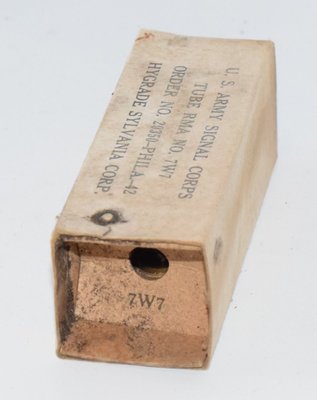
The 7W7 is a sharp cut-off pentode voltage amplifier tube manufactured in the lock-in (loctal) construction format. Produced by Tung-Sol Lamp Works Inc. of Newark, New Jersey, the tube was introduced in the late 1940s, with the original tentative datasheet dated August 2, 1948. It was also manufactured by Sylvania, with NOS (New Old Stock) examples dating from as early as 1942, suggesting the type may have been in development or limited production before Tung-Sol published their formal tentative data.
The 7W7 was designed as a high-performance voltage amplifier characterized by high transconductance and exceptionally low grid-to-plate capacitance, making it particularly well-suited for high-gain narrow-band amplifier service. Its lock-in base construction provided superior mechanical stability and lower inter-pin capacitance compared to the older octal base designs, which was critical for high-frequency and IF amplifier applications. The tube features a coated unipotential cathode and can be operated with AC or DC heater supply.
The lock-in (loctal) base was developed by Sylvania in the late 1930s as an improvement over the octal base, offering a more secure mechanical connection and better high-frequency performance. The 7W7 represents one of the later entries in the loctal tube family, arriving at a time when miniature 7-pin and 9-pin tubes were beginning to dominate new designs. This timing limited its widespread adoption, making it a relatively uncommon type today.
Technical Specifications and Design
General Characteristics
| Parameter | Value |
|---|---|
| Tube Type | Sharp Cut-Off Pentode |
| Cathode Type | Coated Unipotential (Indirectly Heated) |
| Base | Lock-In 8-Pin (Loctal) |
| Envelope | T-9 Glass Bulb |
| Mounting Position | Any |
| Maximum Overall Length | 2-25/32 inches (approx. 71 mm) |
| Maximum Diameter | 1-3/16 inches (approx. 30 mm) — T-9 envelope |
Heater Ratings
| Parameter | Value |
|---|---|
| Heater Voltage | 6.3 Volts (AC or DC) |
| Heater Current | 450 mA |
| Maximum Heater-Cathode Voltage | 90 Volts |
Maximum Ratings (per RMA Standard M8-210)
| Parameter | Value |
|---|---|
| Maximum Plate Voltage | 300 Volts |
| Maximum Grid #2 (Screen) Voltage | 150 Volts |
| Maximum Plate Dissipation | 4 Watts |
| Maximum Grid #2 Dissipation | 0.8 Watts |
Direct Interelectrode Capacitances
(With external shield connected to cathode)
| Parameter | Value |
|---|---|
| Grid to Plate (G to P) — Maximum | 0.0025 µµF (pF) |
| Input: G₁ to (H+K+G₂+G₃) | 9.5 µµF (pF) |
| Output: P to (H+K+G₂+G₃) | 7.0 µµF (pF) |
Typical Operating Conditions — Class A₁ Amplifier
| Parameter | With Fixed Screen Supply | With Series Screen Resistor |
|---|---|---|
| Heater Voltage | 6.3 V | 6.3 V |
| Heater Current | 450 mA | 450 mA |
| Plate Voltage | 300 V | 300 V |
| Grid #3 Voltage | Pin #5 connected to Pin #4 at socket | |
| Grid #2 Voltage | 150 V | — |
| Grid #2 Supply Voltage | — | 300 V |
| Grid #2 Series Resistor | — | 40,000 Ohms |
| Cathode Bias Resistor | 160 Ohms | 160 Ohms |
| Plate Resistance (approx.) | 0.3 MΩ | 0.3 MΩ |
| Transconductance (gm) | 5,800 µmhos | 5,800 µmhos |
| Plate Current | 10 mA | 10 mA |
| Grid #2 Current | 3.9 mA | 3.9 mA |
| Grid #1 Voltage (approx.) for Ib = 10 µA | -8 V | -16 V |
Derived Parameters
From the datasheet values of transconductance (gm) = 5,800 µmhos and plate resistance (rp) = 0.3 MΩ (300,000 Ohms), the amplification factor (µ) can be calculated:
µ = gm × rp = 5,800 × 10⁻⁶ × 300,000 = 1,740
This extremely high amplification factor is characteristic of a sharp cut-off pentode designed for high-gain voltage amplification service.
Pin Configuration
The 7W7 uses a Lock-In (Loctal) 8-pin base, viewed from the bottom:
- Pin 1 — Grid #1 (Control Grid) [G₁]
- Pin 2 — Heater [H]
- Pin 3 — Plate [P]
- Pin 4 — Cathode [K]
- Pin 5 — Grid #3 (Suppressor Grid) [G₃] — connect to Pin 4 (Cathode) at socket
- Pin 6 — Grid #2 (Screen Grid) [G₂]
- Pin 7 — Heater [H]
- Pin 8 — Grid #1 (Control Grid) [G₁] — note: appears as a second G₁ connection
Note: The suppressor grid (Grid #3) is brought out to a separate pin and must be externally connected to the cathode at the socket. The bottom view diagram from the Tung-Sol datasheet shows the pin arrangement with the loctal key at the bottom center.
Important Design Note
When a screen supply voltage in excess of 150 volts is used, a series screen dropping resistor must be employed to limit the screen voltage to 150 volts with plate current at the rated value of 10 mA. The datasheet specifies a 40,000-ohm series resistor when operating from a 300-volt screen supply.
Applications and Usage
The 7W7 was designed primarily for the following applications:
High-Gain Narrow-Band IF Amplifiers
The tube's exceptionally low grid-to-plate capacitance of just 0.0025 pF maximum made it ideal for intermediate frequency amplifier stages in radio receivers. This ultra-low feedback capacitance allowed stable high-gain operation without neutralization, even at elevated IF frequencies. The high transconductance of 5,800 µmhos ensured excellent stage gain.
RF Voltage Amplifiers
The combination of high gm, low interelectrode capacitances, and the superior shielding properties of the lock-in base construction made the 7W7 suitable for RF amplifier stages in communications receivers and similar equipment.
Instrumentation Amplifiers
The sharp cut-off characteristic and high gain capability made the 7W7 useful in laboratory instrumentation where high-gain, low-noise voltage amplification was required. The sharp cut-off behavior provides a more predictable and linear transfer characteristic compared to remote cut-off (variable-mu) pentodes.
Video Amplifiers
With its high transconductance and relatively low output capacitance (7.0 pF), the 7W7 could serve in video amplifier applications where wide bandwidth was needed.
General Voltage Amplification
Any application requiring a high-gain pentode voltage amplifier stage with sharp cut-off characteristics could benefit from the 7W7's performance. The very high µ of approximately 1,740 means that with appropriate plate load resistors, extremely high voltage gain per stage is achievable.
Sound Characteristics
The 7W7 is an uncommon tube in audio circles, and direct listening impressions are rare. However, based on its electrical characteristics and the general sonic behavior of similar sharp cut-off pentodes, the following observations can be made:
Tonal Character
Sharp cut-off pentodes like the 7W7, when used as voltage amplifiers in audio circuits, tend to produce a detailed and articulate sound. The extremely high transconductance (5,800 µmhos) contributes to a fast, responsive character with excellent transient definition. The high plate resistance of 0.3 MΩ means the tube behaves as a near-ideal current source, which in pentode-connected audio stages produces a more analytical and forward presentation compared to triode-connected alternatives.
Pentode vs. Triode Connection
In pentode mode, the 7W7 would be expected to deliver a bright, detailed, and somewhat lean tonal balance — characteristic of high-gm pentodes. The very high gain available means that even small signal variations are faithfully amplified, which can reveal micro-details in recordings but may also emphasize noise or source imperfections.
If triode-connected (screen tied to plate), the 7W7's character would change significantly, offering lower gain but a warmer, more harmonically rich presentation with lower output impedance. The triode-connected µ would be substantially lower than the pentode µ of 1,740, and distortion products would shift toward more musically consonant even-order harmonics.
Noise Performance
The lock-in base construction and the tube's design for high-gain narrow-band service suggest that the 7W7 was engineered with attention to low noise performance. In audio applications, this would translate to a quiet, black background — particularly important in phono preamplifier or microphone preamplifier stages where the tube would be operating at high gain with low-level input signals.
Dynamic Behavior
The sharp cut-off characteristic means the tube transitions cleanly from conduction to cut-off, without the gradual compression that remote cut-off types exhibit. In audio terms, this translates to a more linear and uncompressed dynamic response, though it also means the tube clips more abruptly when overdriven — producing a harder, more aggressive distortion character at the onset of clipping compared to variable-mu pentodes.
Equivalent or Substitute Types
| Type | Relationship | Notes |
|---|---|---|
| CV902 | Close/Identical Substitute | British military (CV) designation. This is the confirmed direct equivalent of the 7W7. Should be directly interchangeable with identical pinout and electrical characteristics. |
Related but Not Directly Interchangeable Types
The 7W7 occupies a somewhat unique niche. While there are other sharp cut-off pentodes with similar electrical parameters, the lock-in base limits direct substitution to types sharing the same base configuration. Some potentially related loctal pentodes include:
- 7V7 — Another loctal pentode, but with different characteristics. Not a direct substitute; verify specifications before attempting substitution.
- 7AG7 — A loctal sharp cut-off pentode with high transconductance, but different operating parameters. Not directly interchangeable.
Note: Due to the relative obscurity of the 7W7, confirmed interchangeable types beyond the CV902 are limited. Any substitution should be verified against manufacturer datasheets for both electrical and pinout compatibility. The lock-in base format significantly restricts the pool of potential substitutes.
Notable Characteristics
Exceptionally Low Grid-to-Plate Capacitance
At just 0.0025 pF maximum, the 7W7's grid-to-plate capacitance is remarkably low, even by sharp cut-off pentode standards. This was the tube's primary design achievement and the feature that made it particularly valuable for high-gain narrow-band amplifier service. This level of internal shielding between input and output circuits is exceptional.
High Transconductance
The 5,800 µmhos transconductance is notably high for a tube of this era and construction. Combined with the 0.3 MΩ plate resistance, this yields a voltage amplification factor (µ) of approximately 1,740 — enabling very high gain per stage.
Sharp Cut-Off Behavior
The tube reaches a plate current of 10 µA at a grid voltage of only -8 V (with fixed screen supply) or -16 V (with series screen resistor). This sharp cut-off characteristic distinguishes it from variable-mu (remote cut-off) pentodes and makes it suitable for applications requiring clean switching behavior or linear amplification without AGC.
Lock-In Base Advantages
The loctal base provides several advantages over octal construction: the pins lock mechanically into the socket, preventing accidental dislodging; the center spigot provides excellent grounding and shielding; and the shorter, more rigid pin structure reduces stray capacitance and inductance. These features were particularly important for the 7W7's intended high-frequency applications.
Moderate Power Requirements
With a heater drawing only 450 mA at 6.3 V (approximately 2.8 watts heater power) and total cathode current of approximately 13.9 mA (10 mA plate + 3.9 mA screen), the 7W7 is relatively economical in terms of power consumption for the performance it delivers.
Characteristic Curves
The Tung-Sol datasheet provides three sets of characteristic curves: plate current vs. plate voltage (Ib vs. Eb) at various control grid voltages, screen current vs. plate voltage (Ic2 vs. Eb) at various control grid voltages, and a composite chart showing plate current, screen current, transconductance, and plate resistance as functions of control grid voltage. These curves reveal the tube's well-behaved pentode characteristics with clean, evenly-spaced curves indicating good linearity in the normal operating region.
Usage in the Audio Community
The 7W7 is a rare and largely undiscovered tube in the audio community. Its obscurity stems from several factors: the lock-in base format fell out of favor by the early 1950s, the tube was primarily designed for RF/IF applications rather than audio, and its late introduction (1948) coincided with the rise of miniature tubes that quickly superseded the loctal format.
Potential Audio Applications
Despite its obscurity, the 7W7 possesses characteristics that could be exploited by adventurous audio designers:
- Phono Preamplifier Stages: The high gain and potentially low noise characteristics make the 7W7 a candidate for RIAA phono preamplifier input stages, where high gain is needed to amplify the tiny signals from moving-magnet or moving-coil cartridges.
- Microphone Preamplifiers: Similar to phono applications, the high gm and gain capability could serve well in microphone preamplifier circuits.
- Line-Level Preamplifier Stages: As a voltage amplifier in a preamplifier or as a gain stage in an integrated amplifier, the 7W7 could provide substantial gain with a single stage.
- Driver Stages: The 7W7 could serve as a high-gain driver stage for power tubes, though its 4-watt plate dissipation limit means it cannot deliver large voltage swings into low-impedance loads.
DIY and Boutique Interest
The 7W7 holds appeal for the DIY tube audio community precisely because of its rarity and unusual format. Builders who enjoy working with uncommon tube types may find the 7W7 an interesting design challenge. The lock-in socket format adds a distinctive vintage aesthetic to any build. However, sourcing both the tubes and the correct loctal sockets can be challenging and potentially expensive.
Availability and Collectibility
NOS (New Old Stock) 7W7 tubes appear occasionally from specialty vintage tube dealers. Sylvania examples from 1942 and Tung-Sol production examples are the most commonly encountered. Due to limited production quantities and the passage of time, the 7W7 is not abundant, and prices can vary significantly depending on condition, brand, and testing results. The tube is more of a collector's item and experimenter's curiosity than a mainstream audio tube.
Practical Considerations for Audio Use
Designers considering the 7W7 for audio projects should note several practical considerations:
- Lock-in (loctal) sockets are less commonly available than octal or noval sockets and may require sourcing from specialty suppliers.
- The suppressor grid must be externally connected to the cathode at the socket — it is not internally connected.
- The maximum plate voltage of 300 V and plate dissipation of 4 watts are adequate for most small-signal audio applications but limit the tube's use in higher-power circuits.
- The 160-ohm cathode bias resistor specified in the datasheet produces a bias voltage of approximately 2.2 V (at 13.9 mA total cathode current), which is a reasonable operating point for audio service.
- The very high gain (µ ≈ 1,740 in pentode mode) means that careful attention to layout, shielding, and power supply filtering is essential to prevent oscillation and noise pickup.
In summary, while the 7W7 is not a mainstream audio tube, it represents an interesting and capable design that rewards the adventurous builder willing to work with its loctal format and source the necessary components. Its combination of high transconductance, ultra-low grid-to-plate capacitance, and sharp cut-off characteristics make it a technically impressive tube that deserves more attention from the audio community.