Introduction and History
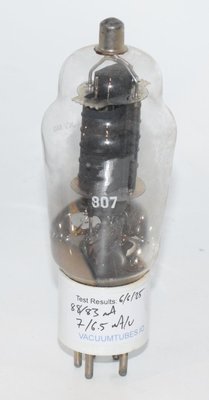
The 807 is one of the most iconic and versatile beam power tubes ever manufactured. Introduced by RCA in the late 1930s, it was designed as a transmitting tube useful at frequencies up to 125 Mc (MHz), bridging the gap between receiving tubes and larger transmitting valves. The 807 quickly became a workhorse in both military and civilian applications, serving extensively during World War II in radio transmitters, modulators, and audio amplifiers across all branches of the armed forces.
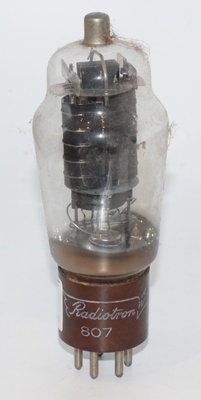
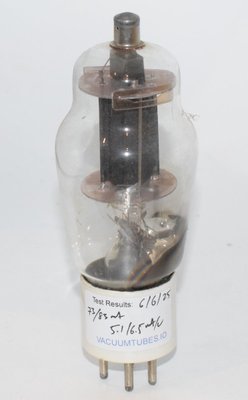
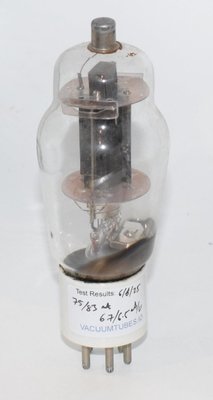
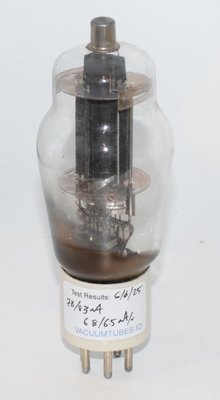
The tube's design is essentially a higher-voltage, higher-dissipation derivative of the famous 6L6 beam power tetrode, sharing similar internal geometry but housed in a larger ST-16 glass envelope with a top-cap plate connection. This top-cap arrangement was critical for its RF applications, as it reduced plate-to-grid capacitance and improved high-frequency stability. The 807 was manufactured by virtually every major tube maker worldwide, including RCA, GE, Sylvania, Hytron, Mullard, Philips, Brimar, and numerous others. It was produced under military designations VT-100 and VT-100A, and remained in active military specification (MIL-E-1/99C) well into the 1970s.
The RCA datasheet for the 807, dated November 5, 1954, describes it simply as a "Beam Power Tube, useful at frequencies up to 125 Mc." Its combination of moderate plate dissipation, high power output capability, and excellent linearity in push-pull configurations made it a natural choice for audio amplifier designers, a role it continues to fill in the 21st century among audiophiles and guitar amplifier builders.
Technical Specifications and Design
Heater / Filament
| Parameter | Value |
|---|---|
| Heater Voltage | 6.3 ± 0.6 V (ac or dc) |
| Heater Current | 0.9 A |
| Cathode Type | Coated unipotential (indirectly heated) |
Maximum Ratings — Pentode (Beam Tetrode) Mode
AF Power Amplifier & Modulator — Class AB1
| Parameter | CCS | ICAS | Unit |
|---|---|---|---|
| DC Plate Voltage | 600 max. | 750 max. | volts |
| DC Grid No.2 (Screen) Voltage | 300 max. | 300 max. | volts |
| Max.-Signal DC Plate Current | 120 max. | 120 max. | mA |
| Max.-Signal DC Plate Input | 60 max. | 90 max. | watts |
| Max.-Signal Grid No.2 Input | 3.5 max. | 3.5 max. | watts |
| Plate Dissipation | 25 max. | 30 max. | watts |
| Peak Heater-Cathode Voltage (either polarity) | 135 max. | 135 max. | volts |
AF Power Amplifier & Modulator — Class AB2
| Parameter | CCS | ICAS | Unit |
|---|---|---|---|
| DC Plate Voltage | 600 max. | 750 max. | volts |
| DC Grid No.2 (Screen) Voltage | 300 max. | 300 max. | volts |
| Max.-Signal DC Plate Current | 120 max. | 120 max. | mA |
| Max.-Signal Plate Input | 60 max. | 90 max. | watts |
| Max.-Signal Grid No.2 Input | 3.5 max. | 3.5 max. | watts |
| Plate Dissipation | 25 max. | 30 max. | watts |
Triode Connection — Class AB1 (Grid No.2 Connected to Plate)
| Parameter | CCS | ICAS | Unit |
|---|---|---|---|
| DC Plate Voltage | 400 max. | 400 max. | volts |
| Max.-Signal DC Plate Current | 125 max. | 125 max. | mA |
| Max.-Signal DC Plate plus Grid No.2 Input | 50 max. | 50 max. | watts |
| Plate Dissipation plus Grid No.2 Input | 25 max. | 30 max. | watts |
RF Power Amplifier — Class B Telephony (per tube, carrier conditions)
| Parameter | CCS | ICAS | Unit |
|---|---|---|---|
| DC Plate Voltage | 600 max. | 750 max. | volts |
| DC Grid No.2 (Screen) Voltage | 300 max. | — | volts |
| DC Plate Current | 80 max. | 90 max. | mA |
| Plate Input | 37.5 max. | 45 max. | watts |
| Grid No.2 Input | 2.5 max. | 2.5 max. | watts |
Key Electrical Characteristics
| Parameter | Value | Conditions |
|---|---|---|
| Transconductance (gm) | 6000 µmhos (6.0 mA/V) | Va=250V, Vg2=250V, Vg1=−14V |
| Mu-Factor (Grid No.2 to Grid No.1) | 8 | Va=250V, Vg2=250V, Vg1=−20V |
| Grid No.1 to Plate Capacitance | 0.2 max. µµf (pF) | With external shield JETEC No. 312 |
| Grid No.1 to Cathode, Grid No.3, Grid No.2, and Heater | 12 µµf (pF) | — |
| Plate to Cathode, Grid No.3, Grid No.2, and Heater | 7 µµf (pF) | — |
Note: The TDSL reference data lists transconductance as 5.7 mA/V at slightly different operating conditions. The RCA datasheet specifies approximately 6000 µmhos (6.0 mA/V) at Va=250V, Vg2=250V, Vg1=−14V. The military specification (MIL-E-1/99C) gives a transconductance range of 5,100 to 6,900 µmhos at Eb=Ec2=250 Vdc, Ec1=−14 Vdc. All values are consistent within the expected range for this tube type.
Maximum Circuit Values (CCS or ICAS)
Class AB1 (Pentode)
| Parameter | Value |
|---|---|
| Grid No.1 Circuit Resistance — Fixed Bias | 0.1 megohm max. |
| Grid No.1 Circuit Resistance — Cathode Bias | Not recommended |
Class AB2 (Pentode)
| Parameter | Value |
|---|---|
| Grid No.1 Circuit Resistance — Fixed Bias | 30,000 ohms max. |
| Grid No.1 Circuit Resistance — Cathode Bias | Not recommended |
Triode Connection — Class AB1
| Parameter | Value |
|---|---|
| Grid No.1 Circuit Resistance — Fixed Bias | 0.1 megohm max. |
| Grid No.1 Circuit Resistance — Cathode Bias | 0.5 megohm max. |
Physical and Mechanical Details
| Parameter | Value |
|---|---|
| Bulb / Envelope | ST-16 |
| Base | Medium-Micanol-Shell Small 5-Pin (JETEC No. A5-11) |
| Cap | Small (JETEC No. C1-1) — Plate connection |
| Basing Designation | 5AW (bottom view) |
| Mounting Position | Any |
| Maximum Overall Length | 5-3/4" (146 mm) |
| Seated Length | 4-31/32" ± 5/32" |
| Maximum Diameter | 2-1/16" (52 mm) |
| Weight (Approx.) | 3 oz (85 g) |
Pin Configuration (Bottom View — Basing 5AW)
| Pin | Connection |
|---|---|
| Pin 1 | Heater |
| Pin 2 | Grid No.2 (Screen Grid) |
| Pin 3 | Grid No.1 (Control Grid) |
| Pin 4 | Cathode, Grid No.3 (Suppressor — internally connected) |
| Pin 5 | Heater |
| Top Cap | Plate (Anode) |
The beam-forming plates and suppressor grid (Grid No.3) are internally connected to the cathode at pin 4. The plate connection is brought out through the top of the glass envelope via a small cap, which is essential for maintaining low grid-to-plate capacitance at high frequencies. The military specification notes that "the beam forming plate lead and the cathode lead shall be individually passed through the glass stem of the tube and shall be electrically connected together only at the base pin."
Typical Operating Conditions — Audio Applications
Class AB1 Push-Pull (Pentode) — Values for 2 Tubes
| Parameter | 400V | 500V | 600V | 750V (ICAS) | Unit |
|---|---|---|---|---|---|
| DC Plate Voltage | 400 | 500 | 600 | 750 | volts |
| DC Grid No.2 Voltage | 300 | 300 | 300 | 300 | volts |
| DC Grid No.1 Voltage (fixed bias) | −30 | −32 | −34 | −35 | volts |
| Peak AF Grid-to-Grid Voltage | 60 | 64 | 68 | 70 | volts |
| Zero-Signal DC Plate Current | 56 | 44 | 36 | 30 | mA |
| Max.-Signal DC Plate Current | 143 | 141 | 139 | 139 | mA |
| Effective Load Resistance (P-to-P) | 6800 | 8200 | 10000 | 12000 | ohms |
| Max.-Signal Driving Power | 0 | 0 | 0 | 0 | watts |
| Max.-Signal Power Output | 36 | 46 | 56 | 72 | watts |
Class AB2 Push-Pull (Pentode) — Values for 2 Tubes
| Parameter | 400V | 500V | 600V | 750V (ICAS) | Unit |
|---|---|---|---|---|---|
| DC Plate Voltage | 400 | 500 | 600 | 750 | volts |
| DC Grid No.2 Voltage | 300 | 300 | 300 | 300 | volts |
| DC Grid No.1 Voltage (fixed bias) | −28 | −30 | −32 | −35 | volts |
| Peak AF Grid-to-Grid Voltage | 80 | 86 | 90 | 96 | volts |
| Zero-Signal DC Plate Current | 72 | 60 | 48 | 30 | mA |
| Max.-Signal DC Plate Current | 240 | 240 | 200 | 240 | mA |
| Effective Load Resistance (P-to-P) | 3700 | 4600 | 6900 | 7300 | ohms |
| Max.-Signal Driving Power | 0.2 | 0.2 | 0.1 | 0.2 | watts |
| Max.-Signal Power Output | 55 | 75 | 80 | 120 | watts |
Class AB1 Push-Pull (Triode Connection) — Values for 2 Tubes
| Parameter | Value | Unit |
|---|---|---|
| DC Plate Voltage | 400 | volts |
| DC Grid No.1 Voltage | −45 | volts |
| Peak AF Grid-to-Grid Voltage | 90 | volts |
| Zero-Signal DC Plate Current | 64 | mA |
| Max.-Signal DC Plate Current | 140 | mA |
| Effective Load Resistance (P-to-P) | 3000 | ohms |
| Max.-Signal Driving Power | 0 | watts |
| Max.-Signal Power Output | 15 | watts |
Additional TDSL Reference Operating Points
| Configuration | Va | Vg2 | Vg1 | Ia | Zout | Pout | THD |
|---|---|---|---|---|---|---|---|
| Class A Single-Ended | 500V | 200V | −14.5V | 50 mA | 6,000 Ω | 11.5W | 12% |
| Class A Push-Pull | 500V | 300V | auto (Rk=270Ω shared) | 50–60 mA | 9,000 Ω P-P | 32.5W | 2.7% |
| Class A Push-Pull (Triode) | 325V | — | auto (Rk=375Ω shared) | 40–42 mA | 8,000 Ω P-P | 6.0W | 0.6% |
| Class AB1 Push-Pull | 600V | 300V | −29.5V | 40–75 mA | 10,000 Ω P-P | 47.5W | 2.2% |
| Class AB1 Push-Pull (Triode) | 400V | — | −45V | 30–70 mA | 3,000 Ω P-P | 15.0W | 3.0% |
| Class AB2 Push-Pull | 600V | 300V | −30V | 30–100 mA | 6,400 Ω P-P | 80.0W | 3.5% |
RF Application Operating Points (per tube)
| Service | Va | Vg2 | Vg1 | Ia | Pout | Notes |
|---|---|---|---|---|---|---|
| Class C (CW) | 750V | 250V | −45V | 100 mA | 50W | — |
| Class C (AM) | 600V | 275V | −90V | 100 mA | 42.5W | — |
| Class AB1 (RF) | 750V | 300V | −35V | 15–70 mA | 72W | — |
| Class B (RF) | 750V | — | 0V | 15–240 mA | 120W | Input on g2; g1 connected to g2 via 20kΩ |
Applications and Usage
Original and Historical Applications
The 807 was originally designed as a transmitting tube and saw its widest deployment in the following roles:
- Amateur Radio Transmitters: The 807 was the quintessential ham radio final amplifier tube from the late 1930s through the 1960s. Its ability to deliver 50 watts of RF output in Class C CW service at plate voltages up to 750V, combined with its relatively low cost and wide availability, made it the default choice for medium-power amateur stations. Pairs of 807s could deliver 120 watts in Class B RF service.
- Military Communications: Under designations VT-100 and VT-100A, the 807 served in countless military transmitters during WWII and the Korean War. The military specification MIL-E-1/99C covered both the 807 and its 12.6V heater equivalent, the 1625, for use across all Department of Defense agencies.
- Audio Modulators: In AM transmitter service, the 807 was widely used as a plate modulator, where a pair in push-pull Class AB2 could deliver up to 80 watts of audio power at 600V plate voltage — more than sufficient to fully modulate a 50-watt carrier.
- Public Address and Cinema Sound: The tube's high power output capability in push-pull made it popular in commercial PA systems and cinema sound installations, where 30–50 watts of clean audio power was required.
- Industrial and Scientific Equipment: The 807 found use in industrial RF heating equipment, scientific instruments, and various electronic control systems.
Audio Amplifier Configurations
The 807 is remarkably versatile in audio service, supporting virtually every amplifier topology:
- Single-Ended Class A (Pentode): A single 807 at 500V plate, 200V screen, and −14.5V grid bias delivers approximately 11.5 watts into a 6,000 ohm load, though with relatively high THD of around 12%. This configuration is best suited for applications where some harmonic richness is acceptable or where negative feedback will be applied.
- Push-Pull Class A (Pentode): A pair of 807s at 500V plate, 300V screen, with a shared 270Ω cathode bias resistor delivers approximately 32.5 watts into a 9,000 ohm plate-to-plate load at only 2.7% THD — a dramatic improvement over single-ended operation.
- Push-Pull Class A (Triode): With screen tied to plate at 325V, using a shared 375Ω cathode bias resistor and 8,000 ohm plate-to-plate load, a pair delivers approximately 6.0 watts at an exceptionally low 0.6% THD. This is the configuration most prized by audiophiles seeking the lowest distortion.
- Push-Pull Class AB1 (Pentode): At 600V plate, 300V screen, and −29.5V fixed bias, a pair delivers approximately 47.5 watts (per TDSL data) to 56 watts (per RCA datasheet) into a 10,000 ohm plate-to-plate load at around 2.2% THD. The RCA datasheet shows this configuration can reach 72 watts at 750V ICAS conditions with a 12,000 ohm load. Zero driving power is required in AB1 service.
- Push-Pull Class AB1 (Triode): At 400V plate with −45V fixed bias, a pair delivers approximately 15 watts into a 3,000 ohm plate-to-plate load at about 3.0% THD. This is a popular configuration for hi-fi amplifiers seeking triode warmth with moderate power.
- Push-Pull Class AB2 (Pentode): The highest-power audio configuration, delivering up to 80 watts at 600V plate voltage into a 6,400 ohm load at 3.5% THD, or an impressive 120 watts at 750V ICAS. Note that AB2 operation requires approximately 0.1–0.2 watts of driving power and demands a low-impedance driver stage — the effective resistance per grid circuit should be kept below 500 ohms and the effective impedance should not exceed 700 ohms at the highest response frequency.
Design Considerations
Several important design considerations apply when using the 807:
- Screen Supply Regulation: The RCA datasheet notes that the screen voltage is "preferably obtained from a separate source, or from the plate-voltage supply with a voltage divider." Poor screen regulation is a common cause of distortion and instability in 807 amplifiers.
- Parasitic Oscillation: The 807's high-frequency capability (useful to 125 MHz) means it can readily oscillate at VHF if proper suppression measures are not taken. Parasitic suppressors (small resistors or resistor-choke combinations) in the plate and/or screen leads are essential in audio amplifier designs.
- Top Cap Connection: The plate connection via top cap requires careful lead dress to minimize stray capacitance and prevent arcing. The top cap clip must make reliable contact, and the plate lead should be kept short and well-insulated.
- Cathode Bias vs. Fixed Bias: For Class AB1 pentode operation, cathode bias is not recommended by RCA. For Class AB2, cathode bias is explicitly "not recommended." Triode-connected Class AB1 operation permits cathode bias with up to 0.5 megohm grid circuit resistance.
Sound Characteristics
The 807's sonic character varies significantly depending on the operating mode, making it one of the most tonally versatile power tubes available:
Pentode / Beam Tetrode Mode
In its native beam tetrode configuration, the 807 produces a sound that is often described as bold, dynamic, and authoritative. The high transconductance (6000 µmhos) and relatively low plate resistance give it excellent transient response and a strong, punchy bass character. The midrange is forward and present without being harsh, and the treble extends well with good detail. In push-pull Class AB1 pentode mode, the 807 delivers a sound that many listeners compare favorably to the KT66 or 6L6GC — not surprising given its shared lineage with the 6L6 family.
The harmonic distortion curves from the RCA datasheet are revealing: in push-pull Class AB1 at 500V with fixed bias and an 8,000 ohm plate-to-plate load, the 3rd harmonic is the dominant distortion component, rising to approximately 2.5% at full output, while the 2nd harmonic remains below 1%. This odd-order harmonic dominance gives the pentode-mode 807 a slightly more aggressive, "present" character compared to triode-connected operation. With cathode bias (autobias resistor of 270 ohms, 9,000 ohm P-P load), the distortion profile shifts — the 5th harmonic becomes more prominent at higher drive levels, and the 3rd harmonic peaks and then dips before rising again, creating a complex and musically interesting distortion signature.
At 600V plate with fixed bias and 10,000 ohm load, the distortion is notably cleaner, with the 3rd harmonic staying below 2% across most of the drive range and the 2nd harmonic remaining under 1%. This suggests that the 807 benefits from higher plate voltages in terms of linearity.
Triode Mode
Triode-connected (screen tied to plate), the 807 transforms into a remarkably refined and linear amplifier. The push-pull Class A triode curves show extraordinarily low distortion — at 250V plate with fixed bias and 5,000 ohm plate-to-plate load, the 2nd harmonic distortion is below 0.5% and the 3rd harmonic is negligible up to moderate output levels. At 325V with cathode bias (375Ω shared) and 8,000 ohm load, the distortion remains below 0.6% at the rated 6 watts output.
Sonically, triode-mode 807s are described as smooth, warm, and exceptionally transparent. The sound has a liquid, flowing quality with a natural midrange that is particularly flattering to vocals and acoustic instruments. The bass is somewhat softer and less controlled than in pentode mode — a characteristic of the higher output impedance in triode connection — but many listeners prefer this as it gives a more relaxed, "breathing" quality to the low frequencies. The treble is sweet and extended without any trace of harshness.
The triode-connected 807 in Class A push-pull is often compared to the 2A3 or 300B in terms of tonal refinement, though with somewhat less power (6 watts vs. 3.5–8 watts for those dedicated triodes). The remarkably low 0.6% THD figure at rated output is competitive with the finest directly-heated triodes.
Overall Sonic Character
Across all modes, the 807 is characterized by:
- Excellent dynamics: The beam power structure provides strong current delivery and good transient response
- Tonal versatility: The ability to switch between pentode and triode modes offers a wider range of sonic flavors than most output tubes
- Musical engagement: The 807's distortion profile, particularly in pentode mode, tends toward the musically pleasing — predominantly low-order harmonics that add warmth and richness rather than harshness
- Scale and presence: Even at moderate power levels, the 807 has a sense of scale and authority that smaller tubes cannot match
- Vintage character: There is an unmistakable "vintage" quality to the 807's sound — a slight warmth and roundness that evokes the golden age of radio and early hi-fi
Equivalent or Substitute Types
Close / Identical Substitutes (Direct Drop-In Replacements)
The following types are electrically identical or very closely matched to the 807 and can generally be used as direct replacements:
- ATS25 / ATS25A — British military/commercial equivalent
- CV124 — British military (CV register) equivalent
- CV1060 — British military equivalent
- CV1364 — British military equivalent
- CV1374 — British military equivalent
- CV1572 — British military equivalent
- QV05-25 — European designation equivalent
- VT-100 / VT-100A — US military designation (WWII era)
- VT60 (RAF) / VT60A (RAF) — Royal Air Force designation
Related Types — NOT Direct Drop-In Replacements
The following types are related but have differences in ratings, pinout, heater voltage, or base configuration that prevent them from being simple drop-in substitutes. Careful circuit modification may be required:
- 807W (CV3809, 5B/245M) — Ruggedized military version of the 807 with improved construction for vibration and shock resistance. Electrically similar but may have tighter specifications. Generally usable as a replacement for the standard 807 but not vice versa in military applications.
- 1625 — The 12.6V heater version of the 807, designed for military vehicular equipment operating from 12V or 24V DC systems. Electrically identical except for the heater (12.6V at 0.45A) and uses a 7-pin base (JETEC A7-13) instead of the 5-pin base. Cannot be directly substituted without heater supply and socket changes.
- 6L6 / 6L6G / 6L6GT (CV1286, CV1947, CV1948, CV428, VT-115, VT-115A) — The 807's "parent" tube. The 6L6 family shares similar internal construction but uses an octal base with all connections on the base pins (no top cap). Maximum plate voltage ratings are significantly lower (typically 360–500V depending on variant). The 6L6 cannot handle the 807's higher voltage ratings, and the different base and plate connection arrangement prevents direct substitution.
- 6BG6 / 6BG6G — A horizontal deflection tube derived from the 807 design, with an octal base. Different operating parameters and not recommended as an audio substitute without careful circuit redesign.
Notable Characteristics
Beam Power Design
The 807 employs beam-forming plates rather than a conventional suppressor grid to create the beam power tetrode characteristic. The beam-forming plates are internally connected to the cathode (brought out at pin 4 along with the suppressor/Grid No.3 connection). This beam power design results in very low screen current in normal operation — typically only 0.5–2 mA at zero signal in Class AB1 — which contributes to high efficiency and long tube life.
Top Cap Plate Connection
The plate connection via a top cap (JETEC C1-1) is one of the 807's most distinctive physical features. This arrangement was essential for the tube's RF applications, keeping the grid-to-plate capacitance to a maximum of only 0.2 pF (with external shield JETEC No. 312). For audio applications, the top cap adds complexity to amplifier construction but provides excellent isolation between input and output circuits.
Frequency Capability
The 807 is rated for use at frequencies up to 125 MHz, making it one of the few tubes that can serve equally well as an audio output tube and a VHF RF amplifier. The military specification confirms operation at both 15 MHz (power oscillation test) and 60 MHz (qualification power oscillation test). This wide frequency range is a testament to the tube's excellent internal construction and low interelectrode capacitances.
Exceptional Power Output Range
Few tubes offer such a wide range of useful power output levels. From approximately 1 watt in single-ended triode Class A, through 6 watts in push-pull triode Class A, to 15 watts in triode AB1, 32.5–56 watts in pentode AB1, and up to 80–120 watts in pentode AB2, the 807 can be configured for virtually any power requirement. This versatility is unmatched by most other output tubes.
Robustness and Longevity
Designed as a transmitting tube, the 807 was built to withstand the rigors of continuous commercial and military service. The plate structure is substantially heavier than receiving tubes of similar power rating, and the tube can tolerate significant overloads without immediate failure. The military life test specification calls for 500 hours of operation, after which the tube must still meet minimum power oscillation requirements (27W minimum). Many 807s in audio service have operated reliably for decades.
Manufacturer Variations
The 807 was produced by an enormous number of manufacturers worldwide over a production span of more than 40 years. Notable variations include:
- RCA: The original manufacturer; early production used a glass ST-16 envelope with a distinctive shouldered shape. Later production featured improved internal construction.
- Ceramic-base versions: Some manufacturers, particularly in the UK, produced 807s with ceramic bases for improved high-frequency performance and better heat resistance.
- Radiotron (Australia): AWV (Amalgamated Wireless Valve Company) produced the 807 under the Radiotron brand for the Australian and Pacific markets.
- Metal-envelope versions: Some manufacturers produced metal-envelope variants for military applications requiring additional shielding and ruggedness.
Usage in the Audio Community
Hi-Fi and Audiophile Applications
The 807 has experienced a significant renaissance in the audiophile community, driven by several factors:
- Availability and Value: Due to massive military production, NOS (New Old Stock) 807s remain relatively abundant and affordable compared to premium audio tubes like the KT66, KT88, or 300B. This makes the 807 an attractive option for builders seeking high-quality sound without the premium pricing of dedicated audio tubes.
- Triode Mode Excellence: The 807 in triode-connected push-pull Class A has become a favorite among audiophiles who appreciate its remarkably low distortion (0.6% THD at rated output) and refined sonic character. Several boutique amplifier manufacturers have built their reputations on 807 triode amplifier designs.
- DIY Appeal: The 807's comprehensive datasheet with extensive operating curves for virtually every amplifier configuration makes it an ideal tube for DIY audio builders. The wealth of published data — including detailed harmonic distortion curves for multiple operating points — allows builders to optimize their designs with confidence.
- Vintage Aesthetic: The ST-16 glass envelope with top cap gives the 807 a dramatic, industrial appearance that appeals to audiophiles who value the visual experience of their equipment. A pair of glowing 807s makes a striking visual statement.
Popular Audio Circuit Configurations
In the audio community, the most popular 807 configurations include:
- Push-Pull Class AB1 (Pentode), 30–50 watts: The most common configuration for general-purpose hi-fi amplifiers. Typically operated at 400–600V plate voltage with 300V screen, delivering 36–56 watts with low distortion. The RCA datasheet curves show that with cathode bias (autobias) at 500V plate, 300V screen, 270Ω shared cathode resistor, and 9,000 ohm plate-to-plate load, approximately 32.5 watts can be achieved at moderate distortion levels. With fixed bias at 600V and 10,000 ohm load, output increases to approximately 47.5–56 watts.
- Push-Pull Class A (Triode), 6 watts: The audiophile's choice for the ultimate in refinement. At 325V plate with 375Ω shared cathode resistor and 8,000 ohm plate-to-plate load, this configuration delivers 6 watts of supremely clean power — sufficient for high-efficiency speakers. The 0.6% THD figure is achieved without any negative feedback.
- Push-Pull Class AB1 (Triode), 15 watts: A practical compromise between triode refinement and useful power output. At 400V plate with −45V fixed bias and 3,000 ohm plate-to-plate load, 15 watts is available — enough for most domestic listening situations with moderately efficient speakers.
- Push-Pull Class AB1 (Pentode) with Ultralinear Connection: While not specified in the original RCA datasheet, many audio designers have successfully operated the 807 in ultralinear mode (screen connected to a tap on the output transformer primary, typically at 40–43% of the total winding). This provides a sonic character intermediate between pure pentode and pure triode, with power output and distortion figures falling between the two extremes.
Guitar Amplifier Applications
The 807 has found a niche following among guitar amplifier builders and players, particularly those seeking vintage tone and high headroom. The tube's ability to deliver 55–80 watts in push-pull pentode configurations makes it suitable for powerful stage amplifiers. Its distortion characteristics — predominantly odd-order harmonics in pentode mode — produce a tone that is aggressive and cutting when driven hard, while remaining clean and articulate at lower levels. Some custom guitar amplifier builders specifically seek out military-surplus 807s for their robust construction and consistent performance.
Practical Considerations for Audio Builders
Builders considering the 807 for audio projects should be aware of several practical matters:
- Output Transformer: The plate-to-plate load impedances specified for the 807 (3,000–12,000 ohms depending on configuration) are well within the range of commonly available output transformers. For 8-ohm speakers, typical transformer ratios range from approximately 19:1 to 39:1 (turns ratio).
- Power Supply Requirements: The 807's high plate voltage requirements (400–750V) demand a robust and well-regulated power supply. The screen supply is particularly critical — the RCA datasheet recommends a separate screen supply or a voltage divider from the plate supply. A series dropping resistor from the plate supply is acceptable but provides poorer regulation.
- Socket and Mounting: The 807 uses a 5-pin base (JETEC A5-11) which is less common than octal sockets. Quality ceramic sockets are recommended, particularly for high-voltage applications. The top cap plate connection requires a suitable clip lead and careful insulation.
- Driver Stage: In Class AB1 operation, the 807 requires zero driving power, making it easy to drive with a conventional voltage amplifier stage. A 6SN7, 12AU7, or 12AT7 makes an excellent driver. For Class AB2 operation, a more capable driver is needed — the effective grid circuit resistance must be kept below 500 ohms, and the driver must be capable of supplying the specified driving power (approximately 0.2 watts) at low distortion.
- Parasitic Suppression: Essential in any 807 audio amplifier. Small carbon composition resistors (47–100 ohms) in series with the plate lead, close to the tube, are the minimum requirement. Some builders also add ferrite beads or small RF chokes.
- Matching: For push-pull operation, matched pairs are desirable. The military specification gives a plate current range of 24–48 mA at the standard test conditions, indicating significant tube-to-tube variation. Matching for idle current within 10% is recommended for best push-pull performance.
The 807 in the Modern Audio Landscape
The 807 occupies a unique position in the modern audio landscape. It offers performance that rivals or exceeds many premium audio tubes at a fraction of the cost. Its military heritage ensures robust construction and long life, while its comprehensive datasheet provides the detailed engineering data needed for optimized amplifier design. Whether used in a minimalist triode amplifier delivering 6 watts of crystalline purity or a muscular pentode push-pull design pumping out 50+ watts, the 807 remains one of the most rewarding tubes for the audio enthusiast to explore.
The tube's continued availability as NOS stock, combined with ongoing production by some manufacturers, ensures that the 807 will remain a viable choice for audio amplifier construction for years to come. For the builder seeking an affordable path to high-quality tube amplification with a rich history and proven performance, the 807 is difficult to surpass.