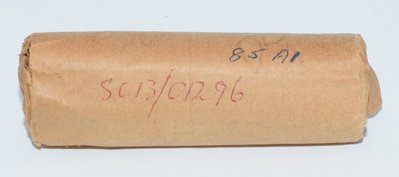
Introduction and History
The Philips 85A1 is a precision voltage reference tube (Präzisionsspannungsstabilisierungsröhre) manufactured by Philips under their Miniwatt Special Tubes division. First documented in Philips datasheets dating from 1948, with subsequent revisions through 1954, the 85A1 is a cold-cathode gas discharge tube designed to provide an exceptionally stable reference voltage of approximately 85 volts. Unlike conventional amplifying valves, the 85A1 contains no heater filament — it operates on the principle of a controlled glow discharge in a gas-filled envelope.
The 85A1 was developed during the post-war era when precision instrumentation, early computing, and telecommunications demanded highly stable voltage references. Philips, based in Eindhoven, Netherlands, was at the forefront of special-purpose tube development, and the 85A1 represented their answer to the need for a compact, reliable voltage standard in a convenient Loctal package. The tube was produced at the Philips Miniwatt Holland factory and saw widespread use in European laboratory equipment, military instrumentation, and precision power supplies throughout the 1950s and 1960s.
The datasheet compilation in the Philips Electronic Tube Handbook spans multiple revisions from November 1950 through April 1954, indicating that the tube underwent specification refinements during its production life, with progressively more detailed stability and environmental data being added over time.
Technical Specifications and Design
General Description
| Type Designation | 85A1 |
| Manufacturer | Philips (Miniwatt) |
| Function | Voltage Reference Tube (Precision Voltage Stabilizer) |
| Construction | Cold-cathode gas discharge (glow discharge) |
| Base Type | Loctal 8-pin (8p) |
| Heater | None (cold-cathode device — no filament) |
Physical Dimensions
| Maximum Diameter | 32 mm |
| Maximum Overall Height (with pins) | 65 mm (early version) / 80 mm (later version) |
| Maximum Seated Height | ~15 mm base protrusion |
Pin Configuration (Loctal 8-pin base)
Based on the datasheet base diagrams, the 85A1 uses a Loctal 8-pin base with the following connections:
- Pin 2 — Anode (a)
- Pin 4 — Cathode (k)
- Pin 8 — Cathode (k)
- Remaining pins are not connected (NC)
Note: The tube must be operated only with the cathode negative and the anode positive.
Electrical Characteristics
| Parameter | Value | Notes |
|---|---|---|
| Average Operating Voltage (Va) | 85 V | Average operating voltage |
| Operating Voltage Range (Va at Ia = 4 mA) | 83 – 87 V | Tube-to-tube variation |
| Ignition Voltage (Vign) | max. 125 V | Requires some ambient illumination; considerable delay possible in complete darkness |
| Operating Current Range (Ia) | 1 – 8 mA | Absolute limits |
| Recommended Quiescent Current | 4 mA | Average recommended operating point |
| Maximum Anode Current (Ia) | 8 mA | Absolute maximum |
| Minimum Anode Current (Ia) | 1 mA | Absolute minimum |
| A.C. Resistance (at Ia = 4 mA) | 285 Ω | Typical; max. 430 Ω |
| Voltage Regulation (Ia = 1–8 mA) | max. 4 V | Total voltage change over full current range |
| Temperature Coefficient of Va | −3.2 mV/°C |
Stability Specifications (at Ia = 4 mA)
| Parameter | Value |
|---|---|
| Variation of V during first 300 hours of life | max. 0.3% |
| Variation of V during subsequent 1000 hours | max. 0.2% |
| Short-term (100 hours max.) variation after first 300 hours | max. 0.1% |
| Variation of V during life (overall) | max. 0.5% |
| Variation of V after first 300 hours of life | max. 0.2% |
Environmental Limits
| Ambient Temperature Range | −55°C to +90°C |
Noise Characteristics
The noise generated by the 85A1 over a frequency band of 30 to 10,000 c/s (Hz) is of the order of 70 μV, which is equivalent to the noise generated by a resistance of approximately 30 MΩ. The noise is evenly distributed over the frequency range.
Important Operating Notes from Philips
- The tube should be operated only with the cathode negative and the anode positive.
- Equilibrium conditions are reached within 3 minutes of operation.
- The greatest constancy of Va is obtained if the tube is operated at only one value of current.
- The A.C. resistance will remain sensibly constant over life, but the temperature coefficient can be expected to decrease slightly.
- The tube should not be subjected to severe shock or continuous vibration.
- In the presence of some ambient illumination, ignition is reliable. In complete darkness, there may be considerable delay in igniting the tube.
Applications and Usage
The Philips 85A1 was designed as a precision voltage reference, and its applications center on providing a stable, repeatable voltage standard. Key application areas include:
Precision Instrumentation
The 85A1's primary role was as a voltage reference in laboratory-grade measuring instruments. Its tight stability specifications — max. 0.1% short-term variation after burn-in — made it suitable for use in precision voltmeters, calibration standards, and bridge circuits where an accurate and stable reference voltage was essential.
Regulated Power Supplies
In vacuum tube era power supply designs, the 85A1 served as the reference element in series-regulated and shunt-regulated power supplies. The 85V reference voltage could be compared against a fraction of the output voltage using a differential amplifier stage, providing closed-loop regulation with excellent stability. The tube's low A.C. resistance of 285 Ω (typical) meant that it presented a relatively low impedance to ripple and noise.
Military and Telecommunications
The wide ambient temperature range of −55°C to +90°C and the tube's inherent ruggedness (within the constraints of avoiding severe shock) made it suitable for military equipment and telecommunications infrastructure. The CV431 military designation confirms its adoption by defense establishments.
Bias Reference
In some circuit designs, the 85A1 was used to establish a precise bias voltage for other tube stages, particularly where the bias voltage needed to remain constant despite supply voltage fluctuations.
Cascaded Voltage References
Multiple 85A1 tubes could be connected in series to provide higher reference voltages in multiples of approximately 85V, or combined with other voltage reference tubes of different voltages to achieve specific reference levels needed for particular instrumentation applications.
Sound Characteristics
The 85A1 is not an amplifying tube and does not directly process audio signals, so it does not have "sound characteristics" in the traditional sense that an audio triode or pentode would. However, when used as a voltage reference or regulator in the power supply of audio equipment, its characteristics can indirectly influence sonic performance:
Noise Floor Contribution
With a specified noise level of approximately 70 μV across the 30–10,000 Hz band, the 85A1 is a relatively quiet gas discharge device. However, all gas-filled voltage reference tubes generate some level of broadband noise due to the stochastic nature of the gas discharge process. In audio power supply applications, this noise must be adequately filtered before reaching sensitive amplification stages. The noise is described by Philips as being evenly distributed over the frequency range, meaning it has a white noise character rather than exhibiting problematic low-frequency flicker noise.
Regulation Quality and Sonic Impact
The 85A1's low dynamic (A.C.) resistance of 285 Ω means it can effectively shunt small signal-frequency perturbations on the supply rail, acting as a partial noise filter. Audiophiles who use gas-discharge voltage references in power supplies often report that well-regulated supplies contribute to a "blacker" background, improved micro-detail retrieval, and a more stable stereo image compared to unregulated or purely resistive/capacitive filtered supplies. The 85A1's excellent long-term stability (max. 0.2% variation over 1000 hours after burn-in) means the operating point of the amplifier stages it supports remains consistent over time.
Microphonic Sensitivity
Philips explicitly warns against subjecting the 85A1 to severe shock or continuous vibration. Gas discharge tubes can be microphonic — physical vibration can modulate the discharge and introduce noise. In audio applications, this means the 85A1 should be mounted with vibration isolation, away from loudspeakers and transformers, to prevent microphonic artifacts from coupling into the audio signal path.
Equivalent or Substitute Types
| Type | Relationship | Notes |
|---|---|---|
| CV431 | Close/identical substitute | British military (CV) designation for the same tube. Direct drop-in replacement with identical specifications and Loctal base. |
The 85A1 is a somewhat specialized type. Other 85V-class voltage reference tubes exist (such as the OA2/150C2 which regulates at 150V, or the OB2/108C1 at 108V), but these operate at different voltages and are not interchangeable with the 85A1. The 85A1's specific 85V operating voltage and Loctal base make it relatively unique in the voltage reference tube family.
Note: Some sources may list additional equivalents; however, only the CV431 is confirmed as a close/identical substitute from verified reference data. Any other claimed equivalents should be verified against manufacturer datasheets for voltage, current range, base type, and stability specifications before substitution.
Notable Characteristics
Exceptional Long-Term Stability
The 85A1 stands out among gas discharge voltage reference tubes for its remarkably tight stability specifications. After an initial 300-hour burn-in period, the tube's reference voltage varies by no more than 0.2% over the subsequent 1000 hours, and short-term variations (100-hour windows) are held to just 0.1%. These specifications approach the performance of some early solid-state references and made the 85A1 a trusted component in precision measurement equipment.
Cold-Cathode Operation
As a cold-cathode device, the 85A1 requires no heater power and reaches equilibrium conditions within just 3 minutes. This is a significant advantage over heated-cathode tubes that may require extended warm-up periods. The absence of a heater also eliminates heater-related noise and hum.
Light Sensitivity
An unusual characteristic noted in the Philips datasheet is the tube's sensitivity to ambient illumination for reliable ignition. In complete darkness, there may be a considerable delay in striking the gas discharge. This is because the initial ionization event that triggers the discharge can be assisted by photons from ambient light. In practical installations, this was rarely a problem, but it is an important consideration for enclosed or light-tight equipment.
Negative Temperature Coefficient
The 85A1 exhibits a temperature coefficient of −3.2 mV/°C. This negative coefficient means the reference voltage decreases slightly as temperature increases. While modest, this characteristic must be accounted for in precision applications, and the tube's wide operating temperature range of −55°C to +90°C means the total temperature-induced voltage shift could be significant in extreme environments.
Low Noise for a Gas Discharge Device
At 70 μV over the 30–10,000 Hz band (equivalent to a 30 MΩ resistance), the 85A1 is a relatively quiet gas discharge tube. The noise is evenly distributed (white noise character), which is preferable to devices that exhibit concentrated low-frequency noise components.
Loctal Base
The Loctal (lock-in) base provides a mechanically secure connection that resists vibration-induced contact intermittency — an important feature for a precision reference device. The Loctal base's center spigot locks into the socket, preventing the tube from working loose in mobile or vibration-prone installations.
Usage in the Audio Community
While the 85A1 was never designed as an audio tube, it has found a dedicated niche in the high-end audio community, particularly among builders and enthusiasts of vacuum tube power supplies for audio amplifiers and preamplifiers.
Regulated Power Supplies for Audio Amplifiers
The most common audio application for the 85A1 is in regulated power supplies for tube preamplifiers and phono stages. Designers of high-end tube audio equipment sometimes prefer gas-discharge voltage references over solid-state alternatives (such as Zener diodes or bandgap references) for philosophical and sometimes practical reasons. The 85A1's 85V reference voltage is convenient for establishing regulated B+ rails in preamplifier circuits, where plate supply voltages of 150–300V can be regulated using the 85A1 as the reference element in a series-pass regulator circuit.
DIY and Boutique Amplifier Builds
The DIY tube audio community values the 85A1 for its precision and its "period-correct" aesthetic in vintage-style builds. Builders of single-ended triode (SET) amplifiers and high-gain phono preamplifiers sometimes incorporate 85A1 tubes in their power supply regulation schemes, appreciating both the technical performance and the visual appeal of the glowing gas discharge tube visible through the glass envelope.
Bias Voltage References
Some audio circuit designers use the 85A1 to establish a fixed, stable bias voltage for output tubes. The 85V reference can be divided down or used directly (depending on the circuit topology) to provide a consistent bias point that doesn't drift with supply voltage variations or temperature changes, potentially improving the consistency of the amplifier's operating point and, by extension, its sonic performance.
Availability and Collectibility
The 85A1 is available as new-old-stock (NOS) from various vintage tube dealers, typically sourced from Philips Miniwatt Holland production. As with many specialized Philips types, NOS examples in original packaging command a premium among collectors and audio enthusiasts. The tube is no longer in production, and supplies are finite, which has contributed to its status as a sought-after component in the vintage audio community.
Practical Considerations for Audio Use
Audio builders using the 85A1 should observe several practical guidelines:
- Vibration isolation: Mount the tube away from transformers and loudspeakers, ideally on vibration-dampening mounts, to minimize microphonic noise injection.
- Current stability: For best voltage constancy, operate the tube at a single, fixed current value — ideally the recommended 4 mA quiescent point.
- Burn-in: Allow a 300-hour burn-in period before expecting the tube to reach its tightest stability specifications.
- Filtering: Follow the 85A1 with appropriate RC or LC filtering to attenuate the tube's inherent broadband noise before it reaches sensitive audio stages.
- Ignition: Ensure the supply voltage is sufficient to exceed the 125V maximum ignition voltage, and be aware that the tube may take longer to strike in enclosed, dark chassis.